Log in
EN
FR

Electro-Harmonix Dynamic or volume pedals

19 products found

Categories
Series
Filter
Sort by
Electro-Harmonix
Evaluation
  • Reviewed or not
  • Editor’s award
  • Reviewed by Audiofanzine
Availability
  • Available or not
  • Sold new or used
  • Sold new
  • Sold used
Must-have products
  • All products
  • Flagship products
  • Best rated products
  • Hot products
  • Popular products
Price
  • Freeware
€
Clear
Sort by
  • Popularity
  • User ratings
  • Price - low to high
  • Price - high to low
  • Used price, increasing
  • Used price, decreasing
  • Name (from A to Z)
  • Name (from Z to A)
  • Added on
Choose a category
Selected category: Dynamic or volume pedals
Choose a series
Sort results
  • Popularity
  • User ratings
  • Price - low to high
  • Price - high to low
  • Used price, increasing
  • Used price, decreasing
  • Name (from A to Z)
  • Name (from Z to A)
  • Added on
Filter results 19 results found
Brands
Evaluation
Availability
Must-have products
Price
  • Freeware
Show results

The best Electro-Harmonix Dynamic or volume pedals reviews

The reviews Audiofanzine members found the most helpful.
  • moosers's review

    The Electro-Harmonix Screaming Tree is a simple treble booster pedal that I have experience using with electric guitar. I wouldn't recommend using it for other instruments, but I haven't tried it so I can't really speak first hand about it. I believe that there a number of different Screaming Trees out there, but the one I've used is the original. The pedal has standard 1/4" connections for input and output and isn't rack mountable. UTILIZATION Using the Electro-Harmonix Screaming Tree is about as simple as using any other pedal out there. There is just one parameter that controls the level of boosting desired, and that's it. It does also have a switch for on/off in addition the pedal to stomp on that does the same thing. There really isn't anything else to know about the pedal, so a manual isn't necessary unless you had some sort of a technical issue. SOUND QUALITY Aside from being quite noisy, the Electro-Harmonix Screaming Tree does a great job in terms of giving your signal that extra boost. I've tried the pedal with a Fender Jazzmaster a '76 Fender Twin Reverb for a recording session, but we ended up not using it because of the noise factor. However, I was impressed with it's tone quality and have come to the conclusion that it would be best suited for a live rig where noise might not be as big of an issue like it would be in the studio. I guess it's just the nature of older pedals to be noisy, but perhaps it was the whole rig we were using. Since I liked the sound a good deal, in the future I hope to be able to try it out within a different context to see what the results would be. OVERALL OPINION I don't think that getting your hands on the Electro-Harmonix Screaming Tree would be an easy thing to do, as I haven't seen many of these around in studios or in people's live rigs. However, I would recommend at least doing some research on it if you're in the market for an older treble booster pedal. While there is definitely a lot of character to the Screaming Tree, I'm not convinced that it is the best pedal to be used in the studio because of the noise...

  • mooseherman's review

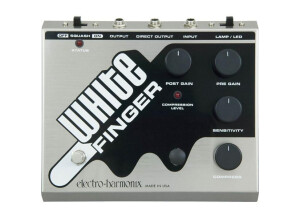
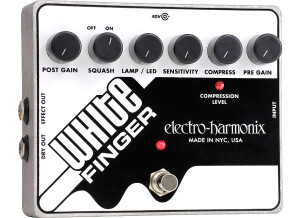
    This is a pedal compressor for guitars, but I've heard it can be used for basses and keys as well. It is pure tube compression, the same voltage that can be found in highend studio compressors. This unit cannot be edited on a computer and is not MIDI ready, and it is not rackable. UTILIZATION The sound effect editing is pretty easy. It's a little bit more complex than a lesser compressor such as a Boss CS-3, but not quite as much of a bear to use as a rackable studio compressor. It's easier to use live than in the studio, as I prefer to use the multitude of outboard compressors that most studios, including the one I work at, have. However, live this thing is incredible. It offers you as much range and voltage as one of those studio ones would (300V), and it doesn't give you that cheap dynamic-robbing sound that most pedal compressors are known for. In fact, it puts most of those, including my former go-to, to shame. The manual explains the technology and the applications of the pedal pretty well. The two modes, Normal and Squash mode, change the basic shape of the compressed signal, and offer two drastically different sounds even when all the settings are identical. Squash, as the name implies, flattens the sound considerably more than normal mode, which I was apprehensive about at first. I eventually discovered to my surprise that this mode was preferable in certain situations. SOUND QUALITY I use it mostly with my Strat and Telecaster, and I have also had greater success with acoustic guitars that are amplified. Most often, when I'm playing live, I would naively assume that I could plug my Taylor Acoustic/Electric straight in and start playing. However, the sound that I get would sometimes be particularly harsh, and far too unnaturally bright. I find that this compressor works wonders in smoothing out the acoustic, and actually gives it a sound far closer to its natural acoustic sound than I had previously achieved. With electrics, especially single-coiled pickups, I find that the compressor works great at giving a lead tone more beef and sustain. It actually even works wonders with (gasp!) rhythm tracks, something I've never been satisfied with in a pedal compressor. The vast range of the compressor will allow you to solve your biggest volume/tone problems. It is diverse enough to go from being really transparent in normal mode, to coloring the sound impressively in the higher compression modes. OVERALL OPINION My only beef with this compressor is a small one, and that is the fact that I can't use it with my EH Big Muff. This is because that pedal already has a ton of compression on it. But that pedal is all about noise and gain anyway, so it's not too big a deal at the end of the day. With a good distortion pedal, the lead tones are out of this world, and they give your playing a beefiness and sustain that will totally boost your confidence as a player. Even with clean lead tones, the effect is great. The main reason it works so well is because it doesn't really sound as though your amp is heavily compressed, which can be painfully obvious with lesser pedals. If you can afford to add it to your arsenal (it averages about $190 online), it's well worth it, especially if you are frustrated with your current compressor or don't have a compression pedal at all. For the live guitarist, it's a very valuable and reliable tool. Just be careful not to break those tubes!

  • Audiofanzine FR's review

    (Originally written by Bk basse/translated from Audiofanzine FR) Tube compressor -Two 12AX7 tubes, optical compressor - Five controls: COMPRESS (compression ratio), LAMP/LED (compression mode), SQSH/NORM (attack time), PRE-GAIN (input level), POST-GAIN (output level). - Compression indicator - On/off switch - No memory - Quite bulky (compared with usual effect pedals) due to the tubes and their protections. I give it only an 8 because the on/off footswitch feels much too hard and it makes noises. But the controls have a good quality. The external PSU cable is very fragile (a 12volt / 1 A PSU is included). UTILIZATION The configuration is very easy but also comprehensive for a compressor: five controls seem to be a lot in the beginning but each one has a very precise function. Very short and poor user's manual: only one sheet of paper! SOUND QUALITY This compressor is very effective and it adds a nice color to the sound due to the tubes... two 12AX7 in a single pedal might be too much. Once you find the right setting you won't need to touch the pedal again, unless it's a studio session. But I think the signal to noise ratio is too low for that anyway. It's a stage product. Caution: it's not easy to find the right setting, and it might generate a bit of noise. I bought it because I wasn't satisfied with my Roland DB900 and this compressor is actually very different... I finally have that big bass sound with limited peaks I was expecting. I think you can also use it with other electric instruments. It clearly adds presence to the sound. It's a bit expensive, but it's worth it because it does a great job. OVERALL OPINION I've only had it for six months but I've send it twice to the service center already because of a manufacturing defect... I wasn't used to this with Electro Harmonix... And I waited a long time before getting it back... Ever since it started working properly I can't play without it anymore. It enhances my sound a lot, adding more presence to it. I connect it to the output of a Sansamp Bass Driver, and these two effects are enough to get a round and warm sound in almost every setup.