Log in
EN
FR

Electro-Harmonix Guitars

335 products found

Categories
Series
Filter
Sort by
Electro-Harmonix
Evaluation
  • Reviewed or not
  • Editor’s award
  • Reviewed by Audiofanzine
Availability
  • Available or not
  • Sold new or used
  • Sold new
  • Sold used
Must-have products
  • All products
  • Flagship products
  • Best rated products
  • Hot products
  • Popular products
Price
  • Freeware
  • Low-cost (< $75)
  • Mid-range ($75 - $150)
  • Premium (> $150)
€
Clear
Sort by
  • Popularity
  • User ratings
  • Price - low to high
  • Price - high to low
  • Used price, increasing
  • Used price, decreasing
  • Name (from A to Z)
  • Name (from Z to A)
  • Added on
Choose a category
Selected category: Guitars
Sort results
  • Popularity
  • User ratings
  • Price - low to high
  • Price - high to low
  • Used price, increasing
  • Used price, decreasing
  • Name (from A to Z)
  • Name (from Z to A)
  • Added on
Filter results 335 results found
Brands
Evaluation
Availability
Must-have products
Price
  • Freeware
  • Low-cost (< $75)
  • Mid-range ($75 - $150)
  • Premium (> $150)
Show results

The best Electro-Harmonix Guitars reviews

The reviews Audiofanzine members found the most helpful.
  • « Electro-Harmonix Hot Tubes »

    Got this pedal at Guitar and Amp Centre for £160, which seemed like a lot but its not really for an all valve distortion. However they were brand new at the time so it could go down soon The difference in the tones is immense. I used to have a Big Muff Pi and the tones were really designed for Smashing Pumpkins type distortion but on my amp was too bassy. However this new pedal has a treble and bass control which means i can pretty much get what i want. It can rasp a bit on cheaper amps but on a tube amp it rules The only real problem, short of the lack of a UK power supply, is the fact that on a cheap amp it sounds bad and it's not y mates Ibanez Tube King but short of that it's added to the list of Electro Harmonix pedals that i have fallen in love with Top notch, although the valves stiv out from the top there is a sturdy feel to the cover and so it doesn't feel dodgy at all, all the dials look nice and secure on there to. Wicked pedal but only really for all valbe or hybrid amps. Lots of tones but an annoying power supply for UK users. This review was originally published on http://www.musicgearreview.com

  • « Holy Cow!! »

    Whenever I think of this pedal I often think of the song cathedral by Van Halen. I know the two are not connected however the sound of that song in conjunction with what this panel actually does it just brings them two together in my mind. This is a stereo reverb unit by the company electro harmonics. They are really known for their big muff pedals as well as many other effects and modulation pedals such as the delays and reverbs in their series. This is a great sounding reverb pedal that has a lot of options to choose from. This is probably the most heavily laden feature that they have. You can get pretty much any reverb sound that you can't imagine from this battle. It is a quite big unit that will fit on your pedal board but it will take up a large amount of space. UTILIZATION electro-harmonix's Cathedral Programmable Stereo Reverb Pedal Features: 24-bit AD/DA convertors True stereo I/O 8 programmable reverb styles with the ability to load and save Tap Tempo to set pre-delay time up to 2 seconds Feedback control for pre-delay section Damping/Tone control available for each reverb mode Grail Spring, Accu Spring, Hall, Room, Plate, Reverse, Grail Flerb, Echo Hold tap tempo for infinite reverb 9VDC-BI power supply included SOUND QUALITY The sound of that was quite nice. There probably isn't any reverb sound that you cannot achieve with this unit. You have six control knobs that change today parameters of this unit. You have a blend knob which allows you the dry and wet signal to come through. And then you have your reverb time which is facing a delay control. You have your damping tone which is basically a EQ control knob. Then you have your feedback which allows you do you repeat and how long the signal gets drawn out. And then you have your pre-delay which is way your normal reverb delay setting actually is. Your final control knob is a mode control that gives you eight possible mode operations as well as a favorite preset. OVERALL OPINION At new you can find these pedals for right around $220 which is a steal of a price. That is a great deal for what this panel can actually achieve. Overall if you are really into reverb settings then this would be the best so that you could probably get it. It's going to be a great sounding pedal and it's good to give you a load of operations and features that can give any guitarist is really into the reverb effect and operation. Overall this is a very cool pedal and if you can muster up the money then I suggest getting one. If I had to pick one pedal for reverb it would be this pedal. if I liked the sound of a tube reverb pedal than it would be the T Rex pedal.

  • « Cool Octave »

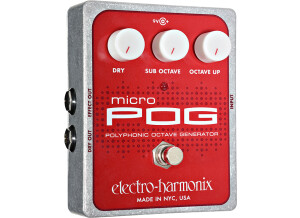
    Electro harmonics is very well-known for their effects pedals and primarily their Big Muff distortion fuzz overdrive pedals. The build very high quality pedals extremely reasonable prices. This pedal is basically an octave reverberator type. So basically it's a filter type pedal that allows you to play your guitar tone with octaves below and underneath. This is a cool pedal for someone who likes to have that octave type sound that really only at pedal like this can achieve. UTILIZATION Features Super fast tracking Glitch-free polyphonic output Dry, Sub Octave, and Octave Up controls Dry and wet outputs Includes 96DC-200BI power supply SOUND QUALITY The tone itself is a cool little unit that only has three control knobs of operation. You have a dry switch , a sub octave control, and an octave up control. You also have an effects out any dry out a allows you to play in multiple amp settings. This is a cool pedal if you're really striving to get a sound and make your guitar or six string guitar sound like a 12 string guitar. Or if you play bass and you play for string and makes it sound like you're playing and 8 string. It's sort of like a chorus pedal in a sense that adds extra sounds that makes it feel like there's a bigger wall of sound. OVERALL OPINION These pedals are a little bit more expensive than a standard Electro Harmonics petals. You can find these new for right around $210 . This pedal will give you a specific sound and it's probably not a sound that you can use a whole lot in a band. So this is a little bit expensive for a pedal that does only one thing. But if you're looking for that particular octave sound and this is a great pedal to own.

  • moosers's review

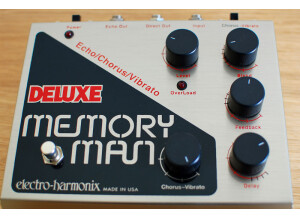
    The Electro Harmonix Deluxe Memory Man is an analog effect pedal that has an echo, chorus and vibrato effect. It has 1/4 inch inputs and outputs and also has a 1/4 inch echo out for sending the echo to a separate amp. It is not rackable as it is a stomp box. UTILIZATION The Deluxe Memory Man is easy to use and the parameters are easy to manipulate. It has parameters for overall level, blend, feedback, delay and chorus-vibrato. There is also a switch for changing between either chorus or vibrato and dictates what the chorus-vibrato knob controls. It is very easy to get a great sound out of this - whether you are looking for delay, chorus or vibrato. I've never needed to use the manual, nor had access to one. SOUND QUALITY The sound quality of this pedal is its best feature. The delay is extremely warm and you can some pretty awesome different delay tones from this. I also really like the chorus and vibrato, but the delay is the best feature on this pedal. I have only used this pedal with guitar - mostly a Schecter Ultra III and a '76 Fender Twin Reverb. I love the delay tone I get from this set up as it unlike most other delays I have used. OVERALL OPINION I've been using the Deluxe Memory Man for about three years. The best part of this pedal is the overall tone quality. I also have a Line 6 DL-4, and the delay on this is better than any of the delays on the DL-4 in my opinion. The DL-4 can create a wider variety of sounds, but the overall tone quality of the Memory Man is much better in my opinion. The price isn't the cheapest, but this pedal is made extremely well and should give you a great tone for a long time if you treat it right. While the chorus and the vibrato are also very usable, the delay on this is unbelievable and is the best part of the pedal.

  • Audiofanzine FR's review

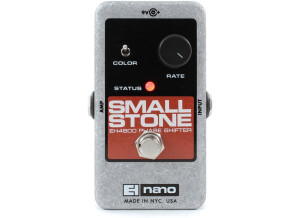
    (Originally written by sonnyscallywag/translated from Audiofanzine FR) Old-school phaser... Analog, solid-state pedal. The PSU connection could be a problem... But if you wanted to get creative you would go buy a PSU with 1/8" plug and you wouldn't have a problem. UTILIZATION Very easy setting... Just plug in and you already get the right sound character... Don't complicate yourself! There's one knob to control the effect's speed and one switch to select between phaser and shifter, and it's more than enough!!! No need for a user's manual. You can easily set the rate, and switch between phaser/shifter with your foot. The setting won't match your drummer's beat perfectly but that's not necessary for a phaser effect anyway (it's not a delay). People that say foot setting is impossible with this pedal should tell me how they manage with the Boss and its four tiny controls. SOUND QUALITY This pedal is a real vintage phaser, not a gizmo that requires 30 years of use to produce the sound you want, or a toy with 36 useless controls. It sounds good right away. The secret to get more or less effect is the speed control. Some people might say they want a very fast effect with a low mix but that's nonsense because high-speed phaser is always clearly audible. The unit produces a warm sound and THERE IS NO VOLUME LOSS on the contrary to what a person here wrote (check the condition of your gear before writing a review... especially when 95% of the users say the opposite of what you think). OVERALL OPINION I've been using it for a couple of days and it produces exactly the sound I was looking for. This effect sounds vintage and doesn't alter the guitar's tone. I tried out the Boss but it has no vintage character even though it tries really hard. I also tested the Fender which also has a very comprehensive foot control but it doesn't sound like I want. I tried out the Maxon (copy of the '74 MXR Phase90) but you don't have the option to choose between phaser and shifter. I tested the EHX WORM but the pedal's function is different (Auto wah, tremolo, etc.)... I would buy it again a dozen times because it's exactly what I was looking for. If I hadn't tested it I would have bought the Maxon Rotary Phaser. It's not the same price and in the end I found exactly what I was looking for with the Small Stone.

  • « A gem for the patient—or the already seasoned »

    I received this pedal just a few days ago, and where to start? Equipped with two Electro-Harmonix 12AX7EH tubes, it's undoubtedly the wildest pedal I've ever owned. It quickly became my favorite. I tried to tame it with two Sylvania 12AU7 tubes, but that attempt was a waste of energy, both for me and for the pedal. In conclusion: you can’t master it (and that’s fascinating), but you can’t hate it either. Extremely sensitive, it’s a stainless steel box full of surprises. At the beginning of my search, I wanted to get my hands on a Guyatone Flip Funky Box, but now I’m glad I couldn’t find one.

  • « Awesome Delay Pedal »

    Electro-Harmonix Deluxe Memory Boy is a analog delay, you have six knobs on top Blend,Gain, Rate, Depth,Feedback and Delay its a good set of knobs to get creative with your sound, you also have the timing subdivisions on the left side name "tap divide" you get to choose 5 note divisions for the metronomic variances. In the mid right side you have "exp mode" to control with you expression pedal you can choose to control the rate, depth, feedback or delay. At the bottom you have the tap button to set your tap tempo and you have your bypass button to turn it on or off. The bypass button has a red light over it to let you know when its active and the tap button flashes green button pulsing the tempo. UTILIZATION The use is very easy and basic, the knobs are accurate I had the pedal over 3 years now and have no problem with it, the tap tempo is always a plus not needing to bend over and control the rate. The pedal is solid made like a tank doesn't wear out. The manual is clear and easy to read which i didn't need to use because everything on the pedal is common sense. SOUND QUALITY I use this with my fender tele, and the reason I bought this pedal is I needed a analog delay which would be softer compare to my Eventide time factor Delay which is a digital straight in your face type of delay, I actually mix in the two delays together when i feel creative, but for the most part I keep my memory boy blended in the back to give that atmosphere you can always bring up the the blend and the gain to throw it up in your face but analog delays are always a bit warmer and softer, its a good standard for delays. I suggest having analog and digital delay and memory boy does the job for me, I got the pedal used for $120 i believe and that is worth the money hands down, if the pedal broke down on me ,which i doubt it it, i would definitely replace is with a new one. OVERALL OPINION I think the pedal is excellent for the analog delay. The sound is beautiful super soft and warm you can combine it with many other pedals and the memory boy won't get in the way, the sound is its best trait very clean and soft, thats the reason i fell in love with analog pedals, i tested a lot of other delay pedals like all the boss delays strymon delays …etc and for the price i couldn't beat this one , so i hear its a love or hate thing, i think it comes down to what type of delay you want digital? analog? and what will it be used for, like i said i mainly use it for soft background delay to create a ecosystem in the sound and that works very well.

  • « Creative Sounds »

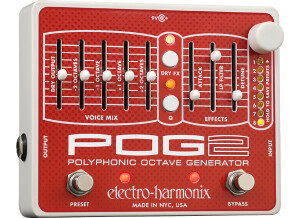
    The Electro Harmonix POG 2 is a Polyphonic Octave Generator, you can translate the word Polyphonic to "producing many sounds simultaneously" In the voice section the knobs are ,1. "dry output" to control the volume of the sounds 2. "-2 Octaves" 3. -1 Octaves 4. +1 Octave 5. +2 Octaves , so you have a lot of space to control with the octaves. In the Effects section you have 1."Attack" that can add swells, fade in speed of the Octaves. 2. "LP Filter" adds resonance to your sound. 3. "Detune" you can enhance your sound. In the middle theres two buttons called "Dry FX" and "Q" with LED lights over them, the "Dry FX" adjusts the effects on the right side you can also select to bypass the effects. The "Q" button effects the resonance of sound of the Low-pass filter knob. You also have the biggest knob on the pedal, all the way to there right is a Preset control knob, this was the reason I bough this pedal. It gives you 8 bank saves that you can adjust on the fly. Its a true bypass Digital pedal, the power is standard 9v. UTILIZATION The POG2 layout is very basic and easy to control and understand. The deeper you dig in the more you will find out. Basic hold down the preset button for quick bank saves. I think for the amount of sounds and knobs it has its a perfect size pedal for me to adjust on the fly and doesn't get in the way of all the other pedals around it. If theres any questions that i would have the manual explains it very detailed. SOUND QUALITY I like to use the Organ sounds + lower octaves sound with my clean sound on my Tele, its very smooth and fits many genres. I also love mixing in other sounds/pedals with it for example like delay or chorus sound also some distortion makes it sound very interesting, its all about experimenting and finding that unique sound that meets your needs. On live shows the pedal stands out a lot especially if I'm using stereo sound with my amps, it catches peoples attention right away. At my studio i like to use the core Shure 57 mic, it reproduces the sound that i hear nicely. I tend to use the Clean channel more on my amp to capture the organic sound of the pedal, but its always fun to mess with that and add little spice to it. OVERALL OPINION The thing i love the best about it is the programmable 8 preset memory, that made my life easier compare to the older version of POG, now all the cool sounds i create i can save and pull it up on the fly without me bending over and switching knobs around. I have nothing bad to say about the pedal it does what its supposed to do. I bought it used so for me the price was fair. The pedal is built like a tank and i haven't had any problems with it at all. I had the first POG which i sold later on since the POG 2 came out, and like i said the Presets memory was the thing i needed the most and got, if i lost the pedal I would buy a new one.

  • « Works great at a price »

    The Electro Harmonix hum debugger is truely a one trick pony. It has a quarter inch in and a quarter inch out and one toggle switch to select the amount of hum to remove. It is a true bypass pedal and has a good stomp switch. It can only be powered by an AC adapter and only by the one supplied with it so DO NOT LOOSE IT. I'm not sure how it achieves the effect but it does remove the hum associated with single coil pickups. UTILIZATION The manual was incredibly simple but the operation of the pedal is a no brainer, have hum turn it on, still have hum flip the switch to strong. It is meant to be used in your effects chain before the amp. SOUND QUALITY This can be used with a guitar or base that has noisy single coil pickups. I guess it will also help if you have a poor lighting situation that is causing your humbuckers to hum. I am impressed in how it does what it states but there is a price to be paid. A price that gets steeper as you increase the level of hum removal. I find that personaly if I am using a guitar with vintage single coil pickups it is because I am desiring a touch sensitive playing experience. I want all the subtle nuances to come through. Every pick stroke is important. All the effort put into putting dynamics into the piece is there for a reason. These are the things that become important to me in that situation. While the unit will remove the hum I also have found that it not only dulls the sound a bit but worse it takes away almost as much of the dynamics of the passage as it does the hum. Playing under the strong setting to me is pure hell and I would rather rely on a coil tapped humbucker than be stuck with the finest single coil having its soul robbed from it. While the loss is not as bad under the normal setting there is still hum present in the signal at this setting. It always returns to the question of is the hum even really that bad compaired to the feel being lost and the tone being dulled. I do not know if it is a bad design or just something that can not be seperated in life. OVERALL OPINION The thing I hate about this is it does work but in my opinion the price of quality and feel loss is too high. I may be a bit prissy when it comes to this so take it with a grain of salt. I know there are people that can not stand noise at any price. If you are old enough to remember it is very similar to the effect the old Dolby noise reduction would have on our cassette tapes. I would never buy this unit again and I honestly do not know what makes me keep it around. It does what it is billed to do but not the way that satisfies me. From what I see from other sources this has always been a love it or hate it unit. Definitly something that needs to be tried before its bought and of course there sre other ways around at least limiting the hum from a noisy axe and although they all require some effort I feel that effort is more than worth it.

  • « Odd tone filter »

    This is indeed one the odder effects in my bag. It is considered to be an equalizer filter pedal. It uses analog high and low filters to combine the newly tailored sound with the original one. While it is called an attack equalizer it certainly effects the entire sound. It utilizes three control knobs, low, dry, and high to set the two filters and mix the wet and dry signals. There is a quarter inch input jack and a quarter inch output jack and can be powered from a nine volt battery or an AC adapter. UTILIZATION In my opinion the manual included is useful and deceptive at the same time. Since EH bills this as an attack equalizer that will fatten a strat like a paul or thin a paul like a strat it leaves a lot to be desired. The unit is very easy to use and can either be placed in your effects chain the same as an equalizer or in the effects loop of the amp. The unit seems to do very little in front of an amp however in the effects loop it has an insane amout of shaping power. Simply set the low and high filters and blend with your original signal. SOUND QUALITY I prefer to use this in the effects loop with a guitar. It can be used with a bass however but I rarely find myself using it with bass. As I stated it seems to have little effect on the signal when used in front of the amp. It is a true bypass pedal so it will not color your sound when it is disengaged. When it is in the effects loop however this becomes a beast. It can be used to add a high end edge, add low end punch, or my favorite add both high and low and blend out a good amount of the dry signal. By nature it seems to have a scooped mid and can act like a contour control on roids. It can add a metal edge to an amp that usually does not generate tones in that vibe. Although it does sound there is something inorganic about it and it seems to become apparant after time. OVERALL OPINION There really are not many pedals to compair this to and it is a neat novelty to own. It is fun but it always finds its way out of service. Maybe if I had less gear options in the amp and guitar departments it would see more service but I always seem to have fun with it untill i decide my tone is better without it in general. It is not a costly pedal but it also sees limited action so value is a wash and I belive it sticks around more as a novelty then anything else. I think it would have been a better unit if maybe the filters were frequency assignable but meh it was inexpensive so what did I expect. It is well built but if something would happen to it I do not believe I would be desiring a replacement.

  • « Nano impression! »

    The Nano series from Electro-Harmonix (EHX) is know for going back to the basics, with as few controls as possible. This is so true. On the Nano Clone Chorus, you get the mandatory 1/4" jack inputs and outputs, the on/off switch and a rate knob. You give it some power from either a 9V battery or and AC adapter, plug in the chords, hit the switch and adjust the chorus rate. Then you're up and running. UTILIZATION Should you find a need for a manual for this simple pedal, you might want to consider wether or not this is something for you. It can't get any simpler then this. They have even taken away the mix and level knob. SOUND QUALITY This is the main issue with the Nano Clone Chorus. When you first get a hold of the pedal, you might think that this is really nice. But then after some time, you wake up and realize, that you actually payed a lot of money for nothing. Consider this: You've bought a chorus pedal, it does the jobs it's supposed to do, but you actually don't really have the sound that you're looking for. You might want the effect to be more subtile, but you can't! EHX won't let you dial down the mix of this one. You might want the depth of the chorus to be bigger - well you can't. EHX won't let you. Essentially, you've let somebody else dictate how your sound should be, and they only let you decide, how fast the chorus needs to be. If that wasn't you get a buzz when using a battery. And if you use a power supply (AC adapter) you get a sound similar to a hair dryer, blowing in a tunnel underneath an old castle! OVERALL OPINION Don't support EHX through the Nano series. Go get some of their much better products. You might as well decide to light a fire and burn you 65$ in that - at least you get some heat out of that. If you're into some kind of psychedelic electronically generated buzz sounds then look no further. Everyone else - stay as far away as possible from this pedal!

  • « You get what you pay for! »

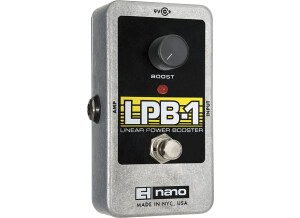
    This is one simpel pedal without any hazzle. It's small, fits into any tight occupied pedal board, does its job and doesn't cost a fortune. What more do you want? You get a die cast housing, volume knob, an input and an output jack and finally an on/off switch. It utilizes a red LED light to indicate weather it's on or off. It can run on either a 9 Volt battery or a power supply. UTILIZATION Yes, you can ask for more then what you get. First of all the volume knob is so unbelievably sensitive, which makes it hard to dial in the correct amount of boos. You don't know how many dB you boost your signal. In a studio enviroment, somebody might find this info useful - Others would just ignore it. In the setup I run at the moment, I can't dial up the boost pedal that much. Only a few percent of its total range. This has also made me tape down the button, so that I won't accidentally hit it, while activating the boost. Some sort of an internal range switch would be nice, in order to keep this problem in check. But for the price range this pedal is in, that wound be an option. SOUND QUALITY I've tried this pedal on several amps and with several guitars. When throwing it into the signal chain, I don't notice any high end loss. And there is no need to worry when you hear a slight hiss, when the pedal is cranked all the way up. You have to be careful where you place the pedal, when you use a solid state amp. If you place in front of the pre-amp you'll only get a gain boost and not a volume boost as such. In order to get the volume boost, you need to place it in the amps effect loop. I've never had any other clean boost pedals, but I must say that I'm pretty impressed by this EHX. OVERALL OPINION This one is build like a brick, doesn't take a lot of space on the pedal board. You have a wide variety of options with it, such as volume unification between several guitar with different output, regaining lost signal strength after a long signal chain or just provide a plain and simple volume boost for a solo. The different volume pedals doesn't cost that much and de difference between them are minute. So if cost is a factor, you can't go wrong with this one. Should it break, you just go and buy a new one. Not excellent, but in no way bad as well.