Log in
EN
FR

Korg Guitars

142 products found

Categories
Series
Filter
Sort by
Korg
Evaluation
  • Reviewed or not
  • Editor’s award
  • Reviewed by Audiofanzine
Availability
  • Available or not
  • Sold new or used
  • Sold new
  • Sold used
Must-have products
  • All products
  • Flagship products
  • Best rated products
  • Hot products
  • Popular products
Price
  • Freeware
  • Low-cost (< $65)
  • Mid-range ($65 - $200)
  • Premium (> $200)
€
Clear
Sort by
  • Popularity
  • User ratings
  • Price - low to high
  • Price - high to low
  • Used price, increasing
  • Used price, decreasing
  • Name (from A to Z)
  • Name (from Z to A)
  • Added on
Choose a category
Selected category: Guitars
Sort results
  • Popularity
  • User ratings
  • Price - low to high
  • Price - high to low
  • Used price, increasing
  • Used price, decreasing
  • Name (from A to Z)
  • Name (from Z to A)
  • Added on
Filter results 142 results found
Brands
Evaluation
Availability
Must-have products
Price
  • Freeware
  • Low-cost (< $65)
  • Mid-range ($65 - $200)
  • Premium (> $200)
Show results

The best Korg Guitars reviews

The reviews Audiofanzine members found the most helpful.
  • « Simplicity - Quickness - Effectiveness »

    There's not much to add to what's been said already. It's rustic and retro... USE The main strength of this unit: Simplicity - Quickness - Effectiveness It's made for people who want to play and not spend hours fiddling with controls. It takes only 5 minutes to understand it and start playing. SOUND QUALITY The quality is very good, at least with a good guitar and a tube amp. It has never altered sound, regardless of the tube amp I use, which is very important, in my opinion. A bit of reverb, a bit of crunch ... and it rocks. A trick that makes all the difference is to plug a TS or T0800 to it so you don't need to lug around tons of gear. Its perfect for blues or rock and you can always find THE sound. Although I don't know how it performs with a solid-state amp. OVERALL OPINION I've had mine for a couple of years and I bought it because a guitarist friend of mine, with whom I regularly play, has used one for many years (despite the huge arsenal of pedals he has). Not only would I buy it again, but as time goes by I often ask myself whether I should buy one or two more...for the future.

  • « Korg Pandora PX4 »

    Having had a good look around at what was available, this seemed to be the best option (price aside). I bought this from Sound Control in Bristol UK for £149. I've had it about 18 months and no problems and recently I have used it every day. It is only after having 'outgrown' the PX4 that I can say just how good it is. I recently bought a Boss GT6 and a Pod 2, BUT having gone back to the PX4 I can state that the presets (the sounds/patches) it comes shipped with are truly exceptional. There are many sounds that my GT6 simply can't easily emulate and I find myself using the basic PX4 sounds for recording far more than anything else. Its size is a great plus point, very small and portable, but don't drop it - it will easily break - a nice rubberised or armoured wrap-around guard would be a nice extra to have available and I'd even welcome more durability for a slightly larger footprint. You must accept that this is not a gigging tool, you simply would not be physically able to switch any settings in the heat of a gig although you can attach it to your guitar strap and if you have cordless headphones, you can do an impression of EVH by playing around the house with no cables as the PX4 has infra-red output. The built in tuner is excellent as is the phrase trainer - but there should be a timer that allows you to physically start the record mode. This is a real blip in that I might lay down a backing track (anything up to the full 32 seconds available, but having pressed the start button, the time it takes to get my hand up back on the fretboard means there is a second or two delay and if I wanted the sound to loop - it simply wouldn't. Back to the sounds available - Melissa and Piezo are truly phenomenal, very atmospheric. I would say that the cabinet modelling is a bit gimmicky though - and all that 'Wet Air' and 'Hall' stuff is a bit daft. I took it on holiday with me together with my Speedster Traveler guitar and to be able to sit anywhere, on the beach etc, and slap some headphones on and simply play was an experience. EVERY electrical appliance that needs a seperate power supply should come supplied with one and not as an extra - the PX4 falls into this camp = pants. This said - this isn't really the unit as such. Construction could be a trifle chunkier. For the guitarist of any level - the PX4 is a great tool but not being a floor based effects processor, it is strictly a desktop recording device or garage rehearsal tool. I would say that as the presets are so good (really they are) - you could be pretty stuffed attempting to emulate the identical sounds on stage. So if you hit upon a superb sound that 'makes' a song really special - be prepared to not have that available when gigging. I found this when recording my own version of Fleetwood Mac's 'Green Manalishi' - I put a much softer down tempo section in the middle with congas with a solo over the top using the PX4. It took the song to a different place - but I was unable to reproduce the sound outside of my home studio setup. I could have taken the PX4 on-stage, but as I said earlier, this wasn't practical as things move at such a frenetic pace during a gig. I got close to the sound using my GT6, but no cigar. Of course it depends on what you want an effects processor to do - it certainly creates a range of interesting, varied and in many cases unique sounds, plus the extras are useful and functional - but it does have its limitations. This review was originally published on http://www.musicgearreview.com

  • Traps's review

    It has lots of effects for the price I paid (€85) and they are of good quality. You have a compressor, a distortion and an overdrive, an EQ, a reverb, delay, chorus, echo and noise reduction, all of them can be mixed and they are completely modifiable. If you have a stereo amp or two amps, it has two jack outputs (Left/mono and right) to get stereo effects (for delay and similar). They can't be edited on a PC and it has no MIDI ports, only 1/4" jacks and a mini-jack for headphones. USE It has a pretty complex configuration and you'll need to take your time to figure out how to edit sounds. But once you do it's truly awesome. The manual is pretty technical but it's good to look for preset sounds. To conclude, it's only a bit hard to configure at first. SOUND QUALITY The noise is great for a unit costing only €85! It's great for rehearsals and gigs, although I doubt it's good enough for high-quality studio recordings (along with your guitar if you don't have noiseless pickups), but it's great for basic studio recordings. Effects can be modified at will so they can be adapted to any amp (from 10W to 100W and more). I play a Stratocaster Vintage and a Jackson PS2 and it sounds fine. I have used it with many other guitars and the sound doesn't vary. OVERALL OPINION I've been using it for a couple of years. I bought it secondhand, so I don't know how old it is, but I've never had a single problem with it. Except for the jack input I had to resolder, but it's a minor detail. I tested other pedals before, but with heftier price tags, especially if you want to get as many effects. I don't think it's too practical to have dozens of pedals in front of you. Its value for money is simply insane! Based on my experience, I wouldn't hesitate to buy it again.

  • moosers's review

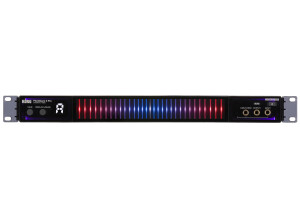
    The Korg DTR-1 is a rack mountable tuner, designed for both use in the studio and on the stage.<span> </span>I’ve only used the unit inside of the recording studio, but for both applications it is the same type of use.<span> </span>The tuner has a few ¼ inch connections in the front for your instrument, as well as headphones.<span> </span>I’m not sure what types of connections it has in the back, as the one that I used was already racked and ready to go.<span> </span>As stated before, this is rackable and will take up only a single rack space. Using Korg DTR-1 is quite easy, as the unit overall is very user friendly.<span> </span>There isn’t really all too much to know beyond how to set the different modes and how to get it all set up.<span> </span>The monitoring screen is extremely large, so you can really zero in on the perfect pitch.<span> </span>You can also see exactly how far off cents wise you are.<span> </span>I don’t believe that a manual is necessary since it is so easy to use on its own.<span> </span>The DTR-1 is definitely one of the most in depth tuner that I have seen, as it goes beyond just being a single instrument tuner.<span> </span>It can be used with an electric stringed instrument that can be plugged into it as well.<span> </span>It won’t color your sound at all either when you plug through it.<span> </span>The price of the Korg DTR-1 is very reasonable for an in depth tuner that is rackable, but is more expensive than your average tuner for sure.<span> </span>I’d say that it is definitely worth it if you’re looking for a top notch tuner though.<span> </span>This is perfect for getting a quick and easy tune both on the stage and for being a main stay in the recording studio.

  • « Korg X-911: A Unique Synth That Still Inspires »

    I mainly use the Korg X-911 with my synths, controlled via CV/gate through a Korg SQ-1, which supports the Hz/oct standard. Occasionally, I also use it with a guitar or bass, but that’s more the exception. What consistently impresses me is the oscillator’s stability. Tuning is reliable, quick, and ready to go almost immediately. All the presets are well-designed and very easy to adjust, which makes jamming intuitive and fluid. Being able to modulate the filter frequency is also a big plus. I use CV for that, and with an added expression pedal, it turns into a kind of Jonny Greenwood-style wah — much more original than a traditional wah pedal. There are a few downsides. When using a guitar or bass, tweaking the sensitivity and polarity takes some time to get right. And as is often the case with vintage Korg gear, it uses two voltage standards: Hz/oct for pitch and V/oct for modulation. It’s manageable, but it adds a layer of complexity when integrating it into a fully modern setup. That said, I really don’t have anything to complain about. The secondhand market price is going down, which is great news — the value for money is becoming more reasonable. It remains a unique, solid, and inspiring piece of gear, especially in a semi-modular context.

  • « The sound of the eighties in a tank format, no more, no less! »

    I use it with guitars and synthesizers. In summary: Practical modular system: you can choose and organize the effects however you want. Typical sounds from the era, with a blend of analog and digital. I got two boards and eight modules, enough to properly test the concept. Apparently, it was originally designed for the Korg MS-20, which makes it even more interesting. The effects I own: Korg KGE-201 Graphic EQ Korg KCO-101 Compressor Korg KOD-101 Over Drive Korg KDI-101 Distortion Korg KCH-301 Stereo Chorus Korg KFL-401 Stereo Flanger Korg KPH-401 Phaser Korg KDD-501 Stereo Digital Delay The positives The overall quality of the effects is really +++, nothing feels like a gimmick. The EQ hardly colors the sound, if at all! The compressor is also amazing, even though it's very simple. The overdrive is right up there with the best tube screamers, in fact, it’s even better! Very cool that they thought of stereo management to keep a dry channel. The less positive The price-to-quality ratio is okay, but it's mainly a board for collectors nowadays. The distortion is very eighties, very Satriani, you either love it or you don’t. A bit of noise on the drives, but no more than you’d get from modern pedals.

  • « Why not, it’s crazy. »

    Crazy pedal. I got it because I’d seen the hologram character sing on a video and thought it was wild. Pedal is absolutely crazy. Really sounds like the character vocalizing. Apparently you can make it say phrases you input from your phone but I couldn’t get it to work. Takes a lot of patience because the latency is so long it’s a different instrument. Anywhere from 50-150ms typically which feels like an eternity. But it’s worth it. Sounds are so strange and crazy. Can add a lot of color if you know how to place it.nothing like it, probably because it’s not for everyone.

  • « Hidden gem »

    I’ve had this one for awhile now. I’ve mainly used it for direct recording and general practice with a small Marshall amp. I probably wouldn’t recommend this one for live stuff unless you spen the time needed to tweak the settings for ideal tones. I saw some reviews complain about hum. This pedal has a a noise gate. The should learn how to use it. This is an older amp modeling multi effects pedal. The built in presets aren’t very good. Given the fact the volumes any gain change drastically switching patches they should only be used as short cuts setting up your own patches. Since it has 40 user patches I set mine up so I have 20 patches for single coil guitars and 20 for Humbuckers. This gave me the flexibility to switch guitars without having to retweak all the patches set for one guitar type. I use many instruments recording. I also used the amp types as a template. I used A00 through A07 and used 10 amp set up for clean tones. Then i copied those 10 and reworked them for driven tones. After that I copied those 20 and tweaked them for humbucker pickups. I added various effects which worked with the various amp patches. I should mention this pedal is very similar to the Vox Stomplab (which is also owned by Korg). Other than it being a bit mor modern an having expanded settings it’s very similar. The Korg can achieve some excellent results for recording direct if you take the time to dial up ideal settings. You need to pay close attention to the various cabinet settings and capture the tones you get from a miced amp. You also have to judge the results within the context of a complete recording with multiple instruments in a mix. This unit solo is at best mediocre but a well recorded instrument is often mediocre so it’s a matter of keeper ng the results in proper perspective when judging how it fills the soundscape

  • « A sturdy, accurate, yet slow and dim tuner. »

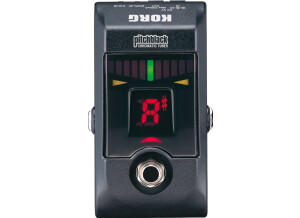
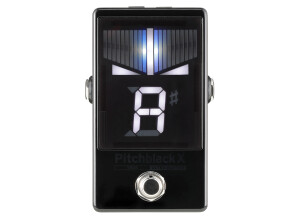
    Korg has been in the tuner game for over 20 years, being famed for the accuracy and quality of their rackmount tuners. Korg introduced the Pitchblack series of tuners in 2008, to much acclaim, and rightly so. It's a very simple, functional design. Encased in a durable metal housing with barrel footswitch, the Pitchblack measures in at just slightly smaller in dimension than the more famous Boss TU-2/3 tuner. This is a plus for those with cramped pedalboards.The Pitchblack also sports true bypass switching, so it won't color your tone when placed in your signal chain, and if you operate it via battery, you won't lose your signal in bypass mode if the battery suddenly dies. It boasts 4 different display modes, including: Meter, Full Strobe, Half Strobe, and Mirror. The display itself is large with a readout of the note along with a range of LED lights that display variances in cent by their brightness in standard meter mode. The tuner also has a parallel power jack for jumpering other 9v pedals from the same power source. The cons of this otherwise great pedal tuner are note tracking time, and display brightness. On a dark stage, it's easily seen, but outdoor daytime gigs are the enemy, and direct sunlight can render the Pitchblack almost impossible to read. I found this was sometimes subverted by tucking the tuner or the pedalboard on which it sat, as close to a monitor wedge or other source of shade, as I could. The Pitchblack exhibits some lag to how quickly it tracks a note compared to other pedal tuners, most notable the Boss TU series. This isn't a good thing when your singer doesn't give you much time in between songs to tune your guitar. What this tuner has going for it is accuracy and simplicity, and this was enough a few years ago, but with the introduction of competitively priced models from other manufacturers that are comparable in accuracy, Korg would do well to update the Pitchblack with a brighter display and faster note tracking. If they can do this, and maintain the original price point, I don't see why the Pitchblack series can't compete with the new and improved Boss TU-3 to become the gold standard in pedalboard tuners.

  • « The perfect little tuner »

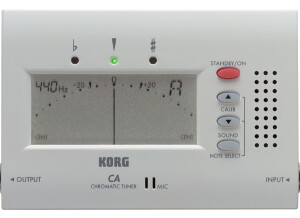
    The Korg CA-30 is a handheld, very portable chromatic tuner. It has a wide range of pitch detection, from C1 to C8, and it is ideal for virtually any instrument. It has both a guitar input (1/4 inch) and a microphone for pitch detection. The visuals on the pitch detection are great: it uses a virtual needle, which is very easy to follow. There are also three LED's across the top that help guide the pitch correction: a green correct LED, and a sharp and flat red LED's. The calibration function allows the tuner to be calibrated to any pitch center. There are two dedicated buttons just for calibration up and down. Of course, the current pitch center is displayed on the screen as well (default would be 440 Hz). There is also a sound generator function, which will play a basic tone of any of the twelve basic scale notes. It is fairly loud, but I personally don't find sound generators too useful. I would rather have a metronome function, which is absent from this compact device. But overall, I find this tuner to work fantastically. It has great accuracy, and great pitch recognition, even in noisy environments. I've had no problem tuning acoustic guitars (without plugging them in), with the TV on, or people talking, and such. I've also used it on bass guitar, and violins, all with no problems. I can even sing into it, and test my singing accuracy, with no problems. I love the simplicity of the tuning mode as well; other tuners have guitar or bass modes, but I find them a bit pointless. A chromatic tuner, which can detect any pitch, can work for any application. I would definitely recommend this tuner for anyone who needs a compact tuning solution. You can even put this device on a pedalboard for guitar players. Go pick one up today!

  • « Korg DTR-1000 »

    It's a grey tuner with one front and one rear input jack, large tuning meter and bright LED's to show the note name. It also features a mute switch for muting the onboard output if you decide to run it in your signal path, a flat switch for tuning down, and a calibration switch for setting A to something other than 440Hz. Last but not least, the display switch switches the tuning meter back and forth from strobe to cent display and back and forth. As a musician, I've played bass and piano professionally in bands, for musicals, and for orchestras for around 12 years now. I have yet to really figure out what my genre or style of choice is. I got it used for $100 because the band I was in was going on a national tour and I wanted an accurate tuner that wasn't going to be another pedal on my already crowded pedal board. I also didn't want a tuner in my signal path. Sure, that's being picky with tone, but some tuners can be quite noisy as well while they're at it. So I knew I wanted a rackmount tuner that could simply run off of the Tuner Output on my amp head and stay out of my way. Also, the strobe display looks really awesome when you aren't playing, beacuse all the lights go crazy. <a href="http://www.myspace.com/ribbonsmakemusic">http://www.myspace.com/ribbonsmakemusic</a> I needed an accurate tuner, and this is accurate to within 1 cent in either direction, which is good enough to be almost beyond human ear detection. Only Peterson has more accurate tuners than that. Still, it's very good for what it does, and I like the ability to switch to a strobe display for further tuning accuracy. I also like the input setup. I can choose between plugging in in front, in back, or running it in my signal path from either input. There is also a mute switch and a jack for a footswitch to control the mute on board. I haven't found any dislikes as of yet. If I had to be really picky, and I do enjoy being picky, I'd like to have a feature that heard and matched the pitch of an instrument you were playing with (so that you knew when to tune to A at 440 Hz and when to tune to A at say, 436 Hz). These situations largely only come up in orchestra, chamber ensembles, or in folk groups with instruments that aren't easily tuned or that don't tune to 440Hz or don't tune at all (such as a penny whistle). Still, in these situations you can usually use your ear to tune with them, but it would help to have a tuner that made the relative adjustment for you, found the new root frequency, and allowed you to tune from there. (UPDATE! The Korg DTR-2000 allows you to do just that with a microphone input) I have no problems with it, and I foresee no problems with it, because I take care of my gear and don't throw it off buildings or down stairs. Solid unit that does exactly what it means to do well. I call that a success. I also can understand why it's the standard among most touring guitar and bass players. 5 stars. This review was originally published on http://www.musicgearreview.com

  • « Korg GA-1 Solo Tuner »

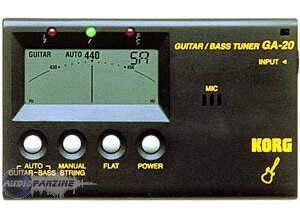
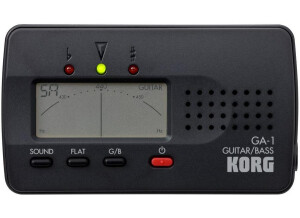
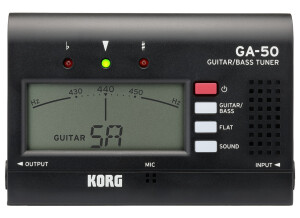
    The Korg GA-1 solo tuner is the standard Korg 'black box' tuner that is available in several models. It's black plastic housing slightly larger than a credit card. Runs on two AAA batteries. 1/4' Input jack; Guitar/Bass pushbutton; Flat button for tuning down; Sound button for audible notes; digital needle readout; LEDS for flat (red)/ in tune green) / sharp (red). Easily fits in a shirt pocket, on a music stand or in a gig bag. I've been playing bass professionally for 45 years. Purchased at a local music store for $19.95 + tax. Needed a tuner that could handle a low B on my bass. the stompbox tuner I inherited wouldn't do so. The Korg GA-1 is easy to use -- plug in, select guitar or bass, play the note and tune. Although I don't run flat tuning, the switch for Flat would come in handy for 4-string bass players who tune down or for guitarist who tune down for metal. It would be nice to have a backlit needle display, but the LED readout makes tuning easy even in dark environments. I'm familiar with Korg tuners and metronome and they will survive a fall from a music stand or amp with ease. I wouldn't put a lot of weight on the plastic case, but it will survive normal use. The Korg GA-1 'Solo' tuner for guitar or base is a great value for less than $20. It tunes six-string basses or even 7-string guitars, offers Flat tuning and audible note for each string through a built-in speaker. Easy to use. It's not a stompbox tuner, but it's handy for practice rooms, backstage or for setting the harmonics in a workshop environment. This review was originally published on http://www.musicgearreview.com