Log in
EN
FR

Carl Martin Guitars

85 products found

Categories
Series
Filter
Sort by
Carl Martin
Evaluation
  • Reviewed or not
  • Editor’s award
  • Reviewed by Audiofanzine
Availability
  • Available or not
  • Sold new or used
  • Sold new
  • Sold used
Must-have products
  • All products
  • Flagship products
  • Best rated products
  • Hot products
  • Popular products
Price
  • Freeware
  • Low-cost (< $150)
  • Mid-range ($150 - $200)
  • Premium (> $200)
€
Clear
Sort by
  • Popularity
  • User ratings
  • Price - low to high
  • Price - high to low
  • Used price, increasing
  • Used price, decreasing
  • Name (from A to Z)
  • Name (from Z to A)
  • Added on
Choose a category
Selected category: Guitars
Choose a series
Sort results
  • Popularity
  • User ratings
  • Price - low to high
  • Price - high to low
  • Used price, increasing
  • Used price, decreasing
  • Name (from A to Z)
  • Name (from Z to A)
  • Added on
Filter results 85 results found
Brands
Evaluation
Availability
Must-have products
Price
  • Freeware
  • Low-cost (< $150)
  • Mid-range ($150 - $200)
  • Premium (> $200)
Show results

The best Carl Martin Guitars reviews

The reviews Audiofanzine members found the most helpful.
  • « Make my life easier! »

    So I finally got it! I'm a proud member of the "I-don't-like-multiFX" party (OK I have an AX3000G - but I don't use it on stage). To me, effect pedals are more realistic, less "it almost sounds like...". Problems: 1/ every live performance soon turns into a musical tap dance contest. OK, the audience gets twice in its money's worth - sound and visual performances. 2/ things can be messy (g'dam loose switch on the Holy Grail Plus, and so on) 3/ if you're like me the singer-guitarist in your band, you tend to negate the stereotype claiming men can't do two things at once - let alone 3 or 12. So, Carl Martin (and other -too rare- brands) came up with that concept of control switches. Up to 8 pedals can be plugged into it, plus the amp's channels (or two different amps if you like), you tweak the small switches that correspond to such or such pedal/channel and you can parameter up to 8 sounds of your own. There's an included buffer - OK it can then lack mids but a graphical EQ at the end of your chain and there you go, or even simpler you turn the buffer off. Works on 9V AC. It really makes life easier in rehearsal, studio and more than all un live! The metal-made pedal seems reliable, only the pedal selection switches are made of plastic. It still has a few cons: first it's BIG and takes a lot of space in an already crowded pedalboard! So now I need a new pedalboard. It makes a lot of (preferably high-quality) jack cables necessary - 2 per pedal, send and return. Oh, and by the way, you can almost forget about stereo. Overall, it's very useful, couls be a little cheaper and has complete features. In case it would fail me someday, I'd immediately replace it with the same.

  • « True Analog Amp-Cab Simulation »

    SOUND: The Rock Bug is an amp-speaker simulator that has an incredibly authentic and analog sound. It offers two basic sounds or responses – an Open Cabinet and a Closed Cabinet. The open cabinet has similar properties to a Vox AC30 (a tighter and crisper sound), whereas the closed cabinet has similar properties to a Marshall stack (thicker with more bottom end). Below is a YouTube video demonstrating how various pedals improve in sound using the Rock Bug, although the Rock Bug really shines when combined with an amp or preamp (I utilized a Carvin Legacy Drive preamp, the Le Lead preamp by Two Tones and a Taurus high-gain stomp head amplifier). There is a reason why cabinet simulators are popular, whether speaking of VST plugins or hardware. Simply put, they make all the equipment before them sound truly alive and with greater dimension! And with today’s technology to reproduce the qualities inherent with actual tube amps and cabinets, the Rock Bug is a worthy investment for anyone wanting private headphone practice, for direct DAW recording, or for a direct plug-in to a PA system without having to lug around a regular sized amp and cabinet to a gig (or in the event your amp-cab fails). OVERALL IMPRESSION: The Rock Bug is both amplification and an effects pedal (an effect that produces the quality of good amplification). Although other companies produce products that offer more than one type of amp-cab simulation, at a price of about $250 Canadian the Rock Bug does what it does very well, and easily just as authentic as what you would hear from a Fractal Audio Axe Fx II rack-mount unit. And that’s what impressed me with the Rock Bug – how good it sounded compared to one of the industry leaders in amp-cab simulation, which is why I compared it to a Fractal unit in the video above. I did not try to tweak the Fractal amps-cabs to make it sound exactly like the Rock Bug, but did strive to produce a decent open-cab and closed-cab tone with a Vox AC30 and Marshall stack selection. Both of these on the Fractal unit sound good (albeit different), but the Rock Bug sounded as good (and in my opinion superior in terms of detail in the tones, harmonics, etc.). EASE OF USE: The Rock Bug is very straight-forward with little tweaking required. Both the open-cab and closed-cab simulations sound awesome on their own, without having to frig around with EQ, gains, etc., all of which is controlled through other hardware/pedals, etc. You need to find your tone or sound with your chosen gear and the Rock Bug then enhances the sound like the gear is on steroids… with incredible vibrancy and authenticity. Once you plug in, the Rock Bug is active (no on/off switch). There is an overall Level control, which affects both the headphone and ¼-inch jack inputs (the balanced XLR output must be controlled via a mixing console). The Guitar Volume knob controls the instrument volume when using the XLR, but also works in relation to the Master Volume when using the headphone jack or ¼-inch stereo jack output. Pretty straight forward. There are two outs and two inputs, thus making it a very nifty and complete package in a pedal. There is a ¼-inch out designed for either headphones or a line out to a mixer, your DAW, etc., and a balanced XLR. There’s a ¼-inch cable input, which obviously is used for your guitar/pedals or other equipment, but also a stereo AUX input for MP3, CD or DAT, so that you can jam with music privately or through speakers, etc. RELIABILITY & DURABILITY: Carl Martin makes good quality gear that is a pleasure to implement. Many other companies are gimmicky or offer dozens of options (e.g., digital reverbs and delays come to mind), but when Carl Martin produces something it is very usable in every respect without excess bells and whistles. Like its other products, the Rock Bug has a steel casing, and since there is no on-off switch (although an LED to let you know it’s on), little can go wrong with wandering feet. There are two plastic knobs toward the top (Master Level and Guitar Level), both of which have a solid and smooth feel when turned. The selector switch for choosing an open cabinet or closed cabinet is at the very top of the pedal – again, away from any potential harm. The power input is located in the back of the pedal, making for easier access to a pedal board power storage and less likely to be damaged by being yanked or pried. (Although you can hook a 9v power supply to the Rock Bug, it can operate on a 9v battery, thus making it ideal for easy hook-up, transportation in a guitar case and private headphone rehearsal.) All cable inputs and outputs are located along the sides. Although I prefer in-puts and out-puts located in the back of a pedal (to save on pedal board real estate), with all the input-output option on the Rock But it would be impossible to fit those in the back.

  • « Two-Stage Noise Reduction »

    SOUND: The Noise Terminator is a great tool when you want to remove unwanted background noise from your gear. The effect from this pedal can range from very subtle to a near complete blockage of the signal (not just the noise, but a guitar’s signal, as well). This means being able to adjust and dial in small increments until you no longer can hear what you don’t want to hear, and I did this under exaggerated conditions. In the accompanying video I hooked up two high-gain pedals, one considered ‘modern,’ being the Friedman BE-OD Deluxe, and the other ‘vintage-modern’ (it’s a current pedal, but based on a 1960s-1970s design and sound), being the Buzz Tone by Jext Telez. With the gain at 2-o’clock on the second channel of the Friedman there was some hum, but nothing extreme, although extreme enough to engage the Hard Gate on the Noise Terminator to a 2-o’clock position as well and in order to completely remove any slight hum or hiss. Next, I linked the Jext Telez at full gain into the first channel of the Friedman (its gain at 12-noon) to create significant and exaggerated amount of background noise – within an environment that is not usual (not many people would put a fuzz/distortion up full and into a high-gain pedal). The Noise Terminator’s High Gate had to be increased to about 95% to completely eradicate any background noise, but it did so and without affecting the original tone. As a bonus, you don’t hear the clicking of the footswitch when engaged or disengaged. OVERALL IMPRESSION: Carl Martin’s Noise Terminator is a precision Gate that allows you to customize the degree of noise to be removed from a signal; that humming, hissing or crackling that messes with a great tone. A small amount of noise is forgivable in a live setting, which likely will go unnoticed unless the entire band and audience is absolutely quiet, but is an annoyance in studio recording conditions. The Noise Terminator allows two levels of artifact control, with a Soft Gate for very minor sounds and a Hard Gate for those high-gain and noisy fuzz pedal situations. For $165 USD the Noise Terminator is a fair price, considering you can switch between two Gate levels, which means keeping your signal quiet while playing clean or with some crunch and then stepping on the footswitch to engage greater line silence during more intense and higher-gain moments. As well, being able to activate the unit via MIDI with its Remote Jack, that you don’t hear any clicking noise from the footswitch and that it doesn’t mess with your original tone are definite features that make the Noise Terminator worth investigating. GENERAL USE: With your gear powered on, the Noise Terminator’s Soft Gate engages automatically. If you want to have no Gated effect, simply keep the Soft Gate turned down completely. However, even when turned up to 12-noon the Soft Gate is very modest and would not interfere with softer playing. The unit shows power received with either a battery (with a guitar plugged in) or via the power adapter and by way of a green LED light located directly below the Soft Gate knob. If you require a more powerful gate, then the Hard Gate can be engaged via the footswitch that shows a red LED light located directly below the Hard Gate knob. If your signal noise is significant, you likely will require the Hard Gate activated, although you can begin by turning up the Soft Gate to determine how much noise can be removed with that control. If still requiring the Hard Gate, activate via the footswitch and begin turning up the Hard Gate until you notice very little or no noise interference. Turning up the Hard Gate to its fullest will result in some of the desired guitar signal being truncated. In regard to proper positioning of the Gate, I find it appropriate to place it after any noisy pedals and likely best to place it before any reverb or delay as their tails and trails could be cut off. However, that may be a desired effect worth exploring. Another option is to place the Noise Terminator within your amplifier’s effect loop. An added feature of the Noise Terminator is the Remote Jack, which allows you to connect the pedal to an external MIDI switching system. In doing so, you can go between the Soft and Hard settings without the need of using the Noise Terminator’s footswitch. OTHER DETAILS: Weighing 250g (12.34 oz) and measuring in at 120 (w) x 95 (D) x 56 (H) mm (4.72 x 3.74 x 2.2 inches), the Carl Martin Noise Terminator has a steel chassis and quality paint job. It has a signal-to-noise ratio of 87dB, input of 20K Ohm and output of 50 Ohm. The Noise Terminator can work on a 9V battery or a standard 9V DC (regulated) 2.1 mm female plug that provides a minimum 50mA power supply (while consuming maximum 12 mA). The power input is located in the back of the pedal, whereas the cable input and outputs are located along the sides. The footswitch has a solid click in feel, yet produces no audio signal when engaged or disengaged. Both knobs and LED lights are situated far enough from the footswitch to prevent any damage or mishaps while stomping. The knobs have a very solid and smooth feel – they are not stiff to turn, but they do require good tension when turning (which means they stay in place once in place).

  • « From Eerie Pink Floyd to Surf Rock,the Surf Trem is excellent value »

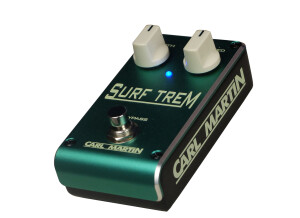
    SOUND: Below is a YouTube demonstration video on the Carl Martin Surf Vibe 2018, which is the latest ‘scaled down’ or streamlined pedal board version of this classic. The Surf Trem is as simple as it gets… only two knobs, DEPTH and SPEED, which vintage sound allows you to mimic the tremolo circuit found in vintage Fender and Ampeg amplifiers. The sounds possible with this pedal are quite expansive and enjoyable to implement in one’s playing and is not so straight forward as simply a Surf music device. For example, by using a lot of Depth and moderate Speed you can get that eerie Pink Floyd quality. Or decreasing the Depth and increasing the Speed works well for faster rhythm and lead work, reminiscent of that Surf sound. However, maximizing both Depth and Speed produces an incredibly fast pulse that can add an extra dimension and thickness to power chords and Metal lead playing. OVERALL IMPRESSION: What I like about Carl Martin is that the company produces highly useable pedals that range from classic to modern. There are few bells and whistles with Carl Martin gear, but what you get is what the pedal suggests in the highest quality. If you want a quality delay or overdrive, then Carl Martin can deliver, with the Surf Trem being no different. Pure analog, the Surf Trem produces incredibly clear and beautiful sounding tremolo that truly is like the vintage amps of yester-year (which is why this pedal is found under the ‘Vintage Series’ section on the Carl Martin website). Because the Surf Trem produces such wide sweeping effect it is indispensable for spacey Prog compositions and long drawn out chords. Add a bit of reverb or echo to it and it sounds simply fantastic. However, one cannot avoid throwing in a bit of Surf music for the sheer fun of it. But what I like most is that you can have just a little or a lot of Speed while dialing back the Depth, so that you get a hint of effect with your dry tone, which produces even more variations of effect. EASE OF USE: You can’t go wrong with only two knobs, although you still will have plenty of tweaking to do because of the wide array of tonal possibilities. Anything below 12 o’clock on the Speed knob has a wave-like effect to something that sounds slightly swirling. Once you get around the 2 o’clock range on the Speed knob you begin getting that familiar pulsating sound. Around 3 o’clock and almost all the way (95%) produces a Surf type effect at different rates (moderately fast to very fast tremolo). All the way must be around 220 bpm and sounds like a super fast stuttering. The Depth knob is simply the ‘mix’ of the tremolo effect. This is the control that makes the Surf Trem so expressive. You can have a high level of Speed and still barely notice it in the mix when the Depth is turned down, which means adding in some dimension and quality into a guitar’s tone without it being overwhelming. And so, because a higher Depth means a more pronounced effect, it’s interesting to note that when you use a very slow Speed, for that spacey sound, you can play at a moderate speed if the Depth is down; but if you increase the Depth then a very slow Speed necessitate a slower speed of playing (otherwise, you miss out on some notes since a tremolo effect means altering loud with SOFT). If this isn’t clear, refer to the Demo video above – you can hear how I had to slow down my playing to use a slow Speed setting to its best effect and as the Depth increased. RELIABILITY & DURABILITY: This is the 2018 version of the Surf Trem, designed in the same manner as the newly and recently released DC Drive 2018. It comes in two-tone anodized die cast housing – black along the sides (with the Carl Martin name) and a groovy surf green metallic top. The switches and knobs are typical, comprised of both metal and plastic. The Surf Trem has a metal foot switch (for on and off) and plastic turning knobs for Depth and Speed – all of which are solid in construction. The foot switch is not close to the plastic knobs, and so it is unlikely there would be any stomping mishaps that would crack the Depth and Speed knobs. The standard 9v 50mA power input is located at the back, which means less chance of a power cord mishap (twisting or bending of the input). Likewise the cable input and output are located in the back, which I tend to prefer (out of harm’s way, but it also allows you to pack in more pedals on a pedal board) and which Carl Martin has been doing with their latest pedal releases (smart move!). As a final note, you cannot use batteries with the Surf Trem – a typical 9v power source/adapter must be used.

  • « Buff DeLuxe Produces a Clearer and more Accurate Tone »

    SOUND: If you’re looking for a pedal that provides a cleaner, clearer and crisper tone… one that can wash away a bit of that ‘mud,’ and one that makes all your other pedals sound better, then likely you will benefit from and appreciate a buffer. Below is a YouTube demo video demonstrating how the Buff DeLuxe by Carl Martin works and sounds when compared to a direct signal (without a buffer) and with this gem in the mix: In every instance you can hear how the highs are re-introduced into the tone, how there is added clarity and crispness and definitely less mud. This buffer effect is most noticeable with high-gain tones, and the guitar I used in the video (a Kiesel Vader) often had a slightly ‘dark’ sound whenever I used it. Typically I had to EQ it in the mix to brighten it up a bit. Even then there always was a bit less ‘life’ in the tone than I wanted, thinking I had to increase gain or distortion to make it ring out as it should. However, when introducing the Buff DeLuxe it was like I replaced the pickups and everything sounded livelier as a result. OVERALL IMPRESSION: When you run a lot of effects, use pedals with weak outputs, use true-bypass switching or run long cables on stage, you will lose some of your tone. Pedal boards are notorious tone-thieves. Any and all of this darkens the tone to some degree and can cause your signal to sound a bit ‘muddy,’ mostly because of the loss of higher frequencies that help define one’s tone. The purpose of a Buffer is keep your guitar signal strong – to provide an electrical impedance transformation from one circuit to another. In doing so, it prevents the signal source (guitar) from being affected by whatever current/voltage the load may produce. If you can imagine running your guitar direct to an amp with a quality 10-foot cable (nothing too long), then you get an idea how pure the signal and tone will be. A buffer helps to maintain that integrity, although some buffers are better than others. What attracted me to the Carl Martin Buff DeLuxe is that unlike other buffers, this one does not simply start at the front of the chain and end there. Rather, you plug your guitar into the Buff DeLuxe, and then from there you plug into your first effect/pedal. Once at the end of the chain of effects, you then reconnect back to the Buff DeLuxe, which then goes out to your amp. This internal looping design of the Buff DeLuxe maintains the guitar’s truest tone best and with greater quality and efficiency. EASE OF USE: Operation-wise, the Buff DeLuxe is very simple to use. Either it is on or off. When on it protects your tone, which is its job. When you switch it off, via the footswitch, the signal goes to a tuner (via a separate Tuner Out). If you don’t have a tuner, then the signal still cuts, but what makes this feature nice is that it places your tuner outside the signal chain, and so there’s one less thing for the Buff DeLuxe to be concerned with when it comes to keeping your tone clear and true. The only minor challenge is one of cables. You plug your guitar into the Buff DeLuxe (Input 1), and from there a cable runs to your first pedal or effect (via Output 1). One pedal then cascades to another, and then at the end of the line the final effect or pedal connects back to the Buff DeLuxe (via Input 2). And so, no matter where you place the Buff DeLuxe on your pedal board, you’re going to have a cable or two zig-zagging across the board, which is easy enough to keep tidy if avoiding overly-long cables and using tape or ties to keep things orderly. Then from the Buff DeLuxe a cable goes direct to an amp/cabinet. However, in my set-up, for the demo video, I have a pre-amp pedal (the Greg Howe Lick Box) in the loop and running into the Buff DeLuxe. I then have the Buff DeLuxe go into an amp-cabinet simulator (the Rock Bug), which then goes into my computer/DAW for direct recording. Overall, the Buff DeLuxe is easy to use and not much to think about, although initially having two Inputs and two Outputs may be slightly confusing at first. However, compared to a multi-effects unit with multiple buttons and an LCD screen, it’s hardly worth mentioning any challenges with the Buff DeLuxe. RELIABILITY & DURABILITY: The Buff DeLuxe comes in Carl Martin’s trademark black with a purple racing stripe. The steel housing is of a heavy grade, and so you likely would have to drop it from an airplane to damage it. It only has one switch, for Muting, which redirects your signal to a tuner and makes it uber-simple to use (either it’s on or it’s off) and for little to go wrong with the electronics. The foot switch is metal and the standard 9v 12mA power input is located at the back, which means less chance of a power cord mishap (twisting or bending of the input). The cable inputs and outputs are located along the side, which can eat up a bit of pedal board real estate once you connect cables, but with two inputs and two outputs the design makes sense. As a final note, you cannot use batteries with the Buff DeLuxe – a typical 9v power source/adapter must be used.

  • « Red Repeat Offers Incredible Delay/Echo Quality »

    SOUND: I REALLY like this pedal. The echo in the Red Repeat is reminiscent of the Echoplex and Space Echo units of yesteryear, but with obvious improved clarity and with today’s technology. Below is a sound sample demo video (including an instrumental with drums and bass about midway through): Carl Martin is known for developing ‘solid’ pedals and gear. Some other companies have produced gimmicky or even more unique style pedals, but when you’re looking for something straight-forward and sounding great, this company routinely delivers. Red Repeat certainly can produce ambient style results (turn up the Echo, Time and Repeat all the way and then stand back!), but it truly shines when it comes to those guitarist wanting a basic delay that is easy to use and sounds awesome. The demo video starts with a basic or traditional slap-back type echo, and then I increase each element individually… Echo, Repeat and Time… and then demonstrated how everything turned pretty much up full still sounds clear and defined, rather than muddy with sound bouncing all over the place. The second aspect that makes this pedal unique, a feature in the 2016 edition of the Red Repeat is the Modulation, which can be turned on and off and affects only the echo and not the dry signal. Think of it as a tremolo or ‘wow and flutter’ effect, similar to results produced by older tape echo machines. There is the Depth knob and the Speed knob. Obviously Depth refers to the degree of the modulation, whereas the Speed, when turned low has a wavering and flowing sound… and when turned up produces a faster pulse. You can produce some very nice Echo effects with this feature, from a spacey vibe to rapid and obvious detuning. The third aspect I like is the Tone knob, which affects the EQ of the echo (not the dry signal). And so, you could have a signal that has more treble in it, but you can have the echo sound darker – and vice versa. Certainly you can match up the tone of the echo with that of your guitar, but creating a tonal contrast adds nicely to the thickness and personality of the guitar’s sound overall. OVERALL IMPRESSION: This is a 2016 re-issue, adding a Tap Tempo and a Modulation effect to the echo. This is an incredible delay pedal because of its simplicity and high usability. The echo is so clear and articulate, and the best I’ve heard; absolutely no ‘mud’ or messing with the original signal. Many delay pedals offer pre-sets of strange echoing patterns, which is good depending on the situation (more so for experimentation as opposed to playing live), but for a delay that will be used a majority of the time on your pedal board, you will be hard pressed to find one better. I also like the Modulation effect, which adds to the dimension of a tone and particularly for lead playing and when used modestly (around 9 o’clock for both Depth and Speed). EASE OF USE: The Red Repeat offers upward of 600 ms of delay; and so, when you turn the Time knob up half-way you get 300 ms; simple enough. The Repeat knob indicates how many times you hear the Echo, with 10 o’clock producing a slap-back type effect (particularly with the Time around 10 o’clock as well). The Echo knob refers to the amount of echo mix – as you turn it up the echo is more obvious and louder in the mix. And so, you can get a very long echo trail, but barely hear it in the mix or more of a slap-back that is loud and in your face (to the point of over-powering the dry signal). As with any good delay/echo pedal, the Red Repeat also has a Tap Tempo, so that you can match the Repeat and echo Timing to the beat of a song. When you use this feature the Time knob no longer is in effect (since you are controlling the timing manual). There is a little Manual Time switch that needs to be engaged for this feature to work. Likewise, there is a switch for the Modulation effect. RELIABILITY & DURABILITY: The Red Repeat comes in an oxblood red metal die cast housing; it has two metal foot switch (for on/off and Tap Tempo) with plastic knobs and metal switches. The foot switches are far enough removed from the plastic knobs that there shouldn’t be any mishaps. And the Manual Time and Modulation switches are located between the larger knobs. Likewise, the smaller Depth and Speed knobs (for the Modulation feature) are small and located between the larger knobs. The standard 9v 100mA power input is located at the back, as are the cable input and output. You cannot use batteries with the Red Repeat.

  • « Make Any Amp Sound Better! »

    SOUND: Below is a video demo that utilizes a Taurus amplifier, but also various amp simulations (via Positive Grid’s Bias 2), and later the Carvin Legacy (Vai) Drive. After listening I would be surprised if anyone cannot hear how the gear influences how the DC Drive interacts and vice versa. For instance, an Orange amp sounds like an Orange amp… but with the DC Drive it’s like an Orange on steroids or with some added personality. The same is true of a Marshall, Fender, etc., and I must add how responsive Fender amps are with the DC Drive… very impressive, as are Marshalls on their clean channels. When it comes to high-gain or Metal type amplifiers, turning on the DC Drive low (e.g., quarter way) often is more than enough to add additional grit, grind and definition to the notes… a little goes a long way and makes the tone stand out in the mix even more. The controls are very straight forward, with an ON-OFF switch, and a VOLUME, TONE and DRIVE knob. Surprisingly there are times when the Tone should be turned down quite a bit, for more bass response (typical with Orange amps, since they tend to be a bit more harsh or trebly). For other amps, as well, there tends to be a sweet spot, although I’ve found between 11 and 1 o’clock a typical range with very flat and clean sounding amps. The Drive does increase volume to some degree, and so you may have to back off the Volume knob a touch. The REGULAR/FAT switch is a very nice addition, particularly with amps that are a bit more trebly. The Regular setting is more flat and provides a typical overdrive, which ranges from slightly overdriven/distorted, to crunchy to sizzling hot. The Fat mode provides more bottom end (and some added mids) while boosting the signal slightly – the tone is more in-your-face as you feel and hear the ‘push’ generated… this mode is great for amps that sound a bit thin and less robust or if you want a more modern and edgy sound. OVERALL IMPRESSION: This is a new 2018 release – a revamping of the original DC Drive in a smaller footprint. The DC Drive is one of those straight forward pedals destined to become a classic, and I don’t say that lightly. I am thorough impressed how it encourages and brings to life the individual characteristics of the guitar and amp being played, thereby producing unique results from one guitar or amp to another… but without any extraneous coloring. EASE OF USE: The DC Drive is not difficult to use, and I suspect the biggest tweak going on with this pedal will be to match the Tone output of the pedal with that of your amp (presuming you want a similar, but beefier flavor). More shrill or trebly amps need the Tone knob turned down, whereas darker amps respond very nicely to increasing the Tone. As indicated, adjusting the Tone will maintain a particular amount of bass/mid/treble, but of course you can adjust to achieve a different effect (more bass or more treble than the original amp’s tone). The Drive also will require tweaking based on personal preference. Just a hint of Drive is more than enough if you want to give some edge to your Blues or Country licks , whereas pushing it beyond 2 o’clock begins getting into high-gain territory; right around 12 o’clock offers some very classic sounding Rock drive with many clean amps. And once you get into high-gain, Metal and insane type amps, having the DC Drive turned on low and in front of your chain adds that extra dimension in the tone – not unlike the effect an EQ or servo drive can have. RELIABILITY & DURABILITY: The DC Drive comes in a two-tone anodized die cast housing; it has a metal foot switch (for on and off) and plastic knobs. The foot switch is somewhat close to the plastic knobs (due to the compact size of the pedal), but you would have to be rather careless to stomp on and break the knobs. The Fat/Reg switch is housed within the three knobs and well protected. The standard 9v 40mA power input is located at the back, as are the cable input and output. You cannot use batteries with the DC Drive.

  • « For the more discerning player »

    The Carl Martin Chorus X2 is a stereo chorus pedal that offers two independent choruses that you can switch between without moving dials midway through a song. So in effect it’s two identical chorus pedals in one box (except for the fact that you can only use one pedal at a time). UTILIZATION So you get a depth dial, a speed dial, another depth dial and another speed dial. You also get an on/off switch and a select switch, which allows you to switch between the two choruses you have dialed up. There are also three LEDs on the pedal, one which lights when the pedal is switched on. Of the other 2 LEDs, one will light depending which chorus has been selected, and it will flash in time with the speed setting, which is quite useful when on stage. When you switch the select switch, the other LED will light on instead. SOUND QUALITY The sound is very warm and rich. Obviously you need 2 amps or stereo speakers to make the most of the pedal. The pedal itself is best suited to bluesy or slightly rocky/alternative music. Nothing to noisy or messy. You can’t really go over the top with the speed or the depth on this pedal. Even at the maximum setting there’s nothing too over the top - it will still only give you a subtle effect. So if you’re after a very heavily chorused sound (think ‘Come As You Are’ by Nirvana), you’ll want to look elsewhere. Other negatives would be that the pedal is connected to it’s power lead - it can’t be connected as part of a daisy chain, and it wont take batteries. Also it is quite a big, bulky pedal. Lastly, with no tap tempo and only 2 different tones you can get without moving the dials it is compared to some digital delays on the market a bit basic in a sense. But you’re not buying this pedal for digital features. You are buying for a clean sound, for true bypass and for subtle warmth. You should not be putting this pedal in between a cheap guitar and a cheap amp, via a daisy chain of the usual suspects of effects. OVERALL OPINION This is a refined pedal for the refined player and needs to be treated as such. One for the more discerning player. Pros Doesn't thin your tone Stereo Nice tone Cons Big and bulky Limited range of effects for the more experimental player In hindsight, would I buy this pedal again? No, I would not. Why? Although it is great having a stereo chorus pedal (I used it at gigs plugged into 2 amps and it made the guitar sound great), I think the effect is too subtle to warrant having the 2 'different' choruses to switch between. For the money I would want something with more obvious, perhaps 'crazy' effects. I've also changed the style of music I make and so the tones this pedal creates doesn't add anything to my sound. If you have a definite style and sound and know this pedal will fit into that then go for it. It's good at what it does. But if you like to chop and change your playing style or experiment with new sounds, this is not the pedal for you.

  • « Tuby like no other »

    Pure analog. Not true bypass but in a great way. UTILIZATION Straight forward. SOUND QUALITY Use it with Vox AC15 heritage hardwired amp with blue alnico speaker. Telecaster guitar, Gibson 339 guitar. I play rock, blues, country rock, punk and everything in between except for metal. Have had many ODs in my life, some more expensive, some less. Non as good as the MK3 HDB. Sound is addictive. I have compare it side by side with other good ODs and ended always trying to make the other pedals sound as this one. The boost option is just amazingly rich and useful. OVERALL OPINION I don't find the clear out plug useful, but that's me. I've had many ODs, as I've said, none like this one. I will never depart from it.

  • « Powerful, quiet, isolated and digital »

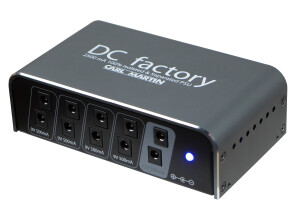
    Carl Martin has released a new power supply, the DC factory, but there are a few differences from the company’s current line-up. Most importantly, this 2500mA supply does not use the typical toroidal transformer technology; rather, it is a fully digital switch mode supply. In effect, there are five groups of two outputs (10 total), each of which is fully isolated and offers 500mA of power. Four of those groups are 9v and the other group is 12v. There’s also a cable/voltage doubler if you have an 18v pedal. Now, each group has two outputs of 500mA of power, which can be divided in any manner. For example, if you have a power-hungry digital pedal at 400mA, but an older analog pedal that may required only 20mA, then you can hook up those two pedals to one of the groupings. Keep in mind that the two pedals could be any mA amount (e.g., 250mA each), so long as they do not exceed 500mA total (and if you have a pedal that requires the full 500mA, then you use only one of the outputs). The above is a basic understanding how this power supply works, but as important is how clean and quiet the unit is. You can have several wah pedals hooked up to DC factory and you will not hear any hum or buzz. The unit also comes with ten 18-inch (50 cm) cables, as well as the voltage doubler mentioned. It’s grey adonized chassis makes it attractive enough to place atop a pedalboard, although it can be mounted underneath with typical Pedaltrain brackets (screws supplied, but brackets not included). The DC factory may not be as exciting as a pedal, but its form factor and function does make this a nifty piece of hardware for consideration. I’ve been using it for the past week with zero complaints… powerful, noise free and looks good; everything you could want in a power supply. List price is $169 USD. For an overview of features and its function, refer to the demo video below.

  • « Incredible DI, Preamp and Pedal Platform »

    I have worked with a number of pre-amps with on-board cab sims, few of which grabbed my attention. The pre-amp sections were fine, for the most part, but often their cab sims sounded boxy, honky or fizzy, thus making it difficult to dial into a usable tone. They were decent and did the job, but they did not find regular use in my home studio. The overall sound and quality of the fully-analog Ampster, which is 12AX7 valve-driven with zero latency, was a very pleasant surprise in both sound and its diversity, which I’ll get into shortly. https://www.youtube.com/watch?v=sR7LD_ofLrY Being old-school, I like hardware, even when VST/plugins sound pretty amazing. The less I have to use computer-based digital stuff the better. The Ampster is small, rugged, sounds great, works like a regular amp and is a great pedal platform – overdrives and distortions sound astonishing! It operates via a 9V adapter (included), although any 1A power source will work. Looking at the front, you have the usual controls, including a Master volume and a Gain. There is a significant amount of headroom with this pedal, and rarely did I have the Master past half-way. The Gain ranges from sparkling clean to modest dirt for slightly crunchy chords – and this is one reason why the Ampster is such a great pedal platform for one’s favorite ODs, fuzzes, etc. The EQ has a very good and usable range, and there’s a Presence knob, which I appreciate (particularly for clearing up heavier Metal riffing). The Mute footswitch works as per its name, and with zero popping in the signal. The Cabinet switch alternates between a 2x12 open-back cab (a crisper tone with more bite, indicated by a red LED) or a 4x12 closed-back cab (a heavier and fuller tone, indicated by a green LED). The back of the Ampster holds a few surprises, besides the usual input and ground lift. There are different ways to output, including a balanced XLR that incorporates Ampster’s Cab sims. There’s also a Link output, which bypasses the Cab sims, so that you can go direct to an amp, to an interface/other Cab sim source, or you can run it with the XLR for double-tracking (direct to DAW vs. a mic’d amp/cab). Further, there is an FX Loop (send/receive) that works in the traditional manner, allowing you to run modulation and time-based effects; but there is a ‘normalizing’ switch of the Return socket, found under the hood of the Ampster, that reassigns the Send, to bypass the Cab sim of the pedal. You won’t be able to use the Loop in a traditional manner, but allows the Ampster to be used as a valve preamp in front of a physical guitar amp. The Remote socket can interface with both analogue and digital external footswitches, ideal for those mounting the Ampster under a pedalboard, if not in a convenient location for effective control or preferring a master control mechanism. Next, a great feature of the Ampster is the three-way Voicing switch, which rolls off the lower-end mids, analogous to a mic’d cab position. One Voicing is similar to micing the outer edge of a speaker, another more toward the middle, and the third center of the cone. This is great if wanting a more robust sound with thin pickups, or to clean up darker and overly-rich pickups. Overall, and particularly if you’re looking for a Marshall-style sound, this is a fantastic preamp. It works for live gigs as much as average players recording at home. It has a very good low-end response without any mud or muffle. The high end, even with the Presence and Treble up full, does not sound brittle, but maintains the tone’s composure and integrity. Similarly, its responsiveness is spot-on, cleaning up with soft picking, yet increasing in crispness and brightness with a harder picking attack. Best of all, this sounds like the real deal… its sound and responsiveness would sit perfectly in recordings, which tells you how far we’ve come with gear over the years.

  • « Warm and Lush while Blending Chorus with Vibe »

    SOUND: The Atlantic Chorus is another in the line of great sounding vintage pedals by Carl Martin. And although considered a chorus pedal, it morphs from Chorus into Vibrato. At 12-noon the Rate knob produces a combination of Chorus/Vibrato. As you turn the knob counter-clockwise you hear a more traditional Chorus and as you turn the knob clockwise it sounds more Vibrato. Regardless of choosing a Chorus or Vibrato (or a mix of the two) the pedal automatically adds warmth to the tone, although more so within the Vibrato zone. This may mean adjusting your EQ slightly and depending on the ‘color’ of your pickups and the desired tone. In a very small dose (with Depth low) both Chorus and Vibrato can add a very pleasant and tasteful dimension to an overdriven lead tone – you know the sound is fuller, but the effect is not overly obvious. But even when pushing an overdriven sound with a lot of Chorus, the effect remains true in the mix and without weakening. As with clean tones, the warm swirling effect of the Atlantic Chorus encourages a guitarist to increase the mix and completely enjoy an exceptionally full sound. What is very notable about the Atlantic Chorus is that it has a very organic aura to it… warm and almost dream-like, and more subtle than modern-based chorus or vibrato pedals. This makes it easy to achieve a more vintage sound, but also a chorus/vibrato that maintains a highly natural presence. Another bonus is the Level knob, which adds quite a bit of boost to the signal, unlike other chorus/vibrato pedals I have tried, and so you need to be careful with that function. OVERALL IMPRESSION: Carl Martin has once again demonstrated that the company and its tech engineers can produce solid and well-intentioned gear. Certainly there are digital chorus and vibrato pedals that offer more options, but this all-analog pedal stands proud in what it offers. If you’re looking for a basic design with chorus/vibrato that ranges from almost inaudible to very noticeable, and yet have characteristics that sound so natural that it becomes part of the tone (rather than producing an effect), then the Atlantic Chorus is a solid buy at approximately $150 Canadian. The Atlantic Chorus will warm your tone, and so there may need to be some EQ adjustment, although I suspect it would sound fabulous on a Fender or Vox clean channel. Not only is there a very healthy boost with the Level control and, of course, you can alter the Speed and Depth of the effect, but the Rate knob allows you to select all Chorus, all Vibrato, or you can bleed one into the other for various levels/combinations. GENERAL USE: The Level control produces quite a boost in the signal; consequently, make certain that it is turned completely down or perhaps at 9-o’clock – then adjust as required. The Depth controls how much of the effect is mixed into the signal – keeping it around 9-o’clock produces a subtle effect, which adds nicely to lead solos or if you want some shimmer in your clean tones. The Speed knob controls how rapid a pulse you get, with either the Chorus or Vibrato, from an eerie Pink Floyd effect to a fast Surf Rock. The Rate controls how much Chorus and or Vibrato you get, which makes the Atlantic Chorus rather unique. At 12-noon you get a mix of both effects, but as you turn the knob counter-clockwise to about 10-o’clock, there is an obvious dominance of Chorus with some vibrato, whereas turning it even more to about 9-o’clock produces primarily a Chorus quality. Conversely, once you get to 2-o’clock and beyond when turned clockwise, the sound is more obvious vibrato and even warmer to the ears. OTHER DETAILS: The Atlantic Chorus consists of a two-tone die-cast chassis and measures 115 x 60 mm (about 4.50 x 2.4 inches). The off-white vintage-looking plastic knobs are of heavy construction and the pots are very solid and firm when turned (not stiff, but they will stay in place even if tapped slightly and accidentally). The bypass switching produces a solid click when turned on/off and there doesn’t appear to be any ‘noise’ when doing so… you do not hear a ‘click.’ The footswitch is a good distance from the knobs and the on/off LED is toward the back and between the upper two knobs. All inputs, including power, connect to the back of the unit, which is an ideal space saver on pedal boards. The Atlantic Chorus does not run on batteries and requires a standard 9VDC power supply (drawing 40mA minimum).