Log in
EN
FR

Boss Guitars

383 products found

Categories
Series
Filter
Sort by
Boss
Evaluation
  • Reviewed or not
  • Editor’s award
  • Reviewed by Audiofanzine
Availability
  • Available or not
  • Sold new or used
  • Sold new
  • Sold used
Must-have products
  • All products
  • Flagship products
  • Best rated products
  • Hot products
  • Popular products
Price
  • Freeware
  • Low-cost (< $150)
  • Mid-range ($150 - $300)
  • Premium (> $300)
€
Clear
Sort by
  • Popularity
  • User ratings
  • Price - low to high
  • Price - high to low
  • Used price, increasing
  • Used price, decreasing
  • Name (from A to Z)
  • Name (from Z to A)
  • Added on
Sort results
  • Popularity
  • User ratings
  • Price - low to high
  • Price - high to low
  • Used price, increasing
  • Used price, decreasing
  • Name (from A to Z)
  • Name (from Z to A)
  • Added on
Filter results 383 results found
Brands
Evaluation
Availability
Must-have products
Price
  • Freeware
  • Low-cost (< $150)
  • Mid-range ($150 - $300)
  • Premium (> $300)
Show results

The best Boss Guitars reviews

The reviews Audiofanzine members found the most helpful.
  • « A genuine improvement on a Classic »

    In the days before guitarists could step on a pedal and tune their guitar on the fly, their best option was either an expensive model from the Peterson 400 Strobe series, or the small needle-based Boss TU-12. Neither were a very convenient option for a variety of reasons. The strobe tuners were difficult to read unless one was educated in how to use them, plus they were bulky, and setting them on top of your amp would still have you turning your back to the audience to tune your guitar. The TU-12 needle tuner was an improvement in simplicity and size, but compromised in accuracy. Another downside to these tuners was they didn't have the capability to mute the guitar signal coming from the amp while the player tuned. As a result, the unpleasant sounds of a guitar being tuned could be heard by everyone. The Boss TU-2 revolutionized stage tuning by placing the tuning solution on the guitarist's pedalboard where, with a step of the foot, mute their guitar signal, and tune the instrument utilizing a series of LED lights and Digital note readout. Pretty soon the TU-2 became standard equipment in every guitarist and bass player's pedalboard. The TU-3 was designed to be everything players had come to love and expect from the TU-2, while addressing common complaints about the TU-2. Boss succeeded beautifully in making the classic TU-2 design even better. The TU-3 sports a 21 LED readout, as opposed to the 12 LED readout of the TU-2, allowing a much more precise readout of microtonal deviations from the note. The display is also considerably brighter than the TU-2, allowing it to be read even on bright outdoor stages. Another improvement is response. The TU-3 tracks the signal pitch considerably faster than the TU-2. It also has a wider Vernier range than the TU-2, allowing a reference range of A436 to A445. All of these improvements are housed in the same familiar aesthetic and functional design of the TU-2. It still sports the mute/bypass jacks, mode change, and stream/cent switch of the TU-2. With these updates, The TU-3 is destined to become the new standard in pedal tuners.

  • nickname009's review

    Compact delay pedal with superb BOSS sound quality Provides 3 delay time modes and a Delay Time control for quick adjustment of exact delay time between 12.5ms - 800ms Hold function repeats delay sound indefinitely for interesting effects BOSS 5-year warranty This is the legendary boss dd-3,the newer revision of this has some new features but the sound, function and size are the same. It's a great delay for those who are just getting into the idea of owning and using a digital delay pedal who don't really know what they're looking for yet but want something simple to use, that sounds good and can open doors into the whole delay world for you. UTILIZATION This is as simple as a digital delay can possibly get. And yes digital delays are usually a bit more complex with knobs and functions than analog delays as there are a lot more parameters that one can control. But again just like with most pedals you can start with everything up at noon and adjust from there. the E. Level knob is like a mix knob allowing how much of your signal is going to be 'wet' with delay. The Feedback knob controls how long the delay will sustain for before it cuts out of the signal. And the delay time controls how soon or how late the repeats will come in or out. The mode knob is what's been changed as far as I can remember with the older 90s versions but it's stupid simple. You adjust the length of repeats that the pedal can operate with I think it goes up to 800ms on these. And the HOLD function is for that oscillation effect, if you're in this mode, all you do is press and hold the footswitch and the delay effect will repeat into a neverending cycle and create a cool space-like effect, "oscillation". SOUND QUALITY The sound of course is digital. This means that the repeats itself are very clear and precise with quite a bit of presence. Technically, the repeats should be just as clear and precise as the original sound source, that's the point of digital delays. Also digital delays tend to usually allow longer repeat times than analog delays. So there's not much to judge here about the sound as delay pedals are really just meant to repeat your original sound source. I will say this however, placement of the pedal changes how the delay sound, for example if you put this in the FX loop and use amp distortion, your delays will be clear and not muddy vs if you put this out in front while using amp distortion. Experiment and see what you prefer the sound of, there is no right or wrong. OVERALL OPINION Overall, best basic digital delay. Legendarily known for being so and definitely worth looking into for those who are just getting started with delay. For those who've played with delay pedals for years and years they'll know what to to with this for sure and have probably moved on to other bigger pieces of gear with more knobs etc. But this has always been a great simple effect to experiment with new guitar sounds and get your creative juices flowing.

  • « COSM based modeling fuzz »

    For about 8 years, there wasn't a single fuzz in the Boss line up. Finally, they decided to make a fuzz, but they changed it up this time. Instead of the normal fuzz style components, they decided to make use of their famous COSM technology to help create an almost modeling style fuzz. It's a bit different, so it's not for everybody, but it's definitely something interesting. It has a knob for the level, knob for the amount of fuzz and a three way selector switch that allows you to select between three different fuzz types. UTILIZATION The manual that Boss provides is wonderful. It's easy to understand what everything does and how everything works. It also gives you some example sentences to help you get some good sounds right away. The knobs are easily accessible, and it's small enough to fit on nearly any pedalboard. The pedal is FET bypassed, so it can be used as a buffer to help boost/preserve your signal, but it doesn't sound quite as good as true bypass. The housing is awesome and will withstand even the most extreme abuse out there. It's withstood the test of time, and there's a reason why they keep using it. SOUND QUALITY The fuzz tones are pretty decent, and it's meant to model the Fuzzface, FZ-1A and Octavia. All three of these fuzzes are pretty iconic in the fuzz world, and they've helped create a majority of the old school 60s/70s tones that were famous back in the day. However, I can't help but think neither of them sound quite as close to the real thing. I mean, they get you in the ballpark, but they don't seem to be able to recreate the complexity and organic-ness that the originals have. The good news is, if you've never played those pedals, you'll probably really like this as it's a fairly versatile fuzz pedal that can create all kinds of different sounds. OVERALL OPINION If you need something for a decent price that can get a good amount of famous fuzz tones, this could be what you're looking for. I find that it's a solid pedal, but it can't match the real things. They just have something special going on that can't be recreated with today's modeling technology, but they might be able to in the future.

  • « Great overdrive »

    Most people out there who have tried the BD-2 know that it's a pretty solid pedal. You can get a very nice overdrive with the pedal, and it can be a nice alternative to the standard tubescreamer that you hear on so many other albums out there. That said, it could use some improvement, and Analogman is here to help. His main mod is the BD-2/Super mod which helps improve pretty much everything about this thing. It still has the same three knobs and operates the same way, so no difference there. UTILIZATION Boss pedals are inherently some of the most reliable and robust pedals out there. I could throw this thing off of the empire state building, and I bet it would still survive with barely a scratch. That said, I do not endorse throwing your pedals off of buildings. I'm sure some moron out there will do that and blame me for injuring somebody later on... The pedal really doesn't look any different on the outside. In fact, the only real way you can tell that it's modded by Analogman is via the sticker on the pedal. Aside from looking inside, you'd probably never know. I can't comment on the manual, but this pedal is easy enough to use without having to look at the manual, especially considering all the example settings are now moot. SOUND QUALITY One word of warning: Do not turn all of the knobs on full. If you do this, you'll get some nasty squealing. That said, you really shouldn't ever turn up all your knobs to max on this thing. It's mainly the tone knob that'll cause the squealing to occur, and I find that'll be way too bright. The pedal now sounds more like a transparent boost instead of that middy overdrive kind of sound that you hear from standard tubescreamers. This can be a good or bad thing, depending on what you're looking for. The tone knob on this is a lot more useful, and the overall pedal just sounds a lot better, in my opinion. OVERALL OPINION If you're looking for a more transparent sounding overdrive, this is the kind of pedal you should be looking to get. It sounds a lot more organic and has a bit more depth to it overall. It's also more versatile as the tone knob actually works this time. It's not as harsh as it was stock, and it has some nice depth to it that the other one really didn't have. Combine this with a tubescreamer to get some awesome versatility.

  • « One of the earliest Boss autowahs »

    This Boss pedal is probably one of the more popular Boss Auto Wahs thanks to it being one of the first auto wahs that Boss ever made. On top of that, there are two different versions of this, so it's worth noting whichever one you have. The earlier ones just had two knobs. The later ones had the switch added in the middle for a bit more versatility. You have a sensitivity knob and a peak knob. On the later ones, the switch in the middle controls the overall modulation. UTILIZATION The pedal is laid out very easily. You can tell what everything does just by looking at it. The earlier ones are even easier to use, but the later ones aren't hard to use, either. We're only talking two knobs, after all. The max would be two knobs with a switch. Just move them around, and you'll figure out how they work. I have never read the manual for this, and in fact, I've never seen the manual for these because they're so old. I'm sure you can get it on Boss's website, but I never bothered to check. The pedal can take some ridiculous abuse, and it's pretty insane how tough these pedals really are. I'd throw it in a true bypass loop, but that's just me. SOUND QUALITY The sound is great, despite it being so old. It has a very vintage, old school auto wah tone that is a lot more organic and 3d sounding than the later auto wahs out there. That said, it can't do as much. You're pretty much locked into the basic effect that Boss gave you. The extra switch on the later ones helped give you some more versatility, and I actually recommend finding those if you can. They can deliver great funk sounds, and it can work quite well in fusion, too. Aside from that, its usages are kinda limited as not much other music uses this kind of effect. OVERALL OPINION If you can find one of these at a good price, I recommend getting it. They sound pretty good, and they can deliver some of that old school, vintage style tone that the newer ones can't seem to deliver. That said, it't not exactly an effect you're going to rush out to have on your board, so I'm not sure how necessary this is for everyone.

  • « Another Boss Autowah »

    The FT-2 was a fairly short lived Dynamic Filter, and to be honest, I can kinda see why. Boss made some improvements on the newer models that kind make this obsolete. That said, this model was still a good model. If you ever wanted that funky kind of sound without having to move your foot all the time on the wah, this is the kind of pedal for you. It features knobs for sensitivity, dynamics, cutoff and a special mode switch that can select between different styles of effects. UTILIZATION Boss pedals are among some of the best, most well built pedals you'll ever find. The FET bypass is pretty good on this, and it's not a horrible tone sucking pedal. There is some tone suckage, but it was never enough for me to consider putting it into a true bypass loop. The pedal is tough as nails and can withstand any kind of abuse. I've seen these things beat to hell and back, and they still perform like a champ. The knobs are laid out nicely, and everything is fairly easy to understand. One thing you might want to do is look at the manual, but I can't say I know what it's like as the pedal I had didn't come with one. That said, the manuals that Boss pedals have are usually really good. SOUND QUALITY If you like different variations on your auto wah, this is probably the pedal for you. It offered some different things that other auto wahs didn't, at the time. You had a bit more versatility than with the older Boss wahs. For example, you can set this thing to where it stays on a frequency, and it sounds kinda like that MIchael Schenker tone. You know, that cocked wah kind of sound. Then again, the Tone Zone pickup kinda does that by itself, so you can choose how you want to get that tone. It does the standard funky kind of expression thing, but it's nothing that inspiring that made me want to keep this. OVERALL OPINION The pedal is solid, but there are some better options out there, especially considering how hard this pedal can be to find. They only made it for a few years, after all. I find that the newer Boss auto wah pedals tend to sound a bit better and offer more versatility, but if you're looking for the most dynamic and old school style, you'll probably want to get the TW1 instead.

  • « Perhaps a bit smoother »

    This is one great sounding flanger pedal. Some say the Japnese version sound more smooth and a little more refined than the Taiwan version but I think they are both the same. Unless you A/B them together that would be the only way to tell for sure and even still both version are fantastic. The change of manufacturing countries ended in Japan in 1990. It is amazing how the limited number of amps and effects were back in the 80's to guys and still were able to pull off some of the best created rock tones to this day. Well it seems a lot of them would get really creative with the stuff that they had rather than gassing for something they didn't have. Ronnie Le Treko used this pedal as a boost in front of a simple Marshall amp. He would run the pedal with all of the knob in the off position except for the level/volume/manual. This would give a midrange boost to the amp and would get that great tone he was so famous for in the 80's. UTILIZATION Version differences from Boss forum. * The BF-2 exists in both metal screw and plastic screw versions. * The earlier versions had all black knobs. These where later changed to the white top knobs. The change took place 1990, very close to the same time that production was moved to Taiwan * There may be some BF-2's in pink. This was the original colour choice, but it was changed to purple in the last minute. Whether some pink ones exists out there is uncertain. * The BF-2's design remained virtually unchanged through its more than 20 year lifespan. The TL022CP opamp was replaced with the Sharp IR9022 opamp at some point but apart from that, the ciruit remained unchanged. SOUND QUALITY The tone of the flanger is a very good and usable tone. You get a very lush tone that really widens the signal to explore warm flanger tones. Te flanger itself is a great feature but as a get more into guitar playing instead of effects using I find myself leaning towards using it as a preamp. If you run this pedal in front of a Marshall Plexi, JMP, or a JCM800 you can get a very cool and usable Le Treko tone or just a boosted midrange distortion tone. It is cool for getting that 80's grind that was distinctly 80's hair metal. This is a great little unit. It is a fantastic sounding flanger and the lush chorusy flanger effects sound amazing. So if you use it as a flanger it sound amazing and if you use it as a booster it sounds amazing as well. OVERALL OPINION These pedals have now been discontinued and have been updated with the Boss Bf-3. Pretty much the same pedal with a few minor and not that noticeable features. On the classifieds you can find this pedal for right around $50 or so. They are pretty inexpensive and not a big investment to find a cool effects pedal or booster pedal.

  • « Nice overdrive »

    This is one of the very best pedals that Boss ever made. It has the normal contl knobs as you would see on many overdrive and distortion pedals from Boss. But it also has a turbo switch to go from a mild distortion to the turbo distortion. Many say that this revision of this pedal had more distortion but they sound pretty close to the same. The next feature that is visible was remote input to connect a remote foot switch to control the turbo on and off. I like to keep the turbo in the ON position. I think I read somewhere that Edge always had it on. So therefore I did as well. The On position for the turbo is where this pedal shines anyway. I would have my Gain up to around 12:00 ad the tone around 11:00 and the Level at unity level to my amp tone. UTILIZATION Specifications * Controls: Level, Tone, Drive, 2-way Turbo Switch * Connectors: Input, Output, Remote, AC Adaptor * Current Draw: 16 mA (DC 9V) * Weight: 440 g (1 lb.) * Nominal Input Level: -20dBm * Input Impedance: 1Mohm * Nominal Output Level: -20dBm * Output Impedance: 1kohm * Residual Noise Level: -110 dBm(lHF-A, Typ.) * Recommended AC Adaptor: PSA Series SOUND QUALITY To get a good classic rock run this pedal with a MArshall amp of some kind and a nice Gibson Les Paul. The coolest part of this pedal is getting a great classic rock tone when you jump the channels of a plexi or JMP Marshall amp. They just work and sound fantastic together. I would also suggest running this pedal in front of a Fender Hot Rod Deluxe with a good quality delay in the mix.. Same result as the Marshall and it will sound great! This pedal is easy to get a good valve sound of of it. All you need to do is get it in front of an good amp and it will do the work for you. OVERALL OPINION These pedals were made by Boss from 1994 to 1999 so the used market is the only way to go at this point. These are great pedals to get a good classic rock tone from. I would recommend this pedal to anyone who uses an overdrive pedal in front of there amp and needs a good boost to get their amp sizzling. This pedal will do that in spades. It is an easy pedal to dial in and you will be cranking out tones with ease as so as you find that perfect sweet spot.

  • « Noise gate....that's it »

    Boss has a pedal for every possible operation in music. They have effects pedals for just about anything and everything that you can think of and have done versions and new editions of a lot of those pedals. If you can't find something that you need I am almost sure Boss has a pedal for ti. Boss is like the iphone app store. When they say there's an app for that...well there is Boos pedal for that. This pedal is simply a noise gate. Not too much to talk about other than it limits the amount of noise one would experience in their guitar rig. The reason for a pedal like this is to give guitar players a limiter on how much noise they will experience in their signal chain. UTILIZATION Specifications Controls: Sens, Decay Connectors: Input, Output, AC Adaptor Current Draw: 3.9 mA (DC 9V) Weight: 400 g (14 oz) Input Impedance: 470kOhm Recommended Load Impedance: 10kOhm or more Recommended AC Adaptor: ACA Series SOUND QUALITY A noise gate will limit the amount of noise one would experience through their effects and signal chain. If you play blues rock or a soft rock then you probably would never need a pedal like this. This is for the guys who use a lot of distortion and possible some extra overdrive peals for high gain purposes. If you don't use high gain then you probably don't experience a lot of noise in your tone and signal chain. For those who do use a lot of gain and possibly some high output pickups would need something to tame all of that noise. I have found that a noise gate also helps when playing gigs in different places where they might not have good electrical outlets and you get some added noise. Possible the wiring is off and so extra noise is introduced into the line. A noise gate would help in that situation just to have in case you ever run into that problem. OVERALL OPINION These pedals were made from 1979 to 1988. So they have been long discontinued for a time now. So the used market is the only way to go now. I would suggest a new edition of a noise gate there are much better ones out there now.

  • « No real differene that the Taiwan »

    This was the third edition to the chorus line from Boss back in the 80's. The reason primarily for this pedal to become produced was the need for two outputs. The CE-2 only has one output and there was a need to run the pedal in stereo, so this pedal was created. The pedal looks unique in that it has the three knobs level in a row. This is the only 3-knob pedal that has three knobs in a row. This caused the LED light to be hidden and it was a design that was soon changed in favor of the V shaped 3 knob control layout. Boss finally stopped making these pedals in 1992. The Japan one had two labels. The first being a black label and then the green label which was introduced in 1984. The tone wasn't changed but people will often times sell these claiming the Japan label as there is an allure to get the Japan made ones over the Taiwan. Some pedals suffer d in the transition but not this one. UTILIZATION Specifications Controls: Rate, Depth, 2-way Mode Switch Connectors: Input, Output A, Output B, AC Adaptor Current Draw: 13 mA (DC 9V) Weight: 400g/0.88 lbs. Input Impedance: 1Mohm Residual Noise Level: -90 dBm (IHF-A) Recommended Load Impedance: 10kOhm or greater Recommended AC Adaptor: ACA Series SOUND QUALITY The sound quality is pretty much the same as the Boss CE-2. The sound quality s pretty much he same as the Taiwan made pedals. The only real change is the output section and the added stereo output. The tone is the same and the EQing of the pedal is the same with simply the rate knob and the depth control knob.You get a nice shimmering watery chorus tone. The liquidity of this pedal is remarkable. It sounds very lush in nature and springs up some nice modulation tone. This is the kind of pedal you use with a nice clean guitar or a distortion amp that you need to add a little bit of beef to. OVERALL OPINION These pedals have long been gone from production so the used market is the only way to to go at this point. The Japanese version goes for a little more because of the allure to have the first editions. The black label being tom most famous and later moving to the green label.I haven't seen them on the classifieds in quite some time and have no idea what the going rate for them are in this market. I would recommend this pedal if you can find one at a decent price in the classifieds. They are lush sounding and will add a great amount of depth to your tone.

  • « Workhorse pedal »

    The Boss OD-2 is a real workhorse pedal. It has been around for many years and has been used in many applications. They have been made all over from Japan to Korea and they were still pretty much the same. The pedal is your basic OD/Distortion pedal. It has the typical Level Tone and Drive knobs but it also has a Turbo knob that lets you switch between two selections. The pedal is powered by a normal 9v jack. UTILIZATION Boss pedals are known for their durability. These pedals are time tested and can handle the worst you can dish out on tour. The chassis is super strong and it is very easy to set up the pedal. The knobs are nice and tight and offer a good amount of resistance when you turn so you get a really solid feel. The pedal does not have true bypass so you may want to watch out. It may make your rig sound different even when it is not on. I think every pedal should have true bypass SOUND QUALITY This pedal can do all sorts of tones very well. It combines overdrive and distortion via the turbo knob. It is seperate from the gain control. With these options you can really dial in the exact overdrive or high gain sound you are looking for with this pedal The sound is great. You can use it as a clean boost or a high gain channel on top of your clean sound. Using as a dirty boost can give you great results. On top of an amp with a bit of gain on it you can really get a crisp sound with some more sizzle from the pedal. OVERALL OPINION The OD-2 already has many fans around the world. This pedal is a workhorse and has been found in many rigs and on many tours. The sound they provide is very good and can really open your tone up to new sounds and possibilities. These pedals can be found for pretty cheap too since they have made them for so long. There is no problem with getting one used since they are so simple and durable. If you are looking for a good overdrive and distortion pedal to expand your tone this is a good choice.

  • « The lesser known OD »

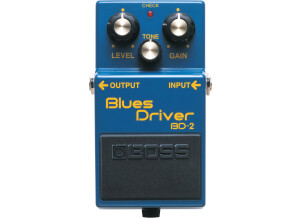
    The Boss BD-2 is an attempt at getting that pushed overdriven sound in a stompbox. It has this almost overdrive Marshall-esque quality to it. It's basically a mixture of an overdrive and a distortion box, almost like a mixture between the TS-9 and the DS-1. Like most Boss overdrive pedals, it features a level, gain and tone knob. UTILIZATION Boss is using their standard enclosure with this pedal. That means it'll withstand a nuclear bomb drop without much of a problem. These enclosures are crazy reliable. It's still using the FET bypass, but it doesn't seem to leak quite as much as the SD-1 does. The manual does a nice job at describing what everything does and gives you some settings, but it's an easy enough pedal to use to where you should be able to get a good tone within about 20 seconds without having used the pedal before. SOUND QUALITY The sound is very similar to a more milder tubescreamer mixed with a DS-1 at times. It has enough bite to send an amp into overdrive and play some 80s metal, but it also is calm enough to be able to do some awesome blues licks. In front of a Marshall, you can get a wide range of tones ranging from VH-style to Eric Johnson/SRV. OVERALL OPINION I find it interesting that this pedal isn't as popular as it is. It's a fairly overlooked pedal, and it goes real cheap on the used market. I can only assume it's because it doesn't push the amp quite as much as the SD-1 does. On the other hand, I find it sounds a bit more "natural" than the SD-1 for whatever reason. It seems to complement the amp a bit more. However, since I'm mainly a metal player, I tend to prefer the SD-1 to really push the amp into overdrive for those crazy legato licks. Regardless, if you're looking for a different kind of overdrive that's a bit more tame than the SD-1, I'd recommend checking this out.