Log in
EN
FR

Ernie Ball Guitars

156 products found

Categories
Filter
Sort by
Ernie Ball
Evaluation
  • Reviewed or not
  • Editor’s award
  • Reviewed by Audiofanzine
Availability
  • Available or not
  • Sold new or used
  • Sold new
  • Sold used
Must-have products
  • All products
  • Flagship products
  • Best rated products
  • Hot products
  • Popular products
Price
  • Freeware
  • Low-cost (< $10)
  • Mid-range ($10 - $20)
  • Premium (> $20)
€
Clear
Sort by
  • Popularity
  • User ratings
  • Price - low to high
  • Price - high to low
  • Used price, increasing
  • Used price, decreasing
  • Name (from A to Z)
  • Name (from Z to A)
  • Added on
Choose a category
Selected category: Guitars
Sort results
  • Popularity
  • User ratings
  • Price - low to high
  • Price - high to low
  • Used price, increasing
  • Used price, decreasing
  • Name (from A to Z)
  • Name (from Z to A)
  • Added on
Filter results 156 results found
Brands
Evaluation
Availability
Must-have products
Price
  • Freeware
  • Low-cost (< $10)
  • Mid-range ($10 - $20)
  • Premium (> $20)
Show results

The best Ernie Ball Guitars reviews

The reviews Audiofanzine members found the most helpful.
  • « Nice volume pedal, but I like the Big Boss Version. »

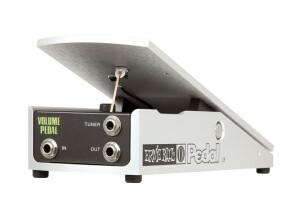
    The VP JR. is a passive volume pedal from Ernie Ball. There are no bells and whistles; there is an input jack to plug your instrument into, an output jack to plug your amplifier into, and an output jack to plug your tuner into. It has a potentiometer with 250k ohm of resistance, so it is suitable for passive instruments. A micro switch offers two different styles of swell rates. Dimensions are 3-12" wide x 10" long x 2-3/8" high. UTILIZATION The actual foot pedal and shell of this pedal is built out of solid metal, and the pivot shaft and springs are made of stainless steel, so they should last. This pedal uses a Kevlar string, that over time, wears out and needs replacing. That isn’t too much of a pain since they are available for purchase online, but I would think Ernie Ball would come up with a better system or provide an extra string or two with your initial purchase. Having the tuner output is a good bonus not found on all volume pedals, but I would like to have seen a minimum volume setting like on the Boss models. SOUND QUALITY This pedal does change your tone a little when it’s in your signal path. I’ve tried it in the loop of my amps and in front of the amp, it sucks a little tone. When I used this pedal I just compensated a little more high end on my amp and it was fine, but I thought it needed mentioning. The two tapers are very smooth and the pedal rolls back very cleanly. You can go from clean to dirty if it’s in front of your amp, or as a more dramatic volume only alteration when it’s in your effects loop. I like to do volume swells and violin like passages, and the tapers on this pedal work well for that. OVERALL OPINION Overall I liked this pedal until I picked up the Boss volume pedal. The Boss pedal is huge in comparison, but is built to last a lot longer and incorporates a minimum volume knob. This is great for going between two different settings and not having to worry about over shooting it. The Boss also does not seem to suck as much tone off the high end as the Ernie Ball. I have to give the smoothest taper feel to Ernie Ball though. If reliability and tone suck is more important to you, I’d go with the Boss. If pedal feel and pedal board real estate is more important go with the Ernie Ball.

  • « Great Strings »

    These strings are great. Nice crisp, clear, and strong tone. They're great for everything from country to metal as long as you put them on the right guitar. The treble strings are bright, but not overly bright. The bass strings are warm, but still crisp and punchy. They have great punch and a nice, full, and rounded sound on all of the strings. They have a great feel and are not floppy at all in E standard or drop D. They are a bit floppy in D standard and Drop C, but they're still usable. They're very easy to string, and very easy to fret. They are super easy to bend as well. They keep their tone for 2-4 weeks depending on how often you play, how much you sweat, and the humidity levels where you normally keep your guitar(s). High humidity and being near salt water would make your strings lose their tone much faster. I used to use GHS strings, but then I started looking for different strings to use since I was not happy with them. They were poor quality and did not sound too good. I have been using Ernie Ball strings for 2 years and I haven't looked back since changed. I've only broken a handful of strings the entire time I have been using them. The only reason they broke was I had a burr on my low E's saddle. Other than that, I haven't had any problems with them breaking. Since I switched from GHS, I won't use any other strings now. They're the best quality and tone for the price in my opinion, and one of the best string makers around. Ernie Ball are known for makers of quality, great sounding strings, and that's exactly what you get when you buy these.

  • mooseherman's review

    The main problem that I have with most volume pedals is the lack of control. I know I'm probably being a huge stickler for quality. I only really bought volume pedals because I thought that they would allow me to lower my volumes during live shows when necessary, but also not rob me of brightness or tone. A second, more active use I have for them is for volume swells. I was used to performing this technique on my guitar's volume knob, but the impracticality of that was severely limiting. I have often been frustrated with some of the volume pedals that I have purchased over the years, but have recently found a few good ones. This pedal is definitely one of those. It's a little more pricey than what I would really want to pay for it, but it's a good value and Ernie Ball will fix it anytime for a reasonable price (so they say). The pedal is only suitable for guitars and basses with passive pickups because of the resistance that it can handle, but I don't own any instruments with active pickups anyway, so it's not a problem for me at all. Another neat feature is the fact that it provides a switch that switches between two rates at which the volume will swell. For the most part I stick with one setting for my main sound, leaving it at about 80-85% of total volume, and cranking to 100% when it's time for a solo. I find the other setting to be better when I actually want to throw some volume swells in there. I find this technique with a good delay can make some really cool sounds! Another neat feature is a tuner bypass switch, which will allow the guitar to tune while the pedal is completely depressed for silent tuning. However, since I already have a tuner that bypasses for silent tuning, I don't really need this at all, though I'm sure many others will appreciate it. I feel like this is one of the better volume pedals I've tried. I have mixed feeling about the Ernie Ball brand in general, but lately I've really been coming around to them. This pedal has certainly helped in that situation. It's versatile enough for anyone trying to stick with one channel.