Log in
EN
FR

Marshall Guitars

453 products found

Categories
Series
Filter
Sort by
Marshall
Evaluation
  • Reviewed or not
  • Editor’s award
  • Reviewed by Audiofanzine
Availability
  • Available or not
  • Sold new or used
  • Sold new
  • Sold used
Must-have products
  • All products
  • Flagship products
  • Best rated products
  • Hot products
  • Popular products
Price
  • Freeware
  • Low-cost (< $500)
  • Mid-range ($500 - $1,000)
  • Premium (> $1,000)
€
Clear
Sort by
  • Popularity
  • User ratings
  • Price - low to high
  • Price - high to low
  • Used price, increasing
  • Used price, decreasing
  • Name (from A to Z)
  • Name (from Z to A)
  • Added on
Choose a category
Selected category: Guitars
Sort results
  • Popularity
  • User ratings
  • Price - low to high
  • Price - high to low
  • Used price, increasing
  • Used price, decreasing
  • Name (from A to Z)
  • Name (from Z to A)
  • Added on
Filter results 453 results found
Brands
Evaluation
Availability
Must-have products
Price
  • Freeware
  • Low-cost (< $500)
  • Mid-range ($500 - $1,000)
  • Premium (> $1,000)
Show results

The best Marshall Guitars reviews

The reviews Audiofanzine members found the most helpful.
  • « It was okay to start out with. »

    Not much to add (solid-state, pseudo hybrid ....clean channel 100% solid-state, OD channel with a marshall 12Ax7 tube). It's a pity it doesn't feature a headphone out or a speaker out to connect it to external cabs, with hindsight I would've really appreciated it. For the rest, it's really comprehensive and versatile. USE I used it live and for rehearsals from 1995 until 2006 (when I switched to a Jcm 900 MK III 2100 model...read my review). Since 2006 I use it for my home studio or to do other jobs. I've played with alternative, pop, rock, and metal bands...and it has always fit well. It sounds all right at low volumes, especially the OD channel. I used it again several years ago for a gig in a small venue...and it was catastrophic!! I'll never do it again! SOUND As soon as you crank it up a bit, it turns shrill and lacks warmth...a 5-watt tube amp sounds better. It doesn't make me feel anything ever since I've been playing tubes... Back in the day, tube amps were inaccessible, they were really expensive, that's why I chose it...there were not many options!! OVERALL OPINION It's okay to start out with and not go broke, but you'll quickly need to move on to something else. Avoid using it for gigs, unless you play at low volumes and are amplified via the PA. Go for a tube amp as soon as you can. + Connections + Reverb + Nice speaker + OD channel - Solid-state sound - Sound is degraded at high volumes - Weight

  • « Decent for an aspiring rocker »

    The Marshall MG100HFX is the updated head version of the MG100 head that has been around for a fair few years. It's meant to be a good amp for beginners who want to have a real Marshall stack, but can't afford the hefty price tags of a JCM800 or Silver Jubilee. It's a 100 watt solid state head that features four programmable channels (think Hughes and Kettner Switchblade) and has a few built in effects as well. It basically takes the idea of the clean/crunch/OD1/OD2 system that has been used on Marshall amps like the JVM and brings it to the MG series and combines it with programmable channels to give more options to the user. Here's a full list of specs: Features 100 watt output 4 storable channels Digital effects including Delay, Chorus, Phaser or Flanger Digital reverb Power amp damping MP3/Line input Emulated Line/Headphone output External Effects Loop MG footcontroller compatibility Reverb & FX The MG100HFX amplifier provides three simultaneous effects, Reverb, Delay and one of three Modulation effects (Chorus, Phaser, or Flanger). Tap Tempo Use tap tempo to set your delay times as easily as tapping your foot. Tap Tempo switch is used for the Delay effect only. MP3/Line In Jam along to your favorite bands or personal recordings by connecting to your MP3 or CD player to this convenient 1/8 inch input jack. Headphones & Line Out The Headphone/Line out provides speaker emulation, so you can hear your guitar like its being blasted through powerful speakers or record direct to a source without using a microphone. Damping Make it sound like your using 2 completely different amplifiers. When Damping is Off the power amp response resembles the feel of a classic power amp with emphasized middle and limited bass and treble. Switching Damping On will boost the speaker resonances both in the bass and high frequency ranges. FX Loop The FX Return socket on the rear panel is used to connect the your favorite external effects pedals or processor. The FX loop is series and set at instrument level so both guitar FX or professional units can be connected. UTILIZATION Getting a good sound out of this amp is not difficult if you don't expect to sound like the pro level Marshall or Mesa tube amps that we all know and love. The programmable channel layout is a welcome change from the dual channel layout of the old MG amps, which was clumsy and hard to balance. The ability to store presets and not have to worry about balancing things like gain levels or EQ settings is something that is good for younger players who just want to jam. The onboard amp models and effects obviously don't sound stellar but who am I kidding if I said I expected this to sound like the tube amps I love. It's definitely an improvement functionality wise on the previous model though. Do the sounds stack up... read on. SOUNDS The Marshall MG100HFX is an amp that is designed to do many different sounds in general for the player who wants to go from clean to mean and everything in between. The clean tones are decent. They lack a lot of the sparkle and punch that I look for in a clean tone but for solid state cleans they're fairly good, especially with effects like chorus and reverb applied to them. The crunch tones are a weak point. I find that crunch tones like that rely on subtle tube breakup to sound good... these just sound forced and pretty fake to me. The OD1 and OD2 modes are good for what they are. They're a bit compressed and scooped sounding for my tastes but they have a nice low end punch to them too that is enjoyable for an amp of this price range. It's a decent amp for anyone who wants to play rock or metal on a budget for sure. OVERALL OPINION All in all I think the Marshall MG100HFX is a decent enough amp, and it's certainly an improvement over the awful MG series of old. There are some better options in the price range such as the Peavey Vypyr amps, but if you want a "real" Marshall head for $350 new, you can't really go wrong here. The matching cab will bring it up to more, but it's still a decent deal for the aspiring rocker.

  • « Marshall's last great amp »

    Note: I'm writing this review about the Marshall 25/53 Jubilee, which is a smaller box version. The Marshall Silver Jubilee came about in 1987 as the flagship amplifier to celebrate the company's 25th anniversary. It was based on a hot-rodded Marshall circuit with cascading gain controls, but it also had a clean channel and was available in a very cool silver tolex. It delivers 50 watts of power (powered by EL34s of course) and has two channels. The EQ is shared between the two channels and it consists of bass, middle, treble, and presence. On the back of the amp are the requisite speaker outputs, footswitch jacks and the send/return plugs for the effects loop. The first gain knob is a push/pull that toggles between the two channels. As I stated before, the two gain controls are cascading and a bit of tweaking is required to get the right balance between gain levels for both channels. UTILIZATION Getting a good sound out of this amp is easy and difficult at the same time. Dialing up a great tone on one channel is easy and straightforward, but getting the two channels to balance can be a tempered nightmare. Because the dual channels share gain and EQ controls, plus the gains are cascading, it can be a chore to get a gain level that suits both channels and there is definitely a bit of patience involved in dialing it in! If you think of it as a one channel high gain amp (or as a high gain amp with a really gritty sounding "clean" channel as a bonus) then you might fare better, but for those looking for sonic versatility, you aren't going to get it with this amp without some tweaking. SOUNDS I've tried this guitar with various Les Pauls, Strats, and the odd superstrat here and there. In my opinion it offers one of the best (if not the best) high gain tone that I've ever heard from a stock, non-modified Marshall. All the traits of a good Jose, Friedman, or Cameron mod are here... tight and responsive low end, a subdued but still punchy midrange and a snarling, vicious top end that screams with harmonics and perfect overtones. It's great for everything from Van Halen/Ratt/Dokken of the early/mid eighties all the way up to modern shred tones. If you back the gains down you can get a nice classic rock tone for stuff like Michael Schecker Group or Deep Purple with ease. The clean tones are good as well when set right and I would say they work well for jazz/blues type things quite well. You can't really switch on the fly like I stated before, but when the amp is setup for good clean tones, it can produce some great unique clean tones that remind me of a goosed up old Fender or VOX. OVERALL OPINION All in all I think the Marshall Silver Jubilee is a great amp for anyone looking for an awesome hot-rodded Marshall amp who doesn't want to get something that's been modified. It has all the traits of a killer sounding Marshall. Sure the functionality isn't great, but there are other amps for that. If you take the Jubilee for what it is, it's probably the best stock Marshall ever produced for high gain. They're getting harder to find and more expensive so snap one up while you can!

  • « Can't ask for much more in a cabinet! »

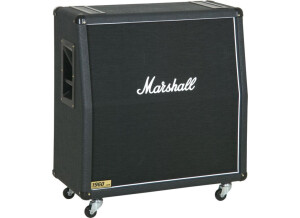
    The Marshall 1960AV and BV cabinets are some of the best cabinets I have owned. I currently own a 1960BV and used to own a 1960AV. The only reason the AV is gone now is that I downgraded from a fullstack to a halfstack. The cabs are made really well, with 15mm birch comb joints and PVC cover with a cotton back. They can take tons of abuse and still work perfectly. My buddy's 1960AV has nearly all of the tolex stripped but no function damage. The cabinet has been toured around the US without a road case and still gigs today. They are truly fantastic cabinets. The cab can run 4ohms or 16 ohms mono and 8 ohms stereo, which I have always found to be extremely helpful when you can run just about any head on the market through this cabinet. The Celestion vintage 30 speakers that you get in the 1960AVs and BVs are fantastic sounding speakers for any genre and take a lot of abuse. I play anything from ambient to heavy metal and even blues stuff through mine. Accompanied by many different heads and it can handle all of the genres fine. It's the perfect go-to amp for any studio and can survive through years of gigging abuse. The 1960BV has a warmer sound with slightly more bass response than the 1960AV but they both deliver the goods. They have nice bass response without getting too boomy and handle high and mid frequencies really well also. Very versatile cabinets. The fact that you can find these cabinets used anywhere from $300-$600 makes them worth every penny. The quality you get with these cabinets along with the craftsmanship that went into them is nearly unmatched. I see they get some flak on forums, but I honestly don't see anything wrong with these fantastic cabinets. I never need to upgrade from my 1960BV, it's just one hell of a cabinet. Recommended to anyway looking for a great cabinet.

  • « Just junk »

    This amp is pretty much just junk. Marshall seems to put out these low end cheap amps and rotate the model numbers every few years or so. They have since discontinued this amp and think is replaced by the MG series amps. If you are simply going for a practice amp that will be decent at low volumes and allow you to just get your chops and technique down then this is a great amp for that. This is in no way a gigging amp or a stage amp of any kind. UTILIZATION Output (RMS): 50 watts Impedance: 4 ohms Speaker: 1 x 12 in. #Channels: 2 Acoustic Simulator: No Digital FX Section: No FX Select Switch: No Accutronics Reverb: Yes FX Loop: Series FX Level Switch: No FX Mix Controls: No Scoop Switch: No Bright Switch: No Emulated Line Out: Yes Headphone Jack: Yes Master Volume: Yes Presence Control: No Speaker Outputs: 1 (int./ext.) CD Input: Yes Footswitch: PEDL-10001 included Dimensions: 515 x 554 x 259mm Weight: 18.6 kg SOUNDS This amp has the classic Marshall/British distortion. You can play this amp at very low volumes and with the headphone jack be able to silently play in your home or office without interruption. Any guitar will sound fine with the amp. I prefer a nice Gibson Les Paul with Marshall amps as they seems to fit sonically together very well. Even a good Fender Stratocaster will sound too. It just depends on the mood whether or not you want to get a fat sounding distortion tone or a sweet Jimi Hendrix Strat tone with the single coils. OVERALL OPINION These amps are not being produced anymore and so the used market is the only option at this point. I have no idea what they are going for these days in this market. I think with the hybrid technology with solid state and tubes give this amp a step above the all solid state amps, but it still doesn't get that real tube punch. I would recommend this amp to someone who needs a good practice amp and doesn't want to spend a lot of money doing it. It has an emulated direct out so if you wanted to use this to record you can or even run a line directly to the house PA system. Not sure how that would sound but worth a shot I guess.

  • « 50 watt digital »

    This is the 50 watt combo version of the JMD:1 amp. You get the same great features and tone. However, the tone will be a bit more spongy due to the cut of half the wattage. You will get a bit less headroom in the overall tone. This amp is an interesting take on the new wave of amplifiers. They take the digital side of modeling and combine that with the power tube section of your already familiar Marshall tone. It was a big surprise at how close to the amp models that this amp comes close too. Marshall JDM50 Digital/Tube Guitar Amp Head Features at a Glance: Power: 50-watts 16 digital preamps Power Amp: 2 x EL34 Four modulation FX Delay FX Reverb Noise Gate Series/Parallel FX Loop Footcontroller included MIDI In and Thru Emulated Line Out Headphone Out MP3/CD Line In UTILIZATION Details Type Hybrid Number of Channels 4 Power 50W Effects Reverb EQ Bass, Middle, Treble Amp Modeling Yes Number of Models 16 Number of Tubes 2 Preamp Tubes No Preamp Tubes Power Tubes 2 x EL34 Inputs 1 x Instrument, 1 x Line (1.4") Outputs 3 x Speaker, 1 x Headphone (1/4"), 1 x Preamp, 1 x XLR Footswitch I/O Effects Loop Height 12.2" Width 29.53" Depth 8.66" Weight 34.61 lbs. SOUNDS So basically it is a digital preamp and a tube driven power section. The preamps cover just about ever Marshall amp that they have done and it does a surprisingly good job. I have never been a fan of amp modeling as most of my experience has been with Line 6 and those things sound terrible. So when I first heard this amp, my ears immediately perked up. The amp covers a lot of Marshall ground and the price is nice as well. If you can't find a decent tone out of 16 amp models then this isn't the amp for you. So you should be able to quickly get the sound you are looking for in about 2 minutes or less. OVERALL OPINION At new these amp come in at around $999, which isn't a bad price for the features and tone that you get. There are plenty of hot-rodded Marshall tones available in this amp and it doesn't take too long to find them either. I would recommend this amp to anyone who loves the Marshall tone and can't decide which series they would like to have. The tone come as close as you can get for a modeler and sounds fairly organic.

  • « A tone monster »

    Back in the day when Marshall made amps that sounded good and took the time needed to build high quality amps not just fast quantity amps they build this little combo. This amp is a big surprise to me because I generally don't like the combos that Marshall has come out with. The sounds very sterile and boxy to my eras. However this amp sounds just as good if not better than many boutique amps out there today. It boggles the mind why they decide to stop making amps like this and think that the MG series is much more worth the time and effect. Well the real reason is they make more money off the trash amps that fit to more people's budgets rather than sticking with quality amps and keeping their integrity. UTILIZATION JTM 60 Valve Combos Features Twin Channel Reverb Reverb/Normal and Boost Channel EQ for Normal and Boost Channel Common Separate Emulated D.I. Output D.I. Pre or Post Option Parallel Effects Loop Series Effects Loop Effects Mix Control Speaker Outputs Foot Pedal Pre-amp Valves (Tubes) 4 x ECC83 (12AX7A) Power Amp Valves 1 x ECC83, 2 x EL34 SOUNDS I love the way this amp sounds with a nice Gibson Les Paul or Gibson SG guitars. It fits the rock tone and compliments my playing very well. This amp sounds amazing with a solid classic rock tone that can get anything from the 60's and 70's rock tones. The tone is warm and rich full of great harmonics. I like the tone especially playing songs from AC/DC or Led Zeppelin. This amp nails those tones without any problem what so ever. OVERALL OPINION Marshall has seriously got down he tubes in recent years...no pun intended. Their amps has a bland cold tone that sound harsh and flat whether its in your bedroom playing or even on stage. I have played most Marshall amps that are currently in production and only a few amps sound anything like the old ones. These are not new amps so you'd have to find them on the used market. I have no idea what the going rate for one of these amps are used, but I highly recommend picking one up.

  • « The most expensive way to sound like Randy »

    The Marshall Randy Rhodes signature model 1959RR is a copy of the amp Randy used while playing with Ozzy Osbourne. The mods on Randys personal amp were unknown until recently when Marshall was able to Examine it. Randys amp was a modded original non master volume 100 watt 1959 Super Lead with four inputs. Marshall stopped making these amps back in 81 when the 59 JCM800 came out. The 1959RR is a two channel head with 100 watts. It is powered by 4 EL34 tubes with volume controls for ceach channel and shared eq controls. The mod on this amp is pretty cool. Randys amp had a mod that cascades both halves of the first 12AX7 in the preamp. And this then feeds the output from the first part into the second part instead of using both parts seperately. This makes the first volume knob kinda act like a master volume while the second volume knob is like a gain control. This lets the amp have way more gain then a normal non master volume Marshall. The amp is covered in white vinyl like Randy's original. UTILIZATION This amp is not very usable in most situations. The being a non master volume Marshall it is extremely loud because you have to turn it up to get any distortion out of it. It is an old school two channel amp so you cant switch between the channels you have to plug your guitar into the different input. Even at the lowest volumes it is too loud. You will need an attenuator to use this thing as a normal amp. And we all know how bad attenuators are for tube amps. SOUNDS If you are not use to old Marshalls you will be surprised at how little gain there is. You really have to kill the amp to get a heavy sound from it. These things were made to play arenas not bed rooms. The amp has to be on the verge of melt down to get an even remotely modern gain sound. If you can get the amp loud enough you can get a nice 80s Marshall sound with the crisp high end bite. I think you really need a overdrive pedal to get Randy's album sound on this. OVERALL OPINION I do not think Marshall really intended anyone to play this amp. This is more of a collectors item judging by the price. There are much much cheaper ways to get Randy's tone nowadays. Modded JCM's are every easy to find and modeling technology has come a long way. Something like an Axe-FX costs a quarter of the price of this and can get this sound and a whole lot more. 4000 dollars is too much for an amp that is pretty much unusable by most people. This is for the rich guys collection not the gigging player.

  • « Better than the four channel. »

    To me this amp is better than the four channel. The four channel is a bit of an overfill for me since there is a lot of replication in the channels. The two channels is the way to go with this series. Still though the amps sounds cold out of the box and you will be inclined to get a new set of tubes and biased for more warmth. Marshall JVM205 50-watt 2 x 12" Tube Amplifier Combo Features: All-tube design: 5 x12AX7, 2 x EL34 (50-watt) or 4 x EL34 (100-watt) Two totally independent, footswitchable channels - clean/crunch and overdrive Each channel has three footswitchable modes - Green, Orange, and Red Each Mode has switch memory (reverb on/off, effects loop on/off, master volume 1 or 2) Footswitchable, studio-quality digital reverb Independent reverb controls for both channels Two footswitchable master volumes Two effects loops - one series, and one parallel/series Parallel/series effects loop is footswitchable on/off Speaker-emulated XLR line out Programmable 4-way, 5-LED footswitch with memory capabilities All switching can be done via MIDI MIDI in and MIDI thru jacks on rear panel Celestion speakers in combos Made in England UTILIZATION Details Type Tube Number of Channels 2 Power 50W Speakers 1 x 12" Vintage, 1 x 12" Heritage No Effects Reverb EQ Treble, Middle, Bass No Amp Modeling Preamp Tubes 4 x ECC83 Power Tubes 1 x ECC83, 4 x EL34 Inputs 1 x Instrument Outputs 5 x Speaker, 1 x XLR (Emulated Line) Footswitch I/O Effects Loop Height 20" Width 27.7" Depth 10.43" Weight 65 lbs. SOUNDS The only problem with this amp is the cold stiff feeling right out of the box. This is typical with Marshall's in the new box. They need a bit of setup to them to get them to sound warm and more usable. This amp takes off where the JCM2000 left off. I much more prefer the JCM2000 but this amp isn't too bad. It has more flexibility with midi and the effects loop controls. Plus the voicing in each channel is a nice touch to dial in exactly what you want. I like the red channel on the gain channel. It is pretty heavy and thick sounding. A bit noisy with this amp compared to the JCM2000 which had some noise but not nearly like this amp. It is due to the amount of gain on tap of this one compared to the 2000. OVERALL OPINION This is a fun amp to play. Not too much to get confused with and not too much to get overwhelming that would distract you from playing the amp. At new these amps come in at around $1700 which is a bit more than the Marshall JCM2000. I would recommend this to anyone who wants to get a good sounding Marshall amp but doesn't want to get a Plexi and a JCM 800 or JCM2000. You can get almost as close as you would get to those tones but in just one amp.

  • badgerific's review

    This is a 100 watt tube amplifier from Marshall. It features: - Three 12AX7 pre-amp tubes - Four EL34 power-amp tubes - Two independent volume controls which are footswitchable - One 12" speaker - Controls are as follows: Pre-amp Volume, Gain Sensitivity, Master Volume A, Master Volume B, Treble, Mids, Bass and Presence - 100W/50W switch UTILIZATION I find this amp really simple to get a good sound out of. Sounds great with all the knobs in middle position and the master volume set to taste. I really like the sound of this amp when it's cranked it has a distinct marshall tone which I think is great. The effects loop make using modulation pedals much more pleasant as it keeps the sound from getting muddy. The tone stack is simple to use in my experience and it's difficult to make this amp sound bad. SOUNDS I've used this amp with a Fender Highway One Telecaster frequently and used various fuzz pedals and it sounds amazing. Using this amp with Fender Blender and Electro Harmonix Big Muff pedals I find I can get very similar tones to those on the album Siamese Dream by the band Smashing Pumpkins. I find this amp takes most pedals well, the line 6 MM4 pedal I used it with sounded amazing in the effects loop. OVERALL OPINION I love this amp, if I had a reason (such as playing in a band) to have such a loud amp then I'd definitely buy it off my friend at the drop of a hat. The only thing I dislike about it is that it does definitely sound like a combo amp so I think I'd try get the head version of this amp although the combo still sounds great and doesn't take up much room.

  • « The best in its category »

    All-tube amp. 2 6v6. One 15-watt output, one 1-watt output for headphones and one 2-watt output for recording. 1 gain, 1 treble, 1 medium, 1 bass, and 1 volume control, all very effective. I jack input. 1 channel. 1 greenback. Simple but effective. USE It couldn't be easier to use. You plug in and it sounds. The attenuated outputs are very practical to drive the amp. User's manual? What user's manual? SOUND It's perfect for the music I play: From blues to Van Halen. Clean, you can get very nice sounds like the Red Hot Chili Peppers on bssm, or Hendrix on Bold as love. Distorted, it goes from a light bluesy crunch to fat Slash-like distortions and even more with a boost. I play strat and tele. I like everything about this amp. Edit: I just added a 2*12 to it: It rocks. It's equipped with a v30. You gain a lot in terms of depth, precision, in foundation in the lows and, unlike what I used to think, the speakers don't sound stiff at all, once you've broken them in. Everything is fine. OVERALL OPINION I've had it for some days and I'm thrilled!! It's a very good value for money. I tried lots of amps, from vox to mesa, but this one is the one that convinced me. As I already said, I like everything about it, especially the speaker, which is excellent. With hindsight, I would surely buy it again, unless I found a jcm800.

  • « Pretty Solid Digital Reverb »

    This is a reverb pedal made by Marshall. Marshall is primarily known for their amps but they are also increasing production of effects pedals. This one is a digital reverb with a lot of different settings. There is a 1/4" jack for input and output, and an input for a power adapter. This pedal is not capable of being edited through MIDI or with a computer. It is also not a rackable unit. UTILIZATION This pedal is a pretty easy one to use overall, it's got a pretty basic functionality to it. It has a mode knob which switches between 6 different modes of reverb (hall, plate, room, spring 1 and 2, and reverse.) There are also knobs for damping, reverb time, and level. The manual explains each function pretty clearly but you can get a feel for using it without the manual pretty easily, in fact I'd say you don't need it in the least as you'll learn more from just using the pedal in practice. SOUND QUALITY I like this pedal for a lot of different things. For a live reverb in a difficult acoustic environment, it's got enough functionality to get great tones. The damping knob really makes this pedal more interesting, you don't always see that on this pedals, and I think that makes the difference. It can give you a variety of reverbs, from a surf-rock drenching reverb to a light room sound. Most of the 6 modes are pretty accurate in terms of their descriptions, and they all work pretty well. I really don't think they compare to analog or tube or spring versions of these effects but they do a pretty solid replication for a pedal. OVERALL OPINION While this isn't my favorite reverb pedal, it's pretty good for a digital, and one of the better pedals that Marshall makes. I'd say it most likely works best with the Marshall pedals, I don't use it with my Twin Reverb because that has its own reverb obviously. I like that it isn't too much money but is still pretty useful. I definitely would recommend this for somebody who needs a versatile reverb pedal and needs a more functional pedal that still sounds good.