Log in
EN
FR

Marshall Guitar amplification

427 products found

Categories
Series
Filter
Sort by
Marshall
Evaluation
  • Reviewed or not
  • Editor’s award
  • Reviewed by Audiofanzine
Availability
  • Available or not
  • Sold new or used
  • Sold new
  • Sold used
Must-have products
  • All products
  • Flagship products
  • Best rated products
  • Hot products
  • Popular products
Price
  • Freeware
  • Low-cost (< $550)
  • Mid-range ($550 - $1,000)
  • Premium (> $1,000)
€
Clear
Sort by
  • Popularity
  • User ratings
  • Price - low to high
  • Price - high to low
  • Used price, increasing
  • Used price, decreasing
  • Name (from A to Z)
  • Name (from Z to A)
  • Added on
Sort results
  • Popularity
  • User ratings
  • Price - low to high
  • Price - high to low
  • Used price, increasing
  • Used price, decreasing
  • Name (from A to Z)
  • Name (from Z to A)
  • Added on
Filter results 427 results found
Brands
Evaluation
Availability
Must-have products
Price
  • Freeware
  • Low-cost (< $550)
  • Mid-range ($550 - $1,000)
  • Premium (> $1,000)
Show results

The best Marshall Guitar amplification reviews

The reviews Audiofanzine members found the most helpful.
  • Audiofanzine FR's review

    (Originally written by Voodoo10/translated from Audiofanzine FR) I've owned this beauty for years, I payed almost nothing for it and I haven't written a review about it yet! I have the 1992 blue version with gold logo and EL34 power tubes. It feeds a cabinet with 50-watt Jensen speakers. Features summary: - Switchable 50/25 watts - Serial or parallel FX loop - Impedance selection (8 or 4/16 ohms) - Midi control I fitted the preamp channels with a mix of several 12AX7 (Golden Dragon, JJ and sometimes EH). I recently equipped the power stage with Harma E34L-STR (cryo). It's mind-blowing! Small con: It isn't possible to switch between channel B modes... It's really a pity because each of these 3 modes has its own tonal character and sounds amazing. UTILIZATION It's so versatile that you'll need some time to get to know it. And you'll have to read the user's manual carefully if you want to understand this beast. You have a lot of parameters to fine-tune your sound thanks to the Midi control, channel voicings, tube interaction, etc. But once you understood everything it isn't that difficult. SOUNDS I play in a rock/metal band. You could say that I'm the rock soul of the band while the other guitarist provides the heavy (metal) touch with his Mesa. Whatever the music style this amp perfectly fits the bill with a Marshall-like character. If you want a Mesa sound, buy a Mesa. But if you like the real British rock sound, this amp head is for you. FYI I use it mainly with a Gibson Nighthawk Custom and sometimes with a Tele 52 :o) Channel 1: Everybody is crazy about this channel and that's for a darn good reason. For once you get a good clean sound with a Marshall. Channel 2: It's the holy Grail. 3 modes (A/B/C): From JMT45 to Plexi and JCM900. The sound just rocks: it has punch, warmth and dynamics! Channel 3: It sounds like a boosted JCM900. This channel can be used for soloing as complement for channel 2. I use it for heavily distorted parts. OVERALL OPINION I've been using it for 10 years now. The electronics of this amp head are somewhat fragile. I had some voltage problems which resulted in several burnt resistors. Since then I connect it only to secure AC power lines (not to the power lines feeding the lights!!) (those of you who play regularly on stage know what I mean...) But I won't give this amp away, all the less when it's price is increasing.

  • RickD's review

    - What type of amplification (Tube,transistor,...)? Analogue, tube. - How much power is delivered? 60 Watts RMS, through 2 x Celestion 12&quot; speakers. - What connection types are there? Input on the front. 2 loops on the back: parallel & serial. Direct out, speaker out for an optional cabinet (i have the 4 x 10&quot;). - What are the setting controls, effects?... Clean channel & distortion channel, operated by provided 1 button footswitch or button on front panel. Each channel has gain, volume, 3 band EQ and reverb. Master volume is common to both. Effects mix knob for parallel FX loop. Presence knob on the back. Weighs about 24 kg so beware it WILL rip your arm out of its socket. Also, beware this is so loud that it will rattle the handle off if played loud enough long enough...well, it might. It did on mine, and i only recorded one song with it on 10/10. UTILIZATION - Is the general configuration/setup simple? Yes. - Can you easily get a good sound? Yes. The EQ is not very powerful so it's actually easier to get a good sound than on a model with a more powerful EQ, cos you can't quite so wrong. ;-) The reverb is nice. - Is the manual clear and sufficient?... To do make manuals for amps? SOUNDS - Does it suit your style of music? I'm not into metal, so yeah. You can get pretty much anything out of this except extremely clean or extremely wild. Some nice jazzy sounds, and great on rick with the distortion on 5 or 7. This sounds British & 70's i think. - With what guitar(s)/bass(es) or effect(s) do you use it? Godin LGX, sometimes with Ibanez Tube King compressor or distortion. The compressor alone is enough to boost this real well and you can get some impressive sustain for those Gary Moore solos... - What kind of sound do you get out of it and with what settings (&quot;clear&quot;, &quot;heavy&quot;,....)? Depending on the guitar settings & amp settings, you can get close to electro-acoustic or jazzy or dirty on the clean channel, and anything from crunch to good old rock on the other channel. - What are your favorite sounds and/or the ones you hate? Don't hate any sounds on this! Most of the time it's quite good, really. It's not high-class, but one would expect worse given the fact it is nothing more than a cheap tube amp. OVERALL OPINION - For how long have you been using it? About 8 years. - What thing do you like most/least about it? It has a sound of its own & its warm. For that alone i am very reluctant to ever sell this. I believe that some bands would be jealous of the sound you can get with this thing if you recorded it properly. - Did you try many other models before getting this one? I tried the other tube amps that came out at the time: the Fender Blues Deluxe, the Fender Hot Rod, and a Peavet tweed something. This was by far the best. The Fender ones were both horrible, bass out of control and muddy sound. The Peavey was close but it was a 1 x 12&quot; speaker and just didn't match the body on this one. To get something better you needed to spend twice as much and go for a vintage Fender or Marshall. - What is your opinion about the value for the price? I paid a good price: 4100 Francs (£410 at the time / 615 €). I added the 4 x 10&quot; cabinet for 2400 Francs (£240 / 360 €). Not exactly cheap but for that you have a tall wide tube wall with quite a range and enough power to play in most places. - Knowing what you know now, would you make the same choice?... I have never regretted getting it and it's provided quite a lot of satisfaction. I would never sell this for less than i paid and i would be very very reluctant to anyway. I would also try many many other amps before replacing it.

  • « I use this amp daily!... But It's not a tube. It's a solid state »

    Marshall's Avt275 is a "ValveState" amp. "ValveState" is a cool word for an amp that has a valve pre amp and a solid state power amp. Basically, it is just a solid state that sorta-kinda-almost-sometimes emulates a tube amp. It has a clean channel, two overdrive channels, and an acoustic simulator channel. It is equipped with a multitude of built in effects ranging from a couple of reverbs to flange and chorus. It pushes 75W through each of the 12" speakers and it also has an "Emulated Line Out" that supposedly emulates the sound of the amp if you ever have the need to record it D.I. UTILIZATION The amp sounds great. Period. My favorite thing about it has definitely been the versatility. The clean channel is fabulous. It sounds delicious. It captures the tone and dynamic that you are looking for - no matter what you are looking for. From twangy blues to flat clean rhythm, the tone can be found. It is pretty incredible. Both of the O.D. channels are usable. The first overdrive channel can give more of that old school crunch and classic Marshall Sound. The second O.D. is much heavier and I rarely use it. It can get out of hand very quickly. It easily becomes muddy and silly. BUT... As far as tube-like sound is concerned... The amp absolutely under performs and will absolutely disappoint you. The acoustic simulator is a joke. Don't even bother. I have to give it a 9 in the Utilization category because of the versatility. I have used this amp on Punk records, blues records, indie, and reggae. It is a solid choice no matter what it is doing. The idea that it was supposed to be a decent substitute for a tube amp is ludicrous. Luckily, I bought it when I was so young that I didn't know the difference and therefore had no prejudice towards the claim. If you want a tube amp then just get a tube amp. SOUNDS I primarily play a Schecter Diamond series. It has a pick up and a humbucker, both are Duncan. It is a fantastic guitar but it has been through hell. The plates for the control knobs are noisy and useless because of my need to quickly repair it with a sauntering iron. It doesn't make sounds unless all of the knobs are all the way up. Hence my surprise at the AVT275's versatility. The Clean channel is perfect. O.D. 1 is good. O.D. 2 is usually silly. The Acoustic simulator is useless. The built in effects are actually O.K. but you will have to dial them in to the point of questioning whether or not any of them are really worth the time or effort. I did a review on this amp a while back and I spent a whole lot of time talking about the "Emulated Line-Out" that is on the back of the head. All that you really need to know about it is that you should just be miking the cab. It is basically just another headphone output and it sounds nothing like it claims. Without the twin Celestion speakers to shape the sound, everything falls apart. Again, being able to control the sound as much as you can with this amp(without using stupid effects), is truly fantastic. But, all of the cool toys and gizmos and gadgets basically add up to nothing more than a waste of space. It sounds great. Just remember that it is an amp- not an effects station. OVERALL OPINION Pros: -Extremely versatile -Can take a beating like a Marshall should(and probably will) -BEAUTIFUL clean channel -I noticed that it was one of the amps on stage at the end of School of Rock Check it out: https://www.youtube.com/watch?v=fvLg4v_nPO4 Right behind the guy with the Flying V. Cons: -Silly toys and effects -Acoustic simulator is just nonsense -Sounds almost nothing like a tube amp -Unusually heavy for it's size As far as the price goes, you should definitely buy it used so that you have a chance at a reasonable deal. I am not sure whether they even make these anymore so it might be your only option. I see one on Ebay for $500. Considering the Clean channel and the versatility and the power(yes, it's frickin' loud), that is a reasonable price. I use this amp every single day.

  • « Good amp, despite some defective components »

    40w solid-state amp with tube preamp and one Valvestate 8040 speaker Manufactured in the '90s in the UK. That's where it gets its charm from. On the other hand, like with many other amps at this price point, the sound starts to "leak" after several years. So you effectively get less output signal and less sound. You can resolder the output capacitors, but it's always the same problem. So, the only solution is to bridge the input and the output (of the preamp) and the sound comes miraculously back! In short, it's a good amp for beginners with a quality clean sound and a nice, not-too-distorted boost. It simply can't be compared to an all-tube amp, but it's a good compromise and, given its price, it's a safe bet. I recommend it to people starting out. UTILIZATION Not many buttons, which makes dialing in easier, interesting reverb. SOUNDS The clean sound is all right, it's better than an mg50 I have. The tube is not there for nothing!!! The boost is all right. OVERALL OPINION Nice size, not too big. I use it at home but not live, for that I use a 100W tube Peavey that is more aggressive.

  • « Excellent solid-state amp! »

    50W, 2 channels, solid-state. 9/10 because the footswitch is a bit light and not too practical for onstage. UTILIZATION It's very easy to get really good sounds, it's easy to dial in. It's good to know that the amp has to be really driven to sound good. At low volumes it seems a bit soft and lacks dynamic response. For the clean channel I set the volume to 7 to get a twangy and well-defined sound, pretty pristine for a Marshall. The master is never below 4, so it can't be easy if you have neighbors. Bass is set to 9 and treble to 5. For the crunch channel, the gain is also set to 7 or 8 (depending on the guitar) and volume to 9. The crunch makes the guitar sing with a lot of nuances. The master goes from 4 (at home) to 5-6 with rehearsals with a drummer (soft) and 8 for gigs in venues. Beyond that, the sound is overcompressed and has no musicality. It's hard to explain but it behaves somewhat like a tube amp, it has to be really driven. SOUNDS The clean channel is twangy and correct, it is very expressive, which is typical of Marshall amps. You can easily play pop, ballads or funk with a Strat or a Tele. For blues it's best with a PRS or a Les Paul. The crunch channel is much warmer and comes close to a real tube amp in terms of nuances and musicality. Although it does lack some thickness. Compared to a tube Fender (I also have a champ 25 SE), it is just as good in terms of dynamic response but it sounds a little less thick and a little less expressive. Only when you compare them with an A/B switch can you tell the difference. Compared to a Marshall Valvestate 8080 (I have two), it's like night and day: The 5210 has a very usable and rich clean sound. The valvestates sound too muddled and cold (despite the tube). On the other hand, they are more versatile and powerful. Personally, I prefer to have a good basic clean sound and use a pedalboard (TS9, Delay DD3 and Proco Rat) for blues or rock solos. I play Strat and PRS and the amp sounds fine with both types of guitars. It respects pretty well the tone and nuances of each instrument. And that's what matters most to my ear. But, obviously, the better the guitar, the better the sound. Important note: The amp has an excellent vintage sound for blues/rock, but it's hard to play metal with it, even with an adequate pedal: The tone of the amp is always present. OVERALL OPINION It's a model from 1984, I've had it for two years. I use it to practice, but also for rehearsals and the couple of gigs we've had. Despite the mileage it has on it, it ages well. It's note heavy to carry around and satisfies my demanding ears. By the way, I have a Blues jr, which I find too typical and compressed, a peavey classic 30 (sensitive to mics and not too versatile), a JCM 900 (good clean and good distortion but it breaks down too often), two Marshall 8080 (muddled and a bit cold, not to mention the crackling pots and the loose solder joints), a Vox VT30+ (too boxy, decent distortion, but hard to get a really clean sound). Today, I scented a burning smell coming from my Fender champ 25 SE (surely the output transformer). I'll have it repaired because it's a very good amp. At the $300 price point, it's a very good secondhand amp. Fortunately, the 5210 is always reliable.

  • « Marshall roar that won't tear the roof off »

    The Marshall DSL401 is a 4 x EL-84, 4 x 12AX7-powererd 1 x 12 combo amp that "officially" has two channels but really functions as a three-channel amp. The DSL401 has a clean channel and an overdrive channel. The DSL401 is rated at 40 watts and has a single 12" Marshall-designed 50-watt speaker specially designed to complement the DSL401. The Clean channel controls are simple: Gain, and the standard Bass, Middle, Treble controls. The Overdrive channel has the same controls and adds a channel master volume to allow you to better match the volume between channels when switching between channels. Then, there is an overall Master amp control section that consists of a Master volume, a Master reverb, and a Mix knob for the desired amount of effects coming from the effects loop. As noted there is an effects loop on the back with send and return controls. The FX loop is parallel, hence the Master FX control on the front. There is also a 1/4" speaker jack to connect an external speaker cabinet and there is a switch to choose between 8 and 16 ohms load. Even better, there is another 1/4" jack that is an emulated line out for going direct to a console or for recording, and in my opinion the Marshall emulated line out isn't half-bad. Other rear panel features include the mains input, fuse holders, and the 1/4" jack for the included 2-button foot switch that allows you to switch between the clean and overdrive channels, and switch between Overdrive 1 and Overdrive 2. The DSL401 is compact in stature and leads to a more compact, punchy feel, more than enough to play small-to-mid-sized venues, and larger venues either mic'ed up or with an extension cabinet. Overall, a great grab-and-go solution for when you have to have "that" Marshall sound. I wish it had one more speaker output and a 4-ohm selection, but suppose that would be pushing it. If you need that much sound you should probably step up to the DSL50 head and 1/2 stack. UTILIZATION The operation of the amp is simple enough. There aren't so many controls as to make the amp difficult to use. The overdrive channel has two modes: OD1 and OD2. OD2 acts as a boost to OD1 and adds a good amount of gain to the mix, 20db to be exact, perfect for harder rock/metal or fluid leads. In true Marshall fashion, cranking up the gain on the "clean" channel and pushing the global Master gets you that Marshall power tube saturation that just growls for days. It is conceivable that depending on the type of music you play you could crank up the gain and master and control everything via your volume knob. Beyond that, you have a myriad of tones available in this amp and are all easily accessible. The manual is downloadable from the MarshallAmps.com web site but I really doubt you'll need it. This is an amp that sounds amazing right out of the box. SOUNDS I mostly play Neal Moser and George Riszanyi custom guitars with a smattering of Ibanez and others thrown in for good measure. If you're looking for a truly classic rock 'n roll sound, plug in a Les Paul and let 'er rip. You won't be disappointed. Personally, I'm a HUGE fan of what I call the EL84 "grease" that comes with the overdrive channels. I haven't really heard a bad note come out of this amp, no matter what I plug into it. Even at extreme settings the amp never gets too much bass or treble--almost like they put in controls to prevent people from self-destructing. Make no mistake, though, you can take this amp from a small club gig, plug it into a 4 x 12, and play the 'bowl. OVERALL OPINION Before the new DSL 40-watt combo launched I did a comparison between the two Marshall 40-watt combos: the DSL401 and the HAZE 40. They're two completely different amps. The reason the DSL401 is more expensive with seemingly less functionality is because it's a true Dual Super Lead amp. This is not a boiled-down version or any type of compromise. This is a bona fide Made in England Marshall DSL Valve amplifier. The DSL401 is a no-frills rock machine but can handle any type of music. Roll back the gain on the clean channel and you've got yourself an awesome Jazz amp. If there's a type of music you can't do with this amp I'd be interested to hear about it. I don't know if Marshall is exporting the DSL401 to the States anymore, so this may become a collectible amp as well--I know I haven't seen it's little brother, the DSL201 in some time so keep your eyes open, and if you're looking for a versatile Marshall platform, the DSL401 is hard to beat. I've heard and read about others having thermal issues with the DSL401 but I've never had ANY issues whatsoever with my DSL401. I guess the message here is that your mileage may vary, but I've never had any issues and although I can say that I would gig it without a backup the truth is I never gig without a backup rig. However, I can't buy into the claims of issues with this amp because I've not experienced any of them. If you can get your hands on one, and you're a "Marshall" player, I'd get one without hesitation.

  • « Working man's live amp »

    The Jcm 2000 DSL50 is a 50 watt, el34 driven amplifier that really stood apart from the rest of the 2000 series amps alongside its bigger brother the DSL100. The amp feature 2 foot switchable channels that share a global EQ. The amp has a decent number of tone shaping options including a deep switch 2 modes per channel that can be toggled between on the front panel, as well as separate EQ and gain controls for each channel. Effects loop is present on this amp and works pretty decently considering the era and pricing of this amp. The look is typical marshall, but has much less class than the 800 series and other prior models. UTILIZATION The DSL 50 and DSL 100 were a departure of sorts from the rest of the 2000 series amplifiers. These two offerings have a much more natural sounding tube distortion to them and are perfectly passable in the professional environment. The abundance of these on the used market for such low prices make them easily replaceable when on the road-- and this reduces anxieties greatly in the touring environment. With that said, the DSL50 had no reliability issues at all for me and sounded great when turned up to gigging volumes, everytime. SOUNDS I played through the DSL 50 with a Gibson SG junior. Mesa boogie 4x12. Carbon copy delay in loop. The amp's clean sounds are not exactly breathtaking, but when paired with the onboard reverb, does the job fine. The ultra channel seemed to have too much gain available and I found myself rolling back the dial to get a tame sound. The crunch setting on channel 1 is a great straight forward marshall tone and when paired with pedals can deliver a lot for the money. OVERALL OPINION The Jcm 2000 series has been around the block. Having been the most attainable tube amp to the generation that made pop punk and harcore music a big deal, it's been spotted on a lot of stage and heard in a lot of recordings. It's essentially a working man's solution for getting a useable mid to high gain sound without venturing into the more expensive mesa boogie offerings. When you look at it in this light, the amp is an amazing value. Leave your nitpicks at the door and this could be the perfect amp for you.

  • « Most popular backline Rock amp for a good reason »

    The Marshall JCM 2000 DSL 100 is a 100 Watt, EL34 based tube amp head with two channels and a comfortable variety of tones and features. Introduced in 1997, it was hailed as the next step to Marshall's famed JCM 800 and JCM 900 series. It offered clean tones, classic, plexi-style crunch, and searing high gain previously only available in modified JCM models. The DSL 100 features two channels with two modes each, a mid scoop switch, deep switch, shared 3 band EQ along with a global master volume and presence. The DSL also features an FX loop and footswitchable spring reverb, which is controlled independantly on each channel by Reverb A and Reverb B controls. UTILIZATION Channel 1 offers two modes-clean or classic crunch- at the flip of a switch. Channel 2 is the Ultra channel, dishing up two savage levels of hotrod Marshall high gain. In addition to the two channels and mode switches, there's also a Deep switch, which is essentially a pre-set resonance control, to add clean lowend punch. There's also a Mid scoop switch, which does exactly what it says, and creates a huge dip in the midrange curve, perfect for that scooped tone Dimebag enthusiasts love so much. The channels are switchable via a single Marshall-style footswitch. The channels as well as the reverb can be switched with a Dual footswitch, or two single footswitches. Obviously, with both channels sharing an EQ, some tweaking is required to get a good tone from both channels if you will be using them both. Otherwise, what might sound great on the clean channel might be too dark or boomy on the lead channel... you get the picture. SOUNDS Great tones are considerably easy to dial in on the DSL. With all controls at 12 O'clock, the clean channel produces a nice, workable clean that isn't too flat or bright. It's one of the best clean tones Marshall has ever produced, but it's still a Marshall clean, and it won't sparkle and shimmer like a Fender. Turning up the gain pushes the clean tone into low-volume JTM45 territory. Engaging the crunch switch brings about the signature Marshall Plexi crunch, and does it in convincing fashion. The Ultra Channel aims to produce and surpass levels of gain that players had already getting by hacking up their JCM 800's for years. And in this regard they succeeded quite well, though in more recent years tastes in high gain may have shifted away from what the DSL brings to the table. That being said, there are a tremendous variety of tones available simply by altering the gain, and using different guitars. An overdrive pedal also helps to cut some of the muddier lowend frequencies and peak the treble response. The major issue with the DSL was lowend response. It was indeed muddy for a high gain amp, and the deep switch made the lowend very boomy. Treble response on the high gain channel is also an issue, as it can be a bit tinny and fizzy with most EQ settings. OVERALL OPINION The DSL 100 can be had on the used market for well under $1000, and for this price point its a great investment. The tones available in the DSL and many and varied, although its not without its issues, as mentioned above. The FX loop and reverb (which is solid-state driven) also leave something to be desired, though not altogether unusable. There are some reliability issues with certain runs of the DSL 100, and these are all well documented on various forums, but fortunately there is also a wealth of information on how to address these issues. Overall the DSL 100 is almost a mandatory piece to have in your collection if you're a hired gun who plays everything. It approximates many classic Marshall tones without hauling out your vintage JMP's or JCM 800's, and it also covers a variety of tonal ground. I'm very excited to see what the new 2012 Marshall DSL 100H brings to the table.

  • « Solid Rock Projections, but overhyped? »

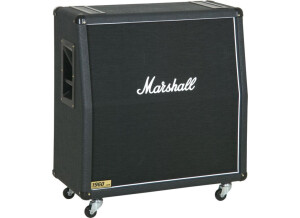
    I acquired this can in the late nineties. I ran this can for about ten years before selling it off (more on that later). My musical stylings were varied over the years: hard rock, metal, pop, punk, rock, atmospheric...but mostly aggressive and loud. I had started playing in 1986 and had a Peavey 4x12 back then, but along the way I downsized to 1x12s. Once I got a live gig happening, I realized I really wanted to push some air. If you're able to play at loud volumes over 90dbs, a 4x12 can really make your chest rumble and your pants sway in the awesome power. I figured all my heroes had Marshall, so time to step up to the big time. Yes, this cab really worked well for me; I played countless practices and dozens of gigs and the cab never failed me- it was a rock. As the years went on, I started seeing different companies putting out products that appeared to be higher quality (based on reviews). People spoke of the abrasive nature of the speakers in the Marshall...perhaps mine was broken in, because I really enjoyed the sound. Perhaps in hindsight it was a bit sharp sounding? This made me want to upgrade...I eventually landed Marshall AV, which sports a higher price tag and v30 speakers. I had the 2 cabs side by side for awhile. I honestly didn't hear a HUGE differnce, perhaps the v30s were a bit warmer and pleasing. Hard to really judge, since the av was a slant and this cab was straight. I enjoyed having 1 cab at home with me for recording, and 1 cab at our band's rehearsal (yeah, no more transporting!). In the end, my band blew up and I realized that I no longer needed 2 4x12s, so this standard cab was sold in order for me to keep the av. A great feature of the cab is the ability to go mono or stereo. The mono was utilized for high volumes with 1 amp. The stereo was great for using 2 amps at the same time, creating a huge monster tone. Or, use 1 side of the stereo setup to reduce volume. Speaking of volume, the only times I could really pound the decibals was at rehearsal. Live shows at local clubs/bars had the soundguy tell me "turn it down" to the point where the 4x12 was ridiculous; the quiet volumes could have easily been produced by a 2x12 or even 1x12. However, hard rock/metal doesn't really sound right with smaller cabs, so there is the quandry. Also, when we gigged up in New York City, I downright felt foolish bringing my 4x12 on stage- everybody had a smaller cab! It is important to note the situations you may encounter. These days I have an oversized vertical Mesa 2x12 that sounds great. Not quite as big as a 4x12, but very close. the Mesa sound is meaner than the Aerosmith-ish tones of a Marshall, so that made it a good choice for me. Also, the 2x12 can fit right into any car's trunk, and its weight is manageable. I still have a large cab at home, but I don't see it ever leaving the home studio. If I had to do it again, I'd probably stay away from the pricier Marshalls. As long as you find a cab that is well constructed (and plenty built better than current Marshall materials), the key is the speaker choice. I hate to give this a bad rating since it served me well, but I'm finding Marshalls are priced too high and at this point you're paying for the name. Your mileage may vary.

  • « Faithful reissue of the classic. »

    1 Channel, 100 watts, 4 EL34's, Standard EQ section with master volume, FX loop with true bypass switch, 4/ 8/ 16 ohm speaker out selector UTILIZATION The JCM800 should need to introduction. There are so many amps based off of its design, it's not even funny. They have been a platform for modifications since the early 80's. Very easy to dial in for that classic rock sound. It's one of those amps that will work for anything. Toss a boost pedal in front and it can do metal. Back off the gain and it does a great clean. The reissues have a built in FX loop, which you can bypass, which makes the reissue the one to get in my opinion. There were many many variations of the 800, but the reissue is a recreation of the famed vertical input 2203. SOUNDS Soundswise, this is a very versatile amplifier. Sure it only has one channel, but you can get anything for crystal clean to classic rock overdrive. The thing I really like about this amp, is that whatever guitar you use sounds like itself. Some amps tend to make every guitar sound kinda similar, but the 800 really shows off each guitar's personality. A Strat will sound very stratty, a les Paul will sound very Les Paul like. The 800 takes boost pedal very well, which is a huge plus. It can also sound killer very clean, which I honestly didn't expect. And it shines with a Strat! My only real complaint about this amp is that it tends to be on the brighter side. I like amps to sound great with everything set at 12 o'clock (except for maybe gain and volume). With the 800, I find myself turning off the treble and turning the presence way down. I do tend to like amps that are somewhat dark, but not too dark. The FX loop is good, but you tend to loose a little bit of 'something' when it is engaged. It's not a deal breaker or anything, but I would definitely not keep it engaged if I wasn't using it. The amp itself is very loud. It's 100 watts is definitely loud. OVERALL OPINION Overall, this is a very solid amp. It's an instrument in of itself and is excellent at showing of each of you guitars' unique voice. I have wanted on of these for years and years, and I am very excited to have on in the collection. I own lot's of great amps, and the 800 will remain in the stable.

  • « Great cab, but somewhat pricey »

    I have owned a ton of speaker cabinets in my day. I currently own 6 4x12's, 3 of them being Marshall. The 1960TV is a great cabinet. It looks amazing with it's 'blues breaker' like grille cloth and small logo. If you didn't know, the 1960TV's and 1960AX's are the Marshall cabs that come with Celestion Greenbacks. I am honestly not a huge fan of the Greenbacks for the style of music I play (heard rock/ metal), but they would sound great for classic rock. My issue with them is the 75Hz bass rolloff. Even if I am toiling in bass guitar territory below that, I would like a more extended bass response. They do have very nice mids though! Construction wise, the cab is built as well or better than the other 1960 cabs. Actually, my TV has a plywood back panel as opposed to a particle board one, so that's a huge plus. Marshall is pretty cheap with some of the components, such as plastic handles, crappy casters, thin tolex, and plastic jack cups. Aside from that, they are pretty awesome. They tend to sound a little more loose than say a Mesa 4x12. One thing that bugs me about the cab, is I never really heard much of the extra bass that the cab promised. Sure, it is taller, but it doesn't sound bigger or anything. To be honest, I think Marshall got the 4x12 cab size down the first time. I would, however, be interested in a TV with a straight front. That would look killer! Overall, this is a great cab. But it really isn't that much different than the 1960's sound wise, aside form the Greenbacks. You can find 1960 cabs used for very cheap, so I really believe you are paying for the aesthetics on this one more than anything.

  • « Not a bad Marshall. It was OK - but NOT a JCM800. »

    Solid state, 80 watts of power (too much for a 1x12, imho). 2 Channels, one which is tube preamp'ed for gain. I don't remember if it had a cab / out jack... I might have mod'ed mine with one if I remember correctly. 1x12 Celestion speaker, white label I think. UTILIZATION I used this amp as a 'backup' for a few years, and while the controls never really bothered me it was super heavy and a big PITA to haul around. I don't think it had a Cabinet out jack, which ticked me off at the time. SOUNDS Sounded pretty good, I don't agree with some reviewers that it sounded horrible. You would be hard pressed to find a Marshall that sounds like dog droppings. The tube in the preamp stage made the dirty channel OK, but it was still lacking something. Maybe because they used an ECC83? instead of a 12AX7 or something. The cleans were merely OK, and not even close to my Fender tube amps. OVERALL OPINION It was OK. As a backup. Wouldn't want it as my 'main rig' though. I could play over the drummer, and FX sounded good through the clean channel, but not GREAT. It was kind of unreliable too, but that's probably because mine was used so much, and for a great number of years before I owned it. After replacing some POTs, and getting it serviced though, it was a good backup amp.