Log in
EN
FR

Fender Guitar amplification

418 products found

Categories
Series
Filter
Sort by
Fender
Evaluation
  • Reviewed or not
  • Editor’s award
  • Reviewed by Audiofanzine
Availability
  • Available or not
  • Sold new or used
  • Sold new
  • Sold used
Must-have products
  • All products
  • Flagship products
  • Best rated products
  • Hot products
  • Popular products
Price
  • Freeware
  • Low-cost (< $300)
  • Mid-range ($300 - $950)
  • Premium (> $950)
€
Clear
Sort by
  • Popularity
  • User ratings
  • Price - low to high
  • Price - high to low
  • Used price, increasing
  • Used price, decreasing
  • Name (from A to Z)
  • Name (from Z to A)
  • Added on
Sort results
  • Popularity
  • User ratings
  • Price - low to high
  • Price - high to low
  • Used price, increasing
  • Used price, decreasing
  • Name (from A to Z)
  • Name (from Z to A)
  • Added on
Filter results 418 results found
Brands
Evaluation
Availability
Must-have products
Price
  • Freeware
  • Low-cost (< $300)
  • Mid-range ($300 - $950)
  • Premium (> $950)
Show results

The best Fender Guitar amplification reviews

The reviews Audiofanzine members found the most helpful.
  • CheapHaendel's review

    - Solid-state amp - 100W: very comfortable at home, enough for rehearsals. - 1 12'' speaker - think about it - 1 input, an effects loop, a headphones output - Clean channel controls: 1 Vol, 1 Treble, 1 Bass - Lead channel controls: 1 Vol, 1 Contour (acid color=>fat), 1 Treble, 1 Bass, - Reverb UTILIZATION - Very easy to use, you know right away what to do without the need for a user guide for basic traditional usage. - In terms of sound, I use 98% of the times the clean channel: I was thrilled to quickly find a basic sound that suits me perfectly. I only use the (effective) controls to adjust this sound depending on the situation (place of the performance, new members in the band...). - In terms of gain: I use it only 2% of my time, I admit that I haven't been able to find a sound that pleases me. I find the settings too "clichéd." It really lacks a mids control. The contour control allows you to very easily work with colors ranging from very fat heavy metal sounds to acid/metallic distortions from the '70s with a gain setting - transistor - that goes from crunch to "too" distorted. - The reverb: effective and reasonable up to the 3 mark (from 10). Very nice color in my opinion and OK at 2! Apart from that, the amp has a lot of presence and it is fine for a solid-sate amp, the difference with a tube amp are the dynamics. I use it as follows: a guitar that goes through a multi-effects and then to the clean channel My trick: the settings are not progressive. I use a volume pedal that makes the use of the amp much simpler. I have never noticed huge level differences (dynamics, harmonics or reproduction) with the control at 2 with and without the pedal 1/2 or 1/4 of the way up. The mark I give it refers to the quality of the clean channel!!!! SOUNDS - I love the clean channel, which is THE foundations of my sound and that I haven't found in any other solid-state amp. Long live the 12'' speaker: warmth and ease of use. - See above for the sound according to the settings. OVERALL OPINION - Bought in December 1996, I've used it on average 10 hours per week ever since. - I haven't found a similar sound from a solid-state amp with these dimensions, power and price!! - I love the clean channel: I can't say it enough!! - It has never broken down, no need to even change a single jack, nothing!!! It's the best. - Quite easy to transport (less than 44 lbs/20 kg I think): on the subway... easy to fit in a car. - It's great at home, but it might be somewhat limited for concerts!! Value for money: in 1996 it was an amazing value for money. For that price, I think I would still go for it today. Would I change it? I've thought about it, but changing to a tube amp to get more character and options (2 speakers, a reverb, an effects loop) is a real investment: I would pay dearly the difference given the advantages it would mean to me. The overall mark is based on the use I give it, considering it's a solid-state amp with less than 100 W!

  • « Sparkly cleans on the go »

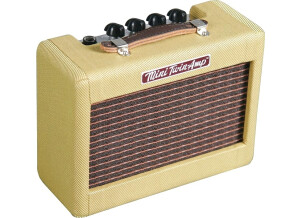
    - Controls for volume, treble, bass, speed, and intensity - Analog tremolo - 2 inputs - 10 inch speaker - watts - All tube circuit - Tube rectifier - Red Jewel light UTILIZATION Hard to find a more usable amp anywhere. Not even a standby switch, just flip it on and you’re good to go. Like most old fenders, here isn’t a whole lot you can do to make it sound bad short of dialing a frequency out completely. I picked one of these up after getting tired of moving lugging my Bassman down icy steps in the winter. The tiny combo sounds incredible and is a lot easier to move. Never had any reliability issues whatsoever. Could be a little louder, but then again, it is what it is. SOUNDS Sounds just fantastic. I plugged it in and had to buy it. I’ll be honest, the built in trem (incorrectly termed vibrato) is probably the coolest sounding thing on this amp. It just shimmers and sparkles in a really musical way that I’d never heard replicated before. It’s more of a glassy fender clean than a warm or round sound. Sag from the tube rectification is really evident at higher volumes, and really brings a lot to the tone. It’s worth mentioning that with single coils you are going to have a hard time pushing this amp into overdrive even with the volume maxed out, it’s more of a clean platform. OVERALL OPINION It would be difficult to ask for more in this tiny amp. Sparkly Fender cleans, incredible sounding tremolo, tube rectified, and as pretty much as portable as it gets. For reference, mine is a 1964. I wouldn’t say this is the be all and end all of amplifiers. For what it is meant to do, it’s great, but I’d be surprised if that is all you need out of an amp. The Princeton Reverb models seem to have exploded in price, so this is a much more reasonable option (and arguably a better sounding/more pure circuit). The blackface ones sound killer, but keep an eye out for a silverface with vertical lines down the front panel, it’s supposed to come pretty close.

  • « Solid build solid buy »

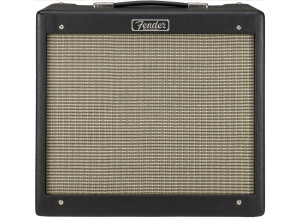
    This may be one of the most heavily used amp that has ever been created. The Fender Blues amp is such a great little amp and the price point for the tube amp is fantastic. Many players have bought into this little amp because of the aggressive price and the just the way that it sounds. It has a dark tone compare to a plexi or a Marshall 800 that really compliments the character of a Fender Stratocaster . Since the Strat seems to be on the thinner side of guitars the darker tone gives it a more robust tone that accept pedals really well and sustains easily. Fender Blues Junior III 15-watt Combo Guitar Tube Amplifier Features at a Glance: * Amplifier type: Tube * Output power: 15 watts * Speaker: 12", 8-ohm, 50-watt Fender Lightning Bolt speaker by Eminence * Output impedance: 8 ohms * Preamp tubes: 3 x 12AX7 * Power tubes: 2 x EL84 * Rectifier: Solid state * Channels: 1 * Controls: Reverb, Master, Middle, Bass, Treble, "FAT" switch (footswitchable), and Volume * Effects: Spring reverb * Speaker jack: Yes (external speaker jack) * Covering/grille cloth: Black textured-vinyl covering with Blackface-style black/silver grille cloth UTILIZATION Detail Type Tube Number of Channels 1 Power 15W Speakers 1 x 12" Fender "Lightning Bolt" Speaker by Eminence Effects No Effects Reverb Yes EQ Treble, Bass, Middle Amp Modeling No Amp Modeling Number of Models 0 Number of Tubes 5 Preamp Tubes 3 x 12AX7 Power Tubes 2 x EL84 Inputs 1 x Instrument Outputs 1 x Speaker Footswitch I/O Yes Effects Loop No Height 16" Width 18" Depth 9.18" Weight 31 lbs. SOUNDS They have updated the gain sounds from the previous models. The Blues ll has actually a usable gain to which the previous was about as useless as the day old coffee. Now you don't need a distortion pedal if you don't want because the distortion from the amp is very tonally responsive and pleasant to the ears. I like this amp with either a Superstrat or a Charvel. They uses the lighter bodied woods such as ash, maple, and alder which blends well with the complexities of this amp. Since this amp tends to be a darker amp the lighter woods compliment each other quite well. OVERALL OPINION For the price of some distortion pedals and effects pedals you could own this amp. At new these units come in at around $500. Not a bad price for a nice little combo tube amplifier. I recommend this amp to anyone who needs a good practice amp or a solid bedroom amp. At 15 watts it might not get you to overpower a band so you would need to up it to the Hot Rod series if you need ore power but similar voicings.

  • pdecirce's review

    The Fender Super 60 is an all-tube 12'' speaker amplifier, manufactured in the US &quot;Rivera&quot; era of Fender amps, which means the early 90s and also sporting their fiery red knobs. 2 ax7 Pre-amp tubes, 26L6GC post tubes. Rivera went on to form his own amplifier company, but the one's he designed for Fender are well known. This amp is a hybrid, sort of a more powerful Blues amp, with two channels of tone, one clean and one driven. The clean tone boasts a bass, mid and treble setting; the drive channel has volume and tone. Both channels have a sweet dial reverb and a dial presence knob. The pedals I've found for it pass the signal back and forth between channels only; the reverb has to be dialed in. This is a fundamental weakness in the design of the reverb, as it sounds really lush and full (and sensitive; 3 is like 'church-room' reverb) but you can't cut it off for a solo or something. It has 1/4'' ins on the front and the usual direct outs and effect loop 1/4''s on the back. It has the solid grey grille with one 12'' speaker, red knobs and the &quot;Super 60&quot; in cool cursive. Oh by the way the thing weighs in at a hefty 55 pounds, so do what I haven't and invest in an anvil road case. UTILIZATION The set up is as easy as any combo, plug in and you're ready. You can fool with the split effects patch in the back but I just use my pedal board in the line. I've been using this as my stage amp for all of 2007 and 2008 and at any coffee-house or bar level this amplifier it's sufficient. The two channels have a shared eq which can be limiting. I've been able to stay on the clean channel all night, using volume + tube drive pedal to get a kind of rich bluesy distortion, however if you do use the overdrive channel, be prepared for bone-crushing volume and distortion. It's almost unheard of to use 60 watts into one speaker nowadays. I just tapped the knobs on the O/D channel and ran my guitar through an '81 MXR Distortion+ and a mild setting on an Ibanez Tube Screamer and came out with the most amazing &quot;Sabbath&quot; meets &quot;Deep Purple&quot; tone, it split my drummer's face! However, all is never perfect in using a vintage amp like this...read on. SOUNDS The bottom and top of the amplifier are relatively thin, meaning the bassy tone and the trebly. The fender speaker has a slight muddy feel at high volumes in general and this amp is no exception. The treble can take more before it 'thins out' and starts to sound cheap. The amp is extremely versatile. It can play picky country twang (try a Tele with a good chorus pedal), clean channel on 5 and crank the presence. It can handle heavy metal (try a Les Paul with bridge pickup and a tube screamer), distortion channel on 3 and that's enough for most bars in your town. It can even handle midrangey jazz; the &quot;Fender&quot; tone is really excellent on this amp, it can often sound like some of their best lines, but requires a lot of adjustment to make really clear. I've found that by 1) killing the bass volume, 2) cranking the tone and 3) chiefing the mids around here and there you can cut through everything from horns to loud drums. But like I said, I found myself wanting when I finally got her to a festival stage. The open air swallowed up my tone and I found myself raising the volume to the point where my pedals became muddy. If you use it outside make sure it's miked AND/or the sound man knows what he/she is doing. OVERALL OPINION For the money you will pay in finding and buying one, it can't be beat. The amount of power in the little amp will not disappoint. Most money today will get you much less power. The amp can be used with other cabinets from the outputs in the back, it can handle massive amounts of drive; it may be worth upgrading the speaker to Celestion or newer Fender perhaps; and while it may not be the first choice for super loud or heavy heavy groups, it is an absolute workhorse for the loudest of blues, funk, reggae, rock and jazz. Its most interesting feature is how 'modern' the distortion still sounds today.

  • Heavyspender's review

    This is the classic tube amp of the ages. I am not sure of the wattage on this model. However, from the volume, I am pretty sure it is at least 60-80 watts per channel, of which this amp has two. With the clean or overdrive channel volume at 2, this amp is already plenty loud enough. There are two sets of stereo inputs. One set of two is for switching channel mode. And this amp came with the channel switching foot-switch included, which is great. The other set of two is for parallel channel mode. It defaults to the clean channel, and you can pull the volume knob of the distortion channel to switch to it. I guess this is useful if you don't have a foot-switch. On the back there is a foot-switch output, effects loop (preamp out and power amp in), power amp thru output, two extension speaker outputs, one for series and one for parallel. There is also an impedance selector which allows you to select between 4,8 and 16 ohms, which is very cool and makes the amp very versatile. On the front, the clean channel has knobs for volume, treble with boost (by pulling the knob), mid and bass. The distortion channel has gain, treble with boost, mid with boost, and base with boost. It also has a wonderful presence knob and a volume knob. (The one that can be pulled out to select the distortion channel.) Finally, there is a reverb knob that controls both channels. UTILIZATION This amp was bought used, so there is no manual. The general configuration, in my opinion is self explanatory as long as you play with the knobs and inputs long enough. This thing is known for the tone that comes out of it, and it has a wide array of wonderful sounds that I keep discovering from additional use! With this being a vintage tube amp and being considered a vintage &quot;red knob&quot; model, I try not to use this as much. Just power it up from time to time to keep the tubes working or if I need it to impress at an audition. I also plan on using it more primarily for recording. If I am playing stadiums, I guess I can afford to play with this loud, tone-full baby on stage more often to get more volume and that wonderful tube sound! SOUNDS This is considered a blues/jazz amp, styles which I incorporate into my playing. It is not really a heavy metal amp, but it takes pedals pretty well. However, I frankly don't remember the distortion channel being that good when I first played this amp in the nineties. But I played it recently, and I don't know if it aged gracefully, but I'll put that 2nd channel against many high gain amps today. With the gain at lower levels, you get a nice tube overdrive from this beauty. Set the gain on 10, and you have a great 70's or 80's heavy metal tone, in my opinion. To get thrash metal, death metal, or nu-metal, you will need a pedal. But like I said, this amp takes pedals well. I put a digitech death metal pedal through the clean channel, and it went from pristine heaven to absolute palm muting hell ! Speaking of the clean channel, I agree with many that it is the best in the business. I've played &quot;boutique&quot; amps that cost 3 times more, and their clean sound didn't sound any better. This baby has always been known and liked by me for it's beautiful &quot;glassy&quot; clean sound. It's got the right amount of shimmer and a wonderful thumping low end bass range. I love it, and there's probably nothing about this amp I hate, as far as tones! OVERALL OPINION My dad bought this in the early nineties. I used it back then, then sporadically since then. As I said, I used it again recently, and with a couple pots being changed, I think this baby gets better with age! I love the volume, the presence, the distortion channel, and that unmistakable clean sound! My Dad and I briefly compared this to other brands, but the glassy clean won us over no problem. Because it is considered vintage, this thing is relatively expensive and hopefully appreciating in value. I think it is worth every penny, so I would get another one if I had the budget, or if I could get one at a steal or deal.

  • « Not too bad »

    Fender music company has been known to make some great sounding amplifiers and guitar instruments. They've built a lot of great sounding tube amplifiers that have been re-issued and used all over the world. And then they'll also build some amplifiers that don't sound that great. The fender 75 is a two channel amplifier with a clean and a distortion channel. UTILIZATION 1980 Fender Model 75, 75 watt, Rivera Designed model combo amp. All transformers are original. Amp works fine. Has Hi-Lo power switch. Tubes are 6L6GC x 2, 12AX7 x 3 and 12AT7 x 2 Front panel reads left to right: Input, Input, Bright Switch, Volume (clean), Treble with pull-knob boost, Middle with pull-knob boost, Bass with pull-knob boost, Lead Drive, Reverb, Lead Level, and Master Volume Rear panel reads left to right: AC outlet, Ground, Speaker output(2), line/recording, effects in/out, output tube matching, footswitch (2), reverb tank(2) and hum balance. SOUNDS This amplifier at 75 W of power and also has a switch that can take down the 15 W if you so desire. It's a decent little amp for cleans primarily because it has a 15 inch speaker. See you get really good sharp highs and round low end tones. So that is very good for someone who plays a clean amplifier and needs that nice push with single coil guitar. This amplifier features 6L6 power tubes and three 12aX7 preamp tubes as well as a 12aT7 preamp tubes. You actually get to it so it has five preamp tubes and all. Since you have a lot of tubes in this amplifier there is going to be a lot of good to push in the time. Primarily the cleaning town because it was designed after the Rivera aunt modeling which was pretty good at the time when this amplifier came out in the early 80s. The distortion doesn't sound that great but the cleaned so if you need to get cleaning up the fire this is a pretty decent on if you can get at a good price. OVERALL OPINION I seen these amplifiers go for right around $300 or so and the used market. So if you can grab one and it's a pretty good little amplifier especially when Fender was making good so solid amplifiers in the early 80s. This is not a bad little pick up if you can find them. They are pretty easy to find on ebay so I would start my search there.

  • « Small but beefy »

    I won't mention the features again, which have been detailed by some colleagues before. UTILIZATION Personally, I love its simplicity and effectiveness Most renown amps (Vox, Marshall, Fender, etc.) always offer a simplicity that makes them effective. SOUNDS The sound is all right, I have nothing to say in that respect. A good EQ, a bit of reverb and you get the fender sound. I've had it for more than 10 years and have played it with different guitar types (Gibson SG, Gibson LP studio, Fender Standard, Telecaster) and it always sounds good. Once you have tamed it and mastered the controls, it doesn't matter what style you play, it sounds good. OVERALL OPINION For me, it's a good compromise for rehearsals, small stages and even big ones, if you mic it with an Sm57 or similar. + Perfect clean sound + Light to transport + Easy to dial in when you know the sound you want + Powerful, rated at 65 watts but it delivers more, that's for sure + The hybrid tag suits the tube preamp very well (because for me it's better than a solid-state but lacks some of the warmth a tube provides current amps, at a higher price, though.) + Effects loop and line out. - The distortion is not clean enough (if you crank it up it turns into noise), so, as someone already wrote before me, it's not the best for metal. - It's too powerful (like many amps, the volume is graded from 0 to 10, at 2 it already makes the walls tremble, at 6-7 the house falls down, afterwards there's nothing left, even if you can go to 8 or 10). The solution is a volume pedal to fix the problem.

  • Dish1's review

    See other reviews where everything is detailed. Big power reserve, comprehensive connections (speaker, send return, direct line). Three channels, controls on the front panel, like on a Deluxe reverb or a Twin. Nice black color. The pots are a bit cheap, like the handle. Grey speaker covering, Fender Made in USA logo. Rather light (big plus!). Footswitch included. Nothing negative in this regard. UTILIZATION Nothing too complicated. SOUNDS Its biggest advantage is the clean sound: ultra simple settings, Volume, Treble, Mid and Bass. It unquestionably has the Fender touch: Brilliant and responsive sound — a classic. This Performer is really worth trying out, at this price point it's impossible to find something better The lead channels are quite usable, the tube plays well its role. These are my dialings: - Clean: Treble set to 5, Mid to 5 and Bass to 7. - Distortion: Gain set to 2/3 on the rhythm channel, 5 on the lead channel, Treble to 5, Body to 3/4 and Bass to 6. You only need to adjust the power with the volume. - Reverb at 4 (I agree with the other reviews, it's excellent). I get a nice clean sound, but it's not aggressive, since I reduce the Treble. A very nice crunch. Reading some reviews, I have noticed that certain lucky owners of the Performer are annoyed by the power of the amp. Don't worry, every problem has a solution! You only need to link the Line Out and the AUX Send on the rear. And, oh miracle, the Effects Mix pot on the front works as a Master control! What's more, you will be able to use your amp at home without risking bothering your neighbors. And the sonic capabilities of the amp also increase by mixing the Master you created with the volume and gain controls. Isn't life nice? The pros: I use it with a cabinet that I made myself with a 15" Eminence, which boosts the low end!!! (Careful: 8 Ohms min) Don't forget that it's solid-state, meaning that the sound is almost the same, regardless of the power used. On a tube amp the sound changes, evolves, benefits when being pushed. This Performer is generous but it doesn't have the compression nor purity of a tube amp. It has a somewhat clinical side, which is characteristic of solid-state amps. OVERALL OPINION I solved the speaker issue, the amp's only drawback. For $325 it's an excellent deal. My advice is to add to that around $120 for a good speaker or cab with a 15 incher: Is there an amp capable of rivaling with it in terms of sound quality and connections, but also aesthetically, for $450?

  • moosers's review

    The Fender '57 Champ is small tube based guitar amplifier designed for practice and recording purposes. The amp is pretty tiny, consisting of only five watts of power and a single 8" speaker. The amp has two 1/4" inputs for plugging your instrument(s) into. UTILIZATION There is simply nothing that you need to know to operate the Fender '57 Champ. It only has a volume knob to control how loud your sound will be, and nothing else at all to control your tone. While this makes using the amp a breeze, I do wish that there was at least some EQ to work with here, as beyond the volume control and the controls on your guitar or effects pedals, there isn't anything that you can do to change your sound within the amp itself. A manual surely isn't necessary to have to operate this amp. SOUNDS For such a small guitar amp, the Fender '57 Champ can absolutely wail. It can get pretty loud, but since I've only used it for practicing and recording, I've never needed to have it on more than five or six. Although it can get pretty loud, I definitely wouldn't recommend using it for live shows as it isn't loud enough for that sort of use. The amp sounds incredible when using a Fender guitar like a Stratocaster or a Telecaster, as nothing beats the Fender on Fender sound in my opinion. The only downfall of the tone is that there aren't more parameters to work with here. OVERALL OPINION As far as practice amps go, the Fender '57 Champ is certainly up there with the best of them. It is built piece by piece after the classic 1950's Fender amps. However, since this is a replication Fender will charge you a whole lot of money here for a five watt amp. For this reason, I'd encourage those interested in getting an amp of any type to stray from this and get something bigger that has more versatility. However, if you're looking for a collector's item that is nonetheless a great sounding amp to be used for practicing and recording only, you can't go wrong with the '57 Champ.

  • « Very good clean and distortion sounds »

    Solid-state amp BUT it has a tube for the distortion/drive, your choice. Line out (8Ohms mini), send return, loop volume control, footswitch input (3 buttons on the pedalboard, to enable the distortion and choose the distortion (there are two), plus activating the reverb). Spring reverb. Not bad already. USE Easy to dial in, it features bass, mid and treble controls for the clean channel and the distortion channels, a reverb control and a VERY sensitive volume control. The sound is five times as loud when you go from 1 to 2 on the volume control! It will rock you off your feet. SOUND It's fine for my music style. I have a 50W all-tube ENGL amp (screamer) that I keep in my rehearsal room. I wanted an amp to play mainly clean sounds, at home. I'm satisfied, the clean channel faithfully reproduces the sound of the guitar. It doesn't have that hi-fi sound often associated with solid-state amps. It's deep, crystal-clear, the reverb is quite all right. As I already mentioned above, be careful with the volume control or you can end up deaf, it's über-sensitive. 100W that won't make you blush. The speaker is an original Fender. The amp is made in the USA. I play Fenders (Mustang and a Tele Aerodyne) and it sounds awesome, not as warm as a tube amp, true, but very satisfying. The distortion sounds are also up to the job, not muddled, rather aggressive, you only need to work the EQ a bit and you can get convincing sounds. The two distortions: One is a tad more nervous than the other, which is more "acid," while the other is more of a "fat overdrive." Independent distortion and clean volume controls. As for the loop, it does the job. I play with some delays (dd20, Memory boy and VS h2O) and a chorus, the sound is well respected and not puffed up. OVERALL OPINION Yeah, okay, I've had it only for a couple of hours... I also have an all-tube amp (ENGL), a small Epiphone combo (Valve junior) and I wanted a not-too-expensive amp to play clean guitar.. I'm very satisfied with the clean sound, it's a real treat. It's solid-state amp in the age of hybrids and modeling amps, of the multiplying of tube watts (as Jesus did with the loaves of bread). The distortions aren't icky at all, they are usable., I'll do a test with my band to see how the sound comes through in a mix. For me it's a very good tool, a good Fender, made in the US and, for the price, it would've been a shame to have missed it.

  • « Excellent reissue with modern construction techniques »

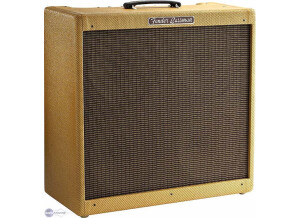
    Although the Bassman series dates back to 1952, The 5F6 Bassman circuit, introduced by Leo Fender in 1959 in 4x10 combo format, is widely considered to be the beginning of guitar amplification as we know it. As its name suggests, it was originally designed with the bass player in mind, but it caught on with guitar players to the extent that it's scarcely even considered a bass amplifier. It was so popular that even Marshall copied the circuit into what became the very first Marshall amplifier, known as the JTM-45. In 1991 Fender saw fit to reissue the Bassman as the Fender Vintage Reissue '59 Bassman LTD. This 50 Watt reissue features a lacquered tweed covered, finger-jointed pine cabinet, 4 Jensen special design speakers, and internal bias pot to adjust bias on the two 6L6GC Power tubes. In keeping with the original, the '59 Bassman features 12AX7 preamp valves, a 5AR4 rectifier tube, and the true 5F6 circuit. There is no effects loop or built-in reverb. UTILIZATION The '59 Bassman sounds excellent right out of the box. It has controls for volume, Treble, Mid, Bass, and Presence. Four inputs give you normal and bright inputs at two different gain levels. This is where the infamous "jumpering" mod was born, by running a short patch cable from one input to another, to loop two gain stages together. SOUNDS Unlike most Fenders that succeeded it, the Bassman uses a cathode-follower driven tonestack, which adds a certain compression to the preamp tone that is part of the Bassman charm. The Bassman is clean without being spanky, and smooth without being overdriven. The touch-sensitivity and dynamics are almost unparalleled. With the stock speakers, its rather easy for the Bassman to get harsh, so keeping the Presence control at a moderate level is a good idea. The Bassman adores pedals. A tubescreamer pushes the Bassman into a woody, organic roar that is neither forced nor aggressive, while a hard pick-hand attack evokes the natural compression the amp encounters from the slow tube rectifier. There is plenty of volume on tap with the Bassman, and most will not need to crank the amp past 4 (it goes to 12. Take that, Nigel!) even in most outdoor venues. OVERALL OPINION Construction of the '59 Bassman LTD is rock-solid, and a worthy of respect in a world where tube amps are now done on automated assembly lines with machines. All of the amp's guts are easily accessible, thanks to the rear cabinet panel over the chassis. This may or may not be a good thing, especially for those who are uneducated, as it makes poking around in a high-voltage circuit ridiculously easy. Most guitar players who are familiar with tube amps know better, however. The speakers are easily upgradable, and one will find a wealth of info online about different aftermarket speaker models that could enhance the Bassman's tone or help reproduce the nuances of the original. To that end, the defining difference between the '59 Bassman Reissue and the original '59 bassman are the speakers, transformers, and circuit construction, as the original used tag-board construction and the reissue uses the now-common PCB. But whatever "mojo" is held off from the reissue due to these differences is rather negligible. The '59 Bassman Reissue is a worthy and faithful reproduction that many, including myself, are and will be proud to own.

  • « Small amp, BIG sound »

    Solid State - 65 Watt UTILIZATION Took about 30 minutes to get the tone I wanted. SOUNDS Awesome Fender clean channel, Overdrive decent, but I'm probably gonna run a Big Muff through it. OVERALL OPINION I couldn't be happier for the price I paid ($100 USD). Got it used from some guy on craigslist. The clean channel on this amp has some of the best tone I've heard come out of a solid state amp. The overdrive leaves a little to be desired, but can be fixed with a pedal of your choosing. The spring reverb has that classic Fender sound. Don't be fooled by the size' this little thing is LOUD. I live in an apartment and had the volume between 1 & 2 and thought I was gonna get a noise complaint. It took me about 30 minutes to set it up for the tones I wanted. Great amp for the money!