Log in
EN
FR

Dunlop Guitars

341 products found

Categories
Series
Filter
Sort by
Dunlop
Evaluation
  • Reviewed or not
  • Editor’s award
  • Reviewed by Audiofanzine
Availability
  • Available or not
  • Sold new or used
  • Sold new
  • Sold used
Must-have products
  • All products
  • Flagship products
  • Best rated products
  • Hot products
  • Popular products
Price
  • Freeware
  • Low-cost (< $20)
  • Mid-range ($20 - $40)
  • Premium (> $40)
€
Clear
Sort by
  • Popularity
  • User ratings
  • Price - low to high
  • Price - high to low
  • Used price, increasing
  • Used price, decreasing
  • Name (from A to Z)
  • Name (from Z to A)
  • Added on
Choose a category
Selected category: Guitars
Sort results
  • Popularity
  • User ratings
  • Price - low to high
  • Price - high to low
  • Used price, increasing
  • Used price, decreasing
  • Name (from A to Z)
  • Name (from Z to A)
  • Added on
Filter results 341 results found
Brands
Evaluation
Availability
Must-have products
Price
  • Freeware
  • Low-cost (< $20)
  • Mid-range ($20 - $40)
  • Premium (> $40)
Show results

The best Dunlop Guitars reviews

The reviews Audiofanzine members found the most helpful.
  • « Great picks »

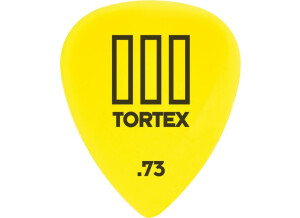
    These are great picks. I love the feel and grip of Ultex. It's easy to grip, doesn't slip, and lasts a while. These picks are great. I used the 1.0 millimeter before switching to 1.14 millimeter. They just weren't thick enough for me. Other than that, these are stellar picks. I prefer these to tortex. They're much easier to keep a hold of, and they don't rotate while playing. They're picks, so they're not expensive. They're about the same price as the tortex, and I like them better. They bounce back and don't bend as much (which I like) and they just feel better. I use these mainly for playing Thrash, so they take a lot of abuse. They last a while. They don't break down or wear down easily. They also handle high speed, alt picked riffs and shredding very well. The grip on them is great. They don't slip while playing, and are easy to hold. They're made of a special plastic designed to be flame and solvent resistant. These picks also hold up well when pick scraping. Other picks get notched when you pick scrape a few times. These do, but not as badly as others I've played, which is a big plus for me. The color can make them somewhat hard to find if you drop 'em, but there's nothing you can do about that. As with every pick, you will drop them occasionally. With their opaque yellow color, it can mean a bit of searching to find one, but that's not a real issue with the way the play or how comfy hey are to hold, so I can over look it. All in all, these are, in my opinion, some of the best picks I've tried. I'm never going to another brand of picks again after playing these. Dunlop have, as usual, made some great picks.

  • « My first slide. »

    Let me state one thing off the bat, I never play much slide guitar. I find it a great tool to have in your bag of tricks but I never used it enough to consider it more than fun. This was my first slide. It was the most readily available slide and when I showed interest in playing a little slide guitar my instructor sold me this one and said you can not go wrong with it. He was right. The sound from this glass slide was very appreciable. It had a warm nature to it with a bit of bite on the top side. I however did find it got very uncomfortable fast as I sweat more than a bit. It never really felt right on my finger. At the time I had only two guitars and neither were really suited for slide playing but this slide found its way into a bit of my writing at the time and I was pleased with it. Unfortunately these do break rather easily being they are made of glass. I should have not stored it on top of my full stack because when it fell it shattered. I should have replaced it with another one but being an experimenter I chose to try a metal slide. The glass slide proved to be a better match to what I was looking for tone and feel wise and was soon replaced after the metal experiment. If you are looking for that classic slide sound this is where you will find it. Glass has a warm but well defined sound with just enough brightness to have it cut through. I found that a touch of powder solved my slippery sweat problem I experienced with the glass material. Just be sure to take care in its storage because they are fragile and do break easily. Over the years I have found slides of other materials and no longer use either type of slide but the glass variety was my second favorite sound as far as slides go.

  • « The first Crybaby. »

    This is the first of what seems like an almost endless line of Crybaby effects from Dunlop. Made as simple as can be there is an input for guitar and an output for connecting to your amp. It produces a Wha sound just as the name implies that kind of cycles from the "W" in heel down position to the "a" in toe down position. The only parts are the rocker pedal and the switch under the front of the pedal which turns it on or off. UTILIZATION This is most likely one of the simplest effects to understand but getting it right with your playing will take some practice. This is truly a plug and play pedal because there is nothing to set up or alter. The pedal controls the sound of the filter and honestly can only be learned and mastered through use. SOUND QUALITY This version of the effect is used on guitars. I'm sure other instruments have made use of it in the past but these days there are ones specifically tailored to the frequency range of lets say a bass for instance. I would see no reason to buy this version for use with anything other than a guitar. This unit will suck some of the sound out of you guitar when not in use and if you are driving a huge pedal board you might want to boost the signal along the line after this unit. When in use there is no denying the signature sound of this effect. Aptly named a Wha-WHa it literally causes that sound to be coupled with your playing. It can be used in rhythm as well as lead playing and when properly applied will add a very desirable emphasis to your playing. OVERALL OPINION This is the standard wha sound and I do prefer many of the alternate models to this one. It is the tried and true wha so money spent on it is well spent in my opinion. The thing is built like a tank and is capable of kicking the butt of any other pedal in a cage match. The major down sides to this pedal are based in its older design. It turns on it the toe up position and starts in the "a" instead of the "W" portion of the sweep. The button can tend to also add a little "pop" into your sound when hit. The worst however is that the pedal itself could be designed to feel a bit more comfortable if they used an updated design instead of the antiquated pot but I guess it would no longer be original then.

  • « Excelent fretboard cleaner and conditioner. »

    There are so many varying opinions on what to use and not to use to clean a fret board. Let us start by stating that this product is only to be used in certain situations. Only use this on unfinished porous fret board wood such as rosewood. Never ever use this near any polyurethane or nitrocellulose finishes. It will deteriorate them. Also be very sire to follow proper cleaning guidelines before trying to use this product. It is not made from lemons but a petroleum distillate and if used improperly it can destroy finishes and loosen glue. OK with that all being said let me tell you that there are very few alternatives to this product that I would suggest over it. It does wonders for cleaning the grime off of and out of the fret board that our natural oils and sweat leave behind. Secondly it provides these woods with an essential infusion of oil that they need to stay healthy. Many people do not realize that when a rosewood fret board starts to get that very open grained look to it or you start to notice an ashy grayness to it that it is in desperate need of help. Left in this state for to long the wood will dry and possibly crack causing a slew of fret board related issues. Use of this product is simply. Carefully apply it in small well placed doses, wipe it with one cloth, and then sop up all the residual oil promptly. It only takes a few seconds for the fret board to get replenished and done properly will ensure the long life of your prized instrument. The only reason I took points away from this product is I am not a fan of the applicator. I would rather suggest using a linen type cloth to apply the product and clean the grime off before removing the excess. I find that the applicator can be a bit unpredictable and I would rather make a mistake on a cloth than on my fret board.

  • « A decent polish with long lasting results. »

    The Dunlop Formula 65 polish and cleaner is designed to be used on guitars and basses with a polyurethane finish. As with any product of this nature you should first dust off any large particles, like pick dust debris, which may mark the finish first. It is designed to be sprayed on a high quality cleaning cloth and applied to the body of the guitar. Then flip the cloth and wipe the excess off which will also buff the finish to a shine. It can also be used on fully finished necks as long as they have been sealed with polyurethane. I purchased this product when I was unable to find my usual brand in the local guitar shop. At first I was a bit disappointed with it because it did not seem to bring out a high quality shine as my normal polish did. I did initially notice that it did clean the instrument very effectively however so I did use it again on other instruments as the need arose. It was after a few weeks that I really did take to this product. I found that although it did not provide as brilliant of a shine it had a much more valuable aspect that I might have missed if I stopped using it and just ordered my usual cleaner. The finish this provided seemed to somehow resist finger printing and that dull haze you get from a sweaty forearm on the lower bout. I also noticed that any dust or debris just blew off easily with a small puff of air. I will continue to use this product as my new go to cleaner and polish just because it saves me work. Any saved effort in my life equates to more playing time and at my age I need all the time I have left to enjoy instead of maintaining my instruments. If I need a higher gloss for any reason I can always apply a coat of my other brand but that need rarely arises and I really only care that my gear is well cared for at this point. I will stress this in caps "DO NOT USE THIS OR ANY SIMILAR PRODUCT ON NITRO FINISHES". These types of products will soften and wear away your precious nitro finishes because they never fully harden. They are intended only for polyurethane so simply make sure you know what you have before applying this family of products to an instrument.

  • « The ultimate metal Jazz III »

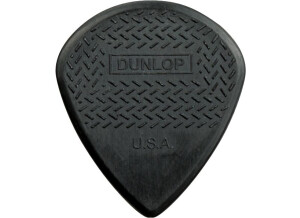
    I had been using the black and red nylon Jazz III picks for close to a decade and was extremely happy with them. While they each had a purpose that I used them for when I saw there were two new choices available I could not wait to give them a try. The new picks appear to be the same shape and size as the original however the carbon fiber variety has proven to excel in many ways above the other varieties. Like the other varieties this pick is about the size of a nickel with a pointed side. The pick is 1.38mm in thickness and has a bevel on all four sides, perhaps a touch more than its counterparts but that may be a visual deception as the pick has a very matte finish. This model of pick is made from carbon fiber and is also part of the max grip line. This pick is black, maybe a very deep charcoal grey color. This model of pick seems to fall between the original black and red nylon type in its pliability, closer to the black than the red. These picks, like there counterparts, hold there point for a very long time and wear very minimally. They leave very little debris behind even after long playing sessions. While this pick offers a high level of picking speed and accuracy like its brethren it has characteristics that make it stand out from the others. The carbon fiber variety with has raised slashes that alternate around the handling area of the pick. These are on both sides of the pick and offer a solid grip under the worst possible conditions. The carbon fiber material also seems to have a complex, thick tonality to them that the other materials do not approach. When comparing its tonality to the others varieties it is deeper than the black nylon but with the clarity of the ultex. Now the reason I find these to be the ultimate metal pick is the way they grab into the strings and the thick pleasing attack they offer. I also find that pinch harmonics flow effortlessly out of these picks with a satisfying fullness of your best hit efforts in almost every attempt. Whether it a devastating rhythm, and intricate passage requiring string jumping, or fast speed soloing these picks just sound flat out amazing. They still retain the ability to move at high speed but seem to afford the player a more definitive strike without a sticky feel off the strings. They do not move as effortlessly as the other models but have an authoritative feel when using them. If you have tried a Jazz III line before and only found them to be slippery you owe it to yourself to give these a shot. I have found this to be an awesome addition to the Jazz III line of picks. I have been a user of this variety for many years and each type has proven to find a place in my arsenal. If I was stuck with the dessert island scenario though I believe this would be the one I would want but I would miss the others greatly.

  • « A great addition to the Jazz III line »

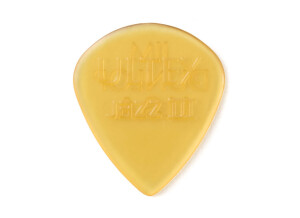
    After being a user of the black and red nylon version of the Jazz III for almost a decade I felt that while no pick would ever replace the original it was definitely worth a six dollar investment to try out these two new offerings from Dunlop. While these picks appear the same in shape and size there are noticeable differences when using the ultex model, many of which make this pick an excellent choice in a wide variety of applications. These are also around the size of a nickel with a pointed side. They are the same 1.38mm thickness as their counterparts with a slight bevel on all four sides. This variety of the pick is made from ultex as the name implies and is yellow in color. These picks seem to be the most ridged in the Jazz III line and offer little to no flexibility. They are extremely durable and will last a very long time. They also seem to hold there point even longer then the original nylon versions and create an almost undetectable amount of residue even after long playing sessions. This pick offers the player a level of speed and accuracy in picking that I have yet to encounter outside of the Jazz III line. The ultex variety seems to have a less slippery feel to it than the nylon version and may feel more dependable as a result. The added stiffness of the ultex variety adds a good dig feeling when riffing on lower strings and has a brighter attack than the black nylon without the squawk that some encounter from the red. Although it has a better grip in your hand this pick has a very glassy feel as it rides over the strings. I believe it to be the speediest of all the Jazz III picks and is unbeatable for sweeping arpeggios. This pick is at home in most guitar application. I feel however that its strong suit is soloing on electric guitar. I find this pick to be a bit too ridged for chord strumming and although the sound is nice on an acoustic it does present me with some difficulties as I prefer the pick to be a bit more flexible when I play acoustic. Perhaps my favorite use for this pick is on electric bass. The stiffness and the sound of the attack make for what I believe to be a perfect combination. Combine that with the enhanced durability and improved grip I will be hard pressed to find a better pick for use on bass. I never thought that anything would replace the original Jazz III picks and I find myself correct in that statement. The ultex version of this pick has become a go to pick for different situations and has simply made the Jazz III line a more solid staple in my life. I only purchase these pick now in the 24 pack for $10 because I am confident they will remain in my life in some way no matter what. I am very pleased that the Jim Dunlop has marketed the Jazz III in more varieties and I only hope everyone take a few dollars and an open mind to give them all a chance.

  • « A great pick in focused situations. »

    I purchased the red variety at the same time I bought the black ones as they were the only two in production at the time. I figured there were no differences between the two other than the color and I would just case them cosmetically with guitars they matched best. Well there are differences between the two some which are good and some bad but that just gives an open minded player the chance to assign them to where they will work there best. The pick is about the size of a nickel with an added point. They come with a slight bevel on all four surfaces and have the pointiest tip of any other picks I have encountered. They are 1.38mm in thickness and are said to be made of nylon but in my opinion seem to have a plastic feel when compared to the black Jazz III variety. They also have more pliability then any of the other Jazz III picks and will flex a touch more. They however are just as indestructible and also last an enormous amount of time leaving little to no debris on your instrument. Other than the color the first and most annoying difference in this variety is its slickness. Once you develop any sweat on your hand these picks will be a chore to hold onto. They are just as accurate as the black nylon Jazz III but because of the added pliability seem to fall just a step behind in speed and accuracy. The red variety seems to have a higher pitched attack which seems a bit undesirable when playing through a heavily distorted signal. On the other side of the coin the red variety of the Jazz III will offer less grab on the string and are even faster in sweep picking situations. They add a lighter touch to the higher notes and seem to flow over the strings with less effort. These picks really shine however on an acoustic guitar. They are my pick of choice for chord strumming as the attack has a higher pitched quality and the added flexibility allows for them to strum effortlessly across the chords while still affording me the accuracy of hitting only the strings I want. They are the perfect choice when voicing chords and melodies together in a solo gig. These are a good choice for use on a bass for the tone of the attack but the pliability seemed to make them a less that perfect choice. Of all the Jazz III pick these are my least favorite but only because they have the smallest amount of application for what I play. If I were more of an acoustic player my opinion would vary but I am not. I believe however that there is no other pick that will replace the red Jazz III for what I do use it for and where I use it I love it, just not enough to rate it any higher.

  • « A Hotrodded 535Q wah with cool facelift »

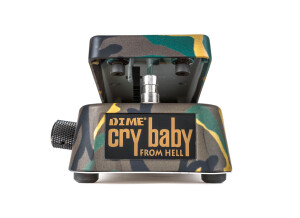
    The Dunlop DB01 Signature Dimebag Darrell wah is pretty much a 535Q crybaby with slight modifications. The fine tune controls allow the sweep to go slightly high and slightly lower, that's pretty much it. Has a 6 way rotary switch on the side to control what frequency range you want the wah to work in. Has a Q control that controls how wide the sweep is. Has a boost switch that adds up to 18db of boost. Boost knob which controls how much boost you want. And LED's to let you know if the wah is on or off as well as the boost. Has a cool look to it as well. Camouflage with grip tape on the treadle with CFH (cowboys from hell) printed on it. UTILIZATION Very easy to setup. Simple controls and for more simplistic people it can just be left at default. But for the people who like tweaking the manual is great and explains in detail how each control works and what it does for your tone. SOUND QUALITY I've been on a wah hunt for few years and this was one of my favorite. Has a very classic crybaby sound but all the tweaking options is what really makes it shine. Take a normal crybaby and it has a great sound, but only 1 great sound and you're stuck with it. This has that same 1 great sound but you get to choose if you want it to be at a higher range, lower range, wider, shorter... as well as adding in a boost to really make the wah scream. OVERALL OPINION Overall it's a great pedal and even though I ended up selling it and am now with the KH95 Kirk Hammett wah there's no doubt I'll get another DB01 again eventually. 2 wahs that should always be in a lead guitarists arsenal.

  • « Dunlop Body and Fingerboard Kit »

    This is the Body and Fingerboard Cleaning Kit from Dunlop. Inside the kit you receive 2 bottles of solutions and 2 cotton polishing cloths. The first bottle is of the famous Formula No. 65 Polish. The second is a bottle of Fretboard 65 Lemon Oil I researched what everyone was using and then realized there are a ton of different kits put out by Dunlop. The Body and Fingerboard is the simplest. Some of them offer things I never see myself using. I believe I ordered this from AMS for around $15 Everything you need to clean a guitar and nothing you do not need. I buy, sell and trade a bunch of guitars and appearance can make or break a deal. The Formula 65 does a great job at cleaning a guitar up quickly. The Fretboard 65 is not supposed to be used on maple finished fretboards. I do not know why but that is what the bottle says. Well none of the bottles have exploded on me! The spray nozzle works great and the bottles are compact to fit in my tool box. Excellent kit to keep your guitar looking brand new. A great way to protect your investments. This review was originally published on http://www.musicgearreview.com

  • « Dunlop Max Grip »

    These are the grey nylon made Max Grip picks by Jim Dunlop. They come in gauges .60, .73 and .88mm 1.0, 1.14 and 1.5 mm. They are made of a tough nylon and have a roughed up grit on them, hence the name Max Grip. If you are always dropping your picks live or when practicing, I would suggest giving these a whirl. Believe it or not my local Guitar Center was giving these away to try out. Free picks? I could not say no! No shame in asking your local shop if they are giving them away as well. Hey a couple hours into playing with these picks and they show no odd wear and tear to the pick or my strings. The only problem I see is if you like to use different angles of the pick or if you like to bury the pick in your fingers to finger pick a section of the song. If so these probably aren't the picks for you. Solid. As I said before no wear to the pick or strings. I'm sure I'll see some wear at some point, but so far so good! Well worth trying out. Nylon picks are more durable than some plastics. The grip is an added bonus. Picks are cheap, I'd highly suggest picking a pack of these up. This review was originally published on http://www.musicgearreview.com

  • « Dunlop Medium Picks »

    For a while I have been using some grey Dunlop .88mm guitar picks. They are made of nylon and have a lot of tiny bumps on them to help with the grip. I play guitar in the worship band at my church, and these grips help a lot when playing live. I bought these at Don's Music Land for about $4 for a pack of six. Like many guitarists out there, I have tried hundreds of different picks. The reason I have stuck with these picks is because of the feel of them. The raised bumps give you a superior grip to the normal flat guitar pick. I never really had a problem with dropping my picks before, but sometimes they would rotate in my hand, but the grip on these picks stops this from happening. The only thing I don't like about these guitar picks is the fact that they don't come in any cool designs. They are either solid or black. I know it's not that big of a deal, but a little design would be nice. These picks hold up pretty well. Eventually, like all guitar picks, they wear down a little bit, but I have never had one break or crack, even after playing some live shows. Overall, this picks won't make a tremendous difference in your playing, but the grip they give does help when playing live shows, or when your hands get sweaty. This review was originally published on http://www.musicgearreview.com