Log in
EN
FR

TC Electronic Guitars

160 products found

Categories
Series
Filter
Sort by
TC Electronic
Evaluation
  • Reviewed or not
  • Editor’s award
  • Reviewed by Audiofanzine
Availability
  • Available or not
  • Sold new or used
  • Sold new
  • Sold used
Must-have products
  • All products
  • Flagship products
  • Best rated products
  • Hot products
  • Popular products
Price
  • Freeware
  • Low-cost (< $80)
  • Mid-range ($80 - $150)
  • Premium (> $150)
€
Clear
Sort by
  • Popularity
  • User ratings
  • Price - low to high
  • Price - high to low
  • Used price, increasing
  • Used price, decreasing
  • Name (from A to Z)
  • Name (from Z to A)
  • Added on
Choose a category
Selected category: Guitars
Sort results
  • Popularity
  • User ratings
  • Price - low to high
  • Price - high to low
  • Used price, increasing
  • Used price, decreasing
  • Name (from A to Z)
  • Name (from Z to A)
  • Added on
Filter results 160 results found
Brands
Evaluation
Availability
Must-have products
Price
  • Freeware
  • Low-cost (< $80)
  • Mid-range ($80 - $150)
  • Premium (> $150)
Show results

The best TC Electronic Guitars reviews

The reviews Audiofanzine members found the most helpful.
  • « Great unit »

    The G Major II includes these effects: Univibe, Tri-Chorus, Through-Zero Flanger, Retuned TC Electronic reverbs (Spring, Hall, Room), New filter/wah block ported 1:1 from G-System, Reverse Delay, Intelligent pitch shifting, Modulated delays, Noise Gate, 3-band parametric EQ, Compressor, Vibrato, Resonance Filter, Phaser (Vintage and Smooth), Tremolo, Panner, Delay/PingPong/Dynamic Delay/Dual Delay, and Whammy. Essentially every effect a guitarist could ever need. It includes 100 factory presets as well as a user bank were you can save your own presets (up too 100). These presets can be programmed manually using the front panel of the G major, or with PC/Mac editing software. It can be midi controlled, and it has relay switching so you can control preamps that aren't midi programmable. This unit has two balanced analog inputs and outputs. This unit is rack mountable. UTILIZATION Setting up your own patches is pretty straight forward so I never used the PC editor. Anything you need to know about the setup can be found in the manual, its really helpful. SOUND QUALITY This unit is specifically designed for guitarists. Seriously, the effects sound amazing. They're crystal clear and pristine. I've yet to hear better effects outside of a studio. This is an amazing unit. The bypass didn't color my tone at all. I honestly can't find anything to complain about the sounds. If anything it sounds too good, meaning it can't really nail a lowfi delay type tone. But thats not what it was designed for. It was designed to deliver studio quality effect through the effects loop of a guitar amp, and it does just that. OVERALL OPINION The only reason I sold this is because I had trouble programming the midi controller I bought. I didn't have the correct hardware, and live this unit is borderline useless without a controller. If it hadn't been for that I'd still own the unit. I plan to buy another in the future. If I had to complain about on thing I'd have to say its the price point. At nearly $600 new its pretty steep. However, if you buy used its much more reasonable.

  • « Great pedal »

    This is a pedal that has just come onto the market. TC Electronics have been know for their excellent effects rack units such as the 2290 or the G Major models. These units have served many artist and musicians around the globe. Now Tc Electronics is going after the pedal market with a new lineup of classic effects sound and overdrive boxes. This unit is a chorus pedal that has a variety of usable tones for just about any chorus or flanger type purposes. You can get subtle chorus tones all the way up to a Leslie speaker simulation sounds. This is a great pedal for the money and with true bypass it makes it a must own for any chorus user. TC Electronic Corona Chorus Guitar Effects Pedal Features: 3 chorus types including SCF- and TriCorus-style effects TonePrint gives you instant access to custom pedal-tweaks made by top performing guitarists Speed, Depth, Color and Level controls let your sculpt your chorus sound from subtle to extreme Stereo I/O for added flexibility True Bypass preserves your tone ToneLock protects your presets under all circumstances Easy battery access Small footprint saves precious pedalboard space High-quality components Road-ready design UTILIZATION Detail Type Stereo Chorus Inputs 2 x Instrument Outputs 2 x 1/4" Power Supply Included No Batteries 1 x 9V Height 1.97" Depth 4.8" Width 2.83" Weight 0.66 lbs. SOUND QUALITY There so many sounds that can come from this unit. I personally like the subtle chorus tone that mixes well with high gain distortion for lead lines and such. If you crank the level up and have the the rest of the knobs around 1-2 o'clock it is perfect for lead playing. Another great feature is the tone print which is the middle switch that takes it out of tri chorus and regular chorus. You can hook this pedal up to your computer and access many artist's favorite setting's and instant download those sounds into your pedal. They are completely free of charge and a cool features to have. OVERALL OPINION At new these pedals come in at around $129, which is a steal of a price. This is such a good price for a pedal that sounds absolutely fantastic! I highly recommend this pedal to anyone who needs a good chorus pedal. It is cheap and sounds good for any style of music.

  • moosers's review

    The TC Electronic Nova System is a multi effects unit designed for use with electric guitar. It is an analog pedal, but has digital features as well. It has 1/4 inch connections and is not a rackable unit as it is a stomp box. UTILIZATION The configuration of the TC Electronic Nova System is very easy to follow and to use, which is really one of its best qualities. It is easy to toggle between all of the different effects and it won't take too long to understand how to use everything in this unit. The variations on this are endless and it is great to have so many different types of sounds within one unit. The manual for the TC Electronic Nova System is very thorough and is definitely helpful to have around while you are learning this pedal. SOUND QUALITY The sound quality of the TC Electronic Nova System is very good and is what I have come to expect from TC Electronic, as this is just the latest great piece of gear that they have issued in a long line of great products. I only use this pedal with guitar, usually a Fender Stratocaster and a '76 Fender Twin Reverb amp. All of the effects on this unit are great, but I would say I definitely like the reverb and delay effects the best, with the chorus and other modulation effects coming next. Overall, all the sounds are useful and it is great to have so many great sounding effects within one powerful unit. OVERALL OPINION I've only been using the TC Electronic Nova System multi effects pedal for less than a year, but since I started using it I have become a big fan of this unit. I'm usually not a big fan of multi effects pedals, but this is an impressive piece of gear. The price isn't cheap, but it is reasonable for what you get and is really aimed at professionals and serious players. I definitely recommend checking out the TC Electronic Nova System if you are a guitar player looking for a multi effects pedal that is compact and sounds great.

  • « Create Multi-Tracking Effect and a Wall of Sound »

    The purpose of the Mimiq Doubler is to thicken up your sound, often achieved by way of a slight chorus or slap-back echo, or more commonly (in the studio) by way of multi-tracking the same guitar part. The MIMIQ Doubler does the latter automatically and at various levels – in a very subtle way or with a lot of aggression. Dialed in correctly (which tweaking can vary whether the signal is clean, heavily distorted or somewhere between) it can sound very natural and full. The YouTube demo video within this review did not ‘dial in’ to the best effect relative to clean or distorted signals, but was set in such a way that you could hear the audible difference clearly (since YouTube often compresses the signal and you lose some of the effect desired). Certainly your playing and composition will dictate how many additional guitars you want to hear… one extra, or two or three, and that also requires tweaking the Dry, Effect and Tightness accordingly to best match the guitar’s tone, amp settings and other effects in the chain. But once you do, you can get closer to that ‘wall of sound’ from just one guitar, bringing a lot more life to leads and heavy rhythms. Depending on the settings there ‘can be’ a coloring of the original tone, although not a bad coloration as the nuances (harmonics, etc.) of the notes seem to be enhanced while making the signal sound livelier – something distorted becomes a bit more distorted and edgy, whereas pinch harmonics ring out even more clearly. And that makes sense if you consider have 1-3 guitarists in your band playing the same thing and with the same gear and settings. This is most apparent as you add more DUBS or increase the EFFECT to obvious levels rather than modest levels. Here is a brief rundown of the controls. The DUBS refer to how many additional guitar signals you want layered with the original or DRY. One DUB can make a difference, whereas three may be too much (depending on the entire scope of your sound, other effects, what effect you want, etc.). The TIGHTNESS adjusts how much variation there is in the layers, e.g., a slight warble or chorus effect vs. very precise in replication, any adjustment that can produce a different quality in time, pick attack and pitch. The EFFECT adjusts the level of the overdubs/added layers and this needs to be coordinated with the DRY knob (which adjusts how much of the input signal is sent to the outputs – full up is parity). What I like about this pedal is that it merely replicates what goes in it, which means it works for ALL instruments, and even the human voice. It thickens up anything, from synth effects to a bass guitar or when you want the vocals to stand out more during the chorus, and obviously it works great for guitar (could be interesting if added to a drum track). It also produces a 12-string guitar effect, if you so choose to dial it in accordingly (keep the tightness low and the effect high). The video with this review was recorded in Mono, but it is a full Stereo pedal, which gives an even greater thickening effect (not a panning effect) when you have left and right speakers communicating in their appropriate corners. What is very impressive is when you add other effects, such as chorus, phaser, etc., as the outcome of the Mimiq Doubler seems to super-enhance everything that much more. Dial in just right and you may find it difficult to return to a regular guitar signal as it can sound relatively ‘weak’ in comparison. Moreover, suppose you already have some songs pre-recorded and you want to make the guitar (or any instrument) sound bigger; you can run the guitar track’s signal into the Mimiq Doubler and record a new ‘multi-layer.’ Another great feature is that the pedal includes a USB port so that you can upload firmware updates when available – a pedal that keeps on giving and improving in technology over time. The Mimiq Doubler has only a few knobs, but as stated there is tweaking to do. If you shift from a completely Dry signal (with the effect off) to the pedal being on, you may create too much of a volume boost, which means keeping the pedal’s DRY turned down (unless you want that boost). Too much EFFECT, relative to how many DUBS you want can make a tone sound slightly messy (more so with a lot of distortion), even if the TIGHTNESS is set right. In that regard, it can take very little EFFECT to make a difference. As well, one DUB often is enough for lead (maybe two DUBS at times) and 1-2 for heavy or distorted rhythm. With a clean or acoustic guitar all three DUBS can work very nicely. However, three DUBS are possible in any instance if you keep the EFFECT in check and rely more on the DRY; lots of fun experimentation for the tweaker. Hooking the Mimiq Doubler is straight forward, usually placed after any distortion or overdrive pedals to give the best control over the layers or Dubs. A second option is through an amp’s effects loop, as doing so ensures a single overdriven sound entering the pedal and, thus, producing better clarity of the layers. However, you can even place the Mimiq Double BEFORE a distortion pedal to produce a lo-fi effect for more of a sludge/stoner rock sound.

  • « Falls short of expectations »

    Just got this pedal yesterday. I immediately noticed the level knob does nothing until turned past 9 o-clock then comes on abruptly. I was finally able to get a decent compression from it. It's quiet for a compressor, but it negatively affects the treble (maybe that's why). It cuts out so much treble, it kills the chime of my Strat guitar through my Mesa amp so switching it off and on as needed while playing is not going to be acceptable. I am in general a TC fan having the TC Corona Chorus and absolutely love my TC Arena reverb pedal. Maybe I just got a lemon, I don't know. Also, in fairness to TC, I have not yet tried updating or changing the Toneprint, but my first impressions are disappointing. Again the 2 factors being the treble cut, and the level knob.

  • « Versatile Features in a Small Package »

    Delay is quite possibly the most universal effect for guitarists used in different forms across all genres. When it came time to build my pedalboard I knew I had to have a delay pedal on there. I had become accustom to having multiple types of delays from my multi-effects devices I had owned. I knew I wanted to have plenty of options, but I wanted to keep it simple and small. The Flashback Delay by TC Electronic embodied everything I was looking for. The mini version was not available when I bought my delay, but I would not have gone for it since it was limited in its application. The X4 version was too large for my board, but it was tempting. Line 6 offers some very nice delays that sound fantastic, but I don’t trust the build quality of the housings and switches of their effects. I didn’t want to buy the DL4, then spend the money to get it modified with better switches. Strymon builds very nice pedals, but the Brigadier and El Capistan were not the type of delays I was looking for and the Timeline seemed like over kill. The Timeline I believe works best in a rig that has midi control, and that was not the type of board I was building at the time. The Flashback was the right size with the right type of delays. There is a wide range of delay types that are available in this small pedal, and they all sound very good. I use the mod, analog, slapback, and TonePrint, throughout my bands set. The TonePrint feature is an amazing addition that expands the capabilities of the pedal. There are four knobs to control- delay, feedback, FX level, and type. There is also a mini-switch that allows choosing between quarter note, dotted quarter note, and a combination of both, for use as the repeats of the delay. It does not have a tap tempo in the traditional sense, instead it has audio tapping. It works by turning on the pedal and holding down the footswitch for about two seconds until the LED turns off. Strum the quarter notes, then release the switch and you are in tempo. A brilliant answer to keeping the pedal small and still having tap tempo. The looper function is good, but without the extra switches of the X2 I find I only use the looper at home and not at gigs. There is a slight hum to the pedal, I believe this has to do with the fact I have it on buffered bypass. There is a dip switch on the inside of the pedal that allows you to switch between true and buffered bypass. It is the last pedal in my chain, and it is a good idea to have that pedal be buffered. I also like that the delays continue after I hit the footswitch to turn the pedal off, which sounds so much more natural than the hard stop of true bypass. The TonePrints are so well crafted that I would prefer to have more slots for them on the type selector knob. Just like my Hall of Fame pedal, the Flashback eats batteries as a snack. I believe the processing power of the pedal, and all its capabilities is the reason for how fast it goes through batteries. I am not complaining about it, because I love what the pedal can do, it just is a fact of its operation that you need to plug it in. The Flashback is a great and versatile pedal. A very good addition to any pedalboard with its small size. If you only use one type of delay, then the mini version may be the one you choose. If your delay use is more extensive, and you use a looper, then check out the X4. For my purposes the standard model works best with plenty of flexibility, and only requires a little bit of on-the-fly knob turning to keep up with my needs at a gig.

  • « Small Box With Big Reverb Choices »

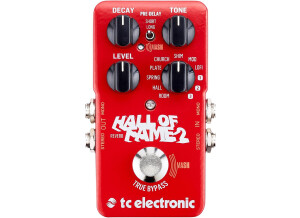
    There are three things I look for in a pedal, besides the sound it makes, and they are: size, flexibility, and simple controls. The Hall of Fame Reverb by TC Electronic has checks by all those boxes, and it sounds really good, too. It is housed in a small rugged enclosure that is only 3.5” x 5”, which is great for saving space. It has ten different reverbs available plus a spot for a TonePrint. If you do not know what TonePrint is, it is a way to custom tune the pedal. There are plenty of TonePrints available, plus with the TonePrint Editor you can make your own versions of the different reverb types. Finally, there are only four knobs to dial in your desired sound, they are: decay, tone, fx level, and type, plus a mini-switch to go between long and short pre-delay. So simple even I can navigate those controls without too much fuss. The tone knob works very well to make adjustments that can help dial in your sound. I thought the pedal sounded better than the Boss RV-5, and was more versatile than the Electro-Harmonix Holy Grail. The e-pedals on my iStomp did not have as many choices for reverb sounds as the Hall of Fame has preloaded. I also had a need for a gated reverb that was not available on the Holy Grail and iStomp. The TonePrint aspect of the Hall of Fame was really the deciding factor. The TonePrint Editor is fun to mess around with, but I haven’t made anything better than what I have heard from the professionals. The Hall of Fame is not a perfect pedal, but my problems with it are pretty minor. I wish it had more slots for TonePrints, I like those sounds much better than some of the preloaded reverb types. Although it is an option, do not run this pedal on batteries. It will eat through a 9-volt in a little over an hour. This pedal is a bit of an overkill for what I use it for in my rig. It isn’t even on my pedalboard, but sits on my amp head. I thought I would be switching through the different reverb types throughout the set, but I pretty much set and forget. I adjust the settings at sound check, then leave it on until tear down. I probably should have bought the mini version of the pedal, but I think that might be too dumbed down with the one knob control. As a pedal in a live situation, it works really well. I believe it shines a bit more as studio/recording tool. Being able to change the TonePrint as you want would be fun, and allow to create some very unique sounds. The reverb effect leaves the core of your tone alone, and adds the lushness of reverb very organically. I like the “Room” type of reverb best, but I think it captures the other types very well, too. This is a very good pedal with a couple of minor glitches. The Strymon Big Sky may be more versatile, but for the price point the Hall of Fame is an excellent purchase. Depending on how you use it you may want to get the mini version of the pedal, but I worry that you lose too many features that make this pedal shine.

  • « Very good pedal tuner »

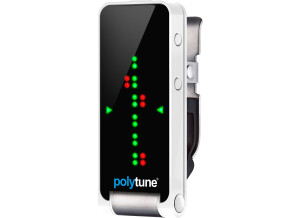
    I bought this tuner online in 2013 for about $90-$100. (Polytune White) I use it for rehearsals right now, I will take it with me onstage. It can work string by string (precise) or all strings at once (a bit less precise, but enough to tell which note is wrong). The luminosity is good. The pedal is really small, it's cool! My guitar goes directly into the Polytune and then into my effects, the sound is muted once I activate the tuner. I sometimes tune in Drop D and it works perfectly. There are other tunings available but I haven't tried them yet. The Polytune seems robust (metal), but be careful with the screen because it's almost as wide as the pedal itself. I use an adapter to power it. Do note that the power connector is on the side, not on top. This tuner is really good, I gladly recommend it. :) 9/10 for the power connector on the side and the fragile screen.

  • « A modern classic in pedal tone modulators »

    The Danish company TC Electronic is very well known for their innovative, top quality musical gear for both studio and stage. The TC Electronic Stereo Chorus, Pitch Modulator, and Flanger (Also known as the SCF) is a bit different from most stomp boxes.Introduced in the mid 80's, the SCF was TC Electronics' stake in the game of tone modulating pedals for guitar, which was a popular niche in the gear market at the time. Rock guitarists loved the sound of chorus on their soaring solos, and experimentation with flange, pitch mod, and other wild sounds was at an all-time high. UTILIZATION The SCF Features a silent (momentary) footswitch, mono/stereo outputs, independent input gain control, along with Speed, Width, and Intensity controls. The user toggles between Chorus, Pitch Mod, and Flanger using the 3-way switch located between the Width and Intensity controls. There's an overload indicator to alert you if your input gain is too high, and a jack for an external bypass switch, so that you can remotely turn the pedal on and off. As an added plus, the pedal plugs directly into a power source with no need for an external adapter, eliminating the need for a space-hogging wall wart. The controls are fairly easy to understand. Speed adjusts the rate at which the pedal modulates the sound with a given effect. Width adjusts how wide the sweep is, from 0 to 6. Intensity blends the individual effects with the dry signal to varying degrees. SOUND QUALITY The SCF is an extremely well-designed pedal in both sound and construction. It was originally designed for guitar, but Keyboardists have been known to take advantage of its capabilities. The Chorus is very smooth and capable, going from light swimmy effect to nausea-inducing tone modulation all with a few twists of the controls. The Pitch modulator is interesting because it isn't strictly a pitch mod, as it pairs the pitch mod effect with chorus to achieve a rather unique effect. Here, you can go from light overtones to raging pitch dissonance again just throughout the range of the controls. And Finally there is the Flanger, which, like the Pitch Mod, is mixed somewhat with the chorus. It's not a particularly overpowering Flanger, but you can get some nice airplane sounds out of it with the Intensity cranked. OVERALL OPINION The TC Electronic Stereo Chorus, Pitch Mod, and Flanger is an enduring effect pedal that has seen a home on the pedalboard of many guitarists, and likely many to come. It's high price ($319 average retail) keeps it out of the hands of most, and that's a shame, because it really does offer top notch Chorus effect for those who are fans, and even on ebay can go used for upwards of $250. The best bet is to give one a try at the music store, and make a decision for yourself whether this classic pedal is worth your investment. I certainly enjoy having it in my arsenal.

  • « TC Electronic PolyTune »

    This is the little white box from outer space that claims to revolutionize the way you tune your instrument. Basically the Polytune by TC Electronics is different from your standard tuning pedal because it can read all 6 strings at once, instead of having to individually pluck each string to get a readout. You can opt to set it to what is called Monopoly and tune your strings individually if that is easier. I was excited to finally see these in stores. I have heard about them for awhile. I bought one and it was $100. The accuracy is great. I feel it is accurate enough to use for a basic intonation setup of your instrument. It is compact, actually smaller than a Boss sized pedal. It is true bypass, so when it is off it will not suck any of your tone. The display can be adjusted to however you can see it best i.e. you can make it brighter or darker. It is new on the market so I am curious how long it will last. What happens if it breaks? Those sort of annoying questions that I have no answers to. Other than that, the pedal performs flawlessly. Feels solid. It can definitely take a few good stomps. I haven't christened it with having a drunk kick a beer over on it yet, after that, if I can still read the LED display I will update this to praise the Polytune's glory. A step in the right direction. Don't be afraid to take a chance on it. A cool, modern and accurate way to tune. This review was originally published on http://www.musicgearreview.com

  • « TC Electronic Nova Modulator »

    I've been playing 25 years and have used both analog and digital modulation effects. I play classic rock to metal. I paid $250 at Make'n Music in Chicago. I bought it because it was one of the only modulation pedals that had preset storage and isn't menu driven (difficult to set up quickly). Setting it up is basically like using an analog modulator. The sound is a lot "organic" than the Line6 modulator. This unit was a lot cheaper than the Eventide unit. It's nice to be able to synch the 2 channels together and get 2 modulations running simultaneously. The footswitch "preset selection" feature doesn't work all of the time. Half the time when I try to use my foot to change the channel nothing happens. The construction quality is good, but I question to design (see above about the footswitch select feature). I tried contacting TC Electronic 4 times about the preset select feature so I can determine if the unit is bad, if the design is bad, or if I'm using it incorrectly (the manual isn't the best). After 5 weeks all I get is a "we're busy and will get back to you" response. I recommend not purchasing a TC Electronic device in the future because of the poor customer service. After 25 years of dealing with effect vendors THIS IS THE WORST CUSTOMER SERVICE I'VE EVER SEEN . This review was originally published on http://www.musicgearreview.com

  • nickname009's review

    • 6 studio quality digital delay types • Two switchable settings: » manual and preset • 9 user programmable presets • Up to 2290 ms delay time • Audio Tapping™ - audio-generated tap tempo • Modulated delay • Delay spillover types of delays available: Delay line • Dynamic • Reverse • Ping-pong • Pan • Slap-back It's a digital delay by TC, but has the tone knob to replicate a more analog-ish delay sound as well. Stereo/mono ins and outs available also. Overall a very versatile piece of equipment! There's also the note section which chose what type of delay rhythm you get, eighth notes, dotted eighths etc. UTILIZATION I found this pedal to be quite versatile for each player's needs. If you want to tweak to get that perfect delay sound and bank it, you can, for up to 9 presets. Or if you just wanna plug it in, pick a delay, and tap the tempo or 'strum' the tempo like the new flashback delay you can do it as well. You can even specifically set the tempo at whatever ms thanks to the huge bright clear display. My only beef with it is the adapter, yes it uses I think a 12V adapter of it's own so for those who have simple boards or don't like anything outside of 9v connections you have to sacrifice space on your board or an outlet or whatever it is to get this baby working right. SOUND QUALITY I think nearly everybody can agree that TC stuff almost always sounds great. The only thing one ever has to worry about with TC stuff is if the features suit their needs or not. In my case I think it's a great pedal and does more than suit my needs. I've actually considered 'downgrading' to the flashback for it's more compact size. But yes you can get that classic TC crystal clear delay sound from the nova delay and it sounds great! OVERALL OPINION I like this pedal a lot. I was comparing this to the DD-20 and even though they were both quite similar, I ended up with the nova delay and don't regret it. The delays sound great, and you can do any delay-related with the nova delay. Again my only beef is the 12v adapter that can be a bit of a buzzkill for some who's built their perfect board to the exact specs with the exact spacing for every adapter and/or pedal etc. My board is personally getting bigger and bigger. Not sure if that's a good thing or a bad thing..