Log in
EN
FR

SeriesTC Electronic TonePrint

38 products found

Filter
Sort by
Evaluation
  • Reviewed or not
  • Editor’s award
  • Reviewed by Audiofanzine
Availability
  • Available or not
  • Sold new or used
  • Sold new
  • Sold used
Must-have products
  • All products
  • Flagship products
  • Best rated products
  • Hot products
  • Popular products
Price
  • Freeware
€
Clear
Sort by
  • Popularity
  • User ratings
  • Price - low to high
  • Price - high to low
  • Used price, increasing
  • Used price, decreasing
  • Name (from A to Z)
  • Name (from Z to A)
  • Added on
Sort results
  • Popularity
  • User ratings
  • Price - low to high
  • Price - high to low
  • Used price, increasing
  • Used price, decreasing
  • Name (from A to Z)
  • Name (from Z to A)
  • Added on
Filter results 38 results found
Evaluation
Availability
Must-have products
Price
  • Freeware
Show results

The best TC Electronic TonePrint reviews

The reviews Audiofanzine members found the most helpful.
  • « Wasn't overly impressed »

    The TC Electronic Corona Chorus is another one of the new Tone Print pedals that the company has released. It was initially of interest to me when I wanted to pair one with my Flashback delay for some shimmer on my clean sounds. It has a slightly less complex feature-set than some of the other pedals in this series. It has a basic chorus setting, and a switch to take it into the Tone Print (load presets on with USB) or Tri Chorus modes. The controls are nice and basic, just speed, depth, tone and a master FX level. It is on par with many of the popular chorus pedals on the market (BOSS, MXR, EHX, etc) for features. It does have the nice small size and easy to access battery compartment which are nice things to have in a pedal for sure. UTILIZATION Setting up this pedal is pretty easy. I wasn't really able to get any chorus tones that I personally cared for, but the controls were easy to use and did what I thought. It can go from a nice light shimmer to a very warbly shaky sounding chorus. A nice feature too is the "tone" knob, which allows the user to dial the EQ in (IE: if they prefer a darker chorus or maybe something brighter) they can do that with this pedal. Like all TC pedals in this series it's shooting for a nice set of boutique level tones in an easy to use package. SOUND QUALITY I was initially very interested in this unit to add some nice shimmer to my clean sounds and perhaps use it with some overdrive for an eighties type "detune" effect as well. Unfortunately I just could not get into the tones of this unit. It didn't quite have the rich and lush choruses that I was hoping for, but it tended to sound a bit thin and bright to my ears. I tried dialing it in as best I could but I found it just not to work for my ears. The regular chorus mode and tri chorus mode didn't sound too different to me, just a bit darker and more bassy in the tri chorus mode. It was surprising because I know TC is known for effects like this, but I guess you can't win 'em all. OVERALL OPINION All in all I think the TC Corona Chorus is a decent idea for a good quality chorus at a fair price. However I just wasn't impressed by the tones or way it sounded. It just seemed thin and anemic compared to what I heard in my head and ultimately I decided not to buy one afterwards. For $130 this pedal is a decent deal, but its tones might not be for everyone. I guess the user should really try one to decide!

  • « Falls short of expectations »

    Just got this pedal yesterday. I immediately noticed the level knob does nothing until turned past 9 o-clock then comes on abruptly. I was finally able to get a decent compression from it. It's quiet for a compressor, but it negatively affects the treble (maybe that's why). It cuts out so much treble, it kills the chime of my Strat guitar through my Mesa amp so switching it off and on as needed while playing is not going to be acceptable. I am in general a TC fan having the TC Corona Chorus and absolutely love my TC Arena reverb pedal. Maybe I just got a lemon, I don't know. Also, in fairness to TC, I have not yet tried updating or changing the Toneprint, but my first impressions are disappointing. Again the 2 factors being the treble cut, and the level knob.

  • « Versatile Features in a Small Package »

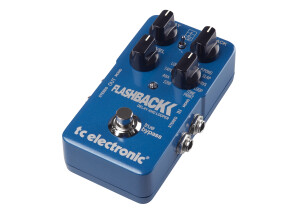
    Delay is quite possibly the most universal effect for guitarists used in different forms across all genres. When it came time to build my pedalboard I knew I had to have a delay pedal on there. I had become accustom to having multiple types of delays from my multi-effects devices I had owned. I knew I wanted to have plenty of options, but I wanted to keep it simple and small. The Flashback Delay by TC Electronic embodied everything I was looking for. The mini version was not available when I bought my delay, but I would not have gone for it since it was limited in its application. The X4 version was too large for my board, but it was tempting. Line 6 offers some very nice delays that sound fantastic, but I don’t trust the build quality of the housings and switches of their effects. I didn’t want to buy the DL4, then spend the money to get it modified with better switches. Strymon builds very nice pedals, but the Brigadier and El Capistan were not the type of delays I was looking for and the Timeline seemed like over kill. The Timeline I believe works best in a rig that has midi control, and that was not the type of board I was building at the time. The Flashback was the right size with the right type of delays. There is a wide range of delay types that are available in this small pedal, and they all sound very good. I use the mod, analog, slapback, and TonePrint, throughout my bands set. The TonePrint feature is an amazing addition that expands the capabilities of the pedal. There are four knobs to control- delay, feedback, FX level, and type. There is also a mini-switch that allows choosing between quarter note, dotted quarter note, and a combination of both, for use as the repeats of the delay. It does not have a tap tempo in the traditional sense, instead it has audio tapping. It works by turning on the pedal and holding down the footswitch for about two seconds until the LED turns off. Strum the quarter notes, then release the switch and you are in tempo. A brilliant answer to keeping the pedal small and still having tap tempo. The looper function is good, but without the extra switches of the X2 I find I only use the looper at home and not at gigs. There is a slight hum to the pedal, I believe this has to do with the fact I have it on buffered bypass. There is a dip switch on the inside of the pedal that allows you to switch between true and buffered bypass. It is the last pedal in my chain, and it is a good idea to have that pedal be buffered. I also like that the delays continue after I hit the footswitch to turn the pedal off, which sounds so much more natural than the hard stop of true bypass. The TonePrints are so well crafted that I would prefer to have more slots for them on the type selector knob. Just like my Hall of Fame pedal, the Flashback eats batteries as a snack. I believe the processing power of the pedal, and all its capabilities is the reason for how fast it goes through batteries. I am not complaining about it, because I love what the pedal can do, it just is a fact of its operation that you need to plug it in. The Flashback is a great and versatile pedal. A very good addition to any pedalboard with its small size. If you only use one type of delay, then the mini version may be the one you choose. If your delay use is more extensive, and you use a looper, then check out the X4. For my purposes the standard model works best with plenty of flexibility, and only requires a little bit of on-the-fly knob turning to keep up with my needs at a gig.

  • « Small Box With Big Reverb Choices »

    There are three things I look for in a pedal, besides the sound it makes, and they are: size, flexibility, and simple controls. The Hall of Fame Reverb by TC Electronic has checks by all those boxes, and it sounds really good, too. It is housed in a small rugged enclosure that is only 3.5” x 5”, which is great for saving space. It has ten different reverbs available plus a spot for a TonePrint. If you do not know what TonePrint is, it is a way to custom tune the pedal. There are plenty of TonePrints available, plus with the TonePrint Editor you can make your own versions of the different reverb types. Finally, there are only four knobs to dial in your desired sound, they are: decay, tone, fx level, and type, plus a mini-switch to go between long and short pre-delay. So simple even I can navigate those controls without too much fuss. The tone knob works very well to make adjustments that can help dial in your sound. I thought the pedal sounded better than the Boss RV-5, and was more versatile than the Electro-Harmonix Holy Grail. The e-pedals on my iStomp did not have as many choices for reverb sounds as the Hall of Fame has preloaded. I also had a need for a gated reverb that was not available on the Holy Grail and iStomp. The TonePrint aspect of the Hall of Fame was really the deciding factor. The TonePrint Editor is fun to mess around with, but I haven’t made anything better than what I have heard from the professionals. The Hall of Fame is not a perfect pedal, but my problems with it are pretty minor. I wish it had more slots for TonePrints, I like those sounds much better than some of the preloaded reverb types. Although it is an option, do not run this pedal on batteries. It will eat through a 9-volt in a little over an hour. This pedal is a bit of an overkill for what I use it for in my rig. It isn’t even on my pedalboard, but sits on my amp head. I thought I would be switching through the different reverb types throughout the set, but I pretty much set and forget. I adjust the settings at sound check, then leave it on until tear down. I probably should have bought the mini version of the pedal, but I think that might be too dumbed down with the one knob control. As a pedal in a live situation, it works really well. I believe it shines a bit more as studio/recording tool. Being able to change the TonePrint as you want would be fun, and allow to create some very unique sounds. The reverb effect leaves the core of your tone alone, and adds the lushness of reverb very organically. I like the “Room” type of reverb best, but I think it captures the other types very well, too. This is a very good pedal with a couple of minor glitches. The Strymon Big Sky may be more versatile, but for the price point the Hall of Fame is an excellent purchase. Depending on how you use it you may want to get the mini version of the pedal, but I worry that you lose too many features that make this pedal shine.