Log in
EN
FR

Hosa

45 products found

Categories
Filter
Sort by
Evaluation
  • Reviewed or not
  • Editor’s award
  • Reviewed by Audiofanzine
Availability
  • Available or not
  • Sold new or used
  • Sold new
  • Sold used
Must-have products
  • All products
  • Flagship products
  • Best rated products
  • Hot products
  • Popular products
Price
  • Freeware
€
Clear
Sort by
  • Popularity
  • User ratings
  • Price - low to high
  • Price - high to low
  • Used price, increasing
  • Used price, decreasing
  • Name (from A to Z)
  • Name (from Z to A)
  • Added on
Sort results
  • Popularity
  • User ratings
  • Price - low to high
  • Price - high to low
  • Used price, increasing
  • Used price, decreasing
  • Name (from A to Z)
  • Name (from Z to A)
  • Added on
Filter results 45 results found
Evaluation
Availability
Must-have products
Price
  • Freeware
Show results

The best Hosa reviews

The reviews Audiofanzine members found the most helpful.
  • moosers's review

    The Hosa MID301N is a simple MIDI cable that I have used in the recording studio for a variety of different applications. I've used these cables with MIDI keyboards to send information to a MIDI interface, as well as for use with a Mackie HUI to send it's information to my computer. There isn't too much to these cables, as they are simple, well made, and come in a variety of different lengths and colors. I don't really have anything to be unhappy about with the Hosa MID301N MIDI cables, as they do the job well and I haven't had too many of them break that I can remember. There are certainly higher quality MIDI cables out there, but I didn't need anything too heavy duty for my home studio since I don't do all that much with MIDI and just needed them for some simple connections. I can't necessarily say that I'd recommend this cable over another brand of MIDI cable, but I will say that these did the job very well for me without any issues. The way I see it, unless you're going to be spending a good amount more money on MIDI cables, you're not going to get something better than this. In other words, unless you're spending the money on a top tier MIDI cable, I think the Hosa MID301N will do the job just as well as any. I haven't yet experienced one of these crapping out on me, but since they are generally pretty inexpensive I wouldn't be surprised or upset if one did - I'd just get another. However, to date they few that I own have held up well in the few years that I've had them, albeit with only a small amount of use. The bottom line is that if you're looking for some inexpensive MIDI cables to get you started with, the Hosa MID301N cables will do just fine...

  • « Good, standard snake cables »

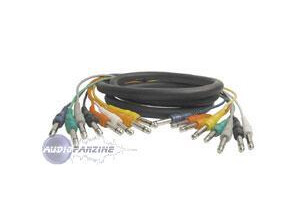
    The Hosa CRA803 is an audio snake with 8 individual cable connections in a 3 meter long length. The connections are available as RCA-RCA, or 1/4"-RCA. In either case, the cables are unbalanced, which means the shorter the cable length that's being run, the better. These snakes are a good choice for connecting mixers to Tascam and Fostex reel to reel multitrack recorders because they are cost-effective, fairly rugged, and have the proper connections. Generally, the user will want to set up the snakes to and from the mixer to the reel to reel recorder and leave it set. The less the cables are moved around, the less likely they are to suffer from disruptions in the signal. Each channel is color coded to avoid confusion. For a 16 track recorder, four of these will be required for all of the necessary ins and outs. These cables are readily available as the "low-end" snake from Guitar Center and Daddy's Junky Music. I've never had one fail on me, and if you own equipment requiring unbalanced cables, there is really little need to run a "higher quality" cable unless it is being run over very long lengths. Generally, the shorter the cable (under 10 feet) when running unbalanced cable the better. If you need cables quickly, Hosa is a great choice. But, if you want to save money on a cable that is of comparable quality, I recommend Pulsar Tech's cables from www.pulsartech.net. I haven't had any issues with my Pulsar Tech cables and I first bought them about six or seven years ago. With any type of cabling, especially unbalanced lines, avoid as much electronic interference as possible by locating them away from power lines. And just to reiterate, the shorter the cable length, the better.

  • moosers's review

    The Hosa YPP-111 is a simple 1/4" Y splitter that splits a single 1/4" male into two 1/4" female jacks. It's useful in all sorts of situations, as I've got one at home for multi-purpose usage. Mostly, I use it for home audio purposes for splitting a signal to go to two speakers, but I've used it in a number of capacities around my home studio as well. I have a few different 1/4" Y splitters, but recently by Planet Waves got broken so the Hosa YPP-111 has take over as my main one. It's not something that I use on a daily basis, but it's definitely something that I need to have around as I like to be prepared for whatever sorts of connections I might need to make. This isn't nearly as sturdy or well built as my old Planet Waves one, but it will definitely get the job done in situations where it's not critical to have the best connection possible. It's not like this will give you a bad or unreliable connection at all, it's just not gold plated or anything like that. The Hosa YPP-111 is the 1/4" Y splitter that I would go with if I'm just looking to have one around and not looking to spend much money at all. You can get one for even cheaper most likely, but anything cheaper than this I wouldn't count on lasting too long. If you do want something a bit better, I'd still go with the Planet Waves version even though I did mention that mine broke. However, it wasn't really due to the product itself as it was kind of a freak accident where the male piece broke off. Still, the Hosa YPP-111 is the one I'd recommend in most situations due to the price...

  • moosers's review

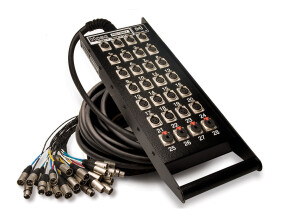
    Hosa's SH 12x4 Pro Conex Snake is a simple connection box designed for use in the recording studio or for a live sound reinforcement rig. I've used this in a recording studio where we ran this through the wall into the live room from our control room. This is in one of the smaller studios on site, so we don't need all that many connections in between the live room and the control room. I don't know if this comes in multiple lengths, but the one that we've got is a 100 foot one, even though we don't need nearly that much slack. If you are going to use this in the recording studio, I'd recommend going with a shorter one if they do have one, as this length is really designed for using this in a live setting. The connections that this has include eight XLR inputs and four dual 1/4" and XLR inputs, the latter of which are 1/4" on the opposite end. I do believe that the Pro Conex series of snakes comes in all shapes and sizes, so you should be able to get any number of different connections on a snake like this if you aren't interested in this exact make up. Hosa in general does really good work with their snakes and cables, and there is no exception here with this snake. It's built very well and should last a pretty long time, especially if you're using it within the confines of a recording studio and not for live sound. All of the jacks on both ends are definitely made of good quality, as you can just feel it when you plug something into it. The 'snake' portion of the cable is tightly wrapped and shouldn't get in the way too much. The Hosa SH 12x4 Pro Conex Snake is a very solid snake that should do the job as well as any other...

  • moosers's review

    The Hosa CFS606 is a 6 pack of 6" in length 1/4" cables. They are right angled, making them perfect plugging into pedals. I've only used these for hooking up my guitar pedal chain, as these are perfect for this type of use due to their short length in addition to the right angle style. While perhaps not the thickest cables out there, you can really only expect so much from a 6 pack of cables at this price. Having said this, I can't say I've ever had a problem with these cables in terms of them breaking, as I've had mine for a while. I have lost a few of them along the way, but never had a problem with them crapping out or breaking. I like that they are so short as they don't leave too much slack between pedals, but there is still enough to have them sit apart from each other comfortably. Too many patch cables for pedals leave too much slack and make it hard to position them comfortably. The right angle also makes a big difference when it comes to this, as when small patch cables are not right angled, it definitely makes it harder to position your pedals comfortably - at least that's what I've found. These aren't the only small patch cables that I have around to connect my pedals, as I have a whole ton of pedals that I will switch in and out depending on what I want. However, they are definitely some of the first ones that I go to when I'm setting up my pedals. In fact, I would say that they are the default 6 inch cables that I will use. There isn't too much more to say about the Hosa CFS606 six pack of 6" 1/4" cables that isn't self explanatory. If you need some small patch cables for your pedals, the Hosa CFS606 six pack is definitely some of the best bang for your buck out there.

  • moosers's review

    The Hosa MSB-139 is a microphone stand that can be used either in the recording studio or in a live situation. I've only used it for recording purposes, as I only do work in the studio and not as a live sound engineer (although I do perform). The mic stand has a base style bottom rather than a tripod, along with a boom arm. It is a pretty standard microphone stand, with plenty of room for adjustments. I generally like using trip stands rather than base ones, but this is weighted down pretty well so I feel secure when there is a microphone on it. OVERALL OPINION I've used the Hosa MSB-139 for a few different applications in terms of types of microphones and what I was recording with them. I have used it with a Shure SM7 on vocals, as well with an AKG C 414 on violin. It worked very well in both situations as I felt that it was easy to manipulate it in the ways that I wanted to. Some microphone stands don't have all the proper adjustments available for you to make, but this definitely isn't the case with the MSB-139. While perhaps not the most heavy duty microphone stand that I've used, it definitely got the job done well. The boom arm is easily adjustable as well and stays in place once you tighten it, without even moving the slightest bit. Having a reliable stand in place is crucial in a recording studio more than anywhere else for a few reasons. First, most of the time you're using expensive microphones that you obviously don't want to break, and also, movements in the microphone can throw off your placement and give you a different sound, which can be unfavorable to say the least. There are cheaper mic stands out there and more expensive ones, but I do believe this could be a few bucks less in an ideal world. All in all, you can't really go wrong with the Hosa MSB-139.

  • moosers's review

    Hosa's LBL505 Console Tape is simply a roll of a white tape that is designed specifically for labeling your console. It is of the right width and overall size to be taped onto a mixing desk under the faders to label what each channel is on a certain session. This of course isn't necessary with more modern digital boards that have LED screens that say what each track is, but for older desks and even newer ones that don't have this feature, this tapes comes in mighty handy. If you're working a studio where you need console tape to labels the channels, having reliable tape around is a must. Many types of tape won't stick right or aren't the right size, but while you don't necessarily need tape that is specifically designed for a console, it doesn't hurt to be able to get it right the first time with something like the LBL505. This tape is pretty much perfect for labeling any console, as it sticks very well to the board and generally won't come up at all until you do so yourself. I've also found that the tape lasts for a while and can be stored conveniently if you need to rip it off the board and put it back down at a later date - you must do so gently of course, as would be the case with any tape. The Hosa LBL505 Console Tape isn't the only tape that I've used on a console, but it is definitely as good or better than any tape I've used for one. The only bad thing about the LBL505 is that it costs a bit more than what you would pay for tape like this that isn't dubbed console tape. So while this tape will certainly do a great job, you can definitely find the same tape elsewhere at a slightly lower price. Of course we are talking about tape here, so the difference would only be a few dollars anyway...

  • moosers's review

    The Hosa SLW-333 is a simple three channel switching box. It allows you to send one stereo signal to three separate outputs and is a unit that I have used for switching between different sets of studio monitors. It simply has stereo 1/4" input connections and three channels of stereo 1/4" outputs. It doesn't require any power and has a knob to choose between the three channels. Like I said, I have used the box for easy switching between different sets of monitors in the recording studio, but I can think of a ton of different uses for the SLW-333 in addition to this use. Hosa has really made it as simple as possible to use this and to set it up, as there isn't very much that you need to know at all. It doesn't affect the sound quality at all, at least that I can hear or that I've been able to compare. In theory it really shouldn't be adding anything of its own and I do not believe that it is. It is built pretty decently, at least for something by Hosa, so I would think that it would be able to have some longevity as long as you don't drop it or anything. The only bad part about the Hosa SLW-333 is the price, as I do think it is a bit overvalued. While it has a nice design and good make up, it doesn't seem to me that it should be worth as much as they are selling it for. However, I can't really think of another product like this to compare it to. I would definitely encourage anyone who needs what is essentially is three way splitter to definitely check out the Hosa SLW-333 to see if it is something that you need or want...