Log in
EN
FR

Boss Loopers

17 products found

Filter
Sort by
Evaluation
  • Reviewed or not
  • Editor’s award
  • Reviewed by Audiofanzine
Availability
  • Available or not
  • Sold new or used
  • Sold new
  • Sold used
Must-have products
  • All products
  • Flagship products
  • Best rated products
  • Hot products
  • Popular products
Price
  • Freeware
  • Low-cost (< $150)
  • Mid-range ($150 - $400)
  • Premium (> $400)
€
Clear
Sort by
  • Popularity
  • User ratings
  • Price - low to high
  • Price - high to low
  • Used price, increasing
  • Used price, decreasing
  • Name (from A to Z)
  • Name (from Z to A)
  • Added on
Sort results
  • Popularity
  • User ratings
  • Price - low to high
  • Price - high to low
  • Used price, increasing
  • Used price, decreasing
  • Name (from A to Z)
  • Name (from Z to A)
  • Added on
Filter results 17 results found
Evaluation
Availability
Must-have products
Price
  • Freeware
  • Low-cost (< $150)
  • Mid-range ($150 - $400)
  • Premium (> $400)
Show results

The best Boss Loopers reviews

The reviews Audiofanzine members found the most helpful.
  • « Pretty good for what it is »

    - 16 minutes of storage - 11 storable loop tracks - Sample drum tracks - Auxiliary input - Overdubbing - External control pedal input - Tap tempo - UTILIZATION Lets face it, this isn't the easiest pedal to operate. You need to set up the track number, set it in record mode, overdub, set drum tracks (by scrolling through all of them...), save, set guitar and drum volume..etc. But it does take something as complicated as looping and present it in a compact footprint. The fact that one needs to double stomp to stop the loop, or bend down to scroll through loops can get really annoying, but that is the price you pay for such a small enclosure. The manual is very lengthy, but I highly recommend that you take the time to read it. It does a good job of breaking down the less intuitive features. SOUND QUALITY I highly recommend running this in the loop if you have one. That way, the pedal will store the actual sound of your preamp, and not just continue to loop the dry signal through the input. You'll get less of a cluttered sound, and also be able to switch channels without affecting the looped track. Just make sure to back off the volume a tad. While the pedal does adjust the loop for minimal tempo changes, it isn't perfect no matter how tight of a job you do stomping it in. I found that with a solid drummer, the pedal will drift after a few loops. OVERALL OPINION It really comes down to what you want to use it for. In a live setting, it is going to get off time, is difficult to control in a hands free manner, and probably isn't what you want to be using. For the bedroom guitarist who just wants to work on improv and listen back to leads, its a very useful tool. I use it pretty frequently while teaching so that I can play WITH a student over a backing track. Prices on these seem to be dropping, they aren't a bad deal at all. I'd also take a look at the digitech jamman line.

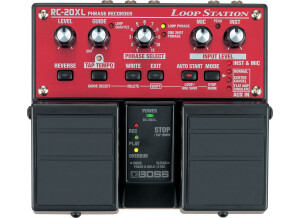
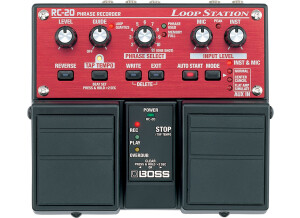
  • moosers's review

    The Boss RC-20XL Loop Station is the ultimate device for looping and sampling. I've only got experience with the pedal in tandem with an electric guitar, but this can definitely be mixed and matched and used with other electronic instruments and even a microphone if you have an XLR to 1/4" converter. The pedal has a slew of 1/4" connections for mic and instrument inputs as well as for output, phase shift, and reverse. It also has a smaller jack for an auxiliary input. I have powered the pedal with the Boss power supply that can along with it, and I'm not sure what other kind of power supply would be able to power it up. Obviously enough, the RC-20XL isn't rack mountable as it is a workstation controlled by your feet. UTILIZATION The Boss RC-20XL Loop Station has a ton of features to work, so getting acquainted with everything that it has to offer will take a little bit of time. Having said this, the pedal has everything laid out clearly, there are just a lot of features to get used to. You can store up to 11 phrases at a time, so there is a knob to choose between them, as well as parameters for level, guide, mic and instrument input levels, and buttons for reverse, tap tempo, write, exit, auto start, and mode. There are two foot pedals which control the recording, overdubbing, and erasing of your phrases. Getting used to everything going on with the Boss RC-20XL Loop Station took me a little bit of practice, but Boss makes it easy enough that all it takes is a bit of time. If you're a beginner or new with looping, it might be a good idea to have the manual around as well. SOUND QUALITY The Boss RC-20XL Loop Station doesn't offer up any actual sounds of its own really, beyond throwing your sounds in reverse. However, the pedal won't color your tone in anyway other than how you set it. Everything goes in exactly the way that it comes out, which is what you look for in a pedal of this nature. I've used the pedal with a Fender Jazzmaster Reissue and a '76 Fender Twin Reverb. I just love layering different phrases and riffs, and having in total 16 minutes of recording really makes it possible to save everything that you'd like. A few other cool features on the pedal include auto quantization, and the ability to change the tempo without changing the pitch, which is really awesome... OVERALL OPINION As far as looping pedals go, the Boss RC-20XL Loop Station is probably the most complete one that I have seen to date. There are a bunch to choose from nowadays like those made by Digitech and Line 6, but Boss, as per usual is at the top of their game here. The RC-20XL is also a pretty considerable upgrade from the RC-20, as it gives you more storage space and time to work with. The price isn't all that cheap, but is about right for a looping station with this much versatility and features. I'd encourage those interested in looping pedals to absolutely check out this pedal as well as Digitech JamMan and the Line 6 JM4, but the Boss RC-20XL is definitely my favorite of the bunch.