Log in
EN
FR

SeriesSeymour Duncan Vintage Output Humbuckers

43 products found

Filter
Sort by
Evaluation
  • Reviewed or not
  • Editor’s award
  • Reviewed by Audiofanzine
Availability
  • Available or not
  • Sold new or used
  • Sold new
  • Sold used
Must-have products
  • All products
  • Flagship products
  • Best rated products
  • Hot products
  • Popular products
Price
  • Freeware
€
Clear
Sort by
  • Popularity
  • User ratings
  • Price - low to high
  • Price - high to low
  • Used price, increasing
  • Used price, decreasing
  • Name (from A to Z)
  • Name (from Z to A)
  • Added on
Sort results
  • Popularity
  • User ratings
  • Price - low to high
  • Price - high to low
  • Used price, increasing
  • Used price, decreasing
  • Name (from A to Z)
  • Name (from Z to A)
  • Added on
Filter results 43 results found
Evaluation
Availability
Must-have products
Price
  • Freeware
Show results

The best Seymour Duncan Vintage Output Humbuckers reviews

The reviews Audiofanzine members found the most helpful.
  • « As vintage as you can get »

    Seymour Duncan is an American pickup maker that has been making aftermarket pickups for many years. Their pickups are the counterparts to brands like Dimarzio. While Dimarzio has been more popular in strat style guitars and Shred guitars Seymour Duncan has been more popular among Les Paul and Gibson players. The Seth Lover is one of Duncans more old school pickups. The Seth Lover is named after an old pickup designer in the 50s who designed the early PAF pickups for Gibson. This is just another hint into the nature of this pickup. This pickup is very vintage in tone. These pickups come with old school Alnico II magnets which were more common before ceramic magnets and more exotic magnets started being used in pickups. Another vintage touch is that they are not wax potted. The pickup also only has single conductor wiring which is another vintage touch. This helps get the vintage tone and feel but makes the pickup very noisy in high gain situations. They are similar to the 59 one of the more common Seymour Duncan pickups but this pickup is fatter and warmer. The clean tones with this pickup are great. They really ring out and you can hear all the harmonics and every string very clearly. They retain the awesome clarity but without sounding overly bright. The clean tones are clear but fat also which is hard to find in a pickup. The dirty tones are good because the eq on this pickup is very even. This is great for a mid to low gain situation but as you get more dense with the sound you may get lost in the mix with a pickup like this. If you are looking for the ultimate vintage bridge tone for your old school humbucker guitar this is a great pickup.

  • « Extremely fat and vintage sounding »

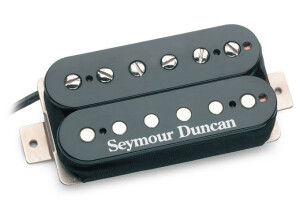
    The Seth Lover Neck is Seymour Duncan’s tribute to the very first PAF that a man by the name of Seth Lover created when he was working at Gibson. It’s a purely vintage pickup that features an Alnico II magnet, single conductor braid shielded wiring, adjustable pole pieces on one coil and is not wax potted. The Seth Lover is a true and true vintage humbucker. They come in both neck and bridge models, so you can get a nicely calibrated set if you’d like. The neck pickup is extremely fat and smooth. When these are put in the neck, they really get that almost Air Norton kind of sound, but better. The lows are extremely fat sounding, the midrange is just perfect, and the highs have just enough bite to be clear without sounding overly trebly. I especially love how well they seem to respond to the tone control knobs. You can get a huge variety of tones out of these with proper manipulation of the neck tone pot. As expected, these pickups tend to sound best in Les Pauls, but I find they can work in just about any wood you throw at them. They’re versatile enough to handle nearly anything you throw at them. The biggest drawback, however, is that they’re not wax potted. Because of that, they can really squeal under high gain, and that’s a big no-no for heavy metal players such as myself. Once you wax pot them, they sound quiet, but they seem to lose some of that great vintage style sparkle they were known for. If you’re looking for a fatter ’59, I highly recommend checking these out. However, just be aware that they’ll probably squeal under high gain, and if you wax pot them, they’ll lose some of the more complex tones these are known for.

  • « Very clear sounding »

    The Seymour Duncan Jazz 7 is probably the second most popular neck pickup in the Duncan seven string lineup. It features slugs on one coil, adjustable screw heads on another, four conductor wiring and an Alnico 5 magnet. This pickup is very similar to the ’59 7. The biggest difference is that the treble on this is extended, and it has more of a cleaner quality to it. This helps really keep those fast lines clear and precise sounding. The low end is fat enough to where it keeps things thick but isn’t too muddy. The midrange is fairly even to maybe being a little scooped. This allows it to stay clear and prevent overdriving the amp more than necessary. The treble on this is extended and fairly crisp. It can get a bit piercing in certain guitars, but it’s generally not too bad. I find this pickup works best with clean tones. Under gain, it’s not too bad, but I think the ’59 7 sounds better under midgain and high gain. It’s just that this pickup sounds a bit more sterile than the ’59 7. However, some people love that quality. This pickup sounds awesome both split and in parallel. I generally recommend this pickup if you have a fatter sounding guitar. Therefore, I find it to be better suited for mahogany or basswood. However, every piece of wood is different. Don’t assume that just because you have a certain wood, it’ll sound a certain way. They’re all just general characteristics. If you’re not satisfied with the ’59 7 and find yourself wanting a clearer, brighter sound, I recommend this pickup. It’s a very nice pickup, and lead tones just sing when it’s installed in a darker sounding guitar. If you find yourself wanting something a bit more vintage, give the ’59 7 a look and see how that works out for you.

  • « Popular for a reason »

    The Seymour Duncan ’59 Neck model is probably one of the most popular pickups Seymour Duncan makes. It features slugs on one coil, adjustable pole pieces on the other, four conductor wiring and Alnico 5 magnet. There are two main neck pickups that are generally considered in the Seymour Duncan lineup – the ’59 and the Jazz. Both of these models sound good, but there are some key differences that help make them unique. The ’59 is one of the most classic PAF clones on the market. It features a “tubey” low end, some scooped midrange and an extended treble range. The extra low end helps make this pickup sound pretty fat, but the low end isn’t super tight. It’s a more vintage style low end. The scooped midrange helps keep everything clear and allows the pickup to be a bit more open. The extended treble range on this gives it some sparkle, but it’s generally not so much that it’s overpowering. I’ve used this pickup successfully in mahogany and decently in alder. In my mahogany guitar, it sounds absolutely wonderful. The notes bloom like crazy, it gets a very fat, “vowely” kinda sound, but it still remains clear. In my alder bodied guitar, however, the pickup is a bit too bright for my tastes. I’m not sure if it’s because of the wood, but it seems to have an almost single coil quality at times. For the record, yes, it’s working fine and isn’t split or being run in parallel. Speaking of that, this pickup sounds very nice both split and in parallel. Both deliver great, usable tones, unlike certain other pickups on the market. If you’re looking for a neck pickup in the Seymour Duncan line, this is probably the one I’d recommend the most. It’s generally more popular than the Jazz, and I prefer it towards the two. Both deliver good tones, but this is my number one go-to full sized neck humbucker in the Duncan line.

  • « picky »

    I recently installed this pickup into the bridge position of my ESP Sc6 just to see if it could hang with the Anderson h3 I have been using for years.The SC6 has an alder body, maple neck through, ebony fret board, and a tune-o-matic bridge. My main amp is a Framus Cobra 100 watt tube amp and I also played it through a Peavey 5150 and Hughes & Kettner triamp.I mainly play metal along the lines of pantera, botch, the dillinger escape plan, and also some spacey ambient stuff. Plugging into my amp without changing my normal settings and the pickup was very thin compared to the Anderson.The clarity is great and the clean sounds are really nice but it lacks the chunk in distortion that I'm used to with the H3. I took a bit and re-did my EQ to try and compensate but was still a bit underwhelmed by it. Boosting the bass got me a little closer to what I was looking for but started to muddy up the sound. I then used an EQ pedal to try and find a happy medium but never quite got the thickness while retaining a tight low end. I have a friend who uses one in his LP style guitar and it sounds great. The construction of that guitar is completely different with a mahogany body and a rosewood board I am sure it is nowhere near as bright of a guitar as my ESP. He also tunes down to B and in that tuning the pickup sounds incredibly full and well balanced. Overall I would say this pickup would be much better in a guitar made of mahogany or other woods with a lower resonance. The alder and ebony combination is just too bright for it. I would suggest this pickup to people playing classic rock as it has that high-mid thing going or for anyone dropping an LP style guitar down to B and playing some slow doom music.

  • « P-90 tone in a humbucker size »

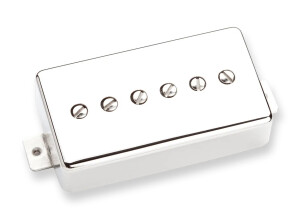
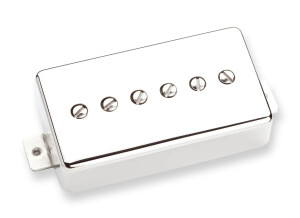
    The Seymour Duncan Phat Cat P-90 sure is a cool cat. With this pikcup you get all the output, tone and sustain of your favorite humbucking pickup but with the all the definition and note clarity of a single coil. This pickup is super dynamic. It can be warm and thick for blues or be crunchy for rock. P-90s respond well to how you are playing and goes along with you. These pickups are very lively and punchy. They have a thinner bottom end than most P-90s but there are a ton of mids and top end spank. They are very responsive and sensitive to pick attack. I compared the Phat Cat Les Paul to a 2004 Gibson Classic SG with stock Gibson P-90’s which are the traditional big P-90s. I also compared it to a Les Paul Historic Special Double Cut reissue, (modeled after the 1960 Les Paul Special DC). I found the Gibson P-90’s in both guitars to be both a bit warmer and smoother with greater bottom end. Overall, the Gibson P-90’s had a much fuller and “wider” sound while the Phat Cats seemed more closely aligned with a hotter Fender single coil sound. With that said, the Phat Cats do not sound bad at all. The Phat Cats sounded very good overdriven and with high gain. They were surprisingly quiet and certainly would help cut through the mix in a band setting. Some tonal differences between the Phat Cat and the Gibson Traditional P-90s can be explained by the Gibson P-90 being much larger in size and able to pick up my frequencies. This also means that they cannot be easily installed onto a guitar that didnt come with them. The Phat Cat can do a variety of tones and could be used for many styles. I could do country to jazz to rock even. If you are looking for some of that classy P-90 tone and do not want to have to cut up your guitar to get them to fit, the SD Phat Cat may be for you.

  • « Excellent neck pickup! »

    The Seymour Duncan Jazz, along with its sister pickup the JB, makes up one half of what is possibly the most widely used pickup set from Seymour Duncan. I purchased a 2009 Jackson King V Select (USA made) that had this pickup combo. I was less than impressed with the JB in this particular guitar, but the Jazz was a different story. It really had a nice clear sound that was neither muddy nor thin. The nice thing about this pickup is that it is able to go from very clean jazzy tones to very high gain applications for rock/metal/shred and not lose any clarity or definition. I often would channel switch on my amplifier to a very fat sounding clean tone and the Jazz was great for comping and single note lead lines. Playing complex chord voicings on a clean tone were a breeze, as the clarity that this pickup has allowed each note to ring through clearly. The dirty tones were great as well. In my opinion, this pickup has a very tight response that is wonderful for shred type lead work. I was using it in conjunction with a Mesa Boogie Mark Five and got very thick and tight lead tones a la John Petrucci or Steve Vai. Again though, even on dirtier tones, the sound has a killer clarity that allows even the most blindingly fast passages to cut through a mix very well. This pickup suffers from none of the inconsistency of the JB either, which is a plus. I've tried it in a few guitars over the years and noticed a great set of tones regardless of guitar brand, construction type, or woods used. There obviously will be some differences from guitar to guitar but it is a much more consistent pickup than the JB to me. If you're looking for nice, thick neck position tones that still have good clarity with both clean and dirty tones, give the Jazz a shot for sure!

  • « '59 in 7 string form »

    The Seymour Duncan ’59 Neck 7 string model is based off of one of the most popular pickups Seymour Duncan makes. It features slugs on one coil, adjustable pole pieces on the other, four conductor wiring and Alnico 5 magnet. There are two main neck pickups that are generally considered in the Seymour Duncan lineup – the ’59 and the Jazz. Both of these models sound good, but there are some key differences that help make them unique. The ’59 is one of the most classic PAF clones on the market. It features a “tubey” low end, some scooped midrange and an extended treble range. The extra low end helps make this pickup sound pretty fat, but the low end isn’t super tight. It’s a more vintage style low end. The scooped midrange helps keep everything clear and allows the pickup to be a bit more open. The extended treble range on this gives it some sparkle, but it’s generally not so much that it’s overpowering. I’ve used this pickup successfully in mahogany and decently in alder. In my mahogany guitar, it sounds absolutely wonderful. The notes bloom like crazy, it gets a very fat, “vowely” kinda sound, but it still remains clear. In my alder bodied guitar, however, the pickup is a bit too bright for my tastes. I’m not sure if it’s because of the wood, but it seems to have an almost single coil quality at times. For the record, yes, it’s working fine and isn’t split or being run in parallel. Speaking of that, this pickup sounds very nice both split and in parallel. Both deliver great, usable tones, unlike certain other pickups on the market. There's no worrying about the low B being overly bass heavy, either. If you’re looking for a neck pickup in the Seymour Duncan line, this is probably the one I’d recommend the most. It’s generally more popular than the Jazz, and I prefer it towards the two. Both deliver good tones, but this is my number one go-to seven string neck humbucker in the Duncan line.