Log in
EN
FR

SeriesYamaha DX

15 products found

Filter
Sort by
Evaluation
  • Reviewed or not
  • Editor’s award
  • Reviewed by Audiofanzine
Availability
  • Available or not
  • Sold new or used
  • Sold new
  • Sold used
Must-have products
  • All products
  • Flagship products
  • Best rated products
  • Hot products
  • Popular products
Price
  • Freeware
€
Clear
Sort by
  • Popularity
  • User ratings
  • Price - low to high
  • Price - high to low
  • Used price, increasing
  • Used price, decreasing
  • Name (from A to Z)
  • Name (from Z to A)
  • Added on
Sort results
  • Popularity
  • User ratings
  • Price - low to high
  • Price - high to low
  • Used price, increasing
  • Used price, decreasing
  • Name (from A to Z)
  • Name (from Z to A)
  • Added on
Filter results 15 results found
Evaluation
Availability
Must-have products
Price
  • Freeware
Show results

The best Yamaha DX reviews

The reviews Audiofanzine members found the most helpful.
  • Audiofanzine FR's review

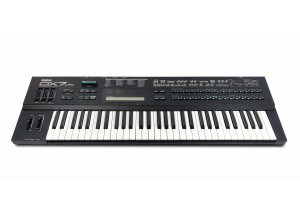
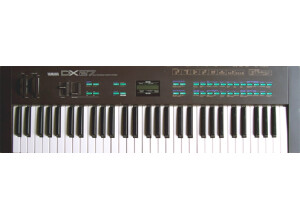
    (Originally written by elriton/translated from Audiofanzine FR) 4-Operator Digital FM synthesizer with 8 octaves and MIDI 61 keys Pitch and modulation controls Sustain via footswitch Breath control (very rare) 8-voice polyphony Connections: MIDI in, out, thru Mono line output Headphone output Yamaha footswitch Breath Control Supply 24 user sounds 8 banks of 24 presets each UTILIZATION I'm not too complicated, I just pick one of the user presets. Possibility to switch between different banks. The sound editing is totally empirical. You'll need a good number of hours with this synth to get to know its real possibilities. Avoid theoretical approaches! FM synthesis on the DX range was perhaps the biggest intellectual rip off in the pro audio world of the 20th century. The user's manual is clear but there's nothing like real-life experience. SOUNDS The easily identifiable sound of the DX range requires you to process the sound with effects or mix it with something else in order to hide the synth's characteristic sound. The sounds aren't realistic. But then again which synthesizer sounds realistic? No effects. The keyboard isn't velocity-sensitive. But you can play with an expression pedal via MIDI. In this case it's very empirical again. The best sounds are: electric bass, lead (Feed Lead), clav-sounds, special presets (Space talk, Schmoo). OVERALL OPINION I purchased a secondhand DX27 in 1987 and I still have it: indestructible and ever trusty. Previously to the DX27, I worked with a DX21, a Korg Poly 800II and a Roland SH101. I've noticed that it produces more noise than the DX 21 and FB 01, but it doesn't matter, it's still my DX27. I only miss a pitch envelope like on the DX21 and the DX7.

  • « can work with current music »

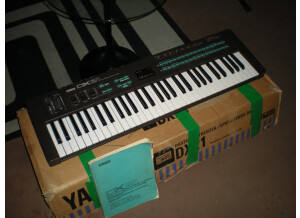
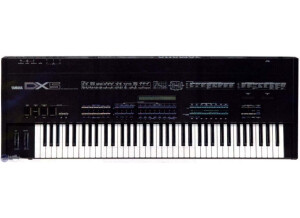
    The Yamaha DX1 was a very expensive keyboard when it first came out a long time ago. It was used by many popular bands of the 80’s and even into the 90’s. Today its value is not what it was at that time but it can still be used to make some really cool vintage sounds. The downside of this keyboard is that it is huge. There is just not space for it anywhere, I do not know the exact measurements of it but I can say it is probably the biggest that I have ever had. UTILIZATION The sounds are mainly based from FM synthesis, and it is very similar to the sounds of the DX7 but the DX1 has better overall quality. There are 73 keys on this board and they are touch and velocity sensitive. It does have MIDI connections which I think is fascinating considering that this keyboard came out such a long time ago. SOUNDS The DX1 is a 32 voice polyphony keyboard that has 64 presets, and all of which will pretty much take you back to the 80’s. None of these sounds can really be used in modern music unless you put it throw a bunch of processors and racks to bring it up to date. But if your style is electro music, then this will sound great for you. You will be able to plug these sounds right into your music and it will fit right in. OVERALL OPINION The DX1 is well made, and when it first came out it cost so much money that the average musicians could not afford it. So the only people that used it were established bands and musicians. The sound is nice and fat plus the keyboard itself looks great with a wood grain trim around the bottom half of it. It will be hard for most people to get their hands on this keyboard now because it still cost a good amount of money and most people are collecting them and not selling them.

  • moosers's review

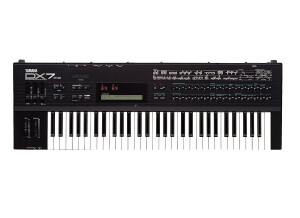
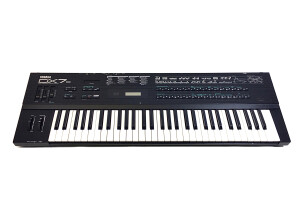
    The Yamaha DX7 is a frequency modulation based digital synthesizer. The keyboard spans about four and a half octaves and has both pitch and modulation wheels. It has 1/4 inch outputs and it also has MIDI connections. In addition, this synth is fully polyphonic. UTILIZATION The configuration of the Yamaha DX7 can definitely take some getting used to, as there are a lot of different things you can do with this. It both has preset sounds and has the ability to store your own sounds as well. It is easy to toggle between all types of sounds, but will take a little while to understand all the ins and outs of this keyboard. The manual for the Yamaha DX7 is pretty complete and is definitely good to have around while you are trying to learn this powerful instrument. SOUNDS The sounds on the Yamaha DX7 are pretty varied, but all have a similar recognizable sound about it. It definitely sounds like the time period in which it came from, which is the 1980s. It is great for dance and pop music, and if you want to get creative you can definitely use it for all types of instruments. The feel of the keyboard is nice and it is very easy to play. The pitch and modulation wheels, and other parameters provide for almost endless possible sounds with this keyboard. Overall, an extremely unique instrument that is a great tool for a wide variety of applications. OVERALL OPINION I've been using the Yamaha DX7 synth for about three years and it is easy to see why it has become a classic. Surprisingly, these are pretty easy to find and aren't really that expensive. So if you are a fan of the sounds on this, it is a pretty easy pick up and is great to have around for both recording and live shows. Overall, the Yamaha DX7 is a unique instrument that definitely holds a place in the history of synthesizers.

  • « A uniquely programmable DX synthesiser with an excellent keyboard and midi spec »

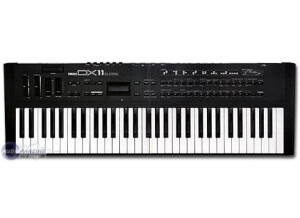
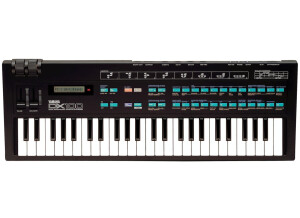
    I used DX7s professionally in the studio with 80s bands including Pet Shop Boys and they had great sounds but were almost impossible to program, so most people were using presets (factory or 3rd party, generated by software which wasn't generally available). The DX11 came along a bit later, it was inexpensive and has a uniquely easy version of FM to program, with controls that vary multiple parameters at once and the possibility of different algorithms and starting waveforms, which you can use as broad-brush attempts to get near the sound you want, before more targeted tweaking. As usual for FM the best sounds I get from it are bells, harps, electric pianos - bright, often percussive, but detailed enough to be featured in the mix if you work on them. The DX11 is really odd and unique, and not a bit like its elder brethren, because apart from the difference in the sound generation it is a quite capable MIDI master keyboard (it lacks polyphonic aftertouch) combined with a MIDI sound module with 8 voices and 2 assignable outputs (not stereo as one might think). This, though limited, I have found particularly convenient for routing through different mixer channels and is really a professional studio feature rather than something for the consumer market. The 8 voices are each statically assigned to one freely-selectable patch (i.e. 'sound') within a 'performance' - each of up to 8 sounds can have a keyboard range, a midi channel (only sounds with the same midi channel as the DX11 is set to transmit on will respond to the local keyboard, but will play from incoming midi from e.g. a sequencer), and can be sent to output I, output II, or both. In addition each sound can have a transpose interval and a volume set. So we have a really quite powerful (particularly for 1987) FM sound module which is largely independent of the internal keyboard if you want it to be. I doubt many people used the DX11 quite as intensively as I did but it's capable of really remarkable things as well as being an incredibly well-made instrument which also constitutes just about the smallest, lightest master keyboard with full-size keys that you can imagine. Eventually the 2032 battery in it fails and needs to be replaced (it's soldered in IIRC) but otherwise it just doesn't go wrong. If you see one at a decent price and you use 'traditional' MIDI, pick it up, is my advice!

  • FP User's review

    For the price it is really well specced. Compression on every channel, 2 effects busses, 16 inputs etc etc. Price paid £1000 UTILIZATION Really really easy. The manual is amongst the best I have encountered. Is easy to follow, it goes into depth about what to use the various effect and compression presets for. It is easy to find an answer if you get stuck. Even though this was essentially my first musical mixer, and I knew nothing about aux sends etc, I did not need the manual to get started, it is very intuitive. I have had 2 little problems. One of the effects rotaries has a slightly dodgy contact. The parameter wheel kind of fell in a little bit, but this was easily rectified. SOUNDS Although it's a digital mixer, I am really happy with the sound - it's an honest representation, but doesn't sound clinical. I cannot fault the eq, effects or compression. OVERALL OPINION I absolutely love this mixer. It does so much it just begs you to try different things. The memories make things so easy - save all your settings with the song, and quickly switch to the next. This is one of the very few things I own where I am continually delighted by new things I find it can do, even after having had it for 2 years. Everything you find you want to do, it has already been designed for. I would wholeheartedly reccomend this mixer. It's hard not to love it Originally posted on FutureProducers.com Posted by: Unknown ( 5-, 2002)