Log in
EN
FR

Connectors

155 products found

Filter
Sort by
Evaluation
  • Reviewed or not
  • Editor’s award
  • Reviewed by Audiofanzine
Availability
  • Available or not
  • Sold new or used
  • Sold new
  • Sold used
Must-have products
  • All products
  • Flagship products
  • Best rated products
  • Hot products
  • Popular products
Price
  • Freeware
  • Low-cost (< $45)
  • Mid-range ($45 - $300)
  • Premium (> $300)
€
Clear
Sort by
  • Popularity
  • User ratings
  • Price - low to high
  • Price - high to low
  • Used price, increasing
  • Used price, decreasing
  • Name (from A to Z)
  • Name (from Z to A)
  • Added on
Sort results
  • Popularity
  • User ratings
  • Price - low to high
  • Price - high to low
  • Used price, increasing
  • Used price, decreasing
  • Name (from A to Z)
  • Name (from Z to A)
  • Added on
Filter results 155 results found
Evaluation
Availability
Must-have products
Price
  • Freeware
  • Low-cost (< $45)
  • Mid-range ($45 - $300)
  • Premium (> $300)
Show results

The best Connectors reviews

The reviews Audiofanzine members found the most helpful.
  • « This should come with the Duet 2 »

    The Apogee Duet 2 Breakout Box has 2 ¼ inputs for instruments, 2 XLR microphone inputs, and 2 XLR outputs. This interface is very inexpensive and could be used as a main portable set up for the roadie! This box is built to last a long time, it is made out of aluminum and will not scratch easy either. One of the things about this unit that left me wondering what Apogee was thinking is that they put the I/O on the front of the device. So that means when it is sitting on your desk you have the cable right in front of you connected instead of on the back where it wouldn’t have mattered. This really isn’t an issue it is more about personal preference but I just don’t see why they did that. Also, this box is only about 1.5 to 2.0” deep (depth) and when you start have your XLR cables plug into the back of it and even some ¼ cables on the back it will cause the Breakout Box to start to tip over and become heavy on the back side so the front of it will lean up. This is also something that they should have thought about before manufacturing this unit to sell. It does work great and is made to last, but they cables should have been more thought out and with the depth of the unit they should have done something to fix that issue. I also feel like when purchasing the Apogee Duet that the breakout box should be included with it because the Duet is very expensive. This unit is not a “must” have but it is very helpful to have. It should have been included with the Duet though, why not it is only a hundred dollars? If you are a Duet user I suggest getting this to make your switch outs and changing your I/O’s a lot easier.

  • moosers's review

    The ProCo Sound MAX20 is a -20 db pad that you insert in between your mic cable and microphone to give you some more head room and -20 of attenuation with hot mics and on loud signals. There isn't really anything that you need to know other than that as it will simply give you -20 db of attenuation. There is also both a -10 db and -30 db version of this pad, each of which varies in price but this one if the most expensive since it's right in the middle and is kind of the perfect amount of attenuation you'd need if you were using one of these. A studio that I recently started doing some work at has one of these on hand for situations where there might be a loud source and we're using a sensitive mic. It definitely comes in handy more times than you would think and is something that every studio should have one or two of. Of course many microphone preamps have a built in pad, as do many microphones, but there are plenty out there of both that have neither of these, so it's always good to be prepared for whatever, especially if you're working in a professional or semi-professional environment. I can't say that the price of the ProCo MAX20 is too unreasonable, but it does seem like there are other pads out there that could be a bit cheaper than this one. Still, it's not all that much more and it's probably in the end worth it as it seems to be a pad that is built to last and can be your studio mainstay for however long you might have it. I'd scope out pads made by Shure and others but you can't really go wrong here with the Proco Sound MAX20.

  • moosers's review

    The Switchcraft Male 1/4" to Male XLR Adapter is a simple connector that can be used to convert any XLR cable to have a 1/4" end on the male end of it. This can be useful in a number of different situations, but what I've used it for is for sending a mono signal from an instrument straight into a female XLR microphone input - both on a mixer and in the studio. It can certainly be used for other applications, but that's the reason that I've got a few of these lying around my home studio. Something like this isn't necessary for everyone, as I haven't found myself needing this connector for quite some time. In fact, most won't need this at all. However, if you do indeed need a male 1/4" to male XLR adapter, Switchcraft's version is as good as any. I've had two of them for a number of years, and while I must admit that they don't see much action, they have held up over the years and are on hand if I ever need them. I got them for my home studio as you really never know when you might need any given connector. If you're going to have clients come in and record, it's definitely crucial that you have any and all connections and converters on hand just in case you need one. I don't know if I can recommend this particular brand of converter over another one, as I don't think I've used another brand's version of this to date. It really shouldn't make all that much of a difference as long as it holds up, so I just went for the cheapest and most readily available ones that I could find. If you need an adapter like this one, I definitely wouldn't hesitate with this one made by Switchcraft.

  • Audiofanzine FR's review

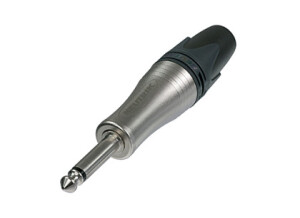
    (Originally written by ti_zourite/translated from Audiofanzine FR) Neutrik connector: right angle 1/4" TS phone plug with nickel body and silver contacts. I use these connectors for my patch cables. They give me great flexibility to connect my effect pedals, rack processors, etc. and to make guitar cables with the right length. I use NP2RX on both ends of my patch cables, and for my guitar cables I use one NP2RX for the amp connection and one NP2X (no angle) for my Strats. I use it only with Mogami 2524 cables. I have no more noise problems, sound loss, etc. It's a very good product and everyone can solder them. And the Neutrik homepage provides an assembly instruction PDF for each connector.