Log in
EN
FR

Other Cables/Connectors

489 products found

Sort results
  • Popularity
  • User ratings
  • Price - low to high
  • Price - high to low
  • Used price, increasing
  • Used price, decreasing
  • Name (from A to Z)
  • Name (from Z to A)
  • Added on

The best Other Cables/Connectors reviews

The reviews Audiofanzine members found the most helpful.
  • moosers's review

    Mogami's Pure Patch TT to TT cables are undoubtedly the best TT patch cables you can get. Mogami has a reputation for crafting some of the finest cables out there, and it's certainly not unwarranted. These are incredibly sturdy cables that are of course ideal for use with a TT patch bay. The studio that I work at has a number of different rooms, all with TT based patch bays and all of them have these Pure Patch TT to TT cables. We must have 200 of these throughout the studio and I can't that I ever experienced a broken one. They feel sturdy in your hands when you're patching them and will send the most secure connection possible from one place to another on your patch bay. They come in a variety of colors which end up being helpful to me as I can color code certain patches that I'm making if necessary or complex enough. The cables also come with a lifetime warranty, which isn't surprising considering that they most likely will not break within your lifetime! Mogami does offer a few different types of TT to TT patch cables, but these are the ones I'm most familiar with using since we have them in all of our studios. As far as price goes, I'm not sure how they are sold in terms of if you buy them in packs or individually as I haven't purchased them myself since I don't have a need in my home studio. I'm sure you can find cheaper TT to TT cables, but it's so important to have a solid connection in your patch bay that this isn't a place you want to try to skate by on and try to save a little bit of money. It's absolutely worth every penny to pick up Mogami Pure Patch TT to TT cables as they'll last forever and are simply some of, if not the best you can buy!

  • « Must have »

    The Roland GKC-5 is a 15’ cable that has a 13 pin connector on it to use with your guitar set up. I currently only a lot of these cables because they are my favorite and have never let me down. The end cap connectors are well made and will not break or fail on you in any situations. You can also purchase this cable in a 30 foot length for about 15 more dollars than the 15 foot length cost. Before I started using the GKC-5 cables I was just using whatever cheap cable I could get my hands on because I didn’t think that it would make that much of a difference but once you get the GKC-5 you will notice some differences right away. If you are using a GR guitar, make sure you don’t go out and get a cheap off brand cable, go get the GKC-15 and save yourself a headache later. The best part about the GKC cable is the life of it, it will last you forever and when you are performing you need something that you can rely on because all gear fails from time to time. It will give you a piece of mind not having to worry about your cords. Overall, this is a must have you have a GK guitar system. There are locks on both ends of the cable and it is worth every penny that it cost. When it comes to cables it took me a long time to understand the importance of getting a good quality one. But now I know that you get what you pay for and buying those cheap 10 dollar off brand cables online will only fail on you later on down the road. The Roland GKC-5 is the best cable for a GK guitar system period! They are must haves!

  • moosers's review

    The Little Labs STD Instrument Cable Extender is a simple and unique device that allows you to extend your instrument cable without losing any quality. If you didn't know, using really long instrument cables can actually cause you to lose some tone, so in the studio it's especially important to be aware of this. That's where the STD comes in handy. While it's not always necessary, in larger studios it's going to help you out. I recently used it in a studio where we wanted the guitarist and bass player to play in the control room and mic'd up the amp in an iso booth that was a decent distance away. Instead of connecting two instrument cables together or using a really long one (which we didn't have at the time anyway), we used the Little Labs STD, which saved time setting up and was helpful in the situation. In theory it isn't supposed to change your tone at all, but the house engineer at the studio who was helping us set up mentioned that it actually adds a bit of drive if anything, possibly overcompensated for losing signal. This can be a good thing, but if you're worried about any changes at all with your sound, definitely A/B with and without STD to make sure truly sure. At the price of a bit over $100, the Little Labs STD Instrument Cable Extender is a good thing to have around larger professional studios. It's not something that is necessary for live shows or home studios (unless you've got a huge one), but professional studio owners should check out STD to see if it's something that might be helpful to them in the longer run. Since I don't own a studio, I won't be looking at getting one of these any time soon, but do hope that the studios I work at have one when I need it.

  • moosers's review

    The Hosa YPP-111 is a simple 1/4" Y splitter that splits a single 1/4" male into two 1/4" female jacks. It's useful in all sorts of situations, as I've got one at home for multi-purpose usage. Mostly, I use it for home audio purposes for splitting a signal to go to two speakers, but I've used it in a number of capacities around my home studio as well. I have a few different 1/4" Y splitters, but recently by Planet Waves got broken so the Hosa YPP-111 has take over as my main one. It's not something that I use on a daily basis, but it's definitely something that I need to have around as I like to be prepared for whatever sorts of connections I might need to make. This isn't nearly as sturdy or well built as my old Planet Waves one, but it will definitely get the job done in situations where it's not critical to have the best connection possible. It's not like this will give you a bad or unreliable connection at all, it's just not gold plated or anything like that. The Hosa YPP-111 is the 1/4" Y splitter that I would go with if I'm just looking to have one around and not looking to spend much money at all. You can get one for even cheaper most likely, but anything cheaper than this I wouldn't count on lasting too long. If you do want something a bit better, I'd still go with the Planet Waves version even though I did mention that mine broke. However, it wasn't really due to the product itself as it was kind of a freak accident where the male piece broke off. Still, the Hosa YPP-111 is the one I'd recommend in most situations due to the price...

  • moosers's review

    The Monster Cable 1/4" St M to 1/8" Mono F Adapter is a simple device, most associated with use for headphones. The ends of headphones usually come in either a 1/4" or 1/8" connector, and this is useful for when you have an 1/8" headphone end and want to plug it into a 1/4" jack. All headphones and headphone boxes are different, but when you're running a recording studio you want to make sure that you have all the bases covered. Most sets of headphones will come with an adapter like this if it's got an 1/8" on the end of it, but the studio that I work at has a few of these around anyway. There are other uses for it too of course, but with headphones is what I've used it for mostly. Monster's version of this adapter in particular is quite sturdy and is one that should last you a lifetime. It's probably not always necessary to have one of this quality, but again when you're working in a professional studio environment it's usually a good idea to get something that's going to last indefinitely. There aren't any technical specifications that users will need to be aware of with the Monster Cable 1/4" St M to 1/8" Mono F Adapter as it is what it is. It's not very expensive, but when compared to others of it's kind it is actually a bit pricey by comparison, but that's always going to be the case when you're dealing with Monster. For this reason I'd probably recommend looking elsewhere for this kind of adapter unless you absolutely need the best for it. Otherwise, I would think most home studio owners out there would be able to pick up this kind of a adapter elsewhere for just a few dollars...

  • moosers's review

    The ATI MMA800-1 Multiple Amplifier Array is a unique device that is designed for boosting mic or line inputs up +24 db's. It consists of eight channels and the ability to use each in whatever fashion you'd like, whether it's for mic, line, or otherwise level matching. We've got one at the studio where I work and it's always hooked up with our console to balance out our converters. It's always running and working for us as I've never had to do anything at all to it. Every once in a while it will have to be calibrated, but that mostly has to do with the converters more than anything else. Since I haven't actually set up an ATI MMA800-1 Multiple Amplifier Array myself, I don't know much about it's make up and really just know how it functions in our studio setting. Having said this, there's a ton of different ways you can use the ATI MMA800-1 Multiple Amplifier Array and I'd check out a full description of the product to get a better idea of everything it can do for you. This is definitely a professional piece of gear as something like this isn't going to be necessary in a professional studio unless you've got something that really needs it. It's not cheap, so this is why I say to check it out only if you really need it, and home studio owners should be able to get by without needing it for anything. The ATI MMA800-1 Multiple Amplifier Array is strictly a utility device and does it's work without needing anything. If you think you need it, this should be the one you check out as I can't say I know any others like it and it seems to be a mainstay for us in the professional studio environment I work in. If you do need a multi amplifier array, definitely do a good amount of research being choosing one...

  • moosers's review

    Henry Engineering's The Matchbox is a two impedance converter. It's designed for use in the studio where you might need to convert a lower impedance or vice versa. It's the older version of the Matchbox, as there is also a Matchbox HD which is the newest version of this. I've used both and they are pretty much the same more or less. It's got stereo balanced XLR inputs and outputs as well as unbalanced stereo RCA connections for input and output as well. The studio that I work at now has this original Matchbox as an impedance converter for using with iPods and computers. We have an 1/8" connection going to the XLR inputs on this and it makes for easy connecting of your iPod, computer, phone, etc for listening through the monitors. It's a nice and easy way to have this available for clients who might want to check something out from an outside source. We have this permanently hooked up in this fashion, but of course the Matchbox is useful for beyond just this and can be used for converting the impedance of any signal. Once you make your connections with the Matchbox, you're good to go as there aren't any parameters or anything to mess with - it does the job more or less for you once you decide what you'd like to do with it. It's not too expensive, although I don't know exactly how it compares to the newer Matchbox HD in terms of price. I'd say you can go with either of them as they seem pretty interchangeable to me with the Matchbox HD just being a slightly updated and newer version. Either way, The Matchbox is the perfect tool for impedance conversion in any situation and is definitely something that studio owners should be aware of.

  • moosers's review

    The Neutrik NKTT12's are TT patch cables for use in a studio's patch bay. Neutrik is best known for makers connectors for cables as well as patch bays and other products for in studio use where connections need to be made. They're probably the most respected in this sense, as whenever custom cables are being used you'll see Neutrik connectors on them. The NKTT12's are for TT based patch bays, which are the only type of patch bays we've got at the studio where I work. We have a number of different rooms on site, each with their own patch bay (many of them Neutrik), and most also feature Neutrik patch cables. We also have a ton of Mogami TT patch cables, but also have a lot of these NKTT12's. It's especially important to have a proper and secure connection when it comes to patching in on your patch bay as everything runs through it, so this is not going to be the place you want to skimp on in the studio. I don't know if you buy these in bulk, but the vast array of them that we have suggests that you can and that would be the way to do. They do come a number of lengths, as we've got some super short, medium, and really long Neutrik patch cables on hand. I don't know what kind of price each of these would command, but being that they are Neutrik, these most likely aren't going to be the cheapest way to get TT patch cables, but again this isn't something where you want to try to save money. Definitely do yourself a favor and get at the Neutrik NKTT12s for your patch bay and never worry again about having a secure connection within your patch bay, as to me that'd be worth the few extra dollars it will cost you to go with Neutrik...

  • moosers's review

    Horizon's Concert Series 24 Channel Snake is a simple yet very sturdy audio snake that can be used in live concert venues or in the recording studio. The place that I've used this snake has been in the studio, as the studio where I'm working has one of these going from the control room to the live room. The panel of the snake is permanently mounted on the wall for plugging microphones in from the live room. While I would think that most users will be using something like this for live sound, the application is essentially the same either way. Of course in a studio it's especially important to have a reliable snake connecting your signals, and this is definitely stable enough to handle this. In addition to the 24 channels of XLR inputs on the snake, it also has four 1/4" returns. The snake does come in a few different lengths, and although I'm not sure what length the one is that we have, I'm pretty sure it's the shortest one since there isn't all that much space between our control and live rooms. On both ends, the snake is built very well and it shows when you plug microphones into it as it doesn't feel the slightest bit cheap. I don't think we've ever had a problem with any of the jacks on it either. The Horizon Concert Series 24 Channel Snake does cost a good amount of money, and there are cheaper options out there for sure, but if you want something that's extremely reliable I'd encourage you to check this one out. Everything that I've used from Horizon in the past has been built well, so I have reason to trust the overall work they do. So while there are definitley options out there, as far as I can tell, this is as good any...

  • moosers's review

    The Shure A15TG is a simple tone generator that fits in between your mic line. It's got XLR connections on either end and is a battery powered device. The tone that it will generator is at 700 Hz, which of course is strategically chosen since it isn't too low and isn't too high. It also has an on/off switch on it for engaging the tone. That's pretty much everything you'd need to know about the make up of this tone generator, as it's really a simple piece of equipment. The A15TG has a number of uses, but I've used it for checking lines in a recording studio. We have one on hand at the studio where I work, and most of the time it gets used for checking the console, although it isn't really necessary since we can also do it in Pro Tools. I've also used it for scratching a line and making sure that something is coming up. While the Shure A15TG isn't something that's going to be necessary in a home studio or in a smaller studio, it definitely comes in handy in larger professional studios, especially those with real consoles. It certainly doesn't see very much use at the studio where I work, but it's necessary to have around for when we will need it. I was definitely surprised to see the price of the Shure A15TG, as I wasn't expecting it to be as much money as it is. So if you're thinking of picking one of these up just to have, you're most likely going to have to think again because of the price. Having said this, if you absolutely do need a hardware tone generator for your studio, I can't say that I know of any better ones out there other than the Shure A15TG.

  • moosers's review

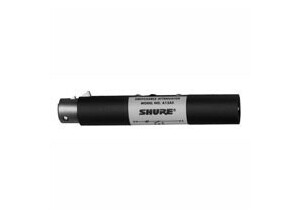
    The Shure A15LA is a line adapter that is designed to convert a high level line output to a low impedance microphone input. It's got 50 db's of attenuation in it, and is more of a utility than anything else. We have one of these in the studio where I work, and although it hasn't seen all that much use in the time I've been working there, it's still a good adapter to have around as you never know when you might need it. It's built very well, and as long as you don't treat it really poorly, you should have an adapter in this for a long time. It certainly does the job for converting a high level line output to a low impedance mic input, and doesn't do anything more or less. You'll see the Shure A15LA being used with things like phono and tape machines to convert this to something that soft enough to be used with a microphone input. Since it does have XLR on both ends, you'll most likely need a converter if you are using it with something like a tape player. I can't say that I've used too many converters like this one that I can recall, so unfortunately I can't really compare this to anything. It doesn't really make much of a difference which way you go if you need one of these, but rest assured with Shure's A15LA that you're getting a very well made product at a pretty reasonable price. It does seem that something like this should be a bit cheaper than it is, but it definitley wouldn't be like Shure to overprice something. Since I can't recommend any other alternatives, if I needed a converter like this one for my home studio or elsewhere, I'd be going with this one for sure.

  • moosers's review

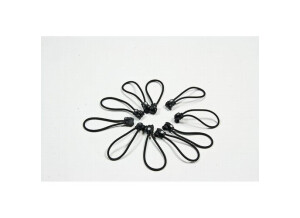
    The Planet Waves 1/4" Elastic Cable Ties are simple little accessories for your instrument or microphone cables that attach to your cables and allows you to hold it together once it's wrapped up and ready to be put away. The elastic band is easily adjustable to hold the cable in place, making it easy to put on your cable rack without having it fall apart. I've got a whole bunch of these on most of my cables now, whether it be for 1/4" cables, mic cables, or even smaller RCA cables and other cables of the sort. They will pretty much work for any cable, although these ones are specifically designed to attach to a cable as thick as a standard 1/4" instrument cable is, and I'm not sure if they make any others for other sized cables, but I don't believe that they do. While some people may prefer to tie their cables up manually, but these are cheap and easy enough to use for me that I don't mind having them around. It definitely helps me to keep the cables I have more organized and I like them a lot better than a simple piece of Velcro that I've seen a lot of cables wrapped up with in my day. There really isn't any risk in picking up some of these, as I believe a ten pack can be had for under $10 USD. In fact, I think that some Planet Waves cables may even come with one of these, but I don't know this for sure. I guess that these aren't necessary to have for every studio, as everyone prefers different things, but if you feel that you might benefit from some handy cable ties, definitely go ahead and pick yourself up a pack of these ones made by the always reliable Planet Waves.