Log in
EN
FR

Boss Delays & reverb pedals

30 products found

Categories
Series
Filter
Sort by
Boss
Evaluation
  • Reviewed or not
  • Editor’s award
  • Reviewed by Audiofanzine
Availability
  • Available or not
  • Sold new or used
  • Sold new
  • Sold used
Must-have products
  • All products
  • Flagship products
  • Best rated products
  • Hot products
  • Popular products
Price
  • Freeware
  • Low-cost (< $200)
  • Mid-range ($200 - $300)
  • Premium (> $300)
€
Clear
Sort by
  • Popularity
  • User ratings
  • Price - low to high
  • Price - high to low
  • Used price, increasing
  • Used price, decreasing
  • Name (from A to Z)
  • Name (from Z to A)
  • Added on
Choose a category
Selected category: Delays & reverb pedals
Choose a series
Sort results
  • Popularity
  • User ratings
  • Price - low to high
  • Price - high to low
  • Used price, increasing
  • Used price, decreasing
  • Name (from A to Z)
  • Name (from Z to A)
  • Added on
Filter results 30 results found
Brands
Evaluation
Availability
Must-have products
Price
  • Freeware
  • Low-cost (< $200)
  • Mid-range ($200 - $300)
  • Premium (> $300)
Show results

The best Boss Delays & reverb pedals reviews

The reviews Audiofanzine members found the most helpful.
  • « Very Digital.. Love it or hate it. »

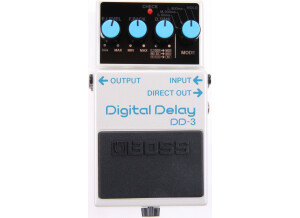
    The Boss DD-3 is the most basic delay pedal out by Boss at the moment. This delay has a four knob design. The pedal has an Effect Level knob that adjusts the amount of delay that is mixed with the dry tone, a Feedback knob that adjust the number of repeats, a Delay Time knob that adjusts the amount of time between repeats, and a four way Mode knob that adjusts between the pedal modes. Mode one or “S” is a short delay with a range of 12.5 ms to 50 ms. Mode two or “M” is a medium delay with a range of 50 ms to 200ms. Mode three or “L” is a long delay with a range of 200 ms to 800ms. The Hold mode is a little different, it allows you to hold a delay and then play over it. The pedal can be powered by 9 volt batter or external AC adapter. Dimensions of the pedal are Boss’s typical 2.4" x 5.1" x 2.9" and it weighs about a pound. Normal input and output jacks are available as well as a direct output. UTILIZATION Boss builds little tanks; it’s as easy as that. They can take serious abuse from the road and never hiccup, and the DD-3 is no exception to the rule. It is a very reliable pedal and I’ve never heard any complaints in the build of the pedal or quality control. It’s a very straightforward layout and the knobs seem sturdy and hold your settings well. The Mode knob has a solid click feel between settings. The housing and jacks are metal and will deal with life on the road. Including a direct out allows the player to use two amps to get that true full stereo delay and is a great addition from Boss. SOUND QUALITY This pedal doesn’t really produce a difference in tone when it is on and off. The bypass of the pedal, though buffered, is very good. Basically what you put into it is what you get out of it. The delays are very clean and crisp and are almost exact replications of what comes into the front end of the pedal. I have moved on to the DL-4 and an analog delay because I like their coloration of the repeats. I feel it sounds more natural if the delays are slightly muffled in the high end like a natural echo and decay. This does a great clean repeat though if you’re looking for that. OVERALL OPINION Overall this is a great delay for clean repeats. It spits out exactly what you put into it, and delays it. The delays aren’t warmer or colored at all like an analog delay or echo pedal, and that’s what it’s supposed to do. This pedal is built road tough, and can really take a beating. I gigged it for awhile, but I felt the clean sounding repeats sounded too digital and unnatural, and I’ve since moved to an analog delay. Had the pedal incorporated an EQ so I could roll off some of the high end on the repeats, I may have stuck with the DD-3. I can’t say it’s a bad pedal though, because it does exactly what it’s meant to do, it’s just not for me.

  • nickname009's review

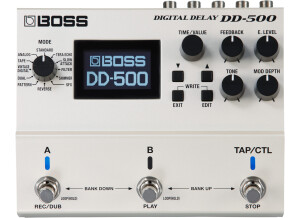
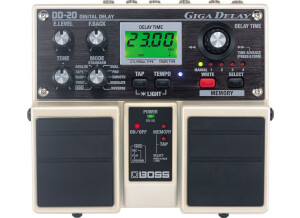
    # BOSS' most powerful delay pedal with up to 23 seconds of delay # 11 delay modes including classic tape delay and sound-on-sound recording # New “Smooth” and “Twist” modes for subtle or radical delay effects # Memory function for changing delay modes seamlessly # New push-button knob for setting delay time in fine or coarse adjustments * E. LEVEL/F. BACK/TONE knobs are set to the center position Display Custom LCD (with backlit) Controls ON/OFF Pedal, MEMORY/TAP Pedal, DELAY TIME Knob, E.LEVEL Knob, F. BACK Knob, TONE Knob, MODE Knob, TAP Button, TEMPO Button, MEMORY WRITE Button, MEMORY SELECT Button Connectors INPUT A (MONO) Jack (1/4 inch phone type) INPUT B Jack (1/4 inch phone type) PHONES Jack (stereo 1/4 inch phone type) CTL PEDAL Jack (1/4 inch phone type) OUTPUT A (MONO) Jack (1/4 inch phone type) OUTPUT B Jack (1/4 inch phone type) AC Adaptor Jack This is a pretty well thought out digital delay pedal. It's sort of meant to be the all-in-one delay pedal with everything included. Meaning all types of delay effects including a tap tempo as well as 4 banks that you can have your preset delays set to. It also has spillover, so when you turn it off or on you'll hear the left over echo. UTILIZATION Not TOO simple to use, since it's a dual pedal it's got quite a few functions so it'll take a little longer to properly figure out. But after a few twists and turns and experimenting, any guitar player should be able to figure out how to work it on a regular basis! The manual is very necessary to understand all the little things that you might not get from just playing around with it. EG for the presets, you can change the how the lighting pattern is, things like that. You can run the pedal as a stereo setup or mono setup, it has enough ins and outs for both depending on what kind of rig you have and whatnot. SOUND QUALITY I think it sounds great. I've heard this used live and used it live myself and haven't had many problems with it. The LED screen is big and legible, though the brightness could be brighter as I always prefer it to be brighter for live stage use. Otherwise majority of the delay sounds are quite good. I use the regular digital, analog and tape echo quite a few times. The SOS not so much, it seemed to be more of an afterthought idea to add onto the pedal so it isn't very tweakable. The tone is generally very crisp and clear, and thus 'digital' however there's also the tone knob available on the unit so you can actually EQ it a bit to make it sound warmer, duller or brighter and even more pristine! How cool is that? OVERALL OPINION Overall, great all-in-one delay pedal. Loads of variety, and good sounding overall delay. A lot of thought has been put into this to make this a programmable and usable live pedal as well. There are lots of functions and lots to go through, if you want to get the best out of this I'd definitely recommend skimming through the manual.

  • « Nice delay »

    The is the second edition to the compact analog delay pedals from Boss and the final one that Boss would ever create. This pedal saw some changes not only to the inside circuit design but also the inputs/outputs and the a different cosmetic design. This was the only pedal from Boss that had these unique looking control knobs. The were kind of a mixed between the usual control knobs that Boss carried on their various pedals. You also got a stereo output though not labeled as that would be able to create a stereo sound. On the inside it got an overhaul to reduce the noise in the circuit. As well as some filter changes to the effects. They began production of this pedal in 1984 and ceased in 1988. UTILIZATION Specifications Controls: Repeat Rate, Echo, Intensity Connectors: Input, Output, AC Adaptor Current Draw: 18 mA (DC 9V, D.Time control at center) Weight: 450 g (0.99 lb.) Input Impedance: 1Mohm (FET Input) Residual Noise Level: -100dBm (IHF-A) Recommended Load Impedance: 10kOhm or greater Delay Time: 20ms to 300ms Recommended AC Adaptor: ACA Series SOUND QUALITY This was a good pedal and a much more user friendly than the previous model the Boss DM-2. User friendly in the sense that is cut the noise of the pedal significantly and allowed the use of s stereo effect. The control knobs did not change a you still have the three knobs for repeat rate, echo, and intensity. This was a great pedal back in the day. It added a good solid analog echo to your tone that didn't cut in the mix but rather added anew dimension of tone to your guitar's current tone. It blends with your distortion very well and colors the tone to expression more of the notes of your guitar. OVERALL OPINION These pedals seem to fetch more of a price than the previous Boss Dm-2. They are going for a few bucks more than I have seen the DM-2's go for. On ebay they seem to sell fro about $300. This is a pretty penny for a used pedal from back in the 80's. I would search the forums and get a good consensus on what the best analog pedal that is produced today. I personally like the Wampler analog echo.

  • « Amazing!! »

    One of the most highly sought after used pedals on the market. These pedals made a huge splash back in 1981 when it was first released. A good analog delay pedal can do wonders go a lead guitar player. This isn't going to be a cutting delay like a digital delay but rather a tone enhancement delay that beefy up either your overall tone or helps with solos. You get three control knobs for adjusting your tone. First there is a repeat rate control knob, which gives you the amount of repeats you hear trailing off from you playing. Net you have an echo and this is how much time you delay the delay to feedback. Finally you have a intensity which give you more of the pedal. UTILIZATION Specifications Controls: Repeat Rate, Echo, Intensity Connectors: Input, Output, AC Adaptor Current Draw: 11 mA (DC 9V) Weight: 450g. Input Impedance: 470kOhm Output Impedance: Over 10kOhm Residual Noise Level: -100dBm (IHF-A) Delay Time: 20ms-300ms Recommended AC Adaptor: ACA Series SOUND QUALITY This is a fantastic sounding delay. One of the best pedals that Boss ever created. Is has a great analog tone that mixes very well with your current guitar signal. I use analog delay a lot on your tone and this one is one of the best. It can be a bit noisy depending on which edition you got. This pedal had three chip replacements during its life span. It sounds great for lead playing in my opinion. It really adds a dimension to your tone that allows the guitar to expand more in the mix. It is a subtle tone additive but a great one to have on your rig. OVERALL OPINION These pedals were discontinued back in 1984 just at the height of metal mania and the start of the chorus effect on the distortion tone rather than the analog delay. These analog delays fetch a nice price today even the ones that look like they have gone through a wood chipper. I have seen them on ebay for anywhere between $250-$300 depending on the condition. My opinion is these are great sounding but obsolete. I like the Wampler analog echo as my all time favorite analog pedal and it is true bypass. Today technology has the upper hand on yesterday's tone.

  • « Great sounding reverb + delay »

    The Boss RV-3 is a combination reverb and digital delay pedal all in one. It's kinda like a CE-1 and DD-3 all rolled up into one device. It has four reverb modes, three delay modes, up to 2000 ms of delay, the ability to have four different modes of both delay and reverb, stereo outputs, a balance knob, a feedback/tone knob and a time knob. UTILIZATION The Boss RV-3 is housed in the famous Boss enclosure, so it's guaranteed to last the life of your guitar playing career. These things are crazy sturdy and reliable. It's a FET bypass, and because of that, there's some tone suckage, but it's not too bad. Boss did an amazing job at packing all these features into a small pedal. The knobs are fairly user intuitive, but if you're confused, just take a look at the manual. The manual describes everything in clear detail, what every knob does, example settings, etc. SOUND QUALITY The RV-3 sounds great. The reverbs are fairly nice sounding, the digital delay doesn't sound too harsh and its stereo out feature is very useful for those who run a stereo setup. It can be a bit hard to find on today's market for a decent price, so keep that in mind. If you find yourself getting tired of messing with both a delay pedal and a reverb pedal, you might want to look into this. OVERALL OPINION The Boss RV-3 is a great pedal, but I feel it goes for too much money on the used market. It's a highly coveted pedal, and I can see why, but I simply can't justify its price. That said, if you're looking for a Boss pedal that does both reverb and delay, I prefer this pedal out of all the others. It's a really great sounding pedal, so if you do decide to spend the coin, it'll be worth it. Do yourself a favor and be patient; a good deal will pop up.

  • « Very simplistic »

    This is a basic delay pedal that really has not much going for it but the price and simplistic value of it. You are not going to find much variations to this pedal. This is going to be a bare bones pedal that adds a bit of delay if you need it. Since there isn't much of a range to it but just the four mode clicks and a delay time knob you can't get to complicated with it like you can the Boss DD-20. This comes in a much smaller case but has a good sound to it like the DD-20. If you are a person who uses delay sparingly or subtly to add character to your tone then this a great pedal. It does cut throw the mix more than an analog pedal even though thes operation is simple like an analog pedal. The layout as follows... Level, Feedback, D TIme, and 4 modes including the fourth mode which produces endless repeats. The first three mode are simple short, medium, and long delay times. The D TIme control will select time within whcihc ever mode you are in. So it acts as range for shirt, medium, and long times. UTILIZATION Fairly easy pedal in that it only has hour knobs and one foot pedal. Takes a 9v battery of plug. It has delay times that goes from12 mil to 800 which is probably most that people are going to use. You can take the D time up to around 2:00 on long delay times and the notes follow a dotted 8th note delay. Great for ambient sounds or U2 times delays. The overall pedal has a very clear transparent warm tone that compliments your guitar playing. It sounds great in the mix and allows the user to add subtle delay repeats for slap back tones or long delay times for solos and such. If you set the delay up to the short mode and have the level all the way up it makes a very cool chorus/octave sound. There is much to explore with this pedal if you have the time. SOUND QUALITY The tone from it is fantastic for all delay applications. It is versatile when you need long or short delay times. I like using it with a Strat into any amp. Preferably a Marshall amp with some heavy gain. I like using it to tailor my guitar tone a bit and sometimes to use as a cutting repeater. Very easy to dial in Welcome to the Jungle tones with this pedal. My favorite setting is a long delay time with the D time up around 2:00 for some Edge type tones. Since this is a digital delay and cuts a little more than an analog echo. I prefer to use this when needing delays to cut in the mix with the band. I have two beefs with this pedal....one being that it isn't true bypas so it will change your tone when you are not using it. You can get it modified to become true bypass but it would be nice to have that come standard. The next thing is if it only had a tamp tempo feature on it somewhere it would be killer. I like using rhythmic delay times so having that ability would make this pedal amazing. OVERALL OPINION I like that it will last you almost forever since Boss makes things to last. You won't have any problems with it failing in the middle of a gig somewhere. I also like how it is small and compact like most Boss pedals are so they fit nicely on your pedal board. The next thing is that is has a sweet delay tone that is warm and smooth. It floats over your guitar playing very sweetly where as an analog delay adds more character to the tone it self. I would recommend this pedal to anyone who needs a simple digital delay pedal and doesn't want to break the bank to buy one. It comes used at around $150 on ebay made in Japan I guess the older Japanese made ones sound better. They don't make this unit any more and have marketed the DD-3 which is basically the same pedal with some different guts inside. Other than that I don't really know the difference. Great pedal for the price.

  • « A legend »

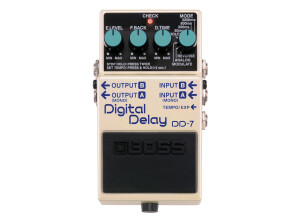
    Besides the Boss DD-3, the DD-7 has to be one of the most recognized digital delays on the planet. You'll see this on almost every guitar player's pedalboard, regardless of the level he or she is at. Players ranging from home rockers to arena guitar heroes. It does this because it's sturdy build and is really easy to use. You get an effect level, feedback time, delay time and mode switch. On top of that, you get an expression pedal input on the side, along with stereo inputs and outputs. Of course you can still run it using mono only, but also from mono input, to stereo output. No wonder it's a favorite amongst so many people! UTILIZATION Tweaking this legend is easy. The effect level knob (labeled as E. Level) is essentially a mix knob, controlling how loud the delay (echo actually) signal is. The feedback knob (labeled F. Back) controls the amount of repeats you get. Pay attention, that if you crank it up to much, the pedal will oscillate. Some find this effect useful, whilst others prefer not to reach that level of repeats. The delay time controls how long each repeat is. Delay time is then controlled by the mode knob, determining what range you can choose the repeat length. As if this wasn't enough. With the DD-7 they give you an analog emulation mode along with a modulation mode. Analog mode is rather self explanatory, while the modulation mode ads a tiny bit of chorus effect to the delay signal. Reverse mode is also available on the DD-7 plus a hold model, giving you 40 seconds of loop time (in mono). Finally you have the Tap Tempo mode. Hold down the pedal for two seconds and the mode switches to Tap Tempo. The expression jack is connected directly to the tap tempo. SOUND QUALITY I actually only used the analog mode once I discovered it. But man does that one sound good! The sound of the delay pedal is widely determined by the processing chip installed, this is also what sets the different delay pedals apart from each other. Does this one then stand out compared to others - hard to tell. It depends upon the ears listening to it. It's not the newest digital delay any more, so it may not sound as good as the new digital ones like TC Flashback delay etc. OVERALL OPINION All in all, you can't go wrong with the DD-7. You can find them for a decent price on the used marked, as it is actually rather old, but still extremely useful. After all, so many persons around the world use it, so I think it's a pedal that's worth holding on to.

  • « Killer delay! »

    This pedal is a killer delay pedal. Does anything you could want! Digital delay at it's best! 8 different delays and a tap tempo external feature. UTILIZATION A little harder to get a delay sound because of the lot of functions on here but in time you will be fine and dig what you come up with! trust me! SOUND QUALITY SOund quality is superb. I've used it on all my pedal boards. Day in and day out this pedal is great OVERALL OPINION This pedal has blown me away. I've only begun to scratch the surface of what this pedal can do, and i've made funky/weird loops of sound, bizarre cricket noises, long delays that instead of fading out actually get LOUDER with time. I dont know how else to say it, If you are looking for a delay pedal, you just found it. This thing can do anything. Also with the price range of 130-160 dollars its a huge bargin compared to other BOSS pedals that might pull off a similar effect such as the RC-2($180-200), or RC-20XL($240-300). Granted i know very little about the FULL capabilities of those pedals, but the DD-7 has up to 40 seconds worth of loop play in "Hold" mode. And the hold mode is so much more sophisticated that what I am familiar with... since previous to this pedal i have only tampered with the DD-3.

  • « Boss 63 Fender Reverb Pedal »

    This pedal digitally reproduces the classic tones of the original 63 Fender Reverb unit. The unit although sounded amazing is powered by tubes and can be somewhat cumbersome and high maintenance. Fender went to Boss and said 'Hey bro, let's make this in pedal form' well OK don't quote me on that, but that is what happened and Boss built Fender's 63 Reverb pedal. My usual expensive 'Yeah I'd like to try this out' pedal shopping extravaganzas. Regularly $129 I was able to score this on sale for $100. It's a simple no nonsense pedal. It can really add that pocket full of sunshine you hear on the old Beach Boys records. The three simple knobs on this pedal are Mixer, Tone and Dwell. Mixer decides how much reverb you are sending out, Tone is a standard treble roll off tone knob like your standard guitar's tone know and Dwell acts as a sustain knob. With the old reverb units every time you tried to move them you'd hear an ear piercing exploding sound from the springs rattling. Well you know what it really is not a problem with me that this pedal doesn't do that, nor can I think of any other negatives. Your regular awesome Boss quality construction you have grown to learn, love and rely on. The Boss Fender 63 Deluxe Reverb pedal sure doesn't top the old tube Reverb units, but it makes life a whole lot easier and sounds great too. This review was originally published on http://www.musicgearreview.com

  • « Boss DD-6 »

    Got it off musicians friend for 130ish, plus another 30 for power, cable and shipping. I wanted to start a pedal collection to replace my digitechs. Bought this as a start. Amazing effects. In addition to standard delay its got a bunch of neato tricks up its sleeve. Reverse delay is amazing; plays your solo backwards! And a warp mode that lets you just build up a wall of noise as long as you keep your foot on the pedal. And my personal favorite: set for 80ms mode, longest delay time, most feedback, low volume and it creates this howl that you can manipulate with the time knob...I use that for a drone sound to riff over. I originally thought that the reverse mode would just alter the dynamics of your playing to sound like it was going backwards. I would have liked that as an option. Also, a way to keep the delay going while playing something without being delayed would be cool. But without those features its still a great pedal and I really dont have anything to complain about. One word: Boss. Need I say more? Great pedal. May seem like alot of money to put down on one pedal, but I have no regrets about it. This review was originally published on http://www.musicgearreview.com

  • « Boss RV-5 Digital Reverb »

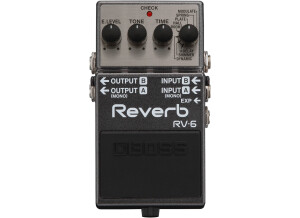
    A few years ago, I bought my dream guitar amp: A Marshall triple channel 6101 30th Anniversary combo with blue tolex covering! Man, that baby puts out 100 Watts with four EL34s and a 240 watt special edition speaker. It has 32 switches and knobs on the front and the back panel is loaded too. Here's the point-it has no reverb! I asked Marshall about this seemingly senseless omission. The rep explained that if a bloke could plop down $2300 USD for an amp, then they should be able to use the reverb of their choice and nobody could agree what sort of verb would suit everybody. So, for years, I used Lexicons, Quadraverbs and all sorts of rack mount gear. Lugging around the rack mount was just getting to be an unplesant ordeal. I used lots of reverb/echo pedals and none of them ever came close to the rack mount equipment until now. I heard about the new Boss RV-5 and had to check it out. I was immediately impressed when I ran it through two amps placed about 12 feet apart in the store. The sounds reminded me of some of the warmth and separation you get with a nice set of headphones. It has both stereo inputs and stereo outputs. Use it with a stereo chorus pedal like the Marshall Supervibe SV-1 and you get that spacious, floating feeling that gives you one of those natural highs. Most pedals seem to have a few great sounds and a hundred useless garbled patches that have names that somebody pulled out of a techno magazine. Let's just say they pulled it out of "somewhere." The pedal has four knobs:effects level, tone, time and mode select. The modes are:spring, plate, hall, room, gate, and modulate. It is quiet and uses the usual FET silent switching. There are plenty of choices. If it seems like I love the RV-5 so much that I take it for long walks and let it share my bed you should wipe those thoughts away immediately. If you plan on using it on a dark stage, forget about tweaking it since you'll be on your knees with a flashlight; which just doesn't have the stage appeal of Jimi igniting his Strat. This thing is no Lexicon by any means but for $139 USD it shouldn't pretend to be. I was not too fond of the plate setting or the "modulate" effect. I'd say that an Alesis Microverb comes way closer to the plate vibe. If you don't know why they call the sound "plate" you better get on the net and Google around because it's not what most people think. The modulate setting is way overdone and is not what I expected. Keep the settings knobs way down on this baby or it launches into overkill mode in a hurry.I like the FX and tone knobs at 10:00 and the time knob at dead noon. One other thing that really makes me want the settings low is that when I go from the clean channel on the Marshall to a boosted channel the effect goes into hyperdrive. So, I finally dial in a cool setting for clean and switching channels is equivalent to reaching down and tweaking the FX level knob to "11." It's not as bullet proof as a Marshall or old Vox Tonebender but it sure beats Danelectro and a host of plastic stomp boxes. If the stereo reverb doesn't knock 'em out, just use it as a bludgeon and that'll take 'em out for sure! I think that the pedal was a bit pricey. I actually bought it locally and got it out the door at $160 USD. I know I could have bought it on the NET for $139 but I had a gig and didn't have the patience to wait around to save $10 bucks (don't forget shipping...er...and handling costs.) I have been looking for years for an affordable stereo reverb stomp pedal and this is a good one. It doesn't rob your tone like the other pedals I've tried. Like I said before, it's still one of those things that you pick a good setting and don't try to mess with it on stage and it definitely does the job quite nicely. This review was originally published on http://www.musicgearreview.com

  • « Good digital tape delay »

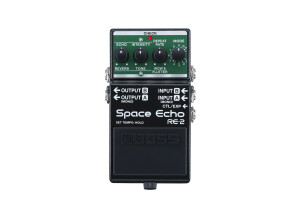
    If you like having effects on your should you probably want to have a tape delay unit. Real tape delay units are becoming very expensive. They require constant maintenence and replacement tape is getting hard to find. With technology now you are able to get a pedal that can simulate all the nuances of a real tape delay in a digital unit. With the RE-20 Boss has been able to replicate the classic Roland RE-201 SPace Echo in digital form. If you remember the old RE-201 it was a big monster of a unit full of delicate electronics and tape. The RE-20 is a twin pedal unit with 8 knobs on the front. The pedals control the on and off of the delay and the tap function. The 8 knobs are Bass, Treble, Reverb volume, Repeat Rate, Intensity and Echo volume. There is also a large 12 mode selector. The unit also had twin inputs and outputs. It also has a jack for an expression pedal UTILIZATION The win pedals are large but they are not labeled. All the knobs are large and labeled. The knobs are big enough to where you can adjust the settings on the fly. The peak level LED is nice so you can see how hard you are pushing the pedal. The tap tempo pedal does what it says. It allows you to tap out a tempo for the delay. If you hold down the tap pedal it also allows you to change the intensity of the delay. You can use batteries but I would not recommend it. A pedal this large will go through batteries very fast. SOUND QUALITY It has a normal mode and long mode. Normal mode gets you up to 3 seconds of delay while long mode gets you up to 6 seconds of delay. The 12 mode selector replicates the 12 modes the original tape delay had. The RE-201 had different modes that used the different tape heads to get different sounds from the delay. The RE-20 simulates this digitally. Some of these different modes are a bit noisy. This may also be on purpose replicating the extra noise you would get from a real tape delay unit. At subtle setting it can act like a reverb pedal and at extreme settings the sound is extreme. Turning up the reverb can get you some crazy sounds. You can even get some wah sounds with this. OVERALL OPINION If you want or had an old Roland RE-201 tape delay and are looking for something cheaper and more reliable this could be the unit for you. It has a ton of features more than anyone should need from just a delay pedal and with its modern design it should last you a long time.