Log in
EN
FR

EarthQuaker Devices

140 products found

Categories
Filter
Sort by
Evaluation
  • Reviewed or not
  • Editor’s award
  • Reviewed by Audiofanzine
Availability
  • Available or not
  • Sold new or used
  • Sold new
  • Sold used
Must-have products
  • All products
  • Flagship products
  • Best rated products
  • Hot products
  • Popular products
Price
  • Freeware
€
Clear
Sort by
  • Popularity
  • User ratings
  • Price - low to high
  • Price - high to low
  • Used price, increasing
  • Used price, decreasing
  • Name (from A to Z)
  • Name (from Z to A)
  • Added on
Sort results
  • Popularity
  • User ratings
  • Price - low to high
  • Price - high to low
  • Used price, increasing
  • Used price, decreasing
  • Name (from A to Z)
  • Name (from Z to A)
  • Added on
Filter results 140 results found
Evaluation
Availability
Must-have products
Price
  • Freeware
Show results

The best EarthQuaker Devices reviews

The reviews Audiofanzine members found the most helpful.
  • moosers's review

    The EarthQuaker Devices Dirt Transmitter is a fuzz pedal suitable for all electric instruments, but designed for use with electric guitar. The pedal is an analog one, consisting of a standard make up with a 1/4" input, a 1/4" output, and options for powering it with either a nine volt battery or external power supply. It isn't rack mountable as it's a stomp box. UTILIZATION The configuration of the EarthQuaker Devices Dirt Transmitter is rather simple, as I was able to catch on quickly. It's got knobs for controlling bias, fuzz, level, and tone. If you've ever used any sort of distortion, fuzz, or overdrive pedal before, you'll notice that this is a fairly recognizable make up. I haven't seen the manual for this pedal, nor do I believe one is necessary. SOUND QUALITY The sound of the EarthQuaker Devices Dirt Transmitter is really cool for what it is, and what it is is a thick fuzz that's great for getting a beefy rhythm guitar part or a heavy lead sound. I would say that I like it best for a nice and fat rhythm tone, as it really gives you a wall of guitars sort of sound. I'm not sure that this is the kind of pedal I'd be using on a daily basis if I had it, but as an extra color to have as needed, it's really a great pedal. Of course there will be those out there who will be using this sort of sound all the time, and the Dirt Transmitter will certainly excel in both roles... OVERALL OPINION While I'm fairly new to pedals made by EarthQuaker Devices, the Dirt Transmitter is a great fuzz box. It's not the most versatile fuzz in the world, but you can definitely get a good amount of varying tones with the given parameters. Again, I'm not sure that this sound is something that I'd personally be using all the time, but it's definitely got a great sound and when used in the right situation will shine. If you're looking for a great fuzz box, the Dirt Transmitter is a pedal worth knowing about.

  • moosers's review

    The Earthquaker Devices Disaster Transport Jr. is a compact delay pedal that is designed for use with electric guitar, but suitable for use with any electronic instrument. However, I’ve only used the pedal with electric guitar, so I’ll be focusing on use of the pedal here. It’s got a pretty standard configuration in terms of it’s general characteristics, with ¼” connections for input and output and a nine volt power supply jack. The pedal isn’t going to be rackable in any fashion as it’s a foot controlled pedal. UTILIZATION You don’t need to know much or have much experience with other delay pedals in order to use the Earthquaker Devices Disaster Transport Jr. The controls that they give you to work with here include those for time, repeats, mix, and tone, which are all pretty self explanatory parameters, even if you’re new to using delay pedals. A manual isn’t something that I’d think would be necessary here… SOUND QUALITY The tone of the Earthquaker Devices Disaster Transport Jr. is incredibly open and wide. It’s a really clean sounding delay pedal as you won’t get any extra sounds or noises other than the repeats. The sound of the pedal reminds me a lot of the type of delay The Edge would use from U2, although I know his delays are much more in depth than this – it’s just that kind of vibe. I’ve used the pedal for a recording session with a Fender Telecaster and a Fender Pro Reverb amplifier. OVERALL OPINION The Earthquaker Devices Disaster Transport Jr. is the perfect little delay pedal if you’re going for this kind of sound. Of course there are endless varieties of delays out there, and while I wouldn’t say that this is the most versatile delay pedal on the market, for what it can do, it’s really great for it. If you don’t use delay all that often, the pedal will undoubtedly do the trick for you, but if you’re looking for something with a bit more control, you’re probably going to need to look elsewhere or use this in tandem with a different type of delay pedal. Having said this, if you had to have one type of delay in a compact unit like this, the Earthquaker Devices Disaster Transport Jr. would be a terrific choice!

  • « erie sounds »

    The EarthQuaker Gost Disaster Synthesizer is actually a guitar pedal as well as a synthesizer. It functions like a guitar synthesizer, except with one crucial difference; it doesn't need a special synthesizer pickup! No, this pedal simply uses the pickups on your guitar instead. This pedal is not capable of being edited with a computer, and is not MIDI-capable. I'm not sure whether or not it is an analog pedal, but I believe it is, since it sounds a lot like an old-school analog synth. This pedal is not rackable. UTILIZATION The editing of effects on this pedal isn't too difficult. It's got a few more features than most pedals, but that's because it has a pretty broad range of possible sounds. It is controlled mostly by faders. The first fader is a master volume. The next four faders control the mix of octave effects on the signal. There is a fader for sub-octave (or an octave below the signal), a fader for the original dry signal, a higher octave fader, and a fader for the "square-wave" signal. The square wave signal is what makes the signal come off as very "synth-y". There is a fader for attack delay, which basically allows you to fade in with every note played (this creates awesome synth effects). The remaining four faders control the envelope, and the rates at which it is filtered. SOUND QUALITY The sounds that come out of this are pretty cool for the most part. It actually has a few that really do sound like an analog synth from the late 70s/early 80s. There are some other tones on it that really also give you a great sound. Between the octave effects and the envelope filtering, this thing gets some pretty cool sounds. The fact of the matter, however, is that there are a lot of people who wish to emulate the sounds of other instruments on the guitar. Unfortunately for them, this pedal has no way of doing that. It simply emulates the Moogs and other synths from the days of old. This pedal really colors the sound drastically, which is sort of the point. If that's a problem for you, avoid this pedal. It's also not true bypass, which means it slightly colors the signal even when switched off. OVERALL OPINION I think that this is a pretty cool box for guitarists. My main beef with it is that chords, with the exception of power chords, almost always come out sounding kind of crappy. It's mainly a single note, power chords type of box. Also, the price almost makes this not worth it for me, and I'd almost rather buy another synth than buy this. Regardless, this is still a great pedal, and one that certainly can be very useful if you know how to use it.

  • « Vintage album tones »

    The Earthquaker Devices Chrysalis is a little different than most overdrive pedals. Instead of trying to sound exactly like vintage amps the Earthquaker Chrysalis emulates the sound of these amps on records. When you think back to your favorite tones most you are thinking of album tones that you have heard on the radio for years and years. The Chrysalis emulates these tones. The cool green color and funky font on the pedal lets you know that this thing has the 70s in mind. The pedal has your basic overdrive pedal layout. It has 3 knobs and a on and off switch. It has a level knob a tone knob and a drive knob. One thing that makes the layout of the pedal different is the indicator LED is by the on and off switch. The pedal can be powered by either a 9 volt adapter or an 18 volt adapter. It can also be run by a 9 volt battery. They say the 18 volt adapter gives more headroom and better tone but I do not really notice it. UTILIZATION The pedal has the same general layout as most overdrive pedals with the 3 knobs on the face. The knobs on this one are a little close together it seems but I can still adjust them fine. With the LED indicator light down by the on off switch I tend to cover it up when I go to switch on the pedal with my foot. I would prefer the light to be at the top of the pedal. With the light under your foot you dont know if the pedal is on or not until you lift your foot up. This isnt a problem when the LED light is on the top of the pedal. The pedal is true bypass which means it will not color your tone when you dont want it to. I would expect nothing less from a pedal at this price. SOUND QUALITY Through a clean amp when you switch this pedal on it is a flood of classic album tones. The pedal always keeps its clarity. Even when playing a fat Les Paul the sound is great with a good amount of bite. With the gain cranked you get a nice hot classic rock tone. At every setting the pedal has a ton of responsiveness and clarity. The pedal is essentially about midrange and presence, and even with the Tone knob all the way down, the signal remained lively and defined without sounding either flabby or muffled. This impressive midrange performance is essentially where the Chrysalis lives up to its billing as all your favorite 70s album tones in a single pedal. The pedal would be perfect if it wasnt so noisy. I guess this is a part of the 70s sound that they could have done with not copying. You may need to use a noise gate if you are using this pedal. OVERALL OPINION This pedal sounds like a fully produced 70s album guitar tone. It is pretty amazing that a single pedal can sound like everything you hear on the classic rock station on your radio. Its clarity and responsiveness mean that your sound will never get lost in the mix and you will always sound great. Make sure you use a noise gate though because this pedal will start misbehaving at loud volumes.

  • moosers's review

    The EarthQuaker Devices Hummingbird is a unique tremolo pedal for electric guitar. While it's definitely a sort of tremolo, it's not your typical sound as it's quite choppy and has it's own unique sound to it. There is an updated version of the pedall that has more parameters and gets more in depth, but this review is for the original pedal. It's an analog pedal that has 1/4" jacks for input and output and can be powered by either a nine volt battery or power supply. It's not rackable as it's a stomp box. UTILIZATION Using the EarthQuaker Devices Hummingbird pedal is incredible simple. There are two modes to choose from, ambiguously labeled flutter and flap, which essentially just gives you two different tremolo timbres to choose from, while the rate knob allows you to set how fast or slow you'd like the effect to be. Most users will be able to figure out all the ins and outs of this pedal without the manual. SOUND QUALITY The sound of the EarthQuaker Devices Hummingbird is really cool as it gives you a unique tremolo sound for sure. I wouldn't say it reinvents the wheel when it comes to tremolo, but it's got it's own vibe to it that isn't something you'll hear on to many other vibrato pedals. This version of the pedal doesn't have too much room to mess around with, but it's still possible to get a good amount of varying tones just by messing between the two modes and the rate knob. If you're looking for a harsh and choppy tremolo, this is the epitome of what you're after. OVERALL OPINION While it's probably worth it to check out the newer version of the EarthQuaker Devices Hummingbird first, it's definitely worth knowing that the original is a nice pedal in itself. It doesn't offer the same amount of control, but you're getting the basic effect here that I find gives enough variation anyway. If you're after a more traditional tremolo/vibrato pedal, I'd look elsewhere, but if you're looking to get adventurous, it's definitely advisable to look into the Hummingbird.

  • moosers's review

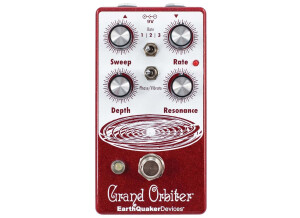
    The EarthQuaker Devices Grand Orbiter is a phase shifting pedal for uses of all types, but primarily designed for electric guitar. It's an analog pedal that consists of 1/4" jacks for input and output, and a nine volt jack for a power supply as well as a battery option. It isn't going to be rack mountable since it's a stomp box. UTILIZATION The configuration of the EarthQuaker Devices Grand Orbiter isn't hard to follow and at the same time it has a lot to offer. There are two different rates to choose from, as well as both phase and vibrato modes. It also has parameters for rate, sweep, depth, and resonance, which should seem familiar if you've used phasing pedals before. I haven't had access to a manual, nor have I ever felt I needed one. SOUND QUALITY The overall tone of the EarthQuaker Devices Grand Orbiter is outstanding. While perhaps it doesn't have the warmth and depth you'd get with a vintage phaser pedals, it still has a very full sound and is capable of achieving many different types of sounds. I love turning it up enough where you can get a little vibrato happening, but where this pedal earns it's living is with the more traditional sort of phasing tones, which are absolutely dynamic. It's a very versatile and flexible pedal, as there are just so many different sounds possible here... OVERALL OPINION The EarthQuaker Devices Grand Orbiter is definitely a phaser pedal for the experienced player, as it's in depth and has a professional sound, with the price tag to match. You can definitely find more expensive pedals out there, but at almost $200 USD, this one certainly isn't cheap. Having said this, if you're using phasing a lot I would say it's worth it to spend the extra money to have an absolutely awesome phaser on hand for years to come. The Grand Orbiter is a pedal worth being aware of and trying out if you're a phaser pedal fan for sure.