Log in
EN
FR

Doc Music Station

40 products found

Categories
Filter
Sort by
Evaluation
  • Reviewed or not
  • Editor’s award
  • Reviewed by Audiofanzine
Availability
  • Available or not
  • Sold new or used
  • Sold new
  • Sold used
Must-have products
  • All products
  • Flagship products
  • Best rated products
  • Hot products
  • Popular products
Price
  • Freeware
€
Clear
Sort by
  • Popularity
  • User ratings
  • Price - low to high
  • Price - high to low
  • Used price, increasing
  • Used price, decreasing
  • Name (from A to Z)
  • Name (from Z to A)
  • Added on
Choose a category
Sort results
  • Popularity
  • User ratings
  • Price - low to high
  • Price - high to low
  • Used price, increasing
  • Used price, decreasing
  • Name (from A to Z)
  • Name (from Z to A)
  • Added on
Filter results 40 results found
Evaluation
Availability
Must-have products
Price
  • Freeware
Show results

The best Doc Music Station reviews

The reviews Audiofanzine members found the most helpful.
  • « Smooth Saturation to Aggressive Fuzz »

    SOUND: https://www.youtube.com/watch?v=DUjs1lKI1jE With two germanium transistors the 2 SA 202 model (which also uses those type of transistors) of Vintage Fuzz II replicates the famous Fuzz Face sound of Jimi Hendrix. However, unlike older models of fuzz (and even some current ones), this fuzz is very quiet with a barely an audio ‘ssshhhh’ when turned up full. With the Bias rotated fully clockwise there is a velvety fuzz tone reminiscent of the 1960s and 1970s, but this Vintage Fuzz II model offers so much more. Turn up the Fuzz only half-way and with the Bias cranked fully counter-clockwise (or thereabouts) and you can achieve some very classic rock sounds on a clean amp channel that produces a breaking-up and overdriven quality without any mess or fuss. When combined with a driven or ‘hot’ amp the Vintage Fuzz II calms the harshness and warms the signal, although I recommend keeping the Fuzz level between 9-o’clock and 11-o’clock at most. Not only do you get a more organic tone when combining this fuzz with a more modern type amp, but the effect is more 3-D to the ears as the harmonics jump out like crazy. OVERALL IMPRESSION: Developed by Doc Music Station (France), Vintage Fuzz II (2 SA 202 model) is a highly diverse fuzz and at a fair price of 159 Euro. This model is powered with two SANYO NOS 2SA202 transistors (hence the sub-name of the pedal) to bring you closer to Hendrix himself. Consequently, Denis over at Doc Music Station did an outstanding job at reproducing the old Fuzz Face, but this pedal proves superior in both noise reduction and versatility in how it interacts with amps and other pedals at various levels of ‘fuzz’ and ‘bias.’ Whether you’re trying to re-create classic or psychedelic rock tones, or even to tame some high-gain amps to produce a less sterile sound (with added warmth and dynamics), the Vintage Fuzz II (2 SA 202) is a worthy investment. Previously I reviewed the Vintage Fuzz II MP 41 MKII model, which is a fuzz, but more of a ‘tone bender.’ Below is a comparison video of three other types of Vintage Fuzz II pedals (including the 2 SA 202), for those who want hear the distinct tones: https://www.youtube.com/watch?v=9oBa_M2DO0o&t=25s EASE OF USE: https://www.youtube.com/watch?v=DUjs1lKI1jE The Vintage Fuzz II 2 SA 202 varies considerably in tone and whether you want a thick, heavily saturated fuzz sound, or a moderately distorted rock ‘n roll sound. Of course, the effect of this pedal when combined with a clean amp or dirty amp signal varies considerably, and the degree of Fuzz and Bias will need to be adjusted accordingly and relative to your needs (and sound of the amp). With a clean amp you can produce a nice rock sound (similar to going through a Fender Bassman amp) with some decent breaking-up and with the Fuzz at low to moderate levels and the Bias turned toward counter-clockwise (keeping the Fuzz relatively low and the Bias up full counter-clockwise works as a nice boost as well). Obviously, if the Fuzz is up very high you can get a rumbling fuzz (Bias toward counter-clockwise) to a very velvety fuzz (Bias all the way clockwise). When combined with a dirty amp, even a high-gain amp, you can use the Vintage Fuzz II to tame any harshness, make the tone thicker and increase harmonics and dynamics considerably. In the demo video I added the Vintage Fuzz II to a modern amp tone (via the Le Lead preamp) and the result was much richer and with improved character. The fine graininess and squeals produced sound fantastic to my ears. RELIABILITY & DURABILITY: Measuring in at 113 x 67 mm (about 4.25 x 2.25 inches) and weighing 230g (8oz), the Vintage Fuzz II is of standard pedal size. Its chassis is a Hammond 1590B aluminum case that is both lightweight and provides shielding of the electronic card. One-hundred percent Analogy and a True Bypass pedal, the Vintage Fuzz II has quality plastic knobs and the pots feel both solid and smooth when turned. It has Neutrik jacks and Alpha 16mm potentiometer faders for Fuzz, Volume and Bias pots. Other audio components comprise of carbon resistors and Panasonic CF and SMF capacitors. The footswitch is somewhat close to the Bias knob, but that knob is of a good quality, and so any slight stomping pressure on the Bias knob should not pose any concern. The LED on/off light is small and well protected by the three knobs. It is powered by a standard 9VDC (negative center) power supply, and due to its internal voltage inverter this pedal can be powered with isolated outputs or not. https://docmusicstation.fr/en/fuzz/45-vintage-fuzz-2-2sa202-3172668180510.html

  • « Classic Growling Fuzz »

    SOUND: An outstanding job replicating that classic 1960s and into the 1970s heavy, thick fuzz sound, you can’t go wrong with the Vintage Fuzz II. With the Fuzz level up full you do not get that thin searing sizzle you hear from some more modern-day counterparts, but a slight breaking up quality that places the Vintage Fuzz II into the category of part fuzz, part distortion and part overdrive. As you turn back (reduce) the Fuzz level it produces a more distorted and thicker quality, which is even more obvious as you adjust the Bias level for a more stabbing or bubbling effect to the tone’s quality. And once you crank out some heavy riffs you can hear the emergence of early Black Sabbath and dark Metal. What makes the Vintage Fuzz II so useful is that it cleans up so nicely when you dial back your guitar’s volume. You can put the Fuzz level up high and get that famous vintage fuzz tone, but as you ease off on the guitar’s volume it sounds more crunchy and distorted… and without losing too much overall volume in the process. It sounds awesome on a clean amp channel (with a hint of gain), but works very well and adds a new dimension to a high-gain channel’s tone. When doing so, I found it best to ease off on the amp’s gain and then add in the Vintage Fuzz II at only quarter way on the Fuzz level for a huge sound. OVERALL IMPRESSION: Developed by Doc Music Station (France), Vintage Fuzz II (MP 41 MK 2 model) produces that classic hard-hitting fuzz tone at a fair price of 159 Euro. Denis (the designer of the Vintage Fuzz II) refers to this pedal as a Tone Bender, powered with three Germanium Russian NOS MP 41 transistors to help you attain the tones of Led Zeppelin, The Who and The Rolling Stones. I also hear quite clearly some Black Sabbath in the mix. The Fuzz knob on its own makes it sound great, and anywhere from a heavy breakup to a grainy sizzle (with a heavy sound that easily enters the feedback zone), but you can really makes some awesome tone changes in the attack and aggression by adjusting the Bias knob. This is one of the best fuzz pedals I have tried that actually mimics that early fuzz tone and is unlike many of the ‘modern’ fuzz pedals out there. Used with a clean amp or very carefully and sparingly with a high-gain amp, there is a ton of tonal options available, particularly as you adjust your guitar’s volume knob. EASE OF USE: The Vintage Fuzz II allows you to dial into somewhat smooth tones to thick and heavy tones. When you turn the Fuzz level all the way up, the tone becomes more saturated and smoother. However, even up full you get a nice grain and edge, while not being a smooth as more modern-day fuzzes (which is why this is a ‘Vintage’ Fuzz). As you dial back the Fuzz level it takes on more of a distorted or over-driven sound, which makes it less fuzz-like and, consequently, more diverse. Certainly there is some fuzz quality when dialed back, but it simply sounds edgier like a Fender Bassman amp being pushed to the limits. The Bias control, likewise, either keeps the signal smoother (turned all the way clockwise) or rougher around the edges with a stabbing quality (turned all the way counter-clockwise). The Level merely controls how loud the signal is, although the tone becomes more hardcore when you push the Level past 1-o’clock. Those three controls then need to be coordinated a bit, since as you increase Bias aggression the volume does increase. As you increase the Fuzz level the volume also increases (although it tends to stabilize around 1-o’clock). And, obviously, as the Level increases so too does the overall volume. The other minor coordinating factor is whether you adjust your guitar’s volume knob, since doing so does produce a different tone (besides affecting volume somewhat) and will affect the fuzz quality or characteristics. RELIABILITY & DURABILITY: Weighing 230g (8oz) and measuring in at 113 x 67 mm (about 4.25 x 2.25 inches), the Hammond 1590B aluminum case is both lightweight and provides shielding of the electronic card. The plastic knobs feel of good quality, and when turned the pots feel both solid and smooth in quality. The audio components comprise of carbon resistors, Wima silver mica capacitors, and the Vintage Fuzz is protected against over-voltage and reverse polarity. The cable input/output both are located on the sides, as well as the power supply insert (standard 9v 2.1 mm), and so there is minor concern with stomping and hitting any of the inputs/output. This true bypass pedal also has Neutrik jacks and Alpha 16mm faders for the Gain, Volume and Tone pots. The footswitch is somewhat close to the Bias knob, but that knob is of a good quality, and so any slight stomping pressure on the Bias knob should not pose any concern. The LED on/off light is small and well protected by the three knobs.

  • « A Pedal for Plexi Lovers »

    SOUND: Designed to provide that classic Marshall Plexi sound, the Ermynn II is demonstrated in accompanying YouTube video. The Ermynn II is not a high-gain pedal when played through a clean channel (with low or modest gain), but offers some very sweet overdriven sounds, from a bit of grit when turned low to a more searing and edgy tone when cranked full. When combined with a crunch channel or even a high-gain channel (obviously you don’t need much Gain from the Ermynn II in such an instance), the tone achieves the next level of dirt and energy quite nicely and helps to give some added balls to your amp. You not only hear this in the notes’ sustain and singing quality of leads, but also when playing some muted chugs that are far punchier in quality. The Tone knob is very sensitive, and in two ways. First, a slight tweak can produce too much or too little bass or treble response, which brings us to the second point: There is an enormous variation from all the way toward bass and all the way toward treble. This makes the Ermynn II very responsive to thin, weak and trebly pickups or dark and muddy pickups, thus allowing you to dial in with added precision. OVERALL IMPRESSION: The Ermynn II was developed in France by Doc Music Station; it is an easy to use pedal at a fair price of 179 Euro. It is a scaled down and smaller version from the original Ermynn. It sounds perfectly fine on a clean channel, particularly if you don’t want excessive gain or dirt, but really shines when added to a crunch or high-gain amp (in doing so, you don’t need as much gain or drive from the amp, while keeping the pedal’s gain less than half-way). It has an unmistakably cool paint-job with solid construction in all its parts, from the chassis and knobs to its guts. The drive or distortion is governed by JFET transistors (located between the input and output of the sound) and is very sensitive with both the Gain and the Tone, thus making it appropriate for music requiring just a hint of dirt (e.g., jazz or blues) to classic and modern rock (particularly when combined with a dirty amp channel). The JFET transistors help reproduce that Plexi tube sound to create a natural saturation and organic sounding tone, but while remaining very quiet (even when turned up full). EASE OF USE: How much Gain needed from the Ermynn II varies considerably, and depending on how clean, crunchy or high-gain your amp’s channel. With a clean channel I like the pedal’s Gain up full or darn close, as doing so produces an edgier tone (too much for most jazz or blues and more appropriate around 10-o’clock for those genres). Once I add the Ermynn II to some dirt, setting the Gain at about 10-o’clock seems sufficient, although that depends on how much dirt you’re getting from the amp (if it’s very dirty, then simply having the Ermynn II on with Gain almost off completely produces a nice fullness with added harmonics to the sound). The Level works in conjunction with the Gain, in that the lower the Gain, the higher the Level needs to be, which should be common sense. However, once the Gain reaches about 1-o’clock I found there no need to further tweak the Level… you can keep increasing the Gain and the overall volume does not increase that much. The Tone knob does add some volume, as you progress from full counter-clockwise to clockwise (from maximum bass to treble); and so, there is a bit of tweaking of the Level knob depending on the degree of bass or treble added and to balance out the overall volume. The Tone knob is very sensitive – slight movement of the Tone knob can produce a bit too much bass or treble, and so you need to know your setting well for proper dialing in when gigging. RELIABILITY & DURABILITY: The Hammond 1590B aluminum case is not only lightweight, weighing 230g (8oz), but it provides shielding of the electronic card. Measuring in at 113 x 67 mm (about 4.25 x 2.25 inches), the plastic knobs feel of good quality, and when turned the pots feel both solid and smooth in quality. The audio components comprise of carbon resistors, Wima silver mica capacitors, and the Ermynn II is protected against over-voltage and reverse polarity. The cable input/output both are located on the sides, as well as the power supply insert (standard 9v 2.1 mm), and so there is minor concern with stomping and hitting any of the inputs/output. This true bypass pedal also has Neutrik jacks and Alpha 16mm faders for the Gain, Volume and Tone pots. The footswitch is somewhat close to the Tone knob, but that knob is of a good quality, and so any slight stomping pressure on the Tone knob should not pose any concern. The LED on/off light is small and well protected by the three knobs. https://docmusicstation.fr/en/overdrive/27-ermynn-2-3172668150339.html

  • « Get a Marshall JCM800 in a Pedal »

    SOUND: The Mystere, by Doc Music Station (France) is a fully analog preamp, allowing you to achieve the tone of a Marshall JCM800 in a pedal: The JCM800 is one of the most popular Marshall amps (used by Clapton, Hetfield, Wylde and many others) producing excellent singing highs for leads, but also unmistakable crunch tones. The Mystere is no exception. Turn up the Preamp just a little and you get a bit of bite, ideal for some dirty rhythm and some Blues leads. But as you crank the Preamp you get that in-your-face 1980s biting tone. The Presence knob seems to work very well with the Preamp, as you can have the Preamp rather high and it doesn’t sound nearly as dirty if the Presence is low or off, but as you increase the Presence to about 9-10 o’clock the Mystere really comes to life. I also was impressed with the Bass, Middle and Treble – not so much the range of each, but that nothing sounds excessive. For example, pushing the Bass and Middle up full does not produce a muddy signal and the Treble up high sounds clean and clear, as opposed to brittle. OVERALL IMPRESSION: Mystere can be translated as Mystery (or ‘a religious truth via divine revelation, hidden spiritual significance’), Denis over at Doc Music Station named the pedal after his dog, which I think I like better and shows how personal this pedal project is. Available for purchase direct from Doc Music Station (209 Euro) or via Reverb.com, the price is reasonable for the Mystere because of its sound (and it’s a lot smaller than a JCM800 head), while producing a very authentic tone with amp-like responses. You can place it direct to an amp (clean or dirty), but Doc Music Station indicates that it sounds best in the Effects Return Loop, or direct to a CAB simulator for direct send/mixing to a DAW (which is what I did in the demo video). One thing for certain is that the Mystere is a darn cool looking pedal with the grill and color matching of a Marshall head, as well as the same type of knobs. It operates on a standard 9V power supply. EASE OF USE: Easy enough to use, as though working with the JCM800 Marshall head, the Mystere does require some minor tweaking in order to get the degree of tone, crunch and sustain you want. No surprise there. The Master control allows you to crank into high-gain territory while keeping the overall levels as low (or as high) as you wish. This works in conjunction with the Preamp (since the Preamp increases volume as the drive/gain increases). However, as you up the Presence, Bass, Middle and Treble, there also is a modest increase in volume. Presence provides a surprising amount of dirt and bite to the tone and works in conjunction with the Preamp. A good dose of Preamp can sound good, but as you get the Presence to about 9-o’clock or a touch higher you really can hear the dirt kick in. As well, the Mystere functions wonderfully with other pedals, including Tube Screamers, fuzzes, distortions and overdrives – accordingly, you may need to adjust the Preamp level and/or the amount of output of the pedals to get the best mix. RELIABILITY & DURABILITY: The Mystere, measuring in at 3.75 x 4.75 inches (9.5 x 12.0 cm), has an obvious Marshall vibe with a smooth finish to its paint. The chassis feels heavy and is made of aluminum (a Hammond 1590BB aluminum case that provides shielding of the electronic card). The LED ‘on-off’ light is far situated from the foot switch and between two knobs (Preamp and Presence). The footswitch has a solid click to it and may be close to some of the knobs, but those are very heavy in construction and should not pose an issue with aggressive stomping. The guitar cable input and output both are located on the sides, but since the Mystere is a somewhat wide pedal there’s plenty of room for stomping without hitting any cables. The power input is located along the side and toward the front, although it does not appear to be an awkward place for strain when switching the Mystere on and off. The plastic knobs with aluminum toppers are of heavy construction and the pots are of good quality when turned. The true bypass Mystere contains some high quality audio components, including carbon resistors, capacitors a Panasonic SMF FC and Silver Mica, as well as PCB double sided plated through holes FR4 with front and back ground plane, Neutrik jacks, and Alpha 16mm faders. Finally, the pedal is protected against overvoltage and reverse polarity.

  • « Chorus and Vibrato with Three Different Modes Equals Diversity »

    SOUND: The Piem II produces some lush and ethereal sounds, from classic vibe and chorus to modern prog shimmers, as demonstrated in the YouTube video below: Unique to the Piem II are the various settings and that you get to choose a Vibrato (tremolo) or a Chorus. And with each you can choose a Classic, Normal or Leslie sound. I'm not sure why it's called Normal, but if I were to compare it to the Classic I would say the Normal mode is more subdued and passive, whereas the Classic is more aggressive (which means controlling the amount of Depth or mix to avoid an effect that sounds too detuned). I like either, as each mode sounds very different. However, what I really like is the Leslie mode, so that your vibe or chorus can have a swirling Leslie speaker type result, which is very 'dreamy' to the ears. There is some minor noise coming from the Piem II, but only on the Classic setting (common among vibrato/tremolo pedals)... and you only hear it if not playing (and mostly if using a high level of Speed). Otherwise it's minor and not very obvious, and absolutely quiet on the Normal and Leslie settings. The reason for the subtle noise on that one particular setting (not sure why the other settings are whisper quiet) is that the way a vibrato/tremolo works, viz., by engaging and disengaging the signal repeatedly, whether slowly or quickly, to give that phasing in and out quality. Bear in mind that is just a minor hiccup in such a great pedal... and, again, it’s barely noticeable, but I thought I would bring it to your attention… you might even hear it the odd time in the demo. I've heard other tremolo-type pedals that are very obvious in the 'sshhhh' department, but only when you stop playing. The only other minor glitch is that you can hear the switching when you move from Classic, Leslie and Normal. OVERALL IMPRESSION: Developed by Doc Music Station (France), the Piem II is a smaller and newer version of the Piem. Now, just what does Piem mean? One would think it has significance to the nature of the pedal, but Denis, the designer of the pedal, was nicknamed Piem during his teen years, and so he must have felt a personal connection to this vibe/chorus merger. Regardless of the name, it's wonderful to have a vibe/tremolo and a chorus under one chassis. Typically you would not use both at the same time (although there may be some compositions out there doing just that), and so being able to choose between the two, and then being able to choose the style or nature of the vibe/chorus is pretty cool. You can get that Classic or vintage quality, a more modern or 'Normal' sound (less intense) or a swirling wave-like Leslie. Priced at 179 Euro, it's not an inexpensive pedal, but you do get two pedals in one... and in a standard size to save on pedal board real estate. A decent deal overall and it sounds fantastically clear and defined. EASE OF USE: This pedal is not difficult to use, but it does requires some tweaking to achieve a proper speed and mix. The Chorus has an obvious multi-instrument sound ( very separated to the ear, as though there are two instruments), which is different from a tremolo type effect with the Vibrato. If choosing the Vibrato, the Speed needs to be set so that it matches the tempo of what you're playing (although nothing wrong with a faster speed when playing slower, although too slow a speed will not pick up effectively when playing quickly). Obviously a more subtle result (to shape your tone) necessitates less Depth or 'mix' than an effect more in-your-face. The Chorus works by doubling up on the signal via detuning. Too much Depth and Speed can produce some wacky results, whereas just enough of either gives you anything from a lush tone to something that resembles a mandolin or 12-string guitar with distinct separation of the notes. And you can produce significant differences among the 'mode' choices, with Classic being more intense or aggressive in its signaling than the Normal mode. The Leslie is very different from the other two in that it produces a swirling wave effect, which is great for those dream-like ethereal compositions. RELIABILITY & DURABILITY: The true bypass Piem measures 2.5 x 4.25 inches (113 x 67 mm) and has an aluminum chassis with a gloss painted ocean blue finish (waves and all, likely to reflect the waves of a vibe or chorus effect). The chassis is a Hammon 1590B model that provides shielding of the electronic card. The LED ‘on-off’ light is far situated from the foot switch and between the two knobs (Speed and Depth). The footswitch has a solid click to it and is somewhat close to the switches to choose between Vibe/Chorus and the respected modes, and so exercise a little care when stomping. Likewise, the guitar cable input and output, as well as the power input (standard 9V DC), are located on the sides, all of which necessitate some obvious care and caution to prevent strain on the cables and inserts. The plastic knobs for Speed and Depth are of heavy construction and the pots are of good quality when turned. The audio components comprise of carbon resistors, Wima silver mica capacitors, and the Piem II is protected against over-voltage and reverse polarity.

  • « Diverse Overdrive Serves More than Just the Blues »

    OVERVIEW: This pedal may be dedicated to the Blues (and the tones associated with the genre), but Blues Delight II certainly acts as an effective drive to push higher-gain amps, due to its very clean to dirty range in both distortion and drive. On a clean amp you can achieve full-bodied tonal improvement, but also get into the realm of crunch and edgy lead (this will depend on how clean your amp is, of course, and I demoed on The Countess’ clean channel, which is very clean and slightly glassy). The reason for such broad responses is that this pedal has three positions (Clean, Soft and Hard) that affect the Drive knob. The Clean mode definitely is clean, offering very mild boost and fullness to the notes, particularly if the Drive is not up too much. The Soft mode pushes the signal somewhat hard, to add edge to the notes, ideal for crunch and moderately intense lead tones (relative to the Blues); soft mode uses MA858 diodes placed in the loop of the operational amplifier (chip). Hard mode increases drive and distortion for a more searing and saturated tone; it places the diodes at the output of the operational amplifier. In all, there are several combinations when you combine the three modes with varying degrees of drive and with a clean vs. driven amp channel. Moreover, like many amplifiers, there is a trim pot under the hood of Blues Delight II that allows you to adjust how much Presence you want in the signal, from very dry to very sparkling. Overall, Blues Delight II allows you to achieve varying degrees of tube amp warmth while respecting the character of the gear you’re using. I did not demo the Presence trim pot inside the pedal. I liked the setting at the half-way point, which added some sparkle, but did not make the guitars sound bright. When turned all the way down I found the pedal sounded a tad dark or dull, but all the way up it sounded too bright. Of course, that would depend on your pickups and preamp/cabinet choices, and so consider my preference in that regard. GENERAL USE: There are a lot of options with this pedal, and so some experimentation is required with the Blues Delight II, particularly with different pickups (on the same guitar or other) and depending on the gear used. In other words, there are several options, which I’ll address in brief. The three knobs are straight forward enough, being Drive, Tone and Level. How much push, how loud and what EQ you want can be dialed in quickly. However, this pedal also has three settings of Clean, Soft and Hard, all accessible via the toggle switch and all of which need to be coordinated with the Drive (specifically). The Clean mode (center position) produces a very dramatic and open sound – very much like a clean boost, although with the added Drive as set by that knob. The Soft mode pushes the signal harder than Clean, in case you want that added energy in your tone. The Hard mode increases distortion and overdrive even further. Overall, the sound can range from very full and broad without adding any notable distortion and all the way up to edgy Rock lead. The Blues Delight II has one other trick up its sleeve… or in this case, under its hood. There is a Presence adjustment (a blue trimmer) that allows you to add sparkle to the signal. The demo included with this review has the Presence set midway. Blues Delight II does not run on batteries and requires a 9VDC power supply.

  • « Best Overdrive I've Used! »

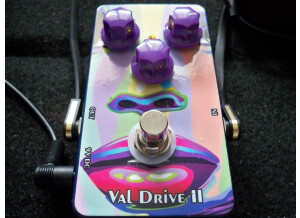
    SOUND: Val Drive II has found a home on my pedalboard. With a drive that ranges from mild to moderate, it provides a good ‘zing’ to clean channels, so that you have something between clean and dirty. So far, so good, and the quality of the drive is excellent with its mild grain that also has a hint of smoothness and warmth in its character. When it comes to dirty channels, particularly those dark in quality (or perhaps a tad muddy, particularly when combined with speakers or guitar pickups that are on the dark side), Val Drive II is incredible sounding. It not only adds a bit extra hair to the dirt, but it clears the signal so that it cuts through the mix even better. That may sound redundant, in that it adds dirt and clears up the signal, but that’s exactly what it does, and without sounding trebly. In one sense it has a slight treble booster character in how it gives that perky spark or clarity to a guitar tone, yet its effect is more robust throughout the entire EQ spectrum. Interestingly, the Tone knob sounds very different (in scope) on my clean vs. dirty amp channels. On the clean channels you get a lot of bass or a lot of treble while dialing all the way back or forward. Conversely, on my dirty channels the entire EQ spectrum on the pedal is usable without sounding like there’s too much bass or too much treble. I’m uncertain why the Tone knob behaves differently in different instances, but it’s easy to dial in a good sound regardless. OVERALL IMPRESSION: Based on the legendary sound of the JRC4558, Val Drive II has an asymmetrically clipping circuit with silicon diodes on one side and a silicon diode in series with germanium diode on the opposite side (giving it a more modern vibe). The JRC4558 integrated circuit was designed by the Japan Radio Company and has been used in a number of famous effects, including the Orange Squeezer, DOD YJM 30, Boss OD1 and the Tube Screamer. Val Drive II carries on that tradition as it merges incredibly well with other pedals and preamps by respecting their nuances – in sum, it’s like you’re hot-rodding gear without losing the characteristics of that gear. What you hear is a clean channel with warm, crunchy attitude while a dirty channel perks up and cuts through the mix like never before. Doc Music Station, the creator of the Val Drive II, also suggests that this pedal works very well with bass (up to 5 strings) – its smoothness and signal improvement certainly suggests as much. GENERAL USE: Even up full on a clean channel you would be pleasantly surprised as to how smooth and natural the Val Drive II sounds (being a low to moderate gain pedal). It adds a warm grain with some headroom when on low (e.g., 10-o’clock) with a very acceptable drive and modest breaking up quality when up full. Obviously the cleaner the amp the more you can crank the Drive, which also depends whether you want to add some glassiness to your tone versus making it more of a crunch. With a dirty channel the Val Drive II shines incredibly well, although how much Drive you want will depend on how nasty your dirt channel is (or how much nastier you want it), and for the most part I’ve been keeping it at 10-o’clock, which seems to enhance the dirt channels on my Victory V4 Preamps (I have all three, The Countess, The Sheriff and The Kraken) in a positive way with no added saturation (in fact, the preamps sound even clearer and cutting edge). As for the Tone knob, you can get a lot of bass or treble for those clean channels, but with dirt channels (as least with my gear) the signal becomes more pronounced on the high end that I keep the Tone knob on the Val Drive II dialed back to about 9-o’clock… and on The Kraken (which has a more harsh tone) I dial back the Tone knob all the way to full bass. I’m surprised I had to do this since on a clean channel dialing all the way back made the tone sound dark and slightly muffled. OTHER DETAILS: A standard sized pedal, Val Drive II measures 113 mm (L) x 67mm (W) x 48mm (H) or 4.4 x 2.5 x 1.88 inches, and weighs 230g/8oz. The heavy-duty metal chassis is powder coated dark blue on sides and underneath with multiple colored graphics on top (of a woman’s face… it must be Val), white lettering and purple knobs. The three knobs (Level, Drive and Tone) are heavy plastic and will withstand normal use and abuse. All knobs have exceptional quality pots (smooth and very solid when turned without any static or noise). The footswitch (on/off) produces a solid click when engaged or disengaged without any unusual popping or noise. The chassis is a Hammond 1590B aluminum case that provides shielding of the electronic card. As well, Val Drive II also includes high-end audio components (carbon resistors and Panasonic, Wima and Silver Mica capacitors), true-bypass Neutrik jacks, Alpha 16mm faders, and is protected against overvoltage and reverse polarity. The cable input/output and power supply all are located along the sides, and so some modest care is to be taken when used (to prevent foot slippage and possible chord input/output/power output damage). Val Drive II does not run on batteries and requires a 9VDC power supply.

  • « Thick and Heavy Fuzz that Mimics the Tones of Led Zep, The Who and The Stones »

    SOUND: An aggressive fuzz with an edgy distorted quality, British Bender definitely is more boisterous than it is smooth, although that depends largely on how clean your clean amp channel is. In that regard, I tried putting the British Bender (with Gain all the way down) before a dirty channel and it sounded better on clean channels. Bear in mind that I use three different preamps in the Victory Amp line – The Sheriff (plexi), The Countess (thick and chewy) and The Kraken (intense and edge). Perhaps a dirty channel from less aggressive dirty amps (like a Vox) would sound better, but I seemed to like the British Bender best on The Countess’ clean channel, which is very clean and glassy. Like most fuzz pedals the British Bender has Fuzz and Bias controls, for tweaking both saturation and that breakup quality. Even with both controls up relatively high the signal remains very clear in the mix and not muddy or muffled – and even with both controls up high heavy rhythm may sound a bit much (unless you like that thick Doom or Proto-Metal quality), but leads do sound absolutely velvety with great sustain. As for riffs and rhythm, I found middle register playing sounded better than deep drop-tuned type stuff (which makes sense, since this is based on a vintage pedal long before drop-tuning was in vogue). OVERALL IMPRESSION: A faithful reproduction of one of the most iconic fuzz models in guitar history, British Bender is characterized by its heavy sound and its ability to go into feedback. It consists of three Germanium NOS MP41 transistors to reproduce the sound of the classic Colorsound Tone Bender MKII. If you’re looking to get that grainy break-up rhythm effect or saturated and sustaining lead tone of Led Zeppelin, The Rolling Stones or The Who, the British Bender should be on your pedalboard. This fuzz sounds best on a clean channel, as the detail in the notes come through vividly and without competing with the dirt on higher-gain amp channels. Straight forward in use, add as much fuzz as you want (even with the Fuzz control down completely there is plenty of signal) and then make it smooth or edgy with the Bias. Overall, British Bender is highly unique in its tone and is not a typical fuzz pedal – as well, the characteristics of the sound whether playing rhythm or lead stand out very differently. British Bender is very aggressive with power chords, but sounds incredibly smooth and velvety when playing lead (ideal for those with a single clean amp channel in need of a solid lead tone). At 189 Euro the British Bender is not an inexpensive pedal, but its quality in parts and uniqueness of sound makes it a worthy consideration. GENERAL USE: Straight forward in its use, start with the Level around 9-o’clock and increase thereafter. There’s enough headroom with this pedal, and so start low. Presuming the Bias is down low (all the way counter-clockwise) the signal will be its smoothest. The Fuzz is very intense, even when turned all the way down, and sounds plenty heavy around the 10-o’clock mark. Increasing the Bias obviously adds a heavier, broken-up quality. For rhythm purposes I prefer a low Bias with Fuzz around 12-noon or less, but when playing lead I like both Fuzz and Bias around the 1-o’clock position. Obviously individual preferences may dictate otherwise, and I’m basing this on a very clean and glassy amp channel. Amps with more or less aggression will determine proper settings of the British Bender. OTHER DETAILS: A standard-sized pedal measuring about 113 mm (L) x 67mm (W) x 48mm (H) or 4.4 x 2.5 x 1.88 inches, British Benders weighs 235g/8.28oz. The heavy-duty metal chassis is powder coated dark blue shades/design with white lettering and white knobs. The three knobs (Level, Fuzz and Bias) are heavy plastic and will withstand normal use and abuse. All knobs have exceptional quality pots (smooth and very solid when turned without any static or noise). The footswitch (on/off) produces a solid click when engaged or disengaged without any unusual popping or noise. The chassis is a Hammond 1590B aluminum case that provides shielding of the electronic card. Under the cover is an internal voltage inverter so that the British Bender can be powered from a 9VDC power supply with isolated outputs or not. As well, the British Bender also includes high-end audio components (carbon resistors and Panasonic, Wima and Silver Mica capacitors), true-bypass Neutrik jacks, Alpha 16mm faders, and is protected against overvoltage and reverse polarity. The cable input/output and power supply all are located along the sides, and so some modest care is to be taken when used (to prevent foot slippage and possible chord input/output/power output damage). The British Bender does not run on batteries and requires a 9VDC power supply.

  • « Heavy & Thick Distortion »

    SOUND: A thick and heavy fuzz-type distortion (more distortion than fuzz, but definitely characteristics of both), Meuf II has a good amount of Distortion even when turned low. On a clean channel it sounds grainy and thick with a touch of sizzle (very clear in the mix, even when turned up beyond 12-noon), making it an unmistakable distortion-fuzz combination. The tone becomes more saturated and thick around the 1-o’clock mark and beyond. The Tone knob ranges from a heavy and slightly ‘muffled’ or dark low with the bass full to a very clear tone (no shrill) when treble is full. Similar tonal characteristics are true if used on a dirty channel, although the amp would affect Meuf II more due to combining dirt from both sources. If used on a dirty channel, I suggest the amp’s gain ranges between 9-o’clock and 12-noon (and not too much higher), since Meuf II is fairly brutal. In the demo example I had The Kraken V4 Preamp around 12-noon, which was not at its ‘heaviest’ (being around 2-o’clock), but once I added the Meuf II at only 8-o’clock Distortion the tone fattened up with a grainy growl that made The Kraken more beastly. OVERALL IMPRESSION: Based on the Ram’s Head schematic, Meuf II has a dual-stage distortion that produces massive gain and great sustain. This second version of the Meuf pedal also has a bias adjustment to manage the attack and aggression so that the tone cuts through the mix better – you get a heavy grainy distortion with a fairly tight bottom end. At 189 Euro Meuf II is a typical priced pedal that is meant to work with clean amp channels. Although it can be applied to a dirty channel (with the pedal’s distortion on low), Meuf II really shines with its distortion cranked beyond 10-o’clock. Nonetheless, if you keep the gain on a dirty amp within reason (12-noon or less) you can add a hefty dose of thick dirt that sounds very nasty in a good way. Although this is part of the ‘fuzz’ collection by Doc Music Station, it does stand apart from the other offerings since it also combines an obvious distortion quality, thus making Meuf II a hybrid distortion-fuzz meant for hard rock and metal music. GENERAL USE: Even on low Meuf II has some fairly serious distortion. And so, if you want moderate dirt then keep the Distortion around 8-9 o’clock and with the Level (volume) about 10-o’clock to start. If your amp is fairly clean and you want a harder driving tone, then begin at 12-o’clock (keep the Level around 10 and adjust accordingly). For a very dirty amp, I would keep the amp’s gain no higher than 10-o’clock with Meuf II’s Distortion at 8-o’clock (up just a touch). I then would tweak both the amp’s gain and Meuf II’s Distortion until achieving the desired dirty growl and thickness. I find the pedal’s Tone to sound pretty good around 1-o’clock, although this depends whether your amp/speaker(s) are dark or bright; consequently, I would start with the Tone knob at 12-noon and adjust from there. OTHER DETAILS: A standard-sized pedal, Meuf II measures about 113 mm (L) x 67mm (W) x 48mm (H) or 4.4 x 2.5 x 1.88 inches, and weighs 230g/8oz. The heavy-duty aluminum chassis is powder coated a dark blue pattern with white lettering and multi-colored knobs. The three knobs (Distortion, Level and Tone) are heavy plastic and will withstand normal use and abuse. All knobs have exceptional quality pots (smooth and very solid when turned without any static or noise). The footswitch (on/off) produces a solid click when engaged or disengaged without any unusual popping or noise. The chassis is a Hammond 1590B aluminum case that provides shielding of the electronic card. As well, Meuf II also includes high-end audio components (carbon resistors and Panasonic, Wima and Silver Mica capacitors), true-bypass Neutrik jacks, Alpha 16mm faders, and is protected against overvoltage and reverse polarity. The cable input/output and power supply all are located along the sides, and so some modest care is to be taken when used (to prevent foot slippage and possible chord input/output/power output damage). Meuf II does not run on batteries and requires a 9VDC power supply.

  • « Simple to Use, Ultra Quiet & Superior Compression »

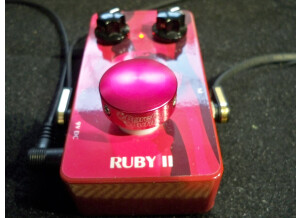
    SOUND: This is one of the best compressors I have used, up there with the famous Keeley compressor. Sound-wise there are a few things that stand out with Ruby II. First, it is so easy to dial in some compression, to balance out the loudness and to even produce added sustain and boldness. Second, even when turned up full the degree of squishiness is minimal. Any compressor will add some element of squishiness, and several I have tried also produce a somewhat sterile effect, as though the tone loses life. With Ruby II, even with the compression turned up full the signal maintains a majority of its life, insofar as harmonics and quality (obviously there is some drop in dynamics and evenness of the notes, which is the point of a compressor). The included demo video goes through several clean, slightly dirty and very dirty signals, and although the audible differences may be minimal in some instances (due to YouTube compression), the effect of Ruby II becomes obvious with amps that have a lot of headroom. In the last part of the demo I have Ruby II going into the Sheriff V4 Preamp (by Victory Amps), which produces a Plexi-style sound with some good headroom and dynamics, and it is with that example compression is most noticeable. Two final points about the sound is that the compression is ‘soft’ (making it more pleasant and less harsh to the ear, which is why there’s less sterility and squishiness) and that it is super quiet – no hissing or added noise, even with the compression and volume up. OVERALL IMPRESSION: Ruby II is not an inexpensive pedal at 189 Euro, but an excellent buy if you’re looking for an easy to use compressor that produces a phenomenal outcome. The Ruby II was designed based on different studio models using optical technology (optocoupler). This VTL5C3 optocoupler provides a soft compression, making it more pleasant to the ear by limiting that highly-squishy and somewhat sterile sound you get from inferior compressors. As well, the integrated OPA2134 integrated circuit is one of the best input circuits dedicated to audio, with the result being an extremely quiet pedal. While other compressors add some noise to the signal as compression and volume increases that is not the case with the Ruby II. As a definite bonus, Ruby II is super easy to use and dial into the right amount of compression – all you need to worry about is how much compression and how much volume for perfect results every time. GENERAL USE: The Ruby II is surprisingly easy to use, whether working with cleans or distorted signals. Tastes will vary, but I find clean sounds work very well with the Compression around 9-12 o’clock, depending if you want a hint of tightness or more control over the dynamics and overall loudness. Of course, if you want a very tight snap to the notes, e.g., Funk guitar, you can push the envelope upward to full Compression and still retail much of the tone’s character without added noise or sterility. When working with higher-gain signals, the amount of compression (for my liking) does vary. For crunch rhythms I prefer 9-12 o’clock – just enough to have some tightness and to make certain all notes have a more even output. With lead I tend to prefer Compression closer to 1-2 o’clock, since doing so adds to the sustain and boldness of each note (ideal for long-held soulful playing, but also hammering on/off and finger-tapping). The Level (volume) control is not overly finicky. Generally I can keep it around 1-2 o’clock with my current gear set-up, while needing to reduce level/volume slightly only once Compression exceeds 1-o’clock. OTHER DETAILS: Ruby II is a standard-sized pedal measuring about 113 mm (L) x 67mm (W) x 48mm (H) or 4.4 x 2.5 x 1.88 inches, and weighing 230g/8oz. The heavy-duty metal chassis is powder coated red with dark red/brown graphics, white lettering and black knobs. The two knobs (Compression and Level) are heavy plastic and will withstand normal use and abuse. Both knobs have exceptional quality pots (smooth and very solid when turned without any static or noise). The footswitch (on/off) produces a solid click when engaged or disengaged without any unusual popping or noise. The chassis is a Hammond 159B aluminum case that provides shielding of the electronic card. Under the cover is an OPA2134 input circuit, reputed to be one of the best in audio engineering, making it a very quiet pedal. As well, Ruby II also includes high-end audio components (carbon resistors and Panasonic, Wima and Silver Mica capacitors), true-bypass Neutrik jacks, Alpha 16mm faders, and is protected against overvoltage and reverse polarity. The cable input/output and power supply all are located along the sides, and so some modest care is to be taken when used (to prevent foot slippage and possible chord input/output/power output damage). Ruby II does not run on batteries and requires a 9VDC power supply.

  • « Boutique Flavor that Ranges from Easy Rock to Hard Rock »

    SOUND: A classic sounding distortion, Dark Blue II produces a very decent range in output and drive. When the Distortion is low there is some grain to the tone and a hint of bite. Once past 12-noon, however, and the Distortion has a fatter and grainier quality and remains surprisingly clear in the mix even when maxed out. Now, there are two stages or modes of distortion: Symmetric (II) and Asymmetric (I), the former of which has a warmer and more classic distortion sound, whereas the latter has a touch more saturation and sizzle. Overall, Dark Blue II is meant to provide a slight edge to your tone at the very least and hard rock when cranked if you decide to go there. It may not be a hi-gain pedal in the modern sense, but it does a good job at pushing an already dirty amp or signal (with Dark Blue II’s Distortion around 9-10 o’clock). As well, it cleans up nicely when dialing back on a guitar’s volume (a heavy rock tone can sound more easy rock). Both of these aspects are demonstrated in the accompanying video. OVERALL IMPRESSION: An upgrade from the original Dark Blue, the new version of this pedal includes an input circuit to work under compression and to clarify the distortion (so that it cuts better in the mix and retains its tonal characteristics). This distortion pedal is based on a JEFT OP amp TL072 – this means plenty of warm and grainy textures to drive your signal. At 189 Euro it is a typically-priced pedal that has excellent quality of sound with a boutique flavor. You can choose either a warmer distortion or a tighter and more aggressive distortion via a toggle switch (selecting from a symmetrical to an asymmetrical distortion). The tone cleans up well when you crank the distortion and dial back on your guitar’s volume, and also adds a delicious bite to an already driven signal (while keeping Dark Blue II’s distortion around the 9-10 o’clock mark). Rhythms are very chunky and thick with a tight bottom end, whereas lead lines sound full and harmonically rich. GENERAL USE: Dark Blue II is simple to use. The Level knob controls how loud you want the signal, and Dark Blue II does have some serious headroom and volume (start with this set at 9-o’clock). The Tone knob controls the degree of bass and treble in the signal and does not seem to exaggerate any particular aspect (the bass does not sound excessively fat and the treble does not sound shrill). The Distortion knob controls how much grain and drive you want, which varies from very modest at around 9-o’clock to exceptionally thick and heavy when cranked full. As well, you can decide on whether you want that distortion to sound more aggressive and saturated with the ‘I’ position (asymmetrical) or warmer and fatter with the ‘II’ position (symmetrical). OTHER DETAILS: A standard-sized pedal, Dark Blue II measures about 113 mm (L) x 67mm (W) x 48mm (H) or 4.4 x 2.5 x 1.88 inches, and weighs 230g/8oz. The heavy-duty metal chassis has eye-catching alphabet graphics with white knobs. The three knobs (Distortion, Level and Tone) are heavy plastic and will withstand normal use and abuse. The toggle switch that controls the type of Distortion (Symmetrical vs Asymmetrical) has decent stiffness and snap when clicked from one position to the next. All knobs have exceptional quality pots (smooth and very solid when turned without any static or noise). The footswitch (on/off) produces a solid click when engaged or disengaged. The toggle switch is next to the Tone knob and is safe from a stomping foot. The output circuit has been redesigned from the original Dark Blue to increase output level, but also boasts high-end audio components (carbon resistors and Panasonic, Wima and Silver Mica capacitors), true-bypass Neutrik jacks, Alpha 16mm faders, and is protected against overvoltage and reverse polarity. The cable input/output and power supply all are located along the sides, and so some modest care is to be taken when used (to prevent foot slippage and possible chord input/output/power output damage). Dark Blue II does not run on batteries and requires a 9VDC power supply (I suspect under 100mA of power, although not clarified on Doc Music Station’s site).

  • « Early Pink Floyd/David Gilmour in a Pedal »

    SOUND: https://www.youtube.com/watch?v=Z7GZZAOCrdI David Gilmour and that early Pink Floyd fuzz tone shines through with the BC 208 version of Vintage Fuzz II. There are other Vintage Fuzz pedals within this collection (the 2 SA 202 and the ASX 12D – both named after the type of transistors used), with the BC 208 being the smoothest of the bunch and using silicon transistors. When using your guitar’s volume knob, and with the BC 208 turned up full, you can achieve tones that range from modestly dirty to fully saturated and sizzling, which is how I like to use this pedal. In other instances, adding the BC 208 with low fuzz and some bias to an already dirty amp tone produces a fuller and more harmonic tone, as though the amp is breaking up (although it may not be turned up that much). The Bias control adds volume when turned counter-clockwise, besides producing more of a rumble, but the effect is not exaggerated and highly usable no matter its position, whether you want more of a rock or a velvety effect. OVERALL IMPRESSION: The Vintage Fuzz II (BC 208 model), developed by Doc Music Station (France), produces a range of tones, although it may be best linked to early Pink Floyd’s Live at Pompeii sound. At a price of 159 Euro, Denis (the designer of the Vintage Fuzz II) named this the BC 208 as he integrated NOS BC208 gold pin transistors in ceramic cases, thus making it a modern version of the Fuzz Face. It produces a sound different from the other Vintage Fuzz II pedals in the collection (as compared to the germanium transistors found in the 2 SA 202 and ASX 12D models. Below is a demo video with all three pedals compared: https://www.youtube.com/watch?v=9oBa_M2DO0o&t=25s An authentic 70s sounding fuzz, the tone is consistent and blossoms very well as you increase the Fuzz level or alter the Bias, thus making it both smooth and edgy, depending on the pedal’s settings. It is very quiet, being housed in an aluminum case that shields the electronic card. Overall, you get a classic Fuzz Face without any of the quirks found in the old models… hence, vintage tone in a modern build. GENERAL USE: The BC 208 Vintage Fuzz II model allows you to dial into both very smooth and even raunchy tones. With the Fuzz level all the way up, the tone becomes more saturated and smoother, with a silky or velvety edge provided by the silicon transistors. With the Fuzz turned up full, you can achieve several modest to extreme fuzz attacks by adjusting the guitar’s volume knob – which means this pedal cleans up very nicely. As you dial back the Fuzz level it takes on more of a distorted or over-driven sound that adds well to an already dirty amp or if you simply want a slightly edgy tone without it sounding too fuzz-like. The Bias control can keep your signal velvety or can produce a very good breaking up quality that adds an immense amount of dynamics in the process. Some bias controls on some fuzz pedals produce too much mess or noise, whereas the BC 208 remains rather quiet even when pushing the Fuzz and Bias levels to the fullest. Obviously the Level controls how loud the signal is, but do note that the tone becomes more pronounced when the Level reaches 1-o’clock or beyond. Coordination among those three controls is required, since as the Bias aggression increases, so too does the volume. Likewise, as the Fuzz level increases, so too does the overall volume (although it stabilizes around 1-o’clock). And if you like to use (manipulate) the BC 208 by adjusting your guitar’s volume knob, then the coordinating factor among the Fuzz, Bias and Level will need to be compensated or adjusted appropriately. All this may seem a bit finicky, but it takes a matter of a few minutes to dial in some great tones and to achieve a harmonious balance. OTHER DETAILS: Measuring in at 113 x 67 mm (about 4.25 x 2.25 inches) and weighing 230g (8oz), the Hammond 1590B aluminum case that enshrines the Vintage Fuzz II (BC 208) provides shielding of the electronic card and is light-weight. The plastic knobs are of good quality, and when turned the pots feel both smooth and solid in quality. The audio components comprise of carbon resistors, Panasonic capacitors, and the Vintage Fuzz is protected against over-voltage and reverse polarity. The cable input/output both are located on the sides, as well as the power supply insert (standard 9v 2.1 mm), and so there is minor concern with stomping and possibly striking any of the inputs/output (do not play when drunk is a good rule to follow). This true bypass pedal also has Neutrik jacks and Alpha 16mm faders for the Gain, Volume and Tone pots. The footswitch is somewhat close to the Bias knob, but that knob is of a good quality, and so any slight stomping strain on the Bias knob should not pose any concern. The LED on/off light is small and well protected by the three knobs.