Log in
EN
FR

Boss Modulation effects pedals

36 products found

Categories
Series
Filter
Sort by
Boss
Evaluation
  • Reviewed or not
  • Editor’s award
  • Reviewed by Audiofanzine
Availability
  • Available or not
  • Sold new or used
  • Sold new
  • Sold used
Must-have products
  • All products
  • Flagship products
  • Best rated products
  • Hot products
  • Popular products
Price
  • Freeware
  • Low-cost (< $150)
  • Mid-range ($150 - $200)
  • Premium (> $200)
€
Clear
Sort by
  • Popularity
  • User ratings
  • Price - low to high
  • Price - high to low
  • Used price, increasing
  • Used price, decreasing
  • Name (from A to Z)
  • Name (from Z to A)
  • Added on
Choose a series
Sort results
  • Popularity
  • User ratings
  • Price - low to high
  • Price - high to low
  • Used price, increasing
  • Used price, decreasing
  • Name (from A to Z)
  • Name (from Z to A)
  • Added on
Filter results 36 results found
Brands
Evaluation
Availability
Must-have products
Price
  • Freeware
  • Low-cost (< $150)
  • Mid-range ($150 - $200)
  • Premium (> $200)
Show results

The best Boss Modulation effects pedals reviews

The reviews Audiofanzine members found the most helpful.
  • « Pass it up. »

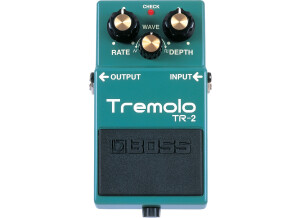
    The TR-2 is a tremolo pedal from Boss. It has a typical three knob design; one knob controls the rate of the tremolo pulsing, one knob adjusts the depth of the tremolo waveform, and the last knob adjusts the shape of the waveform from triangular to square. The pedal can be powered by 9 volt batter or external AC adapter. Dimensions of the pedal are Boss’s typical 2.4" x 5.1" x 2.9" and it weighs about a pound. This pedal has a mono input and output. UTILIZATION Boss is known to be a quality company when it comes to the durability of their pedals. The TR-2 is no exception. The housing and jacks are metal and will deal with life on the road. It is a very reliable pedal and I’ve never heard any complaints in the build of the pedal or quality control. It would have been nice to have stereo outs on this pedal and been able to pan between two outputs along with the tremolo, but it’s features are good enough for a basic trem pedal. SOUND QUALITY The quality of the tremolo is just average in my opinion. There is a very digital feel to it, and it feels a little choppy even when set to the smoothest settings. This uses different technology than the tremolo on old tube amps though, so I guess it is to be expected. There is some tone loss with the pedal, but it’s not that noticeable when bypassed. This thing definitely has a volume drop when engaged and kills the pedal for me. This pedal does not sound as warm as the Cool Cat Tremolo and the Fulltone Supatrem. OVERALL OPINION Overall this is your basic Boss pedal, not overly inspiring but it will last forever. The tone/volume drop when engaged is a big downfall with this pedal, though there are mods out there to fix that. Honestly if I were looking for a tremolo I’d just pick up the Cool Cat Tremolo from Danelectro. It’s about half the price and it is true bypass. For a little more coin and options I’d go with the SupaTrem from Fulltone. Having owned all three I’d put the Fulltone in first place obviously, second to the Cool Cat, and last place to the Boss. Honestly you can do better for the money.

  • « professional sound »

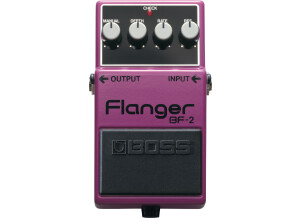
    The Boss BF-2 is a flanger effect stomp box. It has 1/4 inputs and outputs and is not a rackable unit. I believe it is an analog pedal, but I'm not 100% sure about this. It is a cool looking color and is much more versatile than its predecessor, the BF-2. UTILIZATION The configuration of the BF-2 is very easy to figure out. It has four knobs and one of the knobs has another knob on top of it. The first knob controls the resonator, the next controls the depth, the third controls the rate and the last knob is used to set what mode of flanger you would like to use. It is designed to get a wide variety of flanger sounds and it does just that. I've never used the manual as the pedal is pretty easy to figure out. SOUND QUALITY The sound quality of this flanger is very realistic sounding. It is easy to use it subtly and to hint with the flanger, and easy to go nuts to get some real spacey sounds. I have only used the BF-2 with guitar - a Gibson SG and a '76 Fender Twin Reverb amp. The flange sound on this pedal is top notch and totally professional sounding. OVERALL OPINION I first used the BF-2 about three or four years ago. I also have a BF-3, which is the Boss flanger made before this pedal and while the BF-3 is a lot more expensive it is definitely more versatile and overall has a better sound to it. While some sounds between the BF-2 and the BF-3 are comparable, the BF-3 has a more varied arsenal of sounds than the BF-2. While the BF-3 is a bit pricey you are getting a very well made pedal from a company with a great reputation. Overall this is great sounding flanger pedal with a ton of versatility.

  • « Leslie never could »

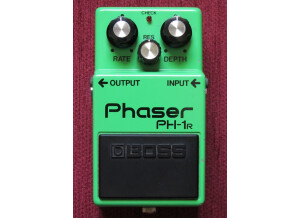
    This is one of the most legendary phaser pedals in the world. When Boss set out to start building compact pedal they introduced three new pedals. They has the Boss OD-1, the Boss SP-1, and this pedal the Boss PH-1. Compounding on the success of these pedals launched a marketing campaign that would put Boss into the most successful guitar pedal company in the world. they have remained on top even since its inception. Several pedal like the TS9 and others have gotten a great hold on the market but nothing like Boss. This is pedal that is design to phase much like you would hear a Leslie speaker do but much more versatile than a Leslie speaker. This pedal has only two control knobs and those are Rate and Depth. this will control the speed and how much mix will be in the dry tone. UTILIZATION Specifications Controls: Rate, Depth Connectors: Input, Output, AC Adaptor Current Draw: 7 mA (DC 9V) Weight: 400 g. Input Impedance: 220kOhm Output Impedance: Over 600Ohm Signal/Noise Ratio: Over 80dB Recommended AC Adaptor: ACA Series SOUND QUALITY The tone of this pedal is quite good. Even though it was the first pedal that Boss made it still holds its great ability to be one of the every best that has come out. Sure there are others now with newer technology and such that can crush this pedal in versatility, but this is one of the pedals that started it all. It is kind of like saying without Sinatra there would not be a Buble. Buble is much more talented but there needs to be something for the original. This pedal has a great sound no matter where you get this thing dialed in. The rate and depth are very easy to control and find a good tone out of. I think both of them in the 11:00 position is the best sounding for what I do. I like a little phaser in some applications but not something that takes over the tone too much. This is nice setting where you can get a good sounding phase effects and still hear the rest of your dry tone in the mix. OVERALL OPINION These pedals were made form 1977 through 1981. The used market is the only way to go at this point. There are much better phasers now a days so this one is obsolete to me. I wold recommend getting an MXR phaser and that pedal is even easier to dial in than this one.

  • « One amazing pedal »

    One of the great units from Boss back in the 80's. The CE-2 was the first compact pedal chorus from Boss. The CE-1 was released 1976 and contained the exact same circuit as the Roland Jazz Chorus JC-120 Amp. So to have the same specs as the Roland Jazz Chorus you are in good company. The Roland JC has been considered the best clean and chorus tone that has ever been produced. So this chorus is something to be revered. This was the pedal to have when playing a good clean tone or even needing a little thickening of the distortion guitar which was popular throughout the 80's. Metal guys would use this pedal to help beef up their overdrive tone and sweet the spectrum of frequencies up a little bit. This pedal was produced in Japan up until 1988. They then took production over to Taiwan. Some say the tone changed but I think unless you A/B them and even still wouldn't hear any difference. The label on the back change from black to green while still in Japan. Then later changed to to Taiwan but kept the same green on the label. UTILIZATION Specifications * Controls: Rate, Depth * Connectors: Input, Output, AC Adaptor * Current Draw: 9 mA (DC 9V) * Weight: 400 g. (14 oz) * Input Impedance: 470kOhm * Signal/Noise Ratio: 90dB or more * Recommended Load Impedance: 10kOhm or greater * Recommended AC Adaptor: ACA Series SOUND QUALITY I think this pedal shines in almost any situation it finds itself in. It sound superior with a clean guitar. You will get a nice watery shimmy tone that is almost magical to listen to. If you use it with an overdriven amp like a Marshall you get lighten up the control knobs a bit to add just a slight sweetening of the distortion. This will get you a big bigger tone much like adding an analog echo to the distortion tone. It is a nice tone filler. This is a legacy pedal from Boss. This was the second introduction to the chorus world and the first compact chorus pedal ever produced from the Boss company. So this pedal can be put on a pedestal. This pedal was one of the best sounding chorus pedal in history. If you can score one then you will understand the tone to which many other manufacturers attempted to emulate. OVERALL OPINION These pedals were stopped being manufactured in 1988. They continued in Taiwan until 1990. So you would have to find one on the used market somewhere. They are great sounding pedal and some considered them the best chorus pedal that has ever been produced. If you score one somewhere you won't be disappointing.

  • Stormleader's review

    The BOSS CE-3 Chorus pedal was made from 1982 to 1992. The model that I have is a Green label that was Made in Japan. The feature set on it is pretty standard, but there are a few interesting things. The features are as follows: - Mono in, ability for Stereo out. - Runs off of either a 9 Volt battery or a 12 volt power supply, but can easily be modded to run off of a standard 9 Volt PS if desired. It has three controls, which are: -Rate: Sets the rate of the chorus, IE how fast it moves around. -Depth: Sets the depth of the chorus (No duh eh?) -Stereo Mode: This is something a bit different from other chorus. In mode 1 Output A (The main output) outputs both the Dry and Wet signals. Output B then outputs only the Dry signal. In Mode 2 Output A sends out the Wet signal only, and then Output B outputs the Dry signal only. UTILIZATION Tweaking the sound to how you like it really couldn't be much simpler. Just set the Rate and Depth knobs to taste, and if you are running stereo set the mode knob to what you want. Simple eh? Since I got it used I can't comment on how clear the instruction manual is, since it didn't come with one, but you don't have to be a rocket scientist to figure it out. I will say that this pedal is the only BOSS three knob pedal that has the knobs in this configuration. That is because with the knobs like they are on the CE-3, it blocks your view of the LED indicator, so you can't visually tell that it's on unless you are standing up and hovering over it. That's why all three knob BOSS pedals now have the controls in a "V" pattern. SOUND QUALITY I run a Peavey Ultra 60 watt tube amp that pushes a 5150 Straight cab with V30's and G12T-75's. I mainly play Thrash metal with some drop-tuned stuff thrown in. My main use for chorus is to add depth to leads and cleans, so I don't really use it on any distorted rhythm stuff. The CE-3 sounds decent, not amazing, but not bad either. It is a pretty natural chorus, and not cheesy sounding at all, so if that's something you are looking for this may be the chorus for you. It just never really jumped out at me as sounding all that amazing, and in fact, I've got an DOD FX-68 Super Stereo Chorus that I modded that I use often, which, in my opinion it sounds better than the CE-3. That being said, the CE-3 is still a decent chorus, so I'd suggest you check it out. OVERALL OPINION Overall, my opinion of the BOSS MIJ CE-3 is that it was pretty mediocre. Not anything especially good about it, but nothing especially bad either. I got mine in a trade, so I really can't comment on if it was a good value or not, but looking on Ebay they seem to go for $50 and under, so they might be worth checking out if you are interested in them. I like that it has different ways to implement stereo, and I dislike that it really doesn't stand out at all.

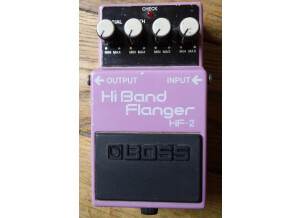
  • « Hi Fi Flanger »

    The is a flanger pedal introduced by Boss to tackle the hi fi sound of the flanger effect. This pedal gets to the higher frequencies of the flanger sound. you can definitely get the jumbo jet flanger sound but the tone of the guitar with be more audible with this pedal. This pedal allows the guitar's natural voice to come through better where as the regular Boss flanger would swallow up the guitar tone more. I would prefer this pedal over the regular one if I just needed a simple and mild flanger tone. this pedal is a magical pedal and sounds great in front of a distorted amp. UTILIZATION Specifications Controls: Manual, Depth, Rate, Res Connectors: Input, Output, AC Adaptor Current Draw: 15 mA (DC 9V) Weight: 400 g (14 oz.) Input Impedance: 470 kOhm Residual Noise Level: -95dBu (IHF-A) Recommended Load Impedance: 10kOhm or greater Delay Time: 0.5 ms ~ 6.5 ms LFO Speed: 100 ms ~ 16 s Recommended AC Adaptor: ACA Series SOUND QUALITY I really like the tone of this pedal. It has the right frequencies in it that make it a little more appealing to me and my tone. It leaves room for the guitar to breath and come through the mix. It doesn't cloud the tone up like a lot of flangers will do naturally. I prefer this pedal out on the front of the amp. I don't like hearing flangers in the effects loop or behind the distortion. I am a fan of Eddie Van Halen and to get the tone he had you need it out in front. So growing up listening to those records i generally favor that setup because that is what my ears are used to hearing. Having it it behind the distortion will make the effect more out front in the mix and not apart of the tone as it would in front of the amp or distortion pedal. OVERALL OPINION This pedal had a good run but it ended in 1995. It seems a lot of Boss pedals ended in this year. you can find them on the classifieds or the used market somewhere for a good price. I generally see them for about $80 to %100. That is a little more than I see the regular go for. This is a great pedal and nice addition to anyone's floor board.

  • « Dimension 3D »

    This was Boss's second installment of the dimension chorus pedals even though it is label Dc-3. Boss tends to just put numbers after the acronym to give it a new name and compound on the existing platform. The Boss DC-3 is not an analog pedal. Which the Boss Dc-2 was all analog. This is a digital platform and the tone is much different. The tone of this one is more processed naturally due to the digital aspects of the circuit. Also on this updated model you had four control knobs rather than four presets. Now you could tailor your tone better to match your playing style or current rig. UTILIZATION Specifications Controls: E. Level, Eq, Rate, Depth Connectors: Input, Output A, Output B, AC Adaptor Current Draw: 65 mA (DC 9V) Input Impedance: 1Mohm Residual Noise Level: Less than -100dBm (IHF-A) Recommended Load Impedance: 10kOhm or greater Sampling rate: 50kHz Frequency Response: 20Hz to 20kHz (+1/-3 dB) Recommended AC Adaptor: PSA Series SOUND QUALITY Chorus pedals in general add vibrato to the tone when you turn them up. This is a natural part of the chorus modulation effect. This one doesn't do that as much. It adds vibrato but very minimal amounts and in turn what you got was a more ethereal sound which came off as 3 dimensional and spacy sounding. This pedal works for clean parts of your guitar. If you have a delay pedal or a clean tone and you need some sparkling lush chorus this is a good pedal for a airy tone. It also work great for the distortion channels and adds a bit of beef and depth to the tone. Great for 80's metal players who naturally use chorus to beef up their tone. OVERALL OPINION This pedal was discontinued back in 1993. You can still find them on the used market from time to time. They are cool and unique sounding pedals that are all on their own for chorus sounds. There isn't anything out there that matches the tone of this thing so if you are used to chorus pedals this might sound different then you are used too. In a good way of course.

  • moosers's review

    The Boss BF1 is a flanger pedal designed for use with electric guitar, but will work with just about any type of electronic instrument. The pedal is an analog one and is one that has 1/4 inch connections. This isn't a rack mountable piece of gear as it is a foot pedal. UTILIZATION Using the Boss BF1 is quite simple and even those without any prior experience with pedals like this one I wouldn't expect that they would have much trouble figuring it out. The pedal simple has parameters for manual, depth, rate, and resonance all in the form of knobs. That is pretty much all there is to the pedal, so as you can see it is quite simple in make up. Beyond this there isn't much to the configuration of the pedal and for this reason I don't think that manual is necessary. SOUND QUALITY The sound quality of the Boss BF1 is incredible. It is one of the best flanger pedals that I have heard and is just as good as a lot of outboard flangers that I have used as well. Since it is a vintage pedal, it definitely has a vintage sound to it, meaning that it is warm and has an analog type of tone. It has a rich sound that is round overall, and is versatile as playing with the parameters will give you a variety of different tones. I usually use the pedal for recording with a Fender Strat and either a '76 Fender Twin Reverb or a '65 Fender Deluxe Reverb. OVERALL OPINION I really don't have anything bad to say about the Boss BF1 as it is a classic pedal that predates all of the flangers to follow in the Boss line. They are hard to find and will cost a decent amount of change to get one, but it is definitely possible to find them for sale. Unless you have to have the original one and are committed to getting a vintage flanger tone, I would suggest at least looking into the BF2 and the BF3 Boss pedals, at least to contrast which will work best for you and the sound that you are going for.

  • moosers's review

    The Boss RT-20 Rotary Ensemble is a digital guitar effects pedal that emulates a rotary effect. It has 1/4 inch inputs and outputs and is powered by the power supply that comes with it. It is not a rackable unit as it is a guitar stomp box. UTILIZATION The general configuration of the pedal is pretty simple, but takes a little time to get used to it as there are a lot of different parameters to control different things. The knobs it has includes one to choose between four different modes, one for effect level, one for direct signal level, one for rise time, one to balance between the bass and horn level, which is kind of like tone, one for overdrive, and one each to control either slow or fast, referring to the speed. The manual is complete and helpful when learning this pedal. SOUND QUALITY The sound quality of the Boss RT-20 is pretty awesome. It basically emulates all types of rotary sounds like a sound from a leslie speaker or a chorus like sound. I have only used this with guitar, as that is what I play, but it would definitely work well with other electronic instruments like an electric piano, or even an organ that needs a leslie simulator. The overall sound is rich and full and the variety of effects is pretty outstanding. The many different modes and parameters allows for this to be a pretty versatile pedal. OVERALL OPINION I've been using the Boss RT-20 Rotary Ensemble for about a year and I have found it to be a great tool when looking for rotary type effects. It is built extremely well, and has the Boss seal that I have come to trust. Once you learn what everything does on this pedal, the possibilities are pretty much endless. While it isn't the cheapest Boss pedal, it is reasonable considering how much you are getting with this pedal. It probably isn't as good as the Hughes & Ketner Rotosphere, but it will cost you less and probably has a wider array of tones. All in all, if you're looking for a leslie simulator or a rotary type sound, definitely check out this pedal.

  • moosers's review

    The Boss PN-2 is a tremolo pedal as well as a stereo panner. You need to set it up with two amps to use the panner. It is an analog effect and has stereo outputs and stereo inputs in the form of 1/4 inch jacks. It is a stomp box and is not rackable. UTILIZATION The configuration of the PN-2 is very easy to follow. It has three knobs - one to set the mode to either tremolo or pan and each of those has 2 waveform modes, another to set the depth and another to set the rate. It is very easy to get a great sounding tremolo effect from this pedal. I bought this pedal used (for only $20 US dollars! what a steal...) and it didn't come with a manual, so I can't say if it is useful or not. SOUND QUALITY The sound quality of the tremolo effect is top notch. I have used it mostly with electric guitar, but have also used it with a synthesizer. It sounds great with both. In fact, this pedal sounds as good as any tremolo sound I've ever heard. It sounds very authentic and rich in tone. OVERALL OPINION I've had my PN-2 for about two years. I love using this electric guitar as it provides me with a great tremolo sound when I need it. I haven't used the panner too much as I mostly use it as a trem. To compare, this comes very close in comparison to the tremolo effect I have on my '76 Fender Twin Reverb. I like this pedal better than the Boss TR-2 which is the tremolo pedal they make now, as I think this one is more authentic sounding. The price varies as Boss no longer makes these pedals and they are hard to find. While I got a steal on this pedal, it can cost up to around $175-$200 US. However, it is a great sounding pedal and definitley worth picking one up if you are looking for a tremolo pedal and can find a good deal on one.

  • « Boss HF-2 HiBand Flanger »

    This is the pastel purple flanger from Boss. I like this a little more than the BF-2 and BF-3 since it focuses more of flanging your high end. This muddies things up a bit less when your lows and mids are left alone. Knobs from Left to Right: Manual, Depth, Level and rate. I found this in my local guitar shop's used rack. I am always intrigued by pedals I have never heard of, so I gave this a test drive and instantly fell in love. A green labeled Made In Japan Boss pedal for $40, heck yes! I was immediately comfortable with Boss' switching, knobs, size and power. The knobs made sense and I was quickly able to dial in some very usable flanges. I'm not going even pretend I didn't rip into Barracuda by Heart! None whatsoever. I loved this pedal. I had to let it loose when my bass head died and I needed to fund a new one. This bad boy alone doubled in value and helped me get the amp. Same quality you would expect from a Boss pedal. People will still be using these in a hundred years! A true sleeper from the late 80s into the 90s. Don't pass up this flanger if you come across one. This review was originally published on http://www.musicgearreview.com

  • « Boss Super Phaser PH-2 »

    Ebay - 41$ (worth every penny) There is no other phaser like it in it's mode 2 setting ... I've actually thought this through and through... nothing... and hey, it's an old pedal no matter where u get it. Boss. Nuff said. Dicast just like any other pedal. Quality - exquisite. Ok... This IS my favorite phaser, because you will NEVER ever get the same IN YOUR FUKING FACE phase like this puppy does in mode 2. Mode 1 is a 10-step phase whereas mode 2 is a 12-step. Even if you only want a thick phase, the mode 1 still shows its worth its weight in gold. Generally, I use the mode 1 for a respectively fast phase, and mode 2 on a really slow phase so it hits every step in detail and it just sets a great mood. Mike Einziger of Incubus has 2 of these in his rig plus a MXR phase 90. Talk about proffesional. He asked himself, "I wonder what it would sound like if I crossed a phased signal into a second phased signal." Listen to The Warmth by Incubus, and wait for the break down. When the drums and bass come in, he turns the second phaser on. You may think to yourself, thats just overly produced. Ught uh. You will hear the same exact thing in person with two PH-2's in mode 2. Fucking 1337. This review was originally published on http://www.musicgearreview.com