Log in
EN
FR

Yamaha Organs

57 products found

Filter
Sort by
Evaluation
  • Reviewed or not
  • Editor’s award
  • Reviewed by Audiofanzine
Availability
  • Available or not
  • Sold new or used
  • Sold new
  • Sold used
Must-have products
  • All products
  • Flagship products
  • Best rated products
  • Hot products
  • Popular products
Price
  • Freeware
€
Clear
Sort by
  • Popularity
  • User ratings
  • Price - low to high
  • Price - high to low
  • Used price, increasing
  • Used price, decreasing
  • Name (from A to Z)
  • Name (from Z to A)
  • Added on
Sort results
  • Popularity
  • User ratings
  • Price - low to high
  • Price - high to low
  • Used price, increasing
  • Used price, decreasing
  • Name (from A to Z)
  • Name (from Z to A)
  • Added on
Filter results 57 results found
Evaluation
Availability
Must-have products
Price
  • Freeware
Show results

The best Yamaha Organs reviews

The reviews Audiofanzine members found the most helpful.
  • « Yamaha 20 »

    I got this one at a charity shop in Southern California, just like Nick Kirk did in New Zealand. I paid 15 dollars. This thing is old. It has serial number 20. I tried the online Yamaha serial number finder and it couldn't find it, and the Yamaha tech support and they couldn't look it up. It has a great old finish, it has inlay dots at 5, 7, 10, and 12 frets, and one inlay dot on the bridge. The headstock looks like it was either stamped or had a decal that said YAMAHA Dynamic Guitar, and it is so old it fades into the brown of the finish, where the lettering is smooth compared to the aged finish. At first I thought "firewood" but then I saw no cracks, a really sturdy guitar with a perfect fretboard, round neck that flattens in the middle. Only one slightly tweaked tuning head stem on the D string. I wonder what it has been doing all these years. Needs two strings. I only got it half an hour ago, and I'm at work so I can't get out to change them. Solid. Wow. I guess the collectors missed this one. It is just like Nick Kirk's story from New Zealand. This review was originally published on http://www.musicgearreview.com

  • « hard to find »

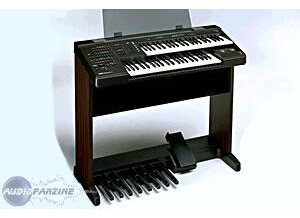
    The Yamaha Electone ME-50 is a dual keyboard organ that is cased in a huge unit and also has bass foot pedals. The organ has a volume pedal and each keyboard has about three and half octaves of keys while the bass pedals has the standard octave. The organ has full polyphony and has a built in speaker. UTILIZATION Since there is so much going on with the ME-50 , it did take me a little while of practice to understand what everything does on this organ. There is endless tone control available and all sorts of effects at your disposal to insure that you will have total control over your sound. Everything is laid out conveniently and because of this is helps you to figure out what everything does because if it wasn't smartly done it would be a mess. I've never seen the manual for the ME-50 , but if you can get one or already have one it is definitely a good idea to have it around because there are a lot of ins and outs to this organ. SOUNDS The tones that are possible with the ME-50 are quite diverse and varied and at the same time still share a common factor that make this organ what it is. It is possible to get all sorts of organ sounds including traditional sounds and some not so traditional ones. It is also great for getting some really quirky and almost circus like organ and keyboard sounds that are really interesting and fun to play around with. Even though some of the sounds are a little too out there for my taste, for the most part this is a really cool sounding organ. OVERALL OPINION They are somewhat hard to find now since they are no longer being made, but if you are seriously seeking for one you can find one at a reasonable price. The hardest part is finding a way to move this thing as it is extremely big and heavy!

  • moosers's review

    The Yamaha YC-30 is a compact organ, which I believe is from the 1980's. I recorded this through a Fender amplifier a few weeks ago at a studio that I frequent, but only recently had a session where we had a need to use. It's kind of like a Farfisa, but at times can be even a bit more cheesy. It has a similar type make up to a Yamaha Electone in that you can choose between different models of acoustic instruments and mix them in out, although you won't get sounds close to the real thing. UTILIZATION The configuration of the Yamaha YC-30 isn't difficult to figure out, as it really just takes some messing around with to get the hang of. You've got a slew of sliders to work with to help you change your tone, featuring different instruments but also featuring presets and also a unique portamento control. You also have control over attack and fuzz. I haven't seen a manual for this and don't expect to every see one. SOUNDS I really dig the sound of the Yamaha YC-30, although it's definitely cheesy and should be used in situations where something like this is called for. We decided to use it over the Farfisa that we also had available, as it's a bit more unique and you can mess with the sound a little bit more. Recording it through a Fender amp, we ended up getting a really cool sound that fit the song perfectly. OVERALL OPINION While I don't know that it's worth it to have the Yamaha YC-30 outside of the studio, the YC-30 is a very cool compact organ for those looking for some cheesy, Farfisa-like sounds. I don't know how readily available the YC-30 is as I wouldn't have ever used it if it wasn't available in the studio where we were working and it's a studio I work at a lot, so it was bound to happen sooner or later. I also don't know the price of these used, but they do seem to be out there if you can find one used. The Yamaha YC-30 is definitely a cool keyboard worth checking out for all interested in analog compact organs!

  • « Interesting Keyboard with Silly Sounds! »

    I don't really know whether I like this keyboard's sounds or whether they are just funny. It's really an organ with some settings that make it sound like an electric piano. The sounds that come out of this are similar to the ones heard on the score to the movie "Napoleon Dynamite", if that rings bells for anybody. There's a couple different settings, some are labeled guitar, strings, etc. but they are pretty much irrelevant as they don't really sound anything like those instruments. The dual keyboards both cover different octaves and are easy to switch between with both hands. There are a lot of drum sounds and rhythm sounds going on, but they are also very cheesy. I don't know if I would ever record with them unless I was going for that campy effect. That being said, these are PERFECT for such effects. I doubt these would run you much money, and if you have enough down time to mess around with this stuff, it can be fun, if a little mindless. I'd say get it at a garage sale for dirt cheap, but nothing more. I have fond memories of this thing, so I like it, but don't get the wrong idea, it's not the greatest electric piano I've seen. It's mostly fun for dinking around on your own as a one man band, and I've actually been able to entertain people with silly songs while playing it. Probably the best instrument around if that happens to be your ambition.

  • moosers's review

    The Yamaha Electone EL-90 is one of the most interesting Electones ever made, as it is mostly digital based and was one of the first of its kind in this respect. It has all of the basic controls you would expect on an Yamaha Electone and then some. It has two different keyboard levels as well as two octaves of bass pedals and two foot controller pedals. It is a fully polyphonic keyboard and unlike the original and older Yamaha Electones, since it is digital you can store your own presets and recall sounds much easier than before. UTILIZATION The configuration of the Yamaha Electone EL-90 will take a little while to understand and isn't the most user friendly keyboard. Around this time period when the switch was being made from analog to digital, a lot of instruments and other gear were hard to use because no one was used to the interfaces and navigating through the different digital screens and whatnot wasn't too easy to do. While this keyboard certainly has that influence on it, after some use it becomes easier to do everything. There are a lot of different features on this keyboard and having the manual around is necessary if you are unfamiliar with this instrument. SOUNDS The sounds on the Yamaha Electone EL-90 are very versatile as it is capable of getting all sorts of unique sounds and emulations. Its vast array of parameters and digital storing and settings make it possible to achieve an almost unlimited amount of different tones. While some of the sounds aren't as realistic sounding as modern instruments, this certainly has a unique sound to it and would encourage those interested to try it out and see if it is something that they are into and is something that will fit with your own unique style. OVERALL OPINION I've been using the Yamaha Electone EL-90 for about two years and it is definitely one of the most interesting and unique Electones. It has a ton of different types of keyboard sounds and is the blueprint for modern digital keyboards that Yamaha makes. These are pretty rare to find these days and I don't think they are too cheap if you can find them, as they are huge instruments and hard to come by. While the sounds on this keyboard are certainly good and interesting for creative purposes, if you are simply looking for a digital keyboard I would advise to look elsewhere. This is a great unit but unless you are after this one specially I would recommend trying out a newer digital keyboard as they sound better and are far smaller!

  • moosers's review

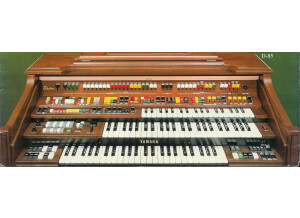
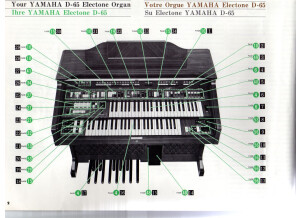
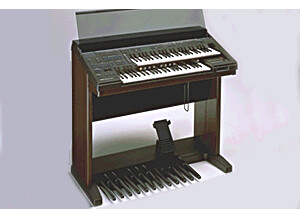
    Although the Yamaha Electone D-65 is listed as an organ and has the look and feel of one, the sound from this baby isn’t too similar a sound to what we traditional would think of an organ. It is a two layered keyboard, with each spanning about three and half octaves. It also has bass foot pedals that span an octave and a volume pedal. UTILIZATION The Yamaha Electone D-65 definitely takes some getting used to because of how many different parameters are features are available. No matter what your previous experience might be with keyboards like this, it will take you some time to understand how everything works on this. There are a ton of features in addition to the variety of tones, including rhythmic patterns, arpeggios, and all sorts of effects. I don't have a manual for the Yamaha Electone D-65, but it would definitely be a good idea to have one if you are going to seriously learn this keyboard. SOUNDS The sounds on the Yamaha Electone D-65 are extremely varied and unique. I love a lot of the sounds on this, but they aren't too realistic sounding in terms of what they are suppose to emulate. However, this makes for a cool in between sound that can be used endlessly for creative purposes. The feel of the keyboard is great and the instrument is very easy to play overall. The Yamaha Electone D-65 is quite versatile, but all of the sounds have a similar sounding quality to them and they all kind of fall under the same umbrella or sounds. Overall, a lot of awesome tones can be achieved with the Yamaha Electone D-65. OVERALL OPINION I've been using the Yamaha Electone D-65 for about two years and I've found it to be a very cool little organ. There are some great sounds that are suitable for recording and live shows, but since this thing is so huge I wouldn't recommend bringing it out of your studio or home. This is one of the best models of the Yamaha Electone, and it is definitely worth a try if you are familiar with the Electone series and like what it can do. All in all, the Yamaha Electone D-65 is not one of my favorite Electones, but it is a worthy model and has some great features to it.