Log in
EN
FR

Sequencers

194 products found

Filter
Sort by
Evaluation
  • Reviewed or not
  • Editor’s award
  • Reviewed by Audiofanzine
Availability
  • Available or not
  • Sold new or used
  • Sold new
  • Sold used
Must-have products
  • All products
  • Flagship products
  • Best rated products
  • Hot products
  • Popular products
Price
  • Freeware
  • Low-cost (< $300)
  • Mid-range ($300 - $1,000)
  • Premium (> $1,000)
€
Clear
Sort by
  • Popularity
  • User ratings
  • Price - low to high
  • Price - high to low
  • Used price, increasing
  • Used price, decreasing
  • Name (from A to Z)
  • Name (from Z to A)
  • Added on
Sort results
  • Popularity
  • User ratings
  • Price - low to high
  • Price - high to low
  • Used price, increasing
  • Used price, decreasing
  • Name (from A to Z)
  • Name (from Z to A)
  • Added on

The best Sequencers reviews

The reviews Audiofanzine members found the most helpful.
  • « A good, small sequencer, but limited features »

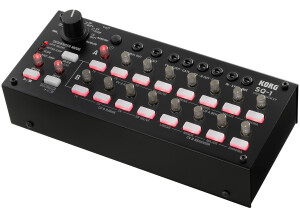
    - I use it with mono and poly synths (with a MIDIpal to sequence chords), but I essentially got it for using with a Korg Arp Odyssey. - I receives it some 6 hours ago - I already have other sequencers. It's a small 2x8-steps sequencer on 2 channels (or 16-steps sequencer on a single channel) sequencer, all-analog, with MIDI out and USB. It can be powered with two batteries (for approximately 5 hours) or the USB port, and a lot of connectors are provided for synchronizing. It features 8 playing modes, in Z, W, alternate, parallel or serial and of course random. You can choose the steps that are to be read (on/off gate), the step jump, the active step (unselected steps are jumped and the number of steps gats lower with it, allowing twisted sounds) and glided steps. Pros: its reduced learning curve, its minor/major modes that allow to gain time with pitches, its (lit) step pads, its many connection/sync slots ans how easy it is to use as a whole. Its appearance and sturdy look (metal case weighing approximately 1.3 lbs). Cons: the main flaw in this device is the mode selector which forces the device to get sync to the first step, so you just can't change mode on-the-fly while playing live - at least you can't with it as a master controller. Also, you won't be able to take advantage of the glide settings if you use it in MIDI, which is quite frustrating. The SQ1's main aim is to deliver patterns on the fly in a really old-school manner, as for more elaborate lines there are much more up-to-date devices. Of course, it allows to modulate other settings such as a filter's frequency cut. Il brings a real electronic and mechanical-sounding touch to your prod, by the way no groove or shuffle setting is available. This makes for a very limited device, just like older analog sequencers (and its bigger brother), but its very practical and finally quite inspirational. I would have liked the possibility to change mode without having to relaunche the sequence, and tp save a few lines. On this matter, the device sends both channels' pitches and gates through MIDI, so it's easy to get the MIDI data (on an MPS for instance) and save it there. Except for the position of the knobs, rebooting the device won't allow you to get the previous program - really old-school! To sync the SQ-1 as a slave, you can either use USB (for configs involving a computer), a Voca, a TR or any other unit with either MIDI or jack (old-school style!) sync. For instance if I want my MPC to be the master in the chain, I send its clock to the TR 707 and the sync to the SQ-1 will be done using the 707's sync out slot and the SQ-1's sync in. The Volca can also receive MIDI and send sync on its (mini jack) sync out. Last but not least, it can be used as a MIDI converter through CV-gate, as all data entering the USB/MIDI in are transmitted to the SQ-1's CV/Gate out.

  • « Squarp Pyramid, or how to get rid of your computer! »

    I’ve used it for a few months now for electro/hip-hop prods in a home studio, and soon in a live context where it will control an Arturia Minibrute, a Moog Sub Phatty, a Korg Minilogue, an Elektron Rytm and an MPC 2500 XL. I control the sunths using a Roland A500PRO MIDI keyboard through the Pyramid’s MIDI in. - In spite of its small format, the Pyramid remains very sturdy. It clearly was built to last, the knobs and chassis all look reliable and sturdy! - It’s easy to adapt to using it, especially thanks to a very well-thought manual. Of course, you’ll need to know the ABC of using a sequencer and also MIDI, but no big deal. The Pyramid offers 4 well-thought and practical modes: LIVE for live recording, STEP for step-by-step editing, TRACK for managing the MIDI tracks and SEQ for editing sequence-relative parameters. The OS features regular updates, bringing new features such as MIDI effects (arpeggiator, transpose, delay…), an improved piano roll, a better sequence manager and so on. The Pyramid is very reliable and so far I have encountered no OS-related issue or bug. - pros : the Pyramid can be taken anywhere easily, takes little space and is sturdy. The OS is stable, and updates come regularly – and they’re very consistent. The Pyramid offers all you could expect from an audio sequencer – and even more! The Squarp team is very attentive to customer reactions. The product is made in France :) - cons: the interface can first appear somehow confusing, but once the machine’s logic has been assimilated the learning curve turns into a musical creation highway. In the end : I’m more than happy with this sequencer, and I’d do the same choice again for sure!!

  • « Easy to use, efficient and practical! »

    I’ve used in in a homestudio with a DRM1, a Doepfer modular, a Matrix 1000, a TX81Z, a SUB 37, an Alpha Juno, a Werstatt, Cubase and OSX. Once the firmware updated, no compatibility problem so far. The metal box seems sturdy, it’s heavy, the knobs are sturdy and velocity-sensitive. In my opinion, the most interesting part of it is how it can be used with all sorts of synths and drum machines. It’s practical, easy-to-use, the multiple outputs are a great feature and I like the simplicity of the TR-type sequencer with the notes displayed to make editing easier. I also like the roller which allows to replay a part of que sequence in 1/4, 1/8, 1/16, 1/32 loops. Computer editing provides the same features as the machine with additional dedicated MIDI mods for each pad and knob, which is practical and easy to use. Though I haven’t really gone through it, there is a Swing feature which shifted my sequences when I tried to reset it, which is quite surprising. In the end, I really love it and while some might say there are more complex (and complete) sequencers (especially in eurorack format for modular synths), I’m very happy with it so far.

  • moosers's review

    The Roland PMA-5 (Personal Music Assistant) is a unique portable MIDI device. I don't know exactly for what years this was made, but it has to be at least twenty years old. It's a Palm style device that sits right in your hand and contains a variety of MIDI sounds, a sequencer, rhythm patterns, and an arranger. Of course something like this is a bit outdated, but it's still a cool thing. The PMA-5 needs power from a nine volt power supply and consists of both a MIDI input and output jack, and a 1/8" headphones output. I believe it can run on batteries, but I'm not sure what kind since when I've tried it it has been with a power supply. UTILIZATION The Roland PMA-5 isn't the easiest device to use, but it was pretty forward thinking and is probably a little strange to use just because it's older. It's still not incredibly hard to use, it's just going to take a little messing around with. The screen is a touchscreen, which is pretty cool for such an older device. I haven't looked at a manual, but if you wanted to learn everything about the PMA-5, I'd say it's going to be required reading. SOUNDS Most of the sounds on the Roland PMA-5 are general MIDI, which is in general pretty cheesy. Having said this, I don't know what more you'd expect from something like this that is of it's age. They do make portable sound modules today and I'm sure there are some devices out there like this one, but this is the only one of it's type that I've really seen. It definitely does have a nice collection of general MIDI sounds and otherwise, as well as a ton of patterns to choose from which is cool. It would definitely be possible to conjure up a little all in one track here, which is the point after all. OVERALL OPINION I don't know how easy it would be to get your hands on a Roland PMA-5 nowadays, but I would think there would be some of them floating around out there. The studio I work at has one of them floating about, but it certainly doesn't get used, or at least I haven't seen it used by any client. I've really only messed around with it just to see what it was all about, but haven't used it for any serious musical purposes. If you're after some cheesy sounding general MIDI stuff only, there are easier ways to achieve it than this. I would really recommend seeking out a Roland PMA-5 as in general it's not going to be worth much. If you can get one cheaply or just happen to stumble upon one, it's fun to play with but I don't think it's going to be a viable music making tool in the modern world.

  • « Alesis Data Disk - All your synths now belong to us »

    So basically if you want convenience, GIG travel usefulness and simplification of your MIDI libary, buy one of these. they average about $50 on ebay. Someone said "you cannot use 1.44MB disks" That is NOT true. It supports both SD and HD 3.5" floppies. (only formats in 720k regardless however) So you are technically "wasting" a 1.44MB floppy however it can be used. You're just going to be only utilizing 720KB of it's capacity. Also keep in mind you won't need to worry about it since MIDI information is plaintext and takes up very little space. I'd say the only CON of this unit is that the powersupply is external. BOO.

  • « Yamaha MDP-5 X Midi Data Player »

    I play part time professionally in a Top 40/Variety band. Not as a keyboardist, but as a bassist. On the side I also DJ (turntables,CD's/MP3's), Karaoke DJ, and play as a duo in a one man band. I achieved my goal of sounding like a 9 piece band with the following items: Korg i3 Intelligent Arranger General Music SK-88 88 key "World" Keyboard/arranger. Korg 05R/W Roland SH-32/Roland SP-808 Roland KC 300 Behringer mixer(s),Alesis processing and Bose Speakers. 80% of music is sequenced on Logic Pro for Windows on a Toshiba M35-X laptop. How: Ebay-These are only available in Japan Where: Kanagawa Japan-NEW- Why: A laptop is just too big to bring on stage,plus unreliable if you have no backup.You can store everything on Floppy, but try loading 4 sets of music on two GM keyboards that have only 2 MB of memory.It also looks unprofessional IMHO.Go for the shock value, don't point and click hehe.I've seen too many bands that sequence their music but they bring their desktops on stage.It's also obvious when the singer(s) are switching between songs behind a covered stand on stage!But all kidding aside, I sequence my songs in blocks so that the arrangements are nonstop, just like a live band. Anyways, how much I paid: $191.00 includes INTERNATIONAL shipping. -Compatability- General Midi General Midi 2 XG soundset GS soundset -Storage- up to 128 on Smart Media card, includes an 8 MB card.PLENTY for any situation. I have over 200 hours of music that takes only 23 MB. -SOUND Quality and Portability- AMAZING sound quality for a little box. It rivals my 05 when playing back custom sequences like Whitney Houston,KC and the Sunchine Band, New Order, and the Black Eyed Peas. Portable-I can listen to my songs on the subway trip home, it can run off of 4 AA batteries. Imagine: Playing on stage with only a Keyboard and a little box the size of a paperback book! "Minus One" Function- Mute parts as necessary. SIMPLE to use- Yes, the instructions are in Japanese, but with a little knowledge of midi and how sequencers work you can pretty much figure it out on your own. USB Midi driver Looks like a toy but hides a beast underneath. Mini Jacks for input/output Midi IN only Ok, white plastic unit, looks like a toy. Small, can fit on top of your keyboard near the pitch bend wheel or anywhere else where space is limited. Small LCD display-Just enough info to do the job which is fine since all my arrangements are made in Logic Pro I took the chance, you should too!Besides only being sold in Japan, how many times will people wonder how you get your tracks out there "live"...Also, uou can repeat passages in realtime!! Beat that!No more clunky laptops. the laptop is now a backup to the MDP, and other sequencers... Contact me anytime for more info: ehandog @ yahoo.com This review was originally published on http://www.musicgearreview.com

Categories that may interest you