Log in
EN
FR

Strymon

Series

63 products found

Categories
Series
Filter
Sort by
Evaluation
  • Reviewed or not
  • Editor’s award
  • Reviewed by Audiofanzine
Availability
  • Available or not
  • Sold new or used
  • Sold new
  • Sold used
Must-have products
  • All products
  • Flagship products
  • Best rated products
  • Hot products
  • Popular products
Price
  • Freeware
€
Clear
Sort by
  • Popularity
  • User ratings
  • Price - low to high
  • Price - high to low
  • Used price, increasing
  • Used price, decreasing
  • Name (from A to Z)
  • Name (from Z to A)
  • Added on
Choose a series
Sort results
  • Popularity
  • User ratings
  • Price - low to high
  • Price - high to low
  • Used price, increasing
  • Used price, decreasing
  • Name (from A to Z)
  • Name (from Z to A)
  • Added on
Filter results 63 results found
Evaluation
Availability
Must-have products
Price
  • Freeware
Show results

The best Strymon reviews

The reviews Audiofanzine members found the most helpful.
  • « A really nice Deco »

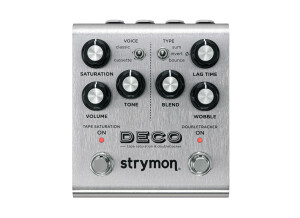
    The Strymon Deco aims at recreating the sound and effects of the tape recorders that were in use in the studios before the digital era. I’ve used the Strymon on two ToneKing amps, the Imperial and Falcon – hence in stereo. These amp models recreate the sound of Fender BlackFace, Tweed or even Supro amps from the 50s-60s with an awesome clean sound that I use as a base for saturated/overdriven sounds and so on. No loop for modulations – these are at the end of the chain and the big sound comes from stompboxes (including the Deco among others such as an OCD, Dyna Comp, Grey Faze and a 1981 TS808). Guitarwise, I mostly use a Mexican Lacquer Stratocaster, a Duesenberg Starplayer TV Rebound, a ’56 Les Pauml Special clone by Tokai. I mostly –but not exclusively– aim at vintage, bluesy, rock sounds. The Deco’s brushed aluminium box is superb, it’s sturdy and definitely very beautiful. Ergonomically, it’s good with many features, well-disposed controls which are pleasant to use. The Blend control allows to balance the sound between both Stereo outputs, Lag Time controls the delay time, Wobble sets the detuning between the two outputs. Saturation and Volume do what they say, Type allows to choose the kind of lag between the tape recorder’s heads. A clear, printed quickstart guide including all features comes with the pedal, hence allowing to start using it even before reading the manual (which you’ll still eventually end up having to do, as usual with Strymon products). The back of the guide also explains lesser-used commands, showing a real effort by the manufacturer to make their product easy to use quickly while still packed with functionalities. You’ll still have to spend a while on it to control the entire beast. The manufacturer’s site and videos provide good examples. The Strymon Deco provides two separately-activable effect lines. A saturation that recreates that of the preamp of a tape recorder: very progressive and soft, really useable in a home studio to get a crunch sound over a clean basic sound. Time-based effects ranging from flanger to delay to doubler, chorus and slapback. These are subtle, very progressive and you get to the point where they remain on all the time, enhancing the sound without their presence being really remarked. Using a 90s Les Paul, you can quickly get Neil Young’s sound from the Dead Man OST: a Tweeb + the Deco’s saturation and delay set at 1 second and here’s the Wild West in your living room. A Strat and the Deco in Flanger/doubleur/Chorus mode (there’s a narrow margin for settings) allows you to recreate the awesome clean sound from A Fool for your stockings by Mr Billy Gibbons on Deguello, or the brilliant and resounding riffs from Sultan of swing. Actually, whenever you wonder “what’s that nice, light modulation on this clean guitar sound?” on a pre-digital recording, it was a tape recorder and the Deco really knows how to recreate this. In a nutshell, this is a really well-built pedal and an absolutely beautiful one with rather unique effects. When the pedal is turned off, there definitely is something lacking in the sound. This pedal is more one to be used in a (home) studio than a tool for live. The stereo sound spatialization is both very subtle and great. As for its cons, it’s still a bit pricey and the Lag setting is only useable in a rather narrow range, but that’s just a detail.

  • « Very Realistic »

    There are three modes available. These are fixed, multi and single. They each emulate different types of tape echo such as the Echoplex and Space Echo. Of course this emulation is digital. A complaint I have is the lack of MIDI and lack of stereo ins. This would bring the functionality level much higher, though it's not the biggest of deals. You at least get stereo outs and tap tempo and can purchase the Favorite Switch if you want a preset. Downside is it's $50 extra. There are five knobs, mix, time, repeats, wow & flutter and tape age. Each knob has a secondary function to control parameters such as crinkle, bias, spring reverb, etc. These allow detailed control over your echo tone. You also have the ability to switch between buffered and true bypass operation. UTILIZATION The primary knob functions are self explanatory, though those unfamiliar with tape echos may not know what the effect of tape age and wow & flutter are. Fortunately, the manual explains these. The secondary knobs are a bit trickier since you probably won't know about them without the manual. The manual explains them and how to access them, though it is a bit of a PITA to actually do it. Set up is easy, though as before it may cause some problems in a stereo rig since it doesn't have stereo ins. It's easy to incorporate in any other rig though and the favorite switch is a breeze to hook up should you choose to purchase it. The high current draw can give you problems depending on your power supply and other pedals, though I just run it off output 5 or 6 on my Voodoo Labs Pedal Power 2+. SOUND QUALITY I use the El Cap with a THD Flexi 50 and a Strat. The dry tone remains unaffected when I kick the El Cap on due to the analog dry path. This gives it the edge over several similarly priced units such as the Eventide Time Factor in my opinion. The echo quality is great. It can get very close to the EP-1 that my friend owns. If it had a similar preamp structure in place, I believe it could nail it no problem. There's a thread on the Gear Page that compares it to several real tape echo units that gets the point across very well. My only complaint sound wise is that the self oscillation is a bit weak. Nowhere near as prominent as a real tape echo or even most analog and digital echos. This isn't a deal breaker for me or most others but it is nice to have around for when you want to go crazy. OVERALL OPINION I absolutely love the El Cap. It does everything I need and it's built incredibly well. My favorite thing would have to be the multi head setting. It gives a great ambient feel to my tone that I love for when I'm the only guitarist. My complaint is still the oscillation. I feel like Strymon could have done better. The value might not be as good as something like the Time Factor since it only does 3 types of delays but it does those 3 types so well that if you're only looking for tape echo, I'd buy this any day over the TF. I'd buy another if it were ever stolen or broken. The former is considerably more likely.

  • « Two for one »

    The Strymon Flint was inspired by the traditional pairing of onboard reverb and tremolo effects in early tube amps. The Flint features two sides for each effect, each with three modes to toggle between. For tremolo, you have the '61 harmonic setting, the '63 tube setting, and the '65 photocell setting. For the reverb side you have sounds from the following modes: 60's (spring), 70's (plate), and 80's (hall). Each effect has separate controls and can be activated individually of one another. Holding both bypass switches, toggles secondary functionality of the controls which include boost/cut controls for each side of the effects, tap subdivision, and effects order. UTILIZATION The Input/Output section of the Strymon is rather versatile. An EXP input can accomodate an expression pedal, tap tempo, or one of strymon's favorite pedals--which recalls a previous arrangement. A selectable TRS stereo input allows use with stereo applications. The power is standard 9v. The unit's build quality is exceptional and rugged. SOUND QUALITY The Flint's sound is second to none. The tremolo sounds are very useable with the speed knob going to a lower threshold than other tremolo effects. Very mellow and pleasant. The harmonic trem was my favorite of the three for its unique flavor. I found the reverb to be no slouch, performing just as splendidly as Strymon's dedicated blue sky reverberator. The ability to configure an expression pedal with any specific control can lead to very interesting results.Having used the pedal through a variety of amps, I was pleased with the flints sound both in front of amps for a more mangled sound and in a given amp's loop as well. OVERALL OPINION The Strymon flint is another excellent, studio-quality offering from the brand. I have never been a fan of Tremolo effects, but the flint's capacity for subtlety charmed me, as well as it's over the top sound quality. The effect is competitively priced against other boutique tremolos alone, let alone for a two-in-one arrangement such as this. Awesome product.

  • « Functionally perfect »

    - Mode switch and Time knob for time/length - Tap switch for quarter, dotted eighth, and eighth note triplets - Mix knob - Bucket Loss knob - Repeats knob - Mod knob - Tap tempo switch UTILIZATION Strymon makes three delay pedals. This one is aimed at the lovers of tried and true analog delay. There are so many options it's a bit dizzying. The best thing to do is to try the suggested settings in the manual. Here's a description, albeit a poor one, of the different functions. The Mode switch is pretty easy to understand. It changes from a short delay to a LONG delay. The knob does the fine tuning. The switch for Tap, I am not really sure what that does. Strymon says that it switches between "quarter, dotted eighth, and eighth note triplets" but I don't know what that means, so that description sounds great to me. The Mix knob is another standard; it sets the amount of effect you have in your signal. Bucket Loss is an interesting one. It allows you to set the amount of signal loss you experience for every cycle. The Mod knob (or LFO modulation) knob controls the amount of tape warble effect. On top of those features, you can also use an expression pedal, or a "Favorite" switch where you can designate your second setting on the fly. There are also other features like an infinite repeat option when you hold the Tap button down. SOUND QUALITY The debate over "analog or digital" has been happening for years with everything from vinyl records to delay pedals. I must admit, when it comes to delay pedals, I think I prefer digital. I prefer it because it allows for features you simply cannot have on an all analog delay but it can also be extremely clean, quiet, and transparent. My only issue with this delay pedal is that the sound is a bit too transparent. What it does (which is just about everything) is done so well, but it doesn't add the depth and the lush overtones that other delay (digital or analog) pedals can. OVERALL OPINION I was originally dazzled by the abundance of features and how well this pedal handled them all. I ultimately decided that, for my delay usage, I'd preferred the sound of other pedals over the extreme amount of functionality the Strymon Brigadier. That doesn't mean this pedal isn't fantastic, it is. It is just a little too transparent for my tastes. If you're looking for a feature filled transparent delay pedal, this just might be what you are looking for.

  • « Brilliant »

    Easily the most powerful time-based digital effects pedal on the market, the Strymon Timeline has everything but the kitchen sink. The timelines features a rotary control that toggles between 12 separate delay types including, digital, dual, pattern, reverse, ice, duck, swell, trem, filter, lo-fi, d-tape, and dbucket. Between the controls you can tweak in the LED panel and the existing front panel controls, there are a plethora of sounds you can get out of this unit. The timeline comes with 200 presets alone. The looping function is a great addition and is very easy to access and manipulate. Aesthetically, I love the Timeline's departure from the rest of Strymon's catalogue. Very modern and clean. UTILIZATION The sheer amount of front panel control offered on the Timeline makes editing very simple. The foot switches have dual functions for controlling the loop, making it extremely gig friendly. The presets are more than useable and the number of them, while perhaps intimidating to some consumers, allow for many quick fixes and momentary inspirations. The rugged construction of the timeline makes it suitable for studio and touring purposes. SOUND QUALITY I have used the Timeline with a myriad variety of guitars and amps. I've never had anything but pleasing results using this pedal. The Sharc DSP onboard the Timeline is the same breed used in the Axe Fx standard, ensuring brilliant sound quality all around. Not all of the presets are going to please you, but many of them will. OVERALL OPINION The Strymon Timeline is brilliant. It is the only digital delay I've used that I couldn't imagine parting with. The sound quality is phenomenal, and the ease of use coupled with the potential for so many separate sounds make this an excellent value and a step above similar offerings. The closest competitor to the Strymon is the Eventide TimeFactor, both of which I've tested. I thoroughly enjoyed the Eventide, but it lacked the evasive mojo that the Timeline boasts so naturally. Pricing can seem lofty, but for the feature set presented, it's more than fair.

  • moosers's review

    The Strymon blueSky is an unbelievable reverb pedal. It’s probably the best sounding and most versatile reverb pedal that I’ve used. I only found out about it recently when a friend showed it to me after he got it. I didn’t know anything about Strymon either and I’m glad that I do now. The pedal is a stereo one so it has two ¼” connections for both input and output and is powered by a nine volt power supply. It’s not rackable at all since it’s a stomp box. UTILIZATION It’s going to take some time to fully grasp the Strymon blueSky and to learn everything that it has to offer, which is almost endless. Getting basic sounds is easy but to master it will take some time for sure. I’ve only scratched the surface of the pedal myself since I don’t yet own it. The basic parameters that it has to play with include knobs for mix, pre-delay, high damp, low damp, and decay. It also has three different modes and three different reverb types – plate, room, and spring. The modes add a whole level of versatility including the ability to infinitely sustain notes. I would check out the manual if I just bought this pedal. SOUND QUALITY The sound of the Strymon blueSky is some of the smoothest reverb I’ve heard come out of any device. It’s stunning how accurate it sounds and what’s more is its amazing versatility between the three reverb types and modes. It has a certain depth to it that I haven’t heard in any pedals before and only seems to be present in the real deal in things like true plate and spring reverbs. Still, it’s not going to sound like a real plate reverb although it’s damn close. OVERALL OPINION The Strymon blueSky is probably the best sounding reveb unit I’ve used for guitar and is definitely at least in the top three. Sure it’s a pretty penny for a pedal but you’re going to get ultimate control, fidelity, and versatility in your reverb sound. It’s definitely a pro’s pedal but that doesn’t mean others can’t dream about it or at least try it for themselves to see if it’s worth the money.