Log in
EN
FR

Wurlitzer

19 products found

Categories
Filter
Sort by
Evaluation
  • Reviewed or not
  • Editor’s award
  • Reviewed by Audiofanzine
Availability
  • Available or not
  • Sold new or used
  • Sold new
  • Sold used
Must-have products
  • All products
  • Flagship products
  • Best rated products
  • Hot products
  • Popular products
Price
  • Freeware
€
Clear
Sort by
  • Popularity
  • User ratings
  • Price - low to high
  • Price - high to low
  • Used price, increasing
  • Used price, decreasing
  • Name (from A to Z)
  • Name (from Z to A)
  • Added on
Sort results
  • Popularity
  • User ratings
  • Price - low to high
  • Price - high to low
  • Used price, increasing
  • Used price, decreasing
  • Name (from A to Z)
  • Name (from Z to A)
  • Added on
Filter results 19 results found
Evaluation
Availability
Must-have products
Price
  • Freeware
Show results

The best Wurlitzer reviews

The reviews Audiofanzine members found the most helpful.
  • mooseherman's review

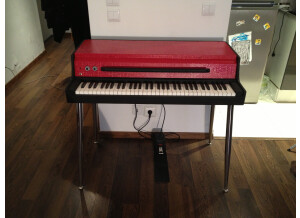
    What can be said about this instrument that hasn't already been said? There's a reason that these are selling at absurdly high rates right now. From Joni Mitchell to Ray Charles to Motown, many great recordings have been made using these great electric pianos. The 200A is a newer model. When I learned that, I was skeptical, as I remember many companies tampering with a classic and turning out a sub-par imitation. However, the 200A is just as good as the original Wurlitzers, at least as far as I could ever tell. It also has a bit more range than those, as there is a knob for controlling tremolo as well as the original volume knob. This is the only benefit that it has over the 112, but it is a tremendous benefit, as it offers far more range on the natural instrument and requires the player to rely less on outside interference. It also has a speaker which allows the player to quietly play it acoustically. It does have the amp output as well. This, in my opinion, is where the interesting possibilities lie. I love the natural distortion that occurs on this instrument. When I listen to Ray Charles' "What'd I Say" or Marvin's "I Heard it Through the Grapevine", I love the distortion that I hear on them. I'm not even sure that it was intentional, but it's almost irrelevant for me as it's the sound I prefer.This similar effect can be achieved, to various intensities and settings, with a good Fender Twin amp, although any good tube amp will do really. Distortion the one advantage that this has over the Fender Rhodes, which doesn't sound as good distorted, although that instrument is great in it's own right. Great for jazz, blues, rock, gospel, even great hip-hop and dance music has featured these instruments. If you can find/afford a good one, it's well worth it, as there aren't many who can. Be prepared to empty out the account though. For serious musicians only, as far as I'm concerned.

  • « Wurlitzer EP-200 »

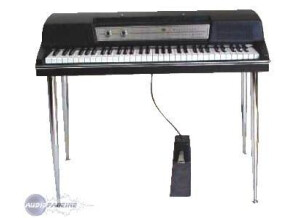
    The Wurlitzer electric piano was produced in various forms from 1955 to about 1982 and is one of rock music's iconic instruments; the keyboardist's equivalent of the Gibson SG or the Rickenbacker 4001 bass. In other words, not quite up there with the Les Paul (Hammond B3?) or the Fender Precision (Fender Rhodes piano?) but still a top-flight vintage instrument featured on hits from Ray Charles to Supertramp and beyond. Inside the instrument is a 64-key grand piano action whose hammers hit tuned steel reeds. The reeds' vibrations are amplified to produce the Wurlitzer's distinctive sweet yet punchy sound, more percussive and cutting than that of a Rhodes. The model I play is the EP-200, the first plastic-bodied model, produced between 1968 and 1975. I use it live and in the studio with an 11-piece ska band, The Skanx. I also play a Casio WK-3000 which I use for organ sounds, plus a Stylophone mini-synth. My band, The Skanx bought the Wurlitzer early this year from a defunct band for about £500. This seems to be the low end of the price range; reconditioned ones can sell for as much as £2000. The original chrome legs and sustain pedal were included - a replacement set could easily cost £300. Previously I had been using a very good Wurlitzer patch on my Casio WK-3000, but when the real thing popped up we decided to try it out, initially on 6 months' loan. The first time the band saw and heard it they were blown away, and buying it became a priority. I used it on our debut mini-album and have been using it live and in the studio ever since. <a href="http://www.theskanxband.co.uk">http://www.theskanxband.co.uk</a> It is my dream instrument. Let's face it - it's the real thing. It looks right, it sounds right, it feels right. The 64-note keyboard's action is fast and light yet responsive - like you wish a grand piano could be. I could play it for hours. And it's not trying to be anything it isn't. The controls are basic but sufficient - a volume/on-off control and a tremolo depth control. That's all you need. The two built-in speakers give plenty of volume for practice or acoustic jams, and there's a output jack underneath for an external amp. It's easy to set up too. Screw in the four legs, attach the sustain pedal's mechanical cable, plug in the power cord and you're ready to go. But most of all it's about the sound. How can you criticize a 40-year-old instrument? Well, it is very sensitive to humidity - it can take up to 20 minutes to 'warm up' (i.e. burn off tiny droplets of moisture between the steel reeds and the electrostatic pickup plates), during which time it produces the most ear-splitting and unearthly screeches, buzzes, crackles and bangs. So you need to set up well in advance of the rest of the band! Also it's heavy - not like a real piano or even a Fender Rhodes, but you either need a strong roadie or two average band members to carry it. The legs are designed for seated playing rather than standing, but I have found a solution for this. Google 'elephant feet' if you want to know... The keyboard and action are essentially those of a grand piano, scaled down; a marvel of woodwork. It simply wouldn't be cost-effective to make these things nowadays. The keys are slightly shorter than those of an acoustic piano but the same width. The shell is sturdy black ABS plastic on a thick plywood base. This thing is tough! The legs are chromed steel with small adjustable feet. The sustain pedal housing is made from black painted plywood with the pedal itself made from chromed steel. It attaches to the piano via a Bowden cable with a special adjustable clutch. The only vulnerable components are the steel reeds themselves which can reportedly become fatigued and eventually break as a result of hard playing. Replacements are fairly easily available, but fitting and tuning them is best left to an expert, so you will need to find a competent Wurlitzer tech if you decide to invest. Ever since I started teaching myself to play keyboards at the age of 16 I have wanted one of these. I'm now 48 and I have finally achieved that dream. With all due respect to modern keyboard manufacturers, there is nothing like the real thing. This review was originally published on http://www.musicgearreview.com

  • moosers's review

    The Wurlitzer 145B is a vintage electric piano, probably best suited in the studio because of it's age. I don't know what the exact year is one this particular model, but for whatever reason I believe it's one of the older ones. I'd only played one of these at the first studio that I worked at, but recently a client brought it in to the studio I'm working at now and I was reacquainted with it. The 145B does have a built in tube amplifier, which gives it an awesome sound that I prefer to the other models. I don't know if this one is more sought after than the others, but it's as good if not better than any other Wurlitzer electric piano that I've used before. It has a really nice feel, even though the keys were definitely wearing down a bit on the one that I recently played. I would imagine that this is a common trend as both models of the 145B that I've seen have been quite old looking. The sound on the 145B, as it's an incredibly warm sound. That isn't to say that I don't also love the sound of the Wurlitzer 200 or 206, but this one seems to have a slightly different quality than those. Those are incredibly instruments and probably don't have all the upkeep that this one does, but the built in tube amp in here really seems to make a difference. You also don't see nearly as many of these out there as you do the 200 series models, leading me to believe that this would be somewhat expensive in comparison if you did come across one. Either way, those in the market for a great electric piano definitely need to leave no stone unturned. If you do come across a 145B in your search, you need to give it serious consideration as it's pretty much the best electric piano I've ever used...

  • moosers's review

    The Wurlitzer Model 131 Headphones are a set cans that come with the Wurlitzer 206 electric piano, which is a student model. The headphones are originally intended for use with the 206 inside classrooms where it may be necessary for the students to be wearing headphones. The studio that I work at has a Wurlitzer 206 and the headphones to match. Usually we don't use the 131 Headphones with the 206, but sometimes they do get used together. Most of the time we have the 131's around as an extra set of headphones. They are pretty bulky headphones and actually have a built in microphone mouthpiece as well, although I haven't ever used this part of the headphones. I believe it has a 1/4" jack on the end of it for plugging directly into the 206. These aren't the most comfortable headphones in the world, as the ear pieces cup around your ears entirely. It's really not too bad, but I've certainly worn more comfortable headphones in the past. However, this does help to keep the sound from coming out, making them good for monitoring during recording if you're having trouble with headphone bleed. As far as sound is concerned, they're about average as I don't find anything too special about them. I don't know if they designed them with keeping in mind they may be used outside of use with the 206, but I would think not. You won't be able to find a set of the 131's for sale on their own anywhere, as it would be hard enough to find a 206 electric piano that still had the headphones with them. Having said this, if you do get or have a 206, the 131's will work well with them and beyond, but they're best suited as an extra set of headphones rather than your main pair...

  • moosers's review

    The Wurlitzer 112 is an electric piano that was made in the 1950s. I believe that it was the third electric piano made by Wurlitzer, with the 110 and the 111 being the first two. There aren't too many features on the 112, as it simply has a volume knob. It has a sustain pedal, although the one that I have used didn't have it, so I can't say how the feel of it is. It also originally came with legs, but over the years many of them have lost the legs. These are quite rare in general and are pretty hard to find information in detail about this old instrument. I can say that the action is pretty good on this as it is an easy instrument to play. The tone is definitely that of a classic Wurly electric piano as you would expect, although the degree that you can alter the sound is minimal as this model doesn't have any parameters beyond volume to work with. It also doesn't have any built in vibrato, but use the vibrato on my '76 Fender Twin Reverb and it sounds awesome. The tone is definitely comparable to any of the great sounding Wurlitzer electric pianos out there that I have used, but probably wouldn't be my first choice as because of the limited parameters that it has to offer. Nonetheless, this is a great sounding keyboard and is a great collectible as well since they are so rare and hard to find. I have seen the price of these range from pretty cheap to quite expensive and since they are so few and far between, it is hard to gauge an average price on what one of these in good shape is worth. All in all, if you stumble upon a Wurlitzer 112 I would definitely recommend checking it out, but if you are looking for a more reliable Wurlitzer electric piano with more features, I would look at the 200A.

  • moosers's review

    The Wurlitzer 270 Butterfly is an electric piano that is encased a small baby grand style piano. I believe that the inside of the keyboard is the same as most in the 200 series of electric pianos, but as you can see in the picture, the outside is drastically different. This is one of the rarest Wurlitzer electric pianos and is probably one of the most unique. My guess is that they decided they wanted to try to make an electric piano that can be viewed upon as a piece of furniture like acoustic pianos are. While I don't think that they quite succeeded if that is what they wanted to do, they did make a pretty awesome keyboard here. I've only had the pleasure of using the Wurlitzer 270 Butterfly one time for recording and was definitely impressed all the way around. It has a great sound that is on par with the other electric pianos in the 200 series if it isn't a direct copy of them. This definitely has the classic Wurlitzer electric piano sound even if it doesn't have the look of any of them. While I can't say that I would recommend seeking one of these out to buy as they are very rare and would probably cost a fortune, not to mention that it would be hard to move as these are quite heavy. While I would recommend trying to buy one of the other Wurlitzer electric pianos in the 200 series, if you ever have the chance to try out the 270 definitely take advantage because you never know when you will find another one! All in all the Wurlitzer 270 Butterfly is an extremely unique keyboard within the classic 200 series electric pianos and although it is rare if you must have one of them you should definitely be able to find one if you look enough...

  • moosers's review

    I've been using the Wurlitzer SU131 acoustic, upright piano for about one year. I have used it only in the recording studio and for practicing, and works great in both situations. The SU131 is easy to play and has great inherent tone to it. It has your your standard piano make up, with a sustain pedal and two other pedals as well. It has a sleek black design and the keys are weighed and extremely realistic feeling. This is a high quality piano that is great for both professionals and amateurs. Since it is an upright, it can be opened up on top, which is where I usually will throw a microphone into for recording, usually with great results. The ease of playing this makes me always feel as if I am getting a nice sound from what is coming out of my finger tips, which is always a good thing. I've played and recorded with a lot of different types of pianos, and while this isn't the best one I have ever used, it does the job effectively. I recorded this with a lot of different piano players, and they always like the unique sound we get with it. The price of these isn't unreasonable, and is probably geared towards those on a budget, in contrast to some of the high end Yamaha acoustic pianos. I usually prefer to record with a baby grand piano when possible, but when that is not an option, the Wurlizter SU131 upright acoustic piano does a great job for me. If you are looking for a piano for either your home to practice in, or your amateur or professional studio, the SU131 is a great option that won't break the bank. While the SU131 isn't the best sounding piano in the world, it still sounds great and works great in all types of situations.