



The first KeyStep had everyone in agreement. A small controller keyboard combined with a simple but effective arpeggiator/sequencer, and armed to dialogue with a modular. So, what's this mk2 version worth?

Almost ten years ago, Arturia surprised the world by unveiling the KeyStep, a controller that combines a portable master keyboard, sequencer, and arpeggiator with control via MIDI, USB, and CV/Gate. Over time, the little white keyboard has become a classic, at the crossroads of modular setups, studios and musicians who travel light. Where the MicroLab, recently tested in its mk3 version, is primarily intended for a computer setup, the KeyStep series has always offered broader functionality. With its arpeggiator, polyphonic sequencer, CV/Gate outputs and direct compatibility with modular or vintage synths, the KeyStep mk2 clearly retains its positioning as an “all-terrain” tool, made for navigating between computers, analog and digital synthesizers.
Now, Arturia has upped the ante with a mk2 version of the KeyStep that it touts as more modern, ergonomic and, above all, powerful. So it’s time to find out if this facelift really does improve the experience, or if it’s just an aesthetic dusting.
Design and Connections: OLED screen, USB-C, MIDI DIN and 4 CV outputs
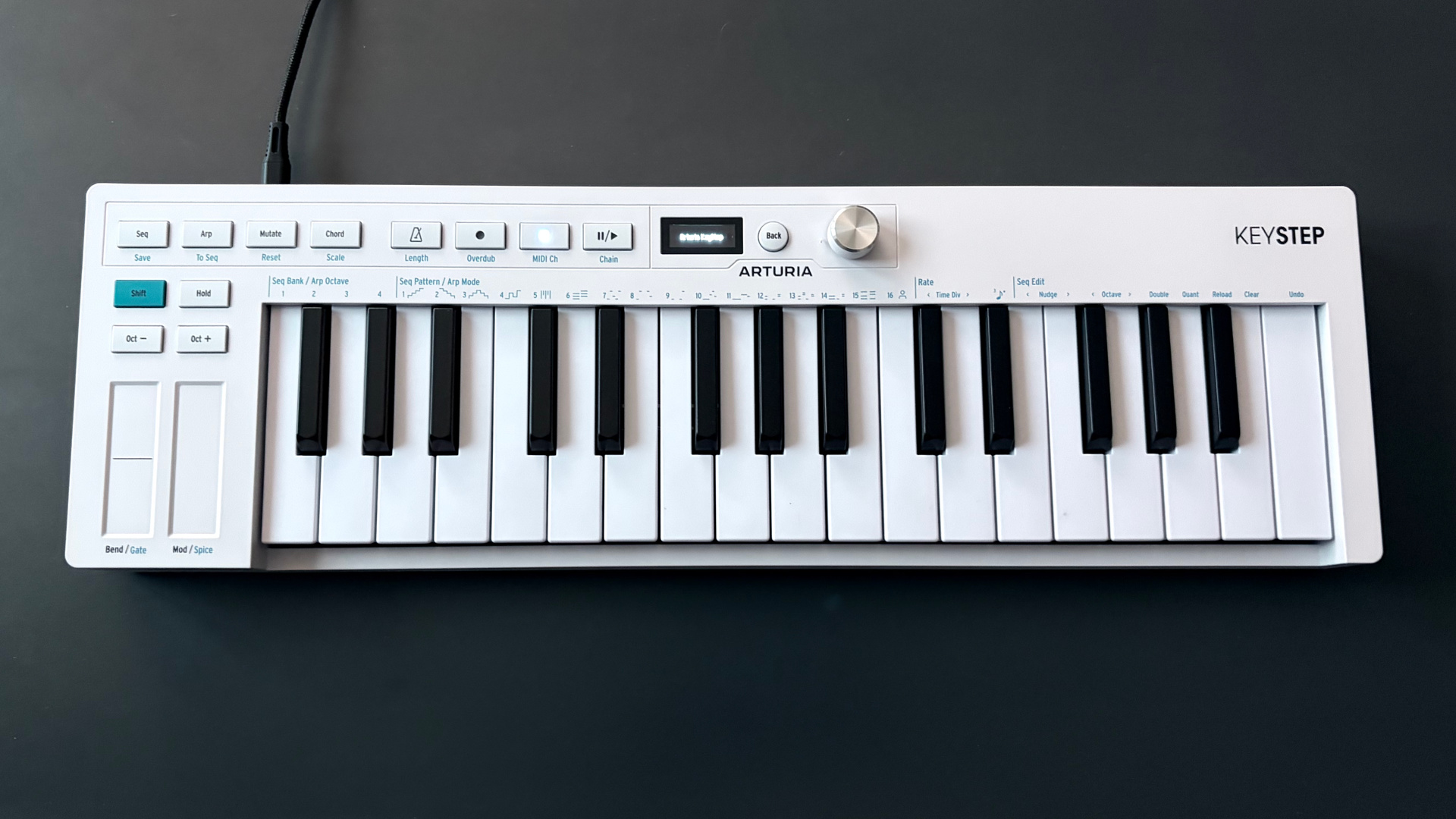
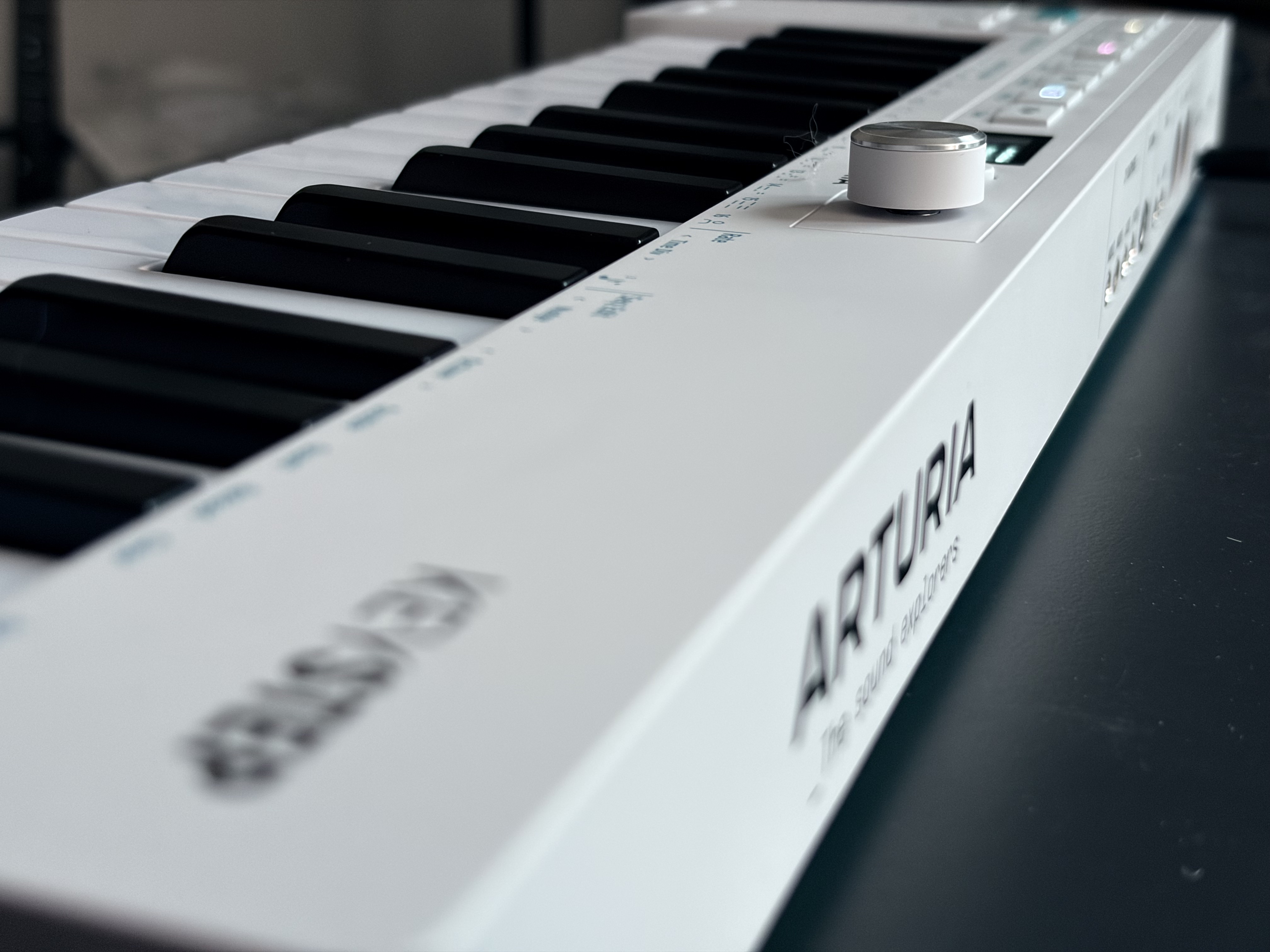
Next to it is the new clickable encoder, now central to internal navigation. With this combination of screen and encoder alone, the KeyStep mk2 already looks distinctly more modern. Unfortunately, this new ergonomic design deprives us of the three encoders on the mk1, which were used to set the arpeggiator and sequencer.
The keyboard remains composed of 32 velocity- and aftertouch-sensitive mini-keys per channel. Key alignment seems slightly improved over the first model, and the mechanics still respond with the same precision. The semi-weighted touch, which contributed greatly to the mk1's success, remains unchanged. The responsive touch strips for modulation and pitch bend are back, as are a series of buttons above the keyboard for transposition, transport, mode selection or activation of various functions. Everything is neatly arranged, and the silk-screen printing is clearer. While the chassis retains its white color, it now features a discreet blue border on the lower part, covering the entire underside of the unit. Underneath, six glides ensure excellent stability.
In the box, we find a USB-C cable for connectivity and power supply, as well as a small printed quick guide, designed to explain connection and basic functions. The complete manual can be downloaded as a PDF from the Arturia website. A software bundle of Analog Lab Intro and Ableton Live Lite is also included.
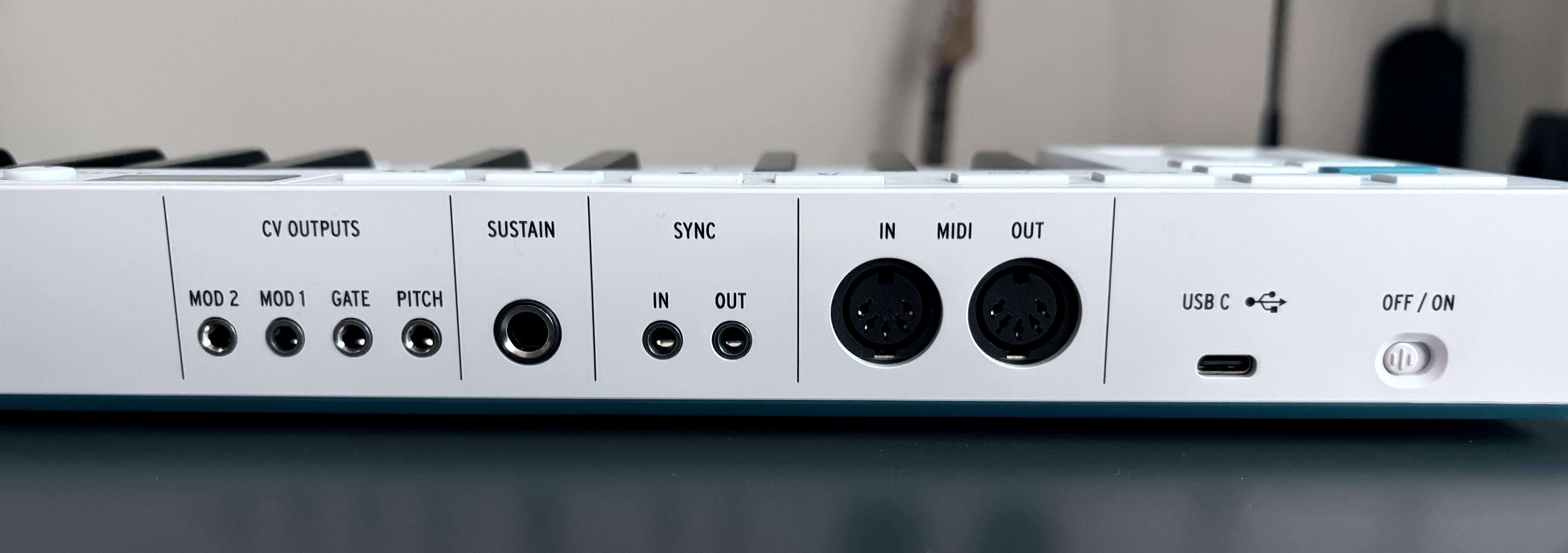
But it’s the revamped CV output section that provides the most noticeable upgrade. Where the first version made do with a trio of pitch, gate and mod, the mk2 version now offers four assignable outputs. The user can independently determine what comes out of each: pitch, velocity, aftertouch, modulation strip, sequence envelope, or any other parameterizable source from the interface. Arturia thus corrects one of the major limitations of the first KeyStep by finally giving real control over signal routing.
32 mini-keyboard: velocity, aftertouch and MIDI/CV assignments via MIDI Control Center
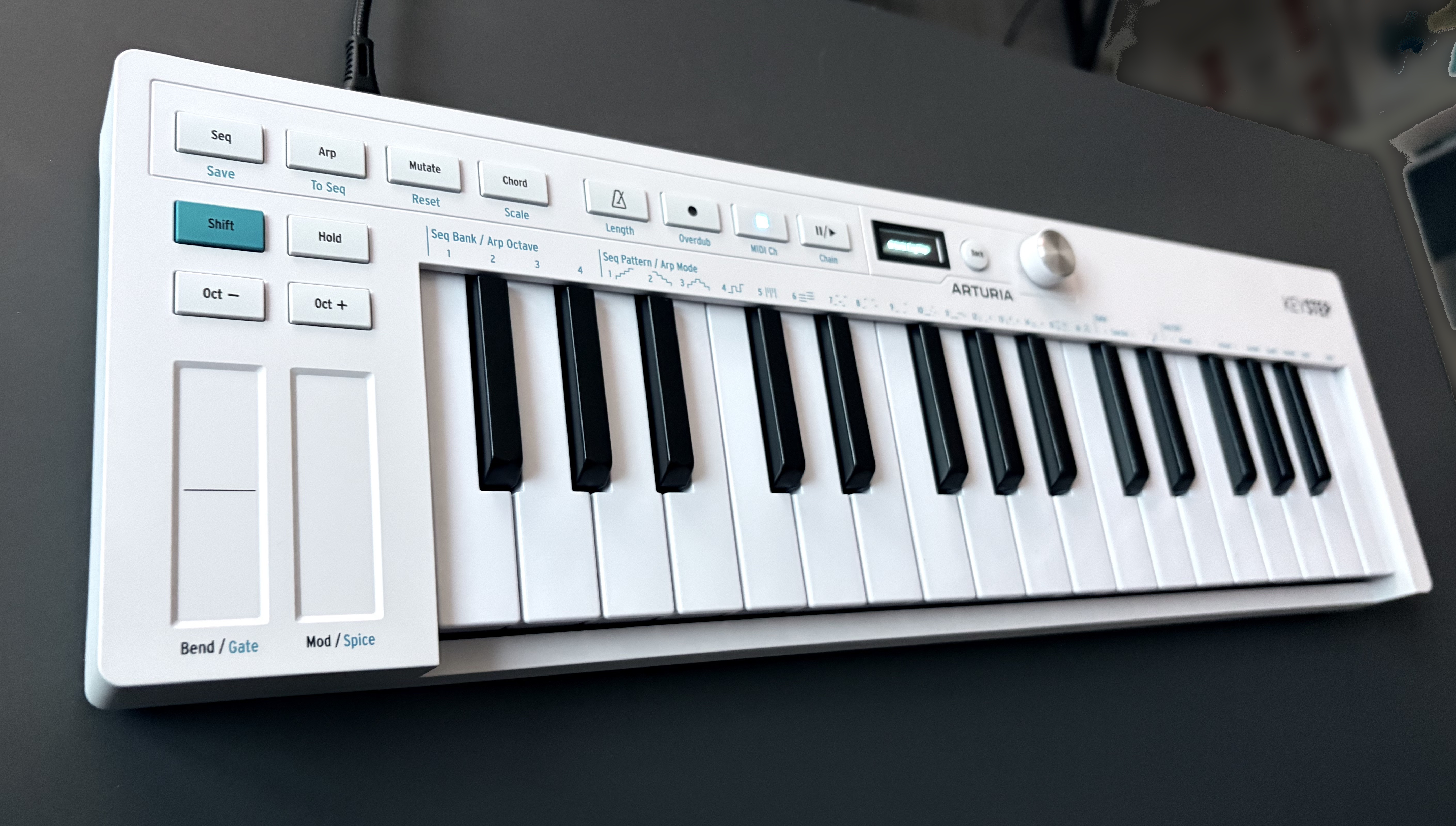
The tactile strips are as sensitive as ever, and allow very clear variations in pitch or modulation. We’ll also appreciate the possibility of assigning MIDI CC controls in an even more flexible way, notably to CV outputs, an adjustment available when using Arturia’s included MIDI Control Center software. This is a fundamental development. Each output can be deactivated or assigned a specific parameter, making KeyStep mk2 just as useful with Eurorack systems as with MIDI machines or plug-ins.
Sequencer and arpeggiator: 64 steps, chaining, Mutate/Phrase Arp/Spice, Scale Mode and modulation tracks
The recording mode can be unquantized, enabling more natural phrases than in the first model. Step-by-step editing offers better clarity thanks to the OLED display, which, at last, shows essential parameters in real time. Multiple patterns can be chained together to create real structures, bringing the mk2 closer to more ambitious machines.
The arpeggiator, meanwhile, has been transformed. Arturia increased the number of modes from 8 to 16, and added the Mutate, Phrase Arp and Spice functions (directly inherited from the MicroFreak and MiniFreak). These somewhat cryptic names actually provide a controlled dose of rhythmic or melodic variation. Mutate introduces slight pattern transformations. Phrase Arp lets you play predefined patterns that go beyond the simple rise and fall of notes. Finally, Spice adds a large dose of randomness. It’s all very creative, close to what some much more expensive drum machines or sequencers offer.
You can adjust note duration, ensemble transposition and randomness in real time, all in an extremely playful way. You can quickly switch from a classic arpeggio to a totally unexpected motif, then to a groove locked in a defined scale thanks to the new Scale Mode. This prevents any harmonic slippage, which is useful on stage or in a modular system. The Chord mode, already present in the first model, is more fluid here, allowing you to record and recall a chord in a single gesture.
The KeyStep mk2 also introduces a new modulation engine. Pitch bend, modulation, gate or Spice variation movements can be recorded in sequence. Four modulation tracks are available. By assigning a modulation to the cutoff of a filter, for example, or to the speed of an LFO on an external synthesizer, you can achieve rapid variations in timbre and texture in a matter of seconds. The unit works like a universal LFO, capable of acting on MIDI instruments as well as analog machines connected via CV. With the two CV modulation outputs, automation can be sent simultaneously to two separate analog parameters. Considering the beautiful (and small) OLED screen, we would have liked to see the animation of these modulations. It’s a shame. Let’s also point out the absence of ratcheting and direction change.
Finally, a special mention for MIDI management and the integration of the MIDI Control Center. Not only is it easier to read than before, but configuring outputs, control curves and MIDI channels is very intuitive. And unlike older devices in the range, the mk2 communicates with the software even if it’s already connected to a DAW, so there’s no need to interrupt work in progress.