Log in
EN
FR

Abbey Road Plug-ins

8 products found

Categories
Filter
Sort by
Evaluation
  • Reviewed or not
  • Editor’s award
  • Reviewed by Audiofanzine
Availability
  • Available or not
  • Sold new or used
  • Sold new
  • Sold used
Must-have products
  • All products
  • Flagship products
  • Best rated products
  • Hot products
  • Popular products
Price
  • Freeware
€
Clear
Sort by
  • Popularity
  • User ratings
  • Price - low to high
  • Price - high to low
  • Used price, increasing
  • Used price, decreasing
  • Name (from A to Z)
  • Name (from Z to A)
  • Added on
Choose a category
Sort results
  • Popularity
  • User ratings
  • Price - low to high
  • Price - high to low
  • Used price, increasing
  • Used price, decreasing
  • Name (from A to Z)
  • Name (from Z to A)
  • Added on
Filter results 8 results found
Evaluation
Availability
Must-have products
Price
  • Freeware
Show results

The best Abbey Road Plug-ins reviews

The reviews Audiofanzine members found the most helpful.
  • moosers's review

    The Abbey Road Plug-ins RS 135 is a really simple, filter plug-in that is part of the Abbey Road Plug-ins Brilliance Pack. This comes along with two other plug-ins in this bundle - the RS 127 Rack and the RS 127 Box, both of which are similar sort of filter plug-ins. This one is probably the simplest of the bunch, however. As far as getting the plug-in up and running is concerned, I wasn't involved in the process since I don't own this plug-in pack and have only used these plug-ins at the studio where I'm working. I can however speak about the extreme ease of use you're getting with this plug-in and the full bundle. This is just a one band filter that is fixed at 8 K. So while you're not really getting any control, this is really meant for adding a bit of high end brilliance to your sound. A manual is surely not necessary... SUITABILITY/PERFORMANCE We're running the Abbey Road Plug-ins RS 135 and the full Brilliance Pack at the studio where I work on a few different Pro Tools HD systems. Running it on this system isn't a good judge of how much processing power plug-ins will take up, as they can handle pretty much anything since they're HD systems. However, I'd definitely be surprised if many users had problems running this plug-in since it's such a simple one. OVERALL OPINION Although limited in what it can do, the Abbey Road Plug-ins RS 135 is great for adding a little bit of brightness to your sound. It's a really warm sounding plug-in, which is really the main reason I like using this for boosting at 8 K rather than using a more traditional parametric or graphic EQ. I love using this on guitars mostly, but even for vocals if I feel the timbre could use a little bit of high end color. This and the other plug-ins in the brilliance pack are great for both mixing and mastering, so definitely check them out if you're looking to add some new high quality plug-ins to your DAW.

  • moosers's review

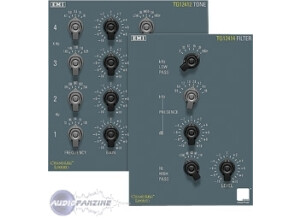
    The Abbey Road Plug-ins TG 12414 Mastering Filter is a plug-in that is found in the Abbey Road Plug-ins Mastering Pack bundle. It's a stripped down version of the TG 12412 equalizer plug-in that is also included in the same bundle. I didn't encounter any problems while installing this plug-in, as I had installed the proper formats and all. It should be simple and easy as long as you follow the instructions. As far as the user friendliness goes, I'd say it's a real easy plug-in to figure out how to use if you have some experience using equalizers. This one has high and low pass bands, as well as a middle 'presence' band, which has a pretty wide selection of frequencies to choose from. So essentially, this is a one band, semi-parametric EQ with high and low pass filters. The low pass has six frequencies to choose from, while the high pass has five. The middle band has eight frequencies to choose from, and a gain knob. There is also an overall output leveler. I didn't need a manual to figure out how to use this, and I really don't think that many users will. SUITABILITY/PERFORMANCE The system that I'm using the Abbey Road Plug-ins TG 12414 Mastering Filter (and the full Mastering Pack bundle) with is a Pro Tools LE based system. I'm running everything on a Mac Book Pro computer, made up of a 2.2 Ghz Intel Core 2 Duo processor, and 4 GB of RAM. I run Pro Tools with a Digi 002R audio interface and I monitor with a set of ADAM A7's. This has definitely been enough to support running this plug-in, and I've used it both for mixing and mastering. It's doesn't seem like the type of mastering plug-in that takes up too much of your system, or at least it hasn't on mine. OVERALL OPINION The Abbey Road Plug-ins TG 12414 Mastering Filter is a great overall equalizer plug-in for both mixing and mastering. While it's dubbed a mastering plug-in, and it certainly is, I've also found it to be great for mixing as well. It's not the most flexible plug-in, but for a one band essentially, there's definitely a lot that you can do with it. I think it has a great overall sound, as it's easy to add some grit or some brilliance with just using the single band. It's also nice that you can easily drop low or high frequencies off that you don't want or that are unnecessary. The Mastering Pack is just made up of this and the other aforementioned TG 12412. It's definitely best suited as a mastering plug-in and bundle, but it's more than nice that it's versatile. Abbey Road makes some great plug-ins that sound quite realistic - the TG 12414 and the Mastering Pack as a whole is absolutely worth checking out if you're in the market for something like this.

  • « What am I paying for? »

    This is probably one of the smallest and easy to install plugins I've ever used. Not much to it really. I don't know if it comes with a manual because I didn't bother looking. The first thing I noticed when I booted this up was no presets. Well that's fine, because upon further inspection I realized all I was looking at was a semi-parametric EQ with some filters. Okay... SUITABILITY/PERFORMANCE I will say that working with it in Cubase it gives me zero issues. Very stable plugin and it doesn't tax my CPU at all. Then again as far as I can tell there's no complex processing going on here so why should it use many resources at all? OVERALL OPINION When I first started using it I was expecting some kind of secret sauce to be involved. Why else would they charge this kind of change for a simple semi-parametic eq filtering master? To my ears that's exactly what it was though. Now I'm not trying to be rude about things, but I can get one of those for free almost anywhere. I pay for one of these because I want it to sound warmer and more pleasant than a cheapo mastering plugin. But the TG honestly doesn't sound any different than the bundle of free master eq plugs I have sitting around. I went online and started asking around. It seems this plugin is very popular with engineers who used to use the real thing and miss the feel of it in a DAW. Now I can understand that. If you get used to a certain piece of hardware, not other soft based equivalent will feel the same. Makes perfect sense. However, for someone like me who has never seen or used a 12410 I had to stop and wonder why I even needed this. Perhaps I'm expecting too much. I have tried some of the other Abbey Road plugs with mixed results so I'll probably do some reviews on them, but I just didn't hear anything special about this one. From what I hear it is a good emulation though, so maybe its the hardware itself that I don't like.

  • « Box or rack? What's the difference »

    Unlike the RS 127 rack, I don't seem to have any trouble "grabbing" the knobs on the interface. To be honest, that is the one thing that makes me feel the Box is any different than the Rack. I will talk more about that later. No need for a manual, two knobs. After using it for a minute, you get the general idea of what each one does (frequency range, db amount of brilliance added or taken away). The only thing simpler than this plugin is one with just one knob. Yes, both are located right on the front of the GUI. SUITABILITY/PERFORMANCE So far the RS 127 box has had zero issues running on a Macbook Pro i7, Fireface 800 and Logic 9. No crashes, no hiccups in audio. As for performance, I am having trouble distinguishing the difference between this plugin and it's sister plugin the RS 127 rack. I spent some time just A-B ing the two and sometimes I think the Box is a hair thinner. Other times, I think my mind is playing tricks on me. Either way, it's negligible enough not to really notice, at least for my ears. It kinda makes me wonder if they slapped a different GUI on the box in order to make you feel you got a better deal (3 plugins for $125 instead of 2). I am not officially saying that is what happened but its really hard for me to tell them apart. I have been using this plugin for about a month now. OVERALL OPINION Like I mentioned in my review of the RS 127 rack, this unit does get you quite close to that vintage Beatles sound. It can really reduce the mud in a mix quickly and efficiently but I really wish the DB knob wasn't so rigid. I feel like I would have been more apt to use this plugin if the knob was more fluid and allowed you to slowly increase the db instead of jumping up and down by 2 db. Of course if they did that, it wouldn't be a true replication of the real unit, so I should probably stop whining about it :) I will say this, if you have 5 minutes to impress a client on a mix, and said client likes vintage sound, grab this guy (or it's twin :) the RS 127 rack). Overall I prefer the BBE Sonic Maximizer's over these guys (hardware or plugins) mainly because there are a few more options to control. I would probably not get this (these) again, only because I tend to do more electronica these days and it (they) don't really do much for that field.

  • « Not as impressive as other offerings »

    I have noticed that occasionally it is "hard" to grab the main knob and change it. I don't know what the problem is but sometimes it takes me a few tries to "grab" the knob. That is really the only strange behavior I have found in this plugin. No real need for a manual. Just two knobs, one for frequency range and one to increase or decrease the "brilliance." I don't believe it could get any simpler. Yes the functions are all easily accessible as both reside on the face of the plugin. SUITABILITY/PERFORMANCE Other than the knob issue (which could be user/my fault) the plugin seems to perform fine. Yes, it is stable. There has been no issues running this on a MBP i7 8gb ram, RME fireface 800 and Logic 9. As for performance, it does what is says it will do, and I respect that, but it doesn't offer enough flexibility for modern applications. I should mention that I am generally biased against these "one knob" style plugins. Of course this has two knobs but essentially the same thing. The thing that bugs me most is the DB knob is not fluid. It simply jumps up or down 2db. What if you want 1db of "brilliance," well too bad. I will say that if you want that old Beatles sound, then this plugin will get you pretty close on its own. I enjoy that aspect but was hoping to get a little more flexibility. I have been using this for a month but it is essentially a one trick pony that I don't often reach for. OVERALL OPINION I guess what I like about it most is the EQ curve. It is very specific to that "Beatles" sound which can be quite popular with modern rock/pop/folk bands who want that vintage sound. What I don't like is the fact that it is a one trick pony in my mind. Well, for $125 you get three plugins, not just this one so it's a decent deal. I would only recommend this to studios who get a fair amount of people wanting that particular sound or you yourself love that sound. I feel like a good eq and compressor could probably achieve the same thing and also offer more flexibility. The sound quality is very good, just like all of Abbey Roads' plugins. I have used BBE products for many years and they essentially do the same thing but with much more options. I have to say, I prefer those in most of the situations that brilliance is needed. I should mention that I did use this plugin once for a client who thought the drums were sitting in the mix to "thick" as he described it. I separated the stereo channel into two monos, put one of these on each channel and within a minute, had the sound he wanted. So that was pretty convenient. Had I known the plugin would have come in handy like I mentioned before, I would definitely have bought it again. It pretty much paid for itself with that one situation. Other than that, I guess I wouldn't have though because I am a "got to have lots of options" kinda guy.

  • « A must have »

    This plugin has performed flawlessly on a macbook pro i7 core and Logic 9. The great thing about plugins like these is that if you have ever used hardware, then you should have no issues using these guys. No need for a manual, this only has a couple parameters to tweak. The configuration couldn't be simpler. It looks like the real thing and is very simple to use so most people should be able to dive right in. Yes, all the functions are very easily accessible and can be automated very easily with Logic 9. SUITABILITY/PERFORMANCE So far the plugin has been perfectly stable. I have never had any issues with lost presets or crashes. The performance of this unit is amazing. The sound is awesome and quite realistic. Although I have never had the privilege to use one of these actual hardware units but in comparison to other hardware compressors this one holds it's own. What's really nice is the plugin uses almost no CPU. Instead of having to use it on an Aux channel I can have one of these on every track I need one on. That's huge in the Virtual world. I have been using this unit for about a month. OVERALL OPINION What I like most about this plugin is a combination of the sound and the fact that it is a plugin that I can instantiate as many times as I need and not suffer loads of CPU pressure. Combine all that with that fact that I can automate all the parameters and it's hard to look at some of the hardware units I have lying around. What don't I like? I guess nothing so far. I have to say I am impressed with the warmth of this plugin. Digital audio is really getting impressive. $165 is not a bad price to pay for this caliber of sound quality and flexibility. I have used several compression plugins including waves (generally my favorite), schaak audio transient shaper, built in Logic and Ableton compressors, etc.... and this one has gone right to the top with my Waves. Yes, I would buy this unit again. I would recommend getting a Waves package first for the diversity but this is a great add on to the arsenal.

  • moosers's review

    The Abbey Road Plug-ins TG12412 Mastering Filter is a plug-in found in the Abbey Road Plug-ins Mastering Pack, which includes this plug-in and the TG12414 filter, which is essentially just a single band version of this one. As far as installing this plug-in and getting it up and running goes, it was quick and easy, without any issues at all. I can say the same thing about the interface, as it's really not hard to figure out how to use this. This is basically a four band, semi-parametric equalizer that is designed after console EQ's. I don't know if it's designed after a particular console or not, however. Each of the four bands has parameters for frequency, with five different frequencies to choose from on each, gain, and for shape (aka bandwidth or Q), also with five different settings to choose from. It also has an overall output leveler. I haven't seen the manual for this plug-in, so I can't say anything about it. SUITABILITY/PERFORMANCE The system that I've been running the Abbey Road Plug-ins TG12412 Mastering Filter on is my home rig, consisting of a Mac Book Pro lap top and Pro Tools LE 8. I run Pro Tools with a Digi 002R audio interface and the computer has 4 GB of RAM and a 2.2 Ghz Intel Core 2 Duo processor. While this is dubbed a mastering plug-in, I've also used it for mixing and haven't had any issues running a few instances at a time of this plug-in within a single session. If you're using it just as a mastering plug-in, you'll of course need less processing power to use this. OVERALL OPINION While the Abbey Road Plug-ins TG12412 Mastering Filter comes in the Mastering Pack, I've found it to be more versatile than just being a mastering filter, as it definitely works well for mixing as well. It's got a good amount of warmth to it for a plug-in and is certainly flexible in what it is able to achieve. Often I'll use the other plug-in the pack, the TG12414 when I'm looking to do a simple job, but the TG12412 comes out when I'm looking to do some serious work, or for mastering of course. This plug-in pack and the TG12412 is absolutely worth knowing about if you're looking for an EQ for mixing or mastering...

  • moosers's review

    The Abbey Road Plug-ins TG 12412 Limiter is actually a bundle of two different compressor/limiter plug-ins. One is a classic 1969 model, while the other one is a 2005 model. Both are similar in look and style but have a slightly different make up and sound. I don't own these plug-ins and have only used the ten day free trail that they offer as a gauge to see if I wanted to buy the plug-in pack. It was easy enough to download it from their website and put it onto my iLok, which only took a few minutes. I believe it would be the same process if you were to buy the full license for the plug-ins. The interface of each of the plug-ins is fairly simple, each containing four parameters. The difference between the 2005 model and the 1969 model is that the 2005 model is based on the Chandler Limited version of this classic piece of outboard gear while the 1969 one is based on the original that was used in Abbey Road Studios on many classic records. In terms of make up, the only difference is that the 1969 model has knobs for input, output, recovery, and for choosing between either a compression or limiting mode, and the 2005 model has the same parameters except that instead of the input parameter it has one for hold. I don't believe that most users will need to check out the manual. SUITABILITY/PERFORMANCE For the demo version of the Abbey Road Plug-ins TG 12412 Limiter that I'm currently using, it's on a Mac Book Pro that has a 2.2 Ghz Intel Core 2 Duo processor and 4 GB of RAM. I'm running it in Pro Tools LE 8 that runs with a Digi 002 rack audio interface. While I was able to run a few of them in a session that was already loaded with plug-ins comfortably, I did notice that I got a CPU overload message a few times when I would first pull up a new instance of the plug-in. After that it ran fine, but it just makes me think that it's the type of plug-in that takes up a decent amount of processing power. I'd encourage those interested to check out the demo version like I did to see how well it will run on your specific system. OVERALL OPINION Of course right off the bat I was intrigued with the Abbey Road Plug-ins TG 12412 Limiter pack just because of who was issuing it. However, even though these are great sounding plug-ins, I don't think it lived up to the hype for me. That's really just because I thought that I would be blown away, and I can't say that I was. While I like both plug-ins in the Abbey Road Plug-ins TG 12412 Limiter a good deal, I decided that I'm going to hold off from adding it permanently to my plug-in suite. I'd absolutely like to have them, so maybe in the future I will do. I'd definitely recommend trying out the full ten day demo if you're at all interested in these plug-ins.