Log in
EN
FR

Multi-Effects for Acoustic Guitar

37 products found

Filter
Sort by
Evaluation
  • Reviewed or not
  • Editor’s award
  • Reviewed by Audiofanzine
Availability
  • Available or not
  • Sold new or used
  • Sold new
  • Sold used
Must-have products
  • All products
  • Flagship products
  • Best rated products
  • Hot products
  • Popular products
Price
  • Freeware
  • Low-cost (< $150)
  • Mid-range ($150 - $250)
  • Premium (> $250)
€
Clear
Sort by
  • Popularity
  • User ratings
  • Price - low to high
  • Price - high to low
  • Used price, increasing
  • Used price, decreasing
  • Name (from A to Z)
  • Name (from Z to A)
  • Added on
Sort results
  • Popularity
  • User ratings
  • Price - low to high
  • Price - high to low
  • Used price, increasing
  • Used price, decreasing
  • Name (from A to Z)
  • Name (from Z to A)
  • Added on
Filter results 37 results found
Evaluation
Availability
Must-have products
Price
  • Freeware
  • Low-cost (< $150)
  • Mid-range ($150 - $250)
  • Premium (> $250)
Show results

The best Multi-Effects for Acoustic Guitar reviews

The reviews Audiofanzine members found the most helpful.
  • « Zoom 504 II Acoustic »

    I got this unit as a Christmas present that I had askef for. I think my parents got it at a Daddy's Junky Music store for about $80. If you bought it online, shipping would make it about the same price. I enjoy everything about this unit. I play a Seagull M6 Spruce that i have been extremely happy with. I like to fool around with some Tim Reynolds stuff and this unit combines the delay that Tim uses with a whole bunch of other effects including the 12 string guitar effect, reverb, and chorus along with many more. Everything sounds great. One thing that i dont like about the unit is your inability to control the effect while your playing. You basically preset and cant control a whole lot while your playing. But, its just a very minor setback. It seems real durable. Since its so small, it doesnt take up much room. Thefefore, its less apt to get damaged. A very very nice unit for the money. Combines many effects into one package. I was debating between the Boss DD3 or this Zoom 504 II acoustic. And i'm glad i chose this! This review was originally published on http://www.musicgearreview.com

  • « Zoom 504 Acoustic Guitar Effects Pedal »

    I got this 5o4 pedal at the local music store, i was looking for a pre amp to a pizo pickup accoustic that lacked luster. The unit was compact easy to carry in a diddy bag and had no bulk to slow me down. mine fit in the back of my amp nicely. the display was easy to read, and the onboard tuner enabled me to leave my tunner in the studio and not worry about another peice of gear. the mute while tuneing made for a professional pleasure at practices and proformances as well as tuning checks on the fly. the volume pedal is an option and should have been a design considersation. the plugs to the cables could have been designed so that they don;t stick forwards but, rather to the sides like the other pedals. construction is high impact plastic I have never had one break in 3 years. this unit would improve the tonality of any thing accoustic electric you pluged in used even for vocals in some cases. This review was originally published on http://www.musicgearreview.com

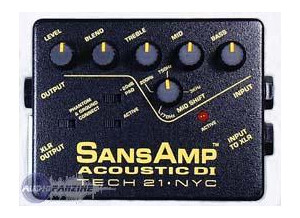
  • moosers's review

    The Tech 21 Sansamp Acoustic DI is a direct input box that is designed specifically for use with acoustic instruments with piezo pick ups. I don't know what the exact differences are between this DI and the others in this line of DI boxes beyond them just being designed for different types of uses. The box has the same make up as the others, with 1/4" jacks for two separate sets of inputs, an output, and an XLR output as well. It doesn't require external power that I'm aware of and isn't rack mountable since it's a DI box. UTILIZATION Using the Tech 21 Sansamp Acoustic DI isn't difficult in the least, although it definitely has a lot more going on than your average DI box. The box has switches for phantom/ground connect, a -20 db pad, and an active switch as well. The general parameters that it has are for level, blend, treble, mid, bass, and a mid shift for choosing the exact mid range frequency you'd like to use. Beyond this there isn't anything you wouldn't see on a normal DI box, so a manual shouldn't be necessary. SOUND QUALITY I've only used the Tech 21 Sansamp Acoustic DI for recording a direct signal for an acoustic guitar, but for this use the DI was nearly perfect. Of course we used a microphone to pick up the guitar as well, but we wanted a DI signal as well since the pick up was a good one and we had this great acoustic DI available. I can't think of a better DI for acoustic guitar, as there is more flexibility and possibilities here than on any other that I've used before. I can't really say how well this would be for other acoustic instruments with pick ups, but for acoustic guitar it's nearly perfect. OVERALL OPINION The only bad thing about the Tech 21 Sansamp Acoustic DI is the price, as it isn't really too affordable for anyone other than professionals. It isn't something that you can just have sitting around just in case because of the price, but if you do want something more all purpose I'd recommend checking out the normal DI boxes from Tech 21. However, if you do a lot of acoustic recording with a DI box, the Sansamp Acoustic DI is the best of it's kind!

  • moosers's review

    The Boss AD-8 is an acoustic guitar multi-effects processor. It has a ton of different features and effects and is designed for the acoustic guitar performer who wants all of their effects and sound processing in a signal unit. The pedal has ¼ inch connections and is powered by the power supply that comes with it. It isn’t rackable – it is a guitar foot pedal. UTILIZATION The make up of the Boss AD-8 is pretty easy to follow, but there is a lot going on and will take a little bit of time to get used to what everything does. In terms of parameters, the pedal has knobs for output level, reverb (with three different types of reverbs to choose from), body type, body level, string enhance and a section for EQ that has knobs for bass, two for middle, one of treble and one for presence. The pedal also has a section for saving sounds, which is a really cool feature in my opinion. There are also three large foot switches for this memory feature and for turning the effects on and off. The manual is put together pretty well and if you have access to it I would recommend having it around as there are a lot of ins and outs to this pedal. SOUND QUALITY While in general I’m not a big fan of effects on acoustic guitars, this pedal does sound good and I can see how it would definitely come in handy for live shows. The reverb sounds really good but the acoustic modeling section and EQ sections are probably the most useful. If you are looking to get your acoustic guitar sounding a bit more precise and pristine, the Boss AD-8 definitely offers that possibility. OVERALL OPINION I’ve only used the Boss AD-8 a handful of times and haven’t used it for any live shows, but I would definitely recommend checking out this pedal if you want to get some effects and sound modeling going with your acoustic guitar for live shows or even for home use. I wouldn’t recommend using this for recording as I always like to record acoustic guitar clean and do what I want with it later on in the mixing process. The price is quite reasonable for a pedal of this nature and overall the Boss AD-8 is definitely worth a look.

  • « Some Brilliant Features Couple With Some Underwhelming Additions »

    I bought the AD-3 for a specific reason, and that was that I did not trust my band’s sound guy. We were starting to do acoustic gigs, and the sound of my guitar out of the mixing board was less than stellar. I did not want to get an amp since there was a lack of space, and the mixing board and speakers were taking up quite a bit of real estate. I knew that the way to take back control of my sound was going to be at my feet in the form of a pedal (so typical of me to think a pedal could solve a sonic problem). There are plenty of acoustic preamp pedals out there, but I had very specific needs. I am not an acoustic player in the sense that I have a repertoire of sing-a-long songs, and other acoustic friendly material. My band simply takes our electric show, and with some minor changes plays it on acoustic. My needs at an acoustic show are different that your typical player, but the basics are the same. I am also playing in a band (two guitars, bass, and singer) which requires different sonic necessities. I initially thought about ripping into my electric pedalboard, and stealing an iStomp or two and reprogram them for a 3-band EQ and whatever else I thought I could use. Pulling pedals off my board just wasn’t the best way to go. I was using a guitar with piezo pick-ups with very little onboard tonal controls- just a volume and tone knob. I needed something to expand my control, and the AD line of Boss acoustic preamps caught my eye. The AD-8 had more bells and whistles than I needed. I settled on the AD-3 since it had enough features for what I was looking for plus a couple of extras. It was designed to work with piezo pick-ups so it seemed like a no brainer to buy the pedal. Building a pedalboard just for the acoustic shows was where I was heading with the AD-3 anchoring it. I am really impressed with some of the features of this pedal. The anti-feedback is brilliant, the controls are intuitive, and the battery saving measures are excellent. It has a long battery life, but I plugged it in during a live situation to try and take battery failure out of the equation (there is enough to worry about already). The AC adaptor is not included, and must be purchased separately. The pedal is not without its problems, and those are the things that weigh it down. The reverb is not the best in my opinion, but is workable. The chorus is also workable, but not a stellar effect. Instead of a chorus I’d rather have a delay or a boost feature. I’m not the biggest fan of the chorus effect (I got my fill of it in the 80’s), and I only use it once or twice in a set. When I have a solo I need to cut through other instruments to be heard so I’d rather have a footswitch activated boost instead of chorus. The tone shaping is designed around use with a piezo pick-up, so keep that in mind when checking this pedal out. Since buying the AD-3 I have upgraded my acoustic guitar to a Breedlove Pursuit Concert Ebony loaded with a Fishman ISYS pick-up. This upgrade in electronics has made the AD-3 obsolete in my live acoustic rig. It is too bulky to add to my electric rig for use with my piezo loaded Telecaster. In conjunction with a piezo loaded guitar this is a great pedal, but it is not for everyone. Chorus and reverb are not necessarily the effects I would choose to go with an acoustic guitar. The anti-feedback is great, and works well without having to stop playing to take care of the issue. It is well designed, but has a very specific target audience that it can be used by.

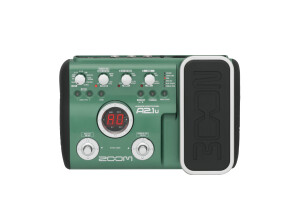
  • « Zoom A2 »

    The product is a multi-fx stomp box--replacing the old 504 unit in the product line-up. it has a footprint of about 9" x 9". It has four rotary knobs, 5 solenoid (soft-touch) buttons and two heavy contact foot switches for scrolling between patches. The construction appears to be some type of anodized aluminum with a green finish. I have been playing guitar for almost forty years. While I gigged some in my high school and college days 30-35 years ago, since then my playing has been more limited to special music at church and musical programs in nursing homes. I purchased this from Sweetwater Sound to replace a Digitech multi-FX unit I was less than pleased with. I paid $100 for it. In shopping, I compared it with previous units I had owned from DigiTech, Alesis, and DOD. I also field compared it to similar units from Line 6, Behringer, and Boss. First off, this unit is very easy to use in terms of editing and storing user patches. As with any Multi-FX unit, you will have to have some idea of what sounds you want to have stored. All in all, I had created 20 user-edited patches in about an hour. A second major plus is that this unit has the capability of 6-band EQ. The best the other manufacturers can offer in this price range is 4-band EQ. The sound is virtually noise-free. While it comes with a Noise reduction component, I have not noticed as much noise compared to Alesis and DigiTech units, which produce a lot of hiss. The unit can be powered by either battery (4-AA cells) or AC. By using rechargeable L-Ion batteries, there is no need to be tied to a wall wart with the wimpy spaghetti cord again. Finally, Zoom builds their units with an on/off switch--something only Boss does. The negatives on this are relatively minor: The first negative is that it has a single 1/4" TRS (stereo) output -- dual (L/R) 1/4" TS outputs would be better. A second negative is that Zoom arranged the FX so that the reverse delay and tape echo FX are located in the Modulation FX cluster with phaser, flanger, chorus and tremolo instead of being located with the delay/reverb cluster. It would be better to move reverse delay and echo functions to the delay/reverb cluster so that they can be used in conjunction with the phase/flange/chorus FX (for some of those Beatlesque mid-60s psychedelic FX) The construction appears to be very sturdy. Except for the battery compartment cover, the top, back and bottom appear to be made of some type of anodized metal (probably aluminum. The sides appear to have some sort of rubberized coating on them. The knobs for adjusting the settings/parameters are very sturdy as well. The 1/4" inputs and outputs are anchored to the casing with reinforcing collars instead of being anchored internally to the circuit board. The footswitches are heavy contact switches (like on MXR stomp boxes). This has many other features I didn't examine because I don't use them--such as acoustic guitar modeling (11 different models). For what it offers that I do use, it was worth cost. This review was originally published on http://www.musicgearreview.com

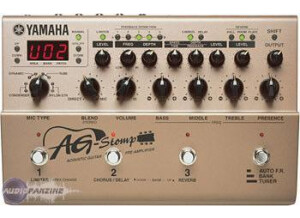
  • « Yamaha AG Stomp Box »

    399.99 via Musicians Friend, and purchased the pedal separately. Built like a rock. Easy to read. Limitless possibilities with EQ range and mic simulations. Each simulator effects the sound noticeably, and you can in turn tweek the sounds to your exact specifications with the EQ chorus, and reverb. Takes time to learn basics. It's complicated. Like a rock. Highly recommend for acoustic guitar player who want to customize sound for different songs/types of music. High quality sounds and construction. This review was originally published on http://www.musicgearreview.com

Categories that may interest you