Log in
EN
FR

Bass Pre-amps

220 products found

Choose a category
Selected category: Bass Pre-amps
Sort results
  • Popularity
  • User ratings
  • Price - low to high
  • Price - high to low
  • Used price, increasing
  • Used price, decreasing
  • Name (from A to Z)
  • Name (from Z to A)
  • Added on

The best Bass Pre-amps reviews

The reviews Audiofanzine members found the most helpful.
  • moosers's review

    The Ampeg SVT-DI is a vacuum tube based direct injection box, designed for use in the studio. Like all DI boxes, it can of course be used in a live setting if you so choose, but as far as the SVT-DI goes I'd recommend only using it in the studio since it does have a vacuum tube inside of it, making it more fragile than your standard DI box. The SVT-DI has 1/4" connections for input and thru, and an XLR balanced output. It also has buttons for a pad, a ground lift, as well as for choosing between tube and direct. UTILIZATION There isn't all that much that you need to know about the way the Ampeg SVT-DI runs, as most of it is self explanatory and you will be able to pick it up as you go along. Even if you haven't got prior experience with direct input boxes, I think that you'll be able to figure out everything without much of a problem. Getting a good sound from it is as simple as sending something that sounds good to it, as it will take care of the rest! SOUNDS As far as direct injection boxes go, the Ampeg SVT-DI probably has the fullest and warmest sound of any that I've used. While you can bypass the tubes and go direct, this isn't something that I do unless I'm looking for a specific type of tone. I've used the SVT-DI primarily for recording bass guitar, but it can be used for anything where you would want a thick DI sound. I think that you'd be hard pressed to find an application where this direct box didn't sound good... OVERALL OPINION While they no long manufacture the Ampeg SVT-DI, you can still find them pretty easily used if you're looking for one. There aren't too many other tube based DI boxes that I've used, and the SVT-DI would probably be the one that I'd recommend if you were looking for one. I don't know exactly what these would cost used, but since they weren't the cheapest DI boxes to begin with, I think you're still going to have to pay a bit more than average for this. All in all I would say that it is definitely worth it, as this is built like a brick and is a great sounding tube DI that will last a long time...

  • « Solid Sounding Sculpting Tool »

    The Sonicake Bass Preamp Factory is spot-on for bassists. The price is fantastic ($79.99 USD or less), and you get a lot under the aluminum chassis. There’s plenty of headroom, particularly if you engage the Drive (usually my volume never exceeds 10-o’clock), the sound is very clean and unadulterated, thanks to a specially designed buffer, and there’s a ground-lift for those noise issues. But let’s check out the fun stuff. The 3-band EQ is excellent, and like the Acoustic Factory that I reviewed, the entire spectrum of Bass, Midrange, and Treble are all useable without sounding out of place. In fact, with the Bass and Treble 12-noon, and the Midrange cranked, you get an impressive Metal bass tone, and that’s without the Drive engaged. The Bass Factory also has a classic-based optical compressor that is very smooth and gradual throughout its range. Some compressors squeeze so hard, that you never go past 12-noon, whereas the Bass Factory compressor is more subtle and practical throughout. I prefer it around 10-o’clock, so that the notes sound fairly consistent in output and with some tightness. The Drive is quite good, and even when turned all the way down there is some added power and push, similar to how a Tube Screamer with its gain all the way down still enhances an amp. What I like about this drive is that it is very smooth and only begins to break-up around 12-noon, which then produces a moderate growling distortion. Even up full the effect remains under control; conversely, I do not place the Orange Bass Butler’s gain past 11-o’clock as it sounds too wild or messy, particularly in a busy mix. Some other features of this analog pedal include placing the EQ pre- or post-effects (before or after the Drive and Compressor, which is subtle, but noticeable), both ¼-inch and balanced XLR outputs, and it requires only 70mA power. Lightweight, portable, functional, and affordable.

  • « From deep and mellow to punchy metal »

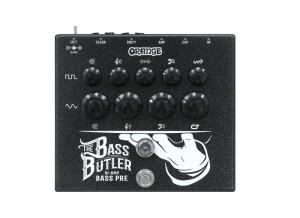
    There are some well-received bass pedals and preamps on the market, and the Bass Butler by Orange ranks toward the top – and for good reason. If you want your bass tone to flourish, and particularly if you want that punch (necessary for rock and metal), this preamp delivers. In a nutshell, the Bass Butler has two channels, a very traditional Clean and a rhythm guitar Dirty (a popular bi-amp arrangement among modern bassists). The Clean channel can work independently, whereas the Dirty channel works in conjunction with the Clean (when activated). There’s also an Expression out/in that allows the merging of the Dirty channel (based on its settings, of course); I’ll get to that later. https://www.youtube.com/watch?v=xp2-9YehNAo Before getting into the sound, as per the demo video included with this review, a brief background on the Bass Butler’s setup. Each channel has its own Cab Sim, being the Orange OBC410 on the Clean and the Orange PPC412 for the guitar (yes, I realize a bass also is a guitar, but I’ll refer to the Clean channel as being ‘bass’ and the Dirty channel as being ‘guitar,’ as a matter of differentiation). There are a few ways to hook up the Bass Butler, the first being from Amp out. When going Amp Out, both channels merge together WITHOUT the Cab Sims, which is ideal if going direct to bass amp/cab hardware. You can go DI to a virtual cab, whereas a virtual amp is optional since the Bass Butler is a preamp insofar as your tone is concerned (I did include this preamp direct to an Ampeg amp/cab and it sounded very good, although the tone will alter when going direct to various amps and for obvious reasons). A second application is to go through an amp’s effects loop. The third method of connection is via the XLR outs, both of which retain the cab sims, which make it very convenient if going direct to a mixer/board, with each channel controlled accordingly. On that note, one thing I wish the Bass Butler had would be the Cab sims from the Amp out connection (with a switch to turn the sims on or off, thereby allowing you to have a single line out for DI recording, rather than using a dual female ¼-inch to a single male ¼-inch (which only costs about $10, which is what I did). As a side note, there’s a Ground Lift switch (to remove unwanted hum and noise). Now, the Bass Butler has a LOT of headroom... an amazing amount that requires its own 18v adapter (included), which means most pedal board supplies likely fall short, thus necessitating a surge protector of sorts. Regardless, for DI recording, I had to keep the volume for both Channels rather low, which is a good thing – I won’t fall short of volume! The Clean channel is very traditional, but big full notes that range from woody to punchy and bright, perfect for music ranging from traditional jazz, country, medium rock, stoner rock, etc. It includes a typical Treble and Bass EQ. The studio-grade Compressor is most impressive, as it keeps the signal very clear and exceptionally tight (when you want that characteristic). The Dirty channel is based on a guitar amp and that’s where you get the ‘clang,’ bite and drive. It also includes a Midrange EQ (besides Treble and Bass). I suspect there’s more than enough Treble and Midrange on this Channel to satisfy any bass player, as both certainly brighten a tone to a great degree and beyond what I ever heard on hard-rock and metal bass tracks. The melding of the two channels spans a significant range, which I demo on the video (bear in mind that my limited talents are directed more toward the six-string rhythm variety, but when you want that intense bass, a pre-recorded track in many software programs often fall short). The Gain control on the Dirty channel holds a lot of magic, in that a little does a lot to provide character, but it’s when you dial the Gain in around 12-noon and beyond that its true nature blossoms. I also find it intense enough that I haven’t set the Gain past 2-o’clock, although an effective setting has a lot to do with the style of music and how much Volume (blend) you include of the Dirty channel. Speaking of blending, the optional expression pedal may not seem so ‘optional.’ This is a fantastic tool that needed to be part of the Bass Butler, to create a massively wide array of bass tones from very deep and brooding to punchy and driven (heavy fuzz sounding when pushed). With an expression pedal’s treadle all the way heel back, you hear nothing but the Clean channel, and as the treadle rocks forward, there is a progressive blending of the Dirty channel – to the point of full blend between the two channels with toe all the way down. This means you can go from super clean to super dirty, and anything between. Overall, this is what a bass guitar is supposed to sound like and can sound like, for those Pastorius and Entwistle inspirations, and I demoed a range of tones on an inexpensive bass (match up a Precision, Rickenbacker, etc., and the results should be more impressive). A pure tone shaper, there is very little to complain about. My only gripe, as indicated (and I heard this on a few video reviews) is that I would like the Cab sims as part of the Amp out (with an on/off switch), as opposed to managing two separate lines via the XLR outs. Regardless, this fantastic preamp weighs 1.29 kg (or 2.84 pounds) and measures 17 cm x 8.5 cm x 17.5 cm (or 6.6 x 3.3 x 6.5 inches), about twice the size/weight of a traditional pedal, forward angled in design for easier viewing and switch/knob access during floor/pedalboard operation.

  • « EBS Classic Mediums »

    EBS has been making high quality bass gear out of Sweden. Most recently they came out with their own line of strings. I was lucky enough to get a set to try out. I was able to get a set a few months back before they were available to the public as of August 2011 the EBS bass strings in Nickel and Stainless Steel are available in the US. I am not sure of the price but I am going to guess it translates to around $40. I installed them on my US Standard Fender Precision bass. Great tone! I put these on and had plenty slack left even after using the string through bridge design that the newer Fender basses use. The tuning is excellent. Once I installed them I made sure to stretch them out and after that I had no major tuning issues. The sound is very fat and warm. None that I can think of. The strings are made in China, which is sort of a bummer as I like to buy US made strings, but hey the strings sounded great. The strings are made from EBS' own design of a Titanium Nickel mix. Ultimately I think the titanium helps the string life as I got twice the life out of these than most of the nickel strings I tried. The gauges are a 45 G string, a 65 D string, an 85 A string and a 105 for the low E string. I really like using a higher gauge E string such as a 105 or even a 110 as it evens out the tension across the neck and helps keep things clean if you need to drop down to D. I went out on a whim to try something new and it was a great end result. Warm tone with a long lasting string life and great tuning stability. This review was originally published on http://www.musicgearreview.com

  • « Hartke VXL Bass Attack Pedal »

    The Hartke VXL pedal is black, probably the size of two Boss sized pedals side by side. I need a DI box and a distortion pedal and this is both of those things in one. I bought it brand new at my local music shop for $89.00 <a href="http://guitarvideochannel.com/blogs/columns/billys-world">http://guitarvideochannel.com/blogs/columns/billys-world</a> I like that that Hartke VXL can be used as either a preamp, a passive or active DI, and a distortion pedal. It packs that into one box, so I get to bring less to the gig. You can power this by a 9 volt battery, Zoom makes a power supply for it as well as I can used my One-Spot or my Godlyke Power All. I do not like that when the pedal is bypassed in my signal the EQ is still active. This is no problem if this pedal is always on for you or if you are running it through a true bypass loop. But, hey it's a small price to pay compared to the cost of some of the similar pedals. This thing is built in a tool metal casing. You wouldn't want to catch this pedal with your teeth! The knobs seem sturdy. The switches are OK, but could be better. I've had them stick once or twice, but the problem worked it self away. Bottom Line is this is a great pedal packed with a ton of features for not a ton of money. Nothing will beat the sound of a cranked tube amp, but when you can't have that, this thing is a great substitute. This review was originally published on http://www.musicgearreview.com

  • « Radial Engineering Tonebone Bassbone »

    History: I've played bass professionally for 44 years and a couple of my bands released 45s when that's what bands did, but none was a hit. I currently play in a praise band in a local church and also do studio work. I favor rock but have played just about every style, even -- shame -- disco. Favorite players include Paul McCartney, James Jamerson, Tony Levin, Chris Squire, Joe Osborn, Bob Glaub and Sting. I first purchased the Radial Bassbone from Musiciansfriend in 2006 when my church band went with a 'silent stage,' requiring all electronic instruments to go straight to the board without amps. The Bassbone offered not only DI but great flexibility. MSRP: $350; Price paid :$260. I sometimes switch between bass guitar and electric upright bass, and the Bassbone offers two channels with separate volumes and EQs, along with a DI, an effects loop/boost, tuner out, a ground lift and a line out to amp for stage monitoring. Channel 1 has a three-position Contour switch (flat or two preset EQs); Channel 2 has three standard boost-or-cut tone controls). Switching between the two channels is accomplished with a heavy-duty footswitch that activates green or orange LEDs to indicate channel. The Boost section, also operated by footswitch with a red LED, can be assigned via a three-position slider to activate Boost, Loop (effects) or Both. A separate boost volume control allows you to set the level of the boost, all the way up to distortion if that's what you need (+12DB). The effects out jack uses a standard stereo Y cord for in/out signals. By using the footswitch to activate the chain, you to leave effects 'out of the loop' until you're ready to use them -- a handy thing if your effects drain the tone from your bass even when switched off. Combining Boost with Effects allows you to pump up the volume for a solo or other feature. The Tuner Out jack allows you to keep a tuner plugged in at all times and send a signal tailored for tuners. The Output 1/4' jack sends a processed signal to your amp and a balanced XLR jack sends the same signal to the board. Even if you're not going to the board, the Bassbone can be used as a handy A/B switch if you use more than one bass. There's very little not to like, but I had to replace the included 15VDC power supply after a year because the end that plugs into the unit developed a stress fracture and stopped working. Because the Bassbone can't be powered by batteries and a 15VDC power supply isn't something you can find in most music or electronics stores, I had to order a replacement adapter direct from Radial. Radial is located in Canada, and US customs held the package at the US border for three days for unknown reasons, so I had to go a week without the 'Bone. Since then, Musiciansfriend has started to carry the power supply ($19.95), so that's not a big problem any more. The new power supply cord has stress reduction at the point where it plugs into the pedal, so I assume this was a common problem. However, I'd suggest buying an additional power supply when you buy the Bassbone to avoid hassles. The Bassbone is very well constructed of 14 gauge steel with a black baked enamel finish. Footswitches are heavy duty and rugged, and the knobs won't fall off. Bright LEDs make it easy to see what channel you're using and if Boost/Effects is in or out, even on a dark stage. Separate channel volume controls allow you to easily match volume of different basses, and the three-band EQ on Channel 2 makes it ideal for tailoring the sound of passive basses when going direct. I run my active Lakland 55-94 through Channel 1 (set flat) and other passive basses, including my EUB, through Channel 2 because of its EQ. The radial Bassbone is more than just a DI and is ideal for the working bassist who needs flexibility and options. Although some might think it pricey, it's no more so than some one-trick-pony effects units, and its quality and durability is superior to many stompboxes. This review was originally published on http://www.musicgearreview.com

  • « Ampeg SVPCL »

    I've played for approximately 30 years, gigging for about 12 of those (including my current band). My roots are in blues rock, blues, and 70's fusion & R/B. I got it from BAss Central, new. I got it for about $450, if I remember correctly. Although I don't stray much from "my" tone, the flexibility to get just about any tone you'd want is there. Huge, full, tube tone, with the booty to back it up. controls feel just a little light-weight. The markings on the "Ultra Low" control are marked a little askew. I've talked to several other SVPCL's that had the same thing on theirs. Construction and quality are first-rate, I've gigged this thing hard for a year, with it hardly even sweating. I truthfully don't know why I'd buy another amp. This is the solid rock tone genie in a bottle. This review was originally published on http://www.musicgearreview.com

  • « Ampeg SVP Pro »

    Used $200 US This pre amp has a lot of features that I like. You can get almost any tone or sound you could want, I love the drive on it, you can add all the juicy tube harmonics you want. I like the 9 band graph too, the normal bass control is set at like 70-80 hz, I have to play dropped, so the 40hz on the 9band helps alot! It has lots of dirty grind while keeping it clean enough for recording. The direct out on mine it kind of dirty, not very clean which I dislike. The mid switch is pretty sweet, and very usefull, you can get down and dirty and switch the mids so got punk in one easy motion. I like the tone, and the features. The direct out is too dirty, the linking on the back could include more patches, it could have some sort of cooling. Good, strong, well built, nice black finish. It's AMPEG! If you see one used test it out, one of the best preamps I've used. This review was originally published on http://www.musicgearreview.com

  • « BBE BMAX Bass Preamplifier »

    I purchased this unit from USSpeaker.com and paid $349.00 no tax and shipping was $18.00. US Speaker is a great place to do business, they realized I lived close to the BBE corp HQ so they had the unit shipped from BBE to me and saved about 5 days transportation time - I had the preamp in 2 or 3 days. I was not expecting to see it for another week at least. I had to replace a Ashley preamp and limiter/compressor that I had been using since 1982. They finally gave out so the search was on for a replacement. I use BBE units in my home stereo as well as my bass rig and have always felt that they provide the best sound improvement per dollar value available. So when I saw they were making bass preamps I knew I wanted to get one. Bass preamp is the logical extension to the BBE line. This unit has a built-in full featured BBE sonic maximizer and a limiter/compressor as well as parametric mid range EQ and Bass, Mid, and Treble controls, input gain, and master out. LED's indicate on/off status of the Maximizer and Limiter/Comp and Limiter/Comp threshold activity. A bright switch provides 8db boost at 5khz. I found this useful for fretless but unneccessary for fretted bass if you have active onboard preamp in your bass. There are front panel inputs for active and passive basses, active input is attenuated by 6db and is very smooth for active bass. The Bass and Treble controls are mainly "boost", the Mid control is all "cut". If all 3 controls are set to zero no sound is passed. I have found that you need to set these controls very low to get great sound so you have a lot of reserve capability to spare. The parametric mid control provides a 250hz to 1000hz frequency range with a -12db to +12db gain control. Rear panel provides foot switch jacks for both the Sonic Maximizer and the Limiter/Compressor. Using these footswitches over rides the front panel switches (the footswitches are not provided but any simple on/off foot switch will work). Direct out (XLR), 1/4" Main out, send/return jacks and a ground lift switch are all provided on the rear panel as well. This is a great sounding preamp, very warm and smooth and with a good power amp this thing is loud. I use it with two old Crown DC300 power amps, one I use bridged into a custom built folded horn with 4 12" EV's. The other Crown is run is Dual mode into 2 1x15" Trace Elliot cabinets. Old equipment but it still sounds great. You simply cannot beat this preamp the value is evident the second you take it out of the box. BBE has since released a version with a 12ax7 tube front end which I would get had it been available at the time. I use a Art Studio 3 tube preamp in front of the BBE but you don't need it to get great sound from the BBE preamp. For $350.00 nothing comes close in my opinion. What's not to like. This unit looks great with the red abalone shell knobs! The build quality is top of the line. the front panel is 1/4" thick aluminum and the chassis is equally as sturdy. This is one of the best built 1 space rack units I have seen. It will withstand heavy touring use for sure. No plastic jacks are used and the switches are solid with very good tactile feedback. You will be very happy with this preamp. You can spend over $1000.00 for a Bass preamp but you will get little for the $650.00 difference in price. BBE has built a great preamp and has put serious thought into the design and engineering not to mention the sound quality - and for $350.00 street price it's the best deal I have seen. You might have to look around to find one or you can go to USSpeaker.com but do yourself a favor and get this preamp! This review was originally published on http://www.musicgearreview.com

  • « ART Nightbass Express »

    My band currently owns 2 SGX NIGHTBASS processors. The first one was purchased out of Musicans Friend somewhere in 1996 and the second unit was bought in 2001 off of Ebay. The first unit was about $600 and the second unit was around $200. The unit is 24 bit and has great sounds on it. Has a lot of sounds that you actually use and not so much of "crazy" sounds. I use it for guitar actally and not bass. I sounds soooo good! Especially the distorions because they are not so "shred and tear" like most guitar effects. When you plug a bass into this bad boy it rocks!! You get awesome bottom end and can model ANY sound that you want. To me... this processor is too good for bass and should be used for guitar. Also what I like about it is that it has some good drum reverbs and effects on it also. I never used them, but it's nice to know that they are there. This processor sounds very nice through my original 1970 fender all tube amp :). One major minus! I have to keep the noise gate cranked because its so noisy! I really gets my nerves but it sounds so good..that I keep it. Also on the used unit we bought...the one of the outputs on the back have got a short in it or something. What can I say..."very fragile material." Don't throw this thing around...even though I did. I has tubes and is very breakable. However the one I bought a couple years ago has had no problems except for the noise. The used one we bought is kinda making me nervous though. This unit sounds AWESOME and is very very very programable. And when matched with the X-15 pedal its unstoppable. However...be wary of the dreaded noise. I called ART and they weren't very much help at all. ART's customer service reicks. Anyways...the noise is alot worse on guitar than it is bass. This review was originally published on http://www.musicgearreview.com

  • Audiofanzine FR's review

    (Originally written by Le Grand Flandrin/translated from Audiofanzine FR) Solid state XLR output with phantom power. 5-band EQ, optical compressor, depth control. It's a high-class device without useless gimmicks and with a beautiful sound. UTILIZATION Easy to use. I use it with a double bass and David Gage's Realist pickup and it sounds awesome. Clear user's manual. It's also great with an electric bass especially for studio applications. SOUNDS Designed specially for double bass. Mine sounds very good with this pickup and this preamp. OVERALL OPINION One year. Of course I would buy it again.

  • Audiofanzine FR's review

    (Originally written by C21h22n2o2/translated from Audiofanzine FR) - Amplification technology (tube, solid state, ...)? *...Both - Output power? *...-10 dBu and more... Very high output level!! - Connections? ...Everything you need! Two programmable FX loops with adjustable level ...XLR ...jacks... B--amp... crossover... limiter... everything. - What about controls, effects etc.? Chorus and compressor... Great... UTILIZATION - What about settings? Yes!!! - Is it easy to get the right sound? ...Yes!!! - Is the user's manual clear and comprehensive? ... Better than perfect... SOUNDS - Does it fit your music style? ... Yes... - Which guitar, bass or effects do you use? Spector... wow... - What kind of sounds do you get and which settings do you use ("crystal-clear", "fat", ...)? ... every possible sound... I'm a Cannibal Corpse, In Flames, Death fan... Also great for softer music... from Duran Duran funky sounds to Guns'n Roses rock sounds and more modern stuff like Muse. I specially like the SWR or Alembic-like settings... but everything is possible from Ampeg to Euphonic Audio and Demeter... Everything!!! - Which sounds do you prefer / hate? The main problem is that it's discontinued... good luck! =) If you are lucky and find it... watch out because it requires 115 volt AC power... It tends to clip easily with an active bass... and also with a high-output level passive bass... Pros: see description above... OVERALL OPINION - How long have you been using it? A long time... I take it everywhere with me... this device is just mind blowing! - Which feature do you like the most / the least? You must buy high-quality tubes... and not especially high gain tubes... with non-selected cheap Sovtek or Chinese tubes you'll get a bad signal to noise ratio! But you won't regret buying quality tubes... Standard selected JJ ECC83 tubes are enough to blow you away! - Did you try any other models before buying it? Yes... almost everything available on the market... Ampeg, Aguilar, BBE,Tech21, EBS... But I wanted an exceptional quality and a large sound range to pick from... And I wanted to have the possibility to save my settings!!!!... - How would you rate its value for money? ...That's a good question... The quality is great!! That's for sure, but the price can be very high, so good luck... - Based on your experience, would you buy this product again? I already bought another one!! I found it in an auction. And I'm still looking for more... But I don't wanna become neurotic =)