Log in
EN
FR

Behringer Electronic instrument

164 products found

Categories
Series
Filter
Sort by
Behringer
Evaluation
  • Reviewed or not
  • Editor’s award
  • Reviewed by Audiofanzine
Availability
  • Available or not
  • Sold new or used
  • Sold new
  • Sold used
Must-have products
  • All products
  • Flagship products
  • Best rated products
  • Hot products
  • Popular products
Price
  • Freeware
  • Low-cost (< $150)
  • Mid-range ($150 - $350)
  • Premium (> $350)
€
Clear
Sort by
  • Popularity
  • User ratings
  • Price - low to high
  • Price - high to low
  • Used price, increasing
  • Used price, decreasing
  • Name (from A to Z)
  • Name (from Z to A)
  • Added on
Choose a category
Selected category: Electronic instrument
Sort results
  • Popularity
  • User ratings
  • Price - low to high
  • Price - high to low
  • Used price, increasing
  • Used price, decreasing
  • Name (from A to Z)
  • Name (from Z to A)
  • Added on
Filter results 164 results found
Brands
Evaluation
Availability
Must-have products
Price
  • Freeware
  • Low-cost (< $150)
  • Mid-range ($150 - $350)
  • Premium (> $350)
Show results

The best Behringer Electronic instrument reviews

The reviews Audiofanzine members found the most helpful.
  • « Effects, 5 Band EQ and a Crisp Sound »

    The Ultratone K900FX is a 1 x 12 keyboard amplifier that has 24 bit digital FX processing with over 100 presets to use. This was the main reason for me even choosing this amp. I was in a local music store looking at the amps and came across this one once I notice it had all of the effects on it I was pretty much sold. I have even used this amp to do some small gigs with and never had a complaint with it. I would not use it in a larger room for a gig though because I do not think it is powerful enough. UTILIZATION I also liked how I could plug in a microphone (dynamic) right into the amp to use for my vocals. You can even put your CD’s into this amp and use it as backing music or just to play along with your favorite songs. I put on a pretty awesome show for a local Elementary Schools music classroom with this amp and the kiddies loved it. I really liked the delay on it and the pitch shifter. I was able to do some really neat stuff between working with the microphone and my keyboard running through this amp. OVERALL OPINION You can even mount this amp to a pole if you want, though didn’t have a pole so it just went on the floor. I do recommend having a good quality cord when using it because I noticed that cheaper cords don’t sound as good. This amp weighs around 40 pounds which is still pretty light; it is a 3 channel amp with a 5 band EQ built right into it! This was awesome, and I recommend this to anyone who is starting off with some really small gigs or is starting to take gigging more serious. The Ultratone K900FX has just about everything you need to work with from the EQ to the effects and microphone input, all at a good price!

  • « Excellent 808 analogique »

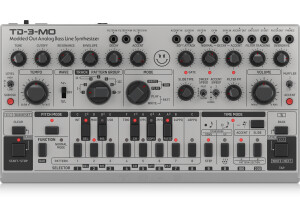
    C’est une superbe machine 808 analogique avec le son chaud qu’on ne retrouve pas vraiment en numérique! Il y a un paquet de possibilités pour sculpter le son entre le wave designer, le decay, les tones indépendants, le cut off à appliquer à l’ensemble des sons ou sur certains, un trigger, un note repeat hyper pratique pour hi hat ou montée de clap ou simplement modifier le pattern facilement pendant l’export audio. C’est ma première journée avec et je dois dire que j’ai déjà facilement enregistré ça sur mon daw. Il y a également des sorties individuelles pour ceux qui ont suffisamment d’inputs. Je recommande! Je ne vais pas la lâcher!

  • « Legacy without evolution »

    I’ll admit, I didn’t really need it… but when you see a synth inspired by the legendary MS-20, used by many of your favorite artists, it’s hard not to jump in. The K2 ended up surprising me, and in a good way. One of the standout features is how well the MS-20 spirit is preserved. The oscillators and filters are impressively close to the original. In terms of sound, it really captures Korg’s DNA, and that’s a real treat. The build quality is solid, and you can tell it’s not a cheap product. It feels reliable right from the first touch. On the downside, Behringer’s version doesn’t bring anything groundbreaking to the table. Sure, it has mini-jacks instead of standard ones, but beyond that, there aren’t any major innovations. For the price, it’s still a great deal, but don’t expect any radical changes compared to the original. Also, the manual is a bit lacking, especially for a synth that can be tricky to grasp. A bit more explanation would have been a nice bonus. Conclusion: If you’re looking for an affordable version of the MS-20 that doesn’t sacrifice much of the original sound, Behringer K2 is an excellent choice. It’s a solid, reliable synth with great sound. However, don’t expect any groundbreaking features, and be prepared to spend some time learning it since the manual doesn’t cover everything. Overall, a solid value for the price, but without any major innovations.

  • « Behringer Crave: A Simple, Reliable, and Affordable Semi-Modular Synth »

    I grabbed the Behringer Crave during a great promotion, and honestly, no regrets, no matter the price. At the time, I also had a Behringer 2600 (which I still own), and I was a bit lost in the complexity of modular synths. The Crave turned out to be a fantastic learning platform—simple and direct. After a few months of use, I even paired it with a Behringer Edge, and the experience was solid. The main strengths of the Crave are its reliability and build quality—no complaints there. The interface is straightforward, and the patch bay is well thought out; it’s intuitive and doesn’t turn into a headache like some Korg interfaces. You plug in, listen, adjust—simple and effective. On the downside, you might feel like you've explored it all fairly quickly, especially once you’ve mastered its basic functions. The manual is a bit sparse, but that’s typical of Behringer, and thankfully, there’s a ton of online documentation to make up for it. I sold it eventually, but even though I don’t particularly miss it, I’d still recommend it to anyone looking for a beginner-friendly, solid, and affordable semi-modular synth.

  • « Unbeatable as a first step or simply as a partner to an intuitive synthesizer »

    The Behringer Deepmind 6 was my first analog synthesizer, and I’m still thrilled with it. The built-in effects are fantastic, adding richness to each sound... and in stereo, please! The control layout on the panel is intuitive, making it enjoyable and easy to use. Perfect for learning or perfecting your skills. The community around the Deepmind 6 is very active and prolific, which allowed me to discover lots of interesting presets, most of which are free. As a first synthesizer, it offers an excellent mix of sound quality, ease of use, and creativity. The only thing it’s missing is a (real) sequencer, but you can easily find one very cheaply, like the Korg SQ-1, if I remember correctly.

  • « Fat and acidic, but the highs are a bit too timid for my taste. »

    I wanted to give these compact synths a chance, and not knowing the original Jupiter at all, it was the perfect opportunity to explore this world without preconceived notions or particular expectations. First pleasant surprise: it excels in fat, rave-y basses. The harmonics stand out clearly even at low volume, which is really appreciated. The filter is highly responsive, perfect for staccato lines that cut through a mix. Another pleasant surprise, the filter reveals a very acidic character: you quickly find yourself in sounds similar to the TB-303, which I definitely didn’t expect. As for features, the available modes are somewhat limited. Direct access to an arpeggiator is nice, but the novelty wears off a bit when you control it via a Keystep 37 or Keystep Pro, where those functions are already available. The weak point, in my opinion, concerns the lead sounds. The highs lack a bit of thickness; it’s not lifeless, but it remains quite thin and feels a bit disappointing after the great performance of the bass. Am I going to keep it? I think so, even though it might quickly become redundant with another of my machines, the (too rarely mentioned) MFB Nanozwerg.

  • « Between nostalgia and efficiency: a successful delay, a slightly overhyped filter »

    I've always had a soft spot for portable instruments, and after selling my Volca Keys a few months ago, a void had settled in my otherwise well-filled setup. This Phara-O Mini immediately intrigued me, and I didn't hesitate to buy it before its announced stock depletion... Having also owned a Minikorg 700 in the past, I was curious to see what this model had to offer, especially in terms of the filter. First impression: very positive. Beyond the grain of the VCO that I knew by heart, the delay is excellent. It is much less noisy than the one in the Volca Keys, and the ability to adjust the effect level (wet/dry) is a real plus. In general, this synth is quieter and seems more powerful, especially in the mids where it develops a nice rumble with a little something that reminds me of a Minimoog's character. It's not the growl of a 2600, but we're almost there. The filter itself is quite good. Softer and more controlled than an MS-20's, but far from the unique grain of the MiniKorg 700 and its famous "Traveller" filter. I admit, I was hoping for a bit more in this regard. Two small downsides to note: the lack of a built-in speaker, which isn't an issue for me but could disappoint some, as well as the absence of battery power. USB-C power is convenient but can quickly introduce noise if directly plugged into a computer or forces you to invest in an external battery to play comfortably. Am I going to keep it? Yes, without hesitation. I've already tested a few sequences with my Keystep Pro, and it works brilliantly. I can't wait to explore it further, for example, with my effect pedals or a more robust master keyboard.

  • « Behringer kx1200 »

    I bought this Behringer kx1200 keyboard amp for $275 u.s.d. at Guitar Center in Memphis,Tennessee, USA. My reason for purchasing this was so that I wouldn't have to haul my large Sunn Coliseum bass amp system to smaller gigs. The thing that I like most about this amplifier is the tone. It is rated at 120 Watts (RMS) and features a 15' driver with a 3' midrange and a little tweeter. It also has four quarter-inch inputs, buffered effects-loop, balanced lines in and out(1 of each) and two sets of RCA jacks, both in and out. The bastard even has a quarter-inch line-out jack plus an internal cooling fan and detachable AC cable. Hell, the thing probably has about 5 or 6 other rear panel features that I forgot to mention, plus a 4-band EQ and master volume. This unit also has 4 individual volume knobs, one per channel. 100% solid-state circuit, which means no tubes to hassle with.Oh, and the Behringer kx1200 features a very traditional Fender cabinet design with silver control panel and logoplus old-school corner guards. The black vynil upholstry is flawless, the speaker is better than expected, and the metal side-handles are a huge convenience when it comes time to pack up and go. No dislikes, everything works beautifully The unit is robustly constructed and heavy, which,as everyone knows,is a sign of quality. The upholstry is flawless. The knobs are of a type easily replaced should they ever chance to fall off or break. The nice brushed-steel control panel is logically arranged and easily read. In a word, BUILT TO LAST Bassists, if a small combo-type amplifier is what you're looking for, make it a Behringr KX1200 combo. The other brands seem to lack features and power by comparison to this unit. This review was originally published on http://www.musicgearreview.com