Log in
EN
FR

Other Drum & Percussion Accessories

166 products found

Filter
Sort by
Evaluation
  • Reviewed or not
  • Editor’s award
  • Reviewed by Audiofanzine
Availability
  • Available or not
  • Sold new or used
  • Sold new
  • Sold used
Must-have products
  • All products
  • Flagship products
  • Best rated products
  • Hot products
  • Popular products
Price
  • Freeware
  • Low-cost (< $30)
  • Mid-range ($30 - $90)
  • Premium (> $90)
€
Clear
Sort by
  • Popularity
  • User ratings
  • Price - low to high
  • Price - high to low
  • Used price, increasing
  • Used price, decreasing
  • Name (from A to Z)
  • Name (from Z to A)
  • Added on
Sort results
  • Popularity
  • User ratings
  • Price - low to high
  • Price - high to low
  • Used price, increasing
  • Used price, decreasing
  • Name (from A to Z)
  • Name (from Z to A)
  • Added on
Filter results 166 results found
Evaluation
Availability
Must-have products
Price
  • Freeware
  • Low-cost (< $30)
  • Mid-range ($30 - $90)
  • Premium (> $90)
Show results

The best Other Drum & Percussion Accessories reviews

The reviews Audiofanzine members found the most helpful.
  • « RTOM Moongel Damper Pads »

    I'm a drummer. I'm originally from Brazil. I play in a band called Glint. If you ever get close to a drum kit anywhere you might find one, in a recording studio, stage, living room or basement, there is a big chance you will see some sort of muffling technique used by the drummer to kill some of the undesirable overtones in a least one of its drumheads. This was the main application for duct tape to me until I discovered Moon Gel. These small adherent blue-gel pieces not only solve the problem greatly but also give the drums a much better esthetic look than the commonly used tape. You will find this jelly material for a price ranging from $6 to $8 bucks. <a href="http://www.glintonline.com">http://www.glintonline.com</a> I love how accurate I can control overtones undesirable overtones. The slight positing move of the gel in the skin makes a huge difference sound result. Also its stickiness doesn't wears off easily, so you can reuse them more then one time. They come in a small case of four. They are made from a non-toxic gel material. This product makes the process on controlling unwanted overtones really easy. This review was originally published on http://www.musicgearreview.com

  • « Speeds up tightning process, and adds precision otherwise impossible to attain »

    This is a great invention that I have been waiting for a while for. The experienced drummer to the intermediate to the beginner, regardless of the level of the user this device is a useful asset and a requirement to any drummer’s arsenal. Somewhat of a wrench, this unit hooks to the lugs of any drum set with them and measures the pressure of the head. This is important because using one’s eye to look for ripples in the drum head when tuning is only so useful. For precision tuning this device is amazing and it really fills a void that when used with other products aids in the creation of an even sound regardless of who is using the set. Another cool feature of this is that anyone can now help. In the past, only one person could tune a head properly, to ensure even turns, even pressure, etc. Now this enables anyone to tune a drum head like a pro. I guess the only downside is that this is purely a tool, and not a full featured unit that can take a drum from headless to tuned in 1 shot. It still requries someone who knows when a drum head is optimally tightened and tuned to finish the set. I have found this unit is awesome to use in the studio, as the tech guys who work the board, and have ltitle if any familiarity with drums or tuning can help lend a hand. This means the unit has paid for itself. I suggest this unit for anyone looking to tune fast and accurately. All in all, I amd very happy with my purchase, and see no downside or bad thing about the unit. It is reasonable, and is not too expensive, but it also has it’s limits and will require someone to know the procedures for tuning a drum head beyond just tightening lugs.

  • « A must for any drummer looking to personalize his or her sound »

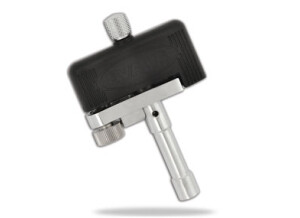
    Drum Dial Review: Tuning drums can be a frustrating process to say the least. I found over the past 15 years drumming, the key to good drum sound is in the prep work. Mastering proper technique in regards to tuning heads, maintaining drum quality, are all equally as important as practicing chops. I have found along my journey as a musician there are some shortcuts, or helpful hands in maintaining a top operating drum set and sound. One such device is known as the DrumDial. The DrumDial is a steal at around 60 dollars and is very helpful even if you just plan to use it to tune your snare alone. I, on the other hand, prefer it for it’s ability to accurately determine a set tension for my new heads, which means recordings from 5 years ago with my DW set sound just the same as recordings from 3 weeks ago. This is something every drummer faces along the timeline of drumming in rock groups, as the drum set ages, the heads change, the sound changes. This device offers you the guaranteed satisfaction that your drumhead is tuned to the same tension as you like it. That is not to say all the years of old drum tuning can be thrown away. On the contrary, this device is an addendum to the age-old curriculum. I advice the following for tuning a new snare head with DrumDial: 1. Start with resonant head first. Tighten to remove wrinkles in a star fashion always. Don’t over tighten! Just so that the head is started 2. Use your index finger to tap along the edge and listen for even sound across the head 3. Continue tightening in the star formation. However, place the DrumDial in the center of the head. 4. Recommended tension for resonant head: 74-75 5. Make sure to pickup the DrumDial and drop down each time to ensure an even reading. 6. Follow same procedure for batter head 7. Recommended tension for batter head: 89.5-90.5 All in all, This device is a must for a drummer. I cannot see a good drummer seeking his or her own “sound” without refining tone with one of these devices. Please do yourself a favor and pick one up ASAP.

  • moosers's review

    HQ Percussion's Real Feel 12" is a drum pad that is designed for practicing with. It's great for getting down that technique without making much noise at all and disturbing your neighbors late at night. They used to give these to drummers back in school to get them started with, as it feels like you're playing a real drum to a degree. I myself am not primarily a drummer, but I've played on this pad a number of times just to mess around as my friend has one of them at home. Coming from him as a drummer by trade, he loves taking the pad on the go to practice when he's not going to be by a kit for some time. While some will say that you could just bring your sticks and bang away on your table, I would tell those people that it won't have nearly the same feel. The padding on this is a perfect emulator of a drum head, as it isn't hard and has just the right amount of bounce to feel real. Of course there isn't really any musical worth to the Real Feel, as it's just made for practicing and isn't good for anything. HQ Percussion has a whole bunch of different pads in the Real Feel collection, but this is definitely one of the nicer ones. I don't know anything about the price of this at all, but I don't think that any of these pads are very expensive at all. They do come in a variety of different sizes, but this one at 12" seems to be just right. I don't know if they come in different types of padding, but I'm pretty sure this is the standard feel. The bottom line is that if you're looking to pick up a practice pad, there isn't any better than the Real Feel.

  • sanjuro's review

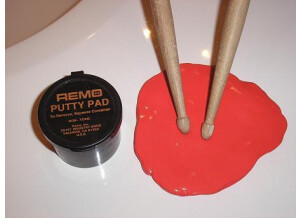
    The Remo Putty Pad is one of the coolest products in the accessories category. After trying a multitude of condensed practice surfaces, like other small pads and rubber pieces, this has to be my favorite. The problem with the small pads is that they are either big enough to play on comfortably and can't be carried easily, or they can be carried but are so small its annoying to practice with them. The practice putty has the advantage of being soft enough to be stuffed into its container, but hard enough to play on. After some effort needed to flatten the putty, the stick response is about as good as any other practice pad. It has great rebound and response. The putty is surprisingly tough, and the drumsticks rarely pierce through or leave significant dents. This is assuming the putty is not spread too thin on the table or whatever surface its being played on. If stick marks are present, every few minuted the putty pad can be merely turned over. Some problems with this include noise. If it is placed on a loud surface (like a wooden desk), the volume tends to be louder than a normal practice pad. On the other hand, if this is dropped on the ground, it could pick up some nasty dirt and other contaminants that will be difficult to clean off. Over time, this does get sort of dirty. In general, this does definitely get some cool points. When busting this out in public, it certainly opens some eyes. I really enjoy this, and its a pretty cool, fun thing to try out. I gave one to a friend of mine as a Christmas gift and it was a total hit. I would highly recommend this product to any fun loving person looking to practice in random locations.

  • sanjuro's review

    The Remo practice Pad is the practice pad that my first drum teacher used, so I saw it a couple times a week for almost 2 years. It is definitely the pad with the most realistic feel out of all the pads i ave tried out. The white plastic interior has amazing rebound that responds just like that of a real snare. Every roll is easy to maintain and control, and different dynamic levels are a breeze. It doesn't have a real coating, but considering its size and purpose this doesn't matter. The black plastic rims also do a lot to increase its realistic feel. When pads don't have rims, it is a real challenge to simulate rimshots. I always find myself slapping the shoulder of the stick parallel to the pad (on normal pads), which produces a louder sound. It doesn't feel normal, however, and the Remo pad takes care of this. The rims on the Remo pad are just about as high as a snare, so the style of playing doesn't have to be changed. Apart from its realistic feel and ease to play, the Remo practice pad has a fatal flaw. It is LOUD. It is nowhere as loud a a real snare, but at the same time a practice pad is supposed to be mostly quiet. When I played this in the drum practice room my teacher had, the individual strokes could be heard on the opposite end of the house. The rimshots were even louder. To some people, who don't have to worry about noise, this may be a good option because it is nice to hear your strokes as if it was a real drum. It certainly never gets so loud that earplugs are needed like a normal drum (thankfully). If you are living in an apartment with thin walls, the neighbors might get very agitated very quickly. I often play rudiments and things on quieter pads while watching tv. This would not be possible with this practice pad, because of its volume. Apart from the sound, it is a great practice pad.