


More than forty years after its release, the Memorymoog continues to fascinate fans of analog synthesis. With Memory V, Arturia takes on this extraordinary machine and offers a modern reinterpretation, enriched with numerous features.
Long before it shook up the world of synthesis with the Brute and Freak series and helped revitalize the audio interface market, MIDI controllers, and live performance keyboards, the Grenoble-based company had already built a solid reputation thanks to software recreations of the great classics of synthesizer history, including the Minimoog, Prophet-5, CS-80, OB-Xa, Jupiter-8, Juno, and Synclavier. But until recently, they had not yet produced a software version of the Memorymoog.
That omission was all the more curious given that it’s one of the most iconic polyphonic analog synthesizers in history. Is it the high standards of the instrument’s fans or certain specific aspects of its behavior that explain why the Memmy (its nickname among enthusiasts) had never been given an Arturian version? Probably a bit of both. In fact, few software developers have actually attempted to recreate it, and the rare existing offerings only came close to the original from a distance.
Released in 1982, the Memorymoog was the last synthesizer of Moog’s early era, before the company ran into financial difficulties. Often described as “six Minimoogs in a single instrument”—yet so much more than that—it combined six-voice polyphony, three VCOs per voice, discrete Moog transistor-ladder filters, mono and polyphonic modulation, memories, an arpeggiator… and above all, a sound. THE sound!
As a bit of background, more than twenty years ago, I was literally blown away during a concert by a local band. On stage, a Memorymoog was rumbling and growling. It was love at first sight. It wasn’t until very recently that I was finally able to spend several hours on a Memorymoog Plus in perfect working order. At first intimidated by the instrument’s imposing presence and charisma, I gradually learned to tame it and find a connection with it. Aside from the keyboard’s quality, I was not disappointed in the slightest. The Memorymoog was exactly as I had imagined it in my wildest dreams—and even more so. Capable of both roaring and caressing, it possesses an extraordinary sonic personality.
The instrument has a reputation for being temperamental, but during those few hours, this particular unit behaved impeccably. Needless to say, a software version capable of capturing its essence was bound to excite me. Of course, it won’t replicate the physical feel or the vibrations that run through the keyboard and chassis when the three oscillators and filter kick in. But today, the few working Memorymoogs frequently exceed €/$10,000, and can be costly to maintain. Suffice it to say that they remain out of reach for the vast majority of musicians.
However, after Arturia finally set its sights on the instrument, it produced a software version that’s significantly more affordable (€149/$149). As is often the case with Arturia, the goal was as much to reproduce the behavior of the original synthesizer as it is to enhance it with modern tools suited to a software environment. In this review, we’ll look at whether this software emulation captures the Memorymoog’s unique personality while justifying its existence amid the profusion of virtual analog synthesizers available today.
Installation, interface, and usability
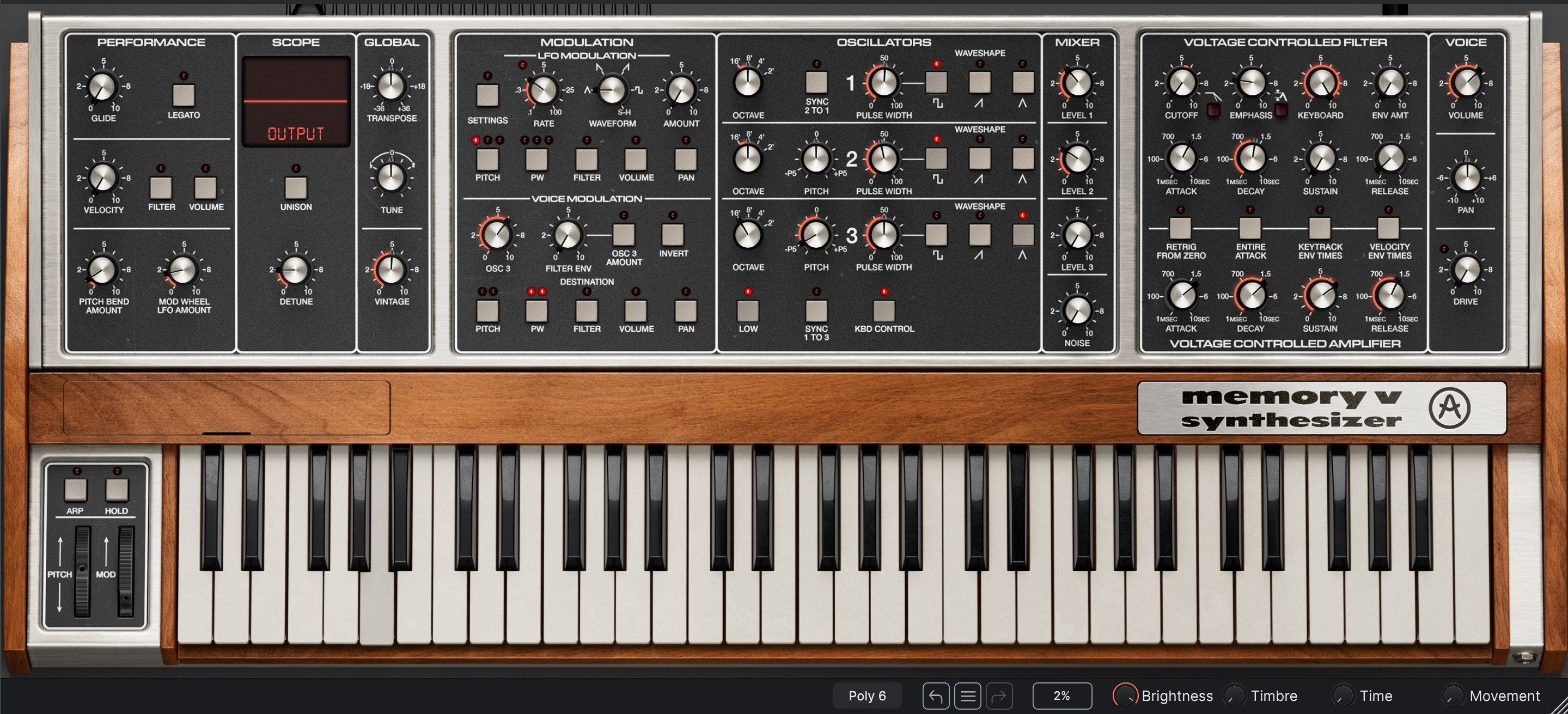
From the very first launch, those familiar with Arturia instruments will immediately feel right at home. The interface retains the aesthetic of the original machine while adopting a layout that’s easier to read and better suited to modern screens. The main panel is user-friendly, and despite the large number of parameters inherited from the Memorymoog, the overall layout remains clear and relatively intuitive. The oscillator, mixer, filter, envelope, and modulation sections are clearly identifiable.
As is often the case with Arturia, the balance between historical accuracy and ease of use is spot on. Of course, a few adjustments have been made. The octave selection buttons, for example, have been replaced by a rotary selector to save space. Purists will nevertheless recognize the general layout of the original synthesizer, while numerous refinements have been added: tooltips, a resizable interface, modulation visualization, and a preset browser with a tagging and search system.
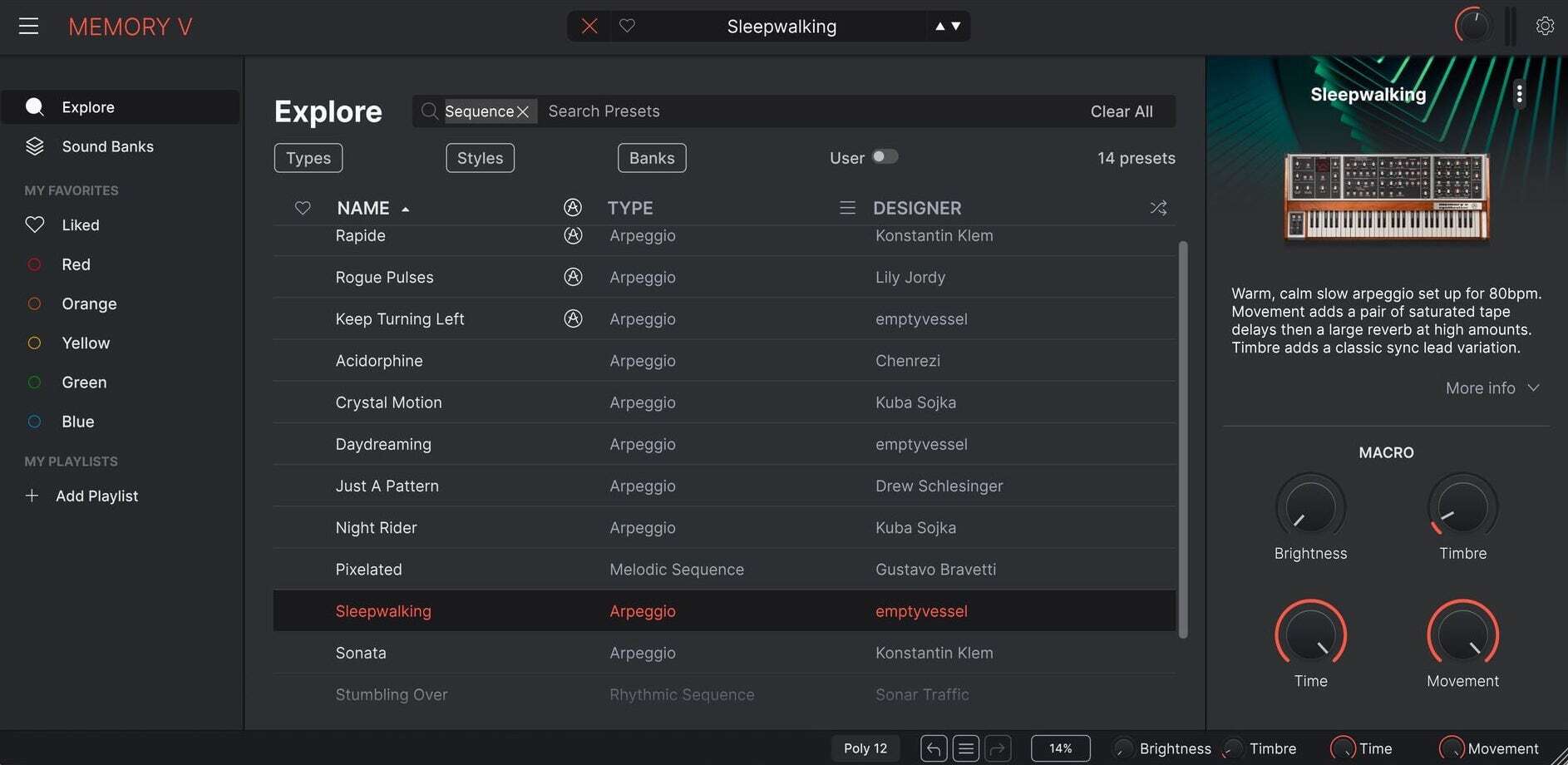
Over 300 presets are included and can be filtered by type, musical style, designer, or sonic characteristics. The original Memorymoog bank is included. Not only does it allow you to recreate iconic sounds, but it also remains perfectly suitable for contemporary productions with a retro feel. It is, of course, complemented by a wide selection of modern patches that take full advantage of the enhancements provided by Arturia. Unfortunately, while the engine is perfectly capable of utilizing the capabilities of MPE (MIDI Polyphonic Expression), more presets specifically designed for this technology would have been appreciated.
The sound engine of the Arturia Memory V: three oscillators, a filter, and an extraordinary personality
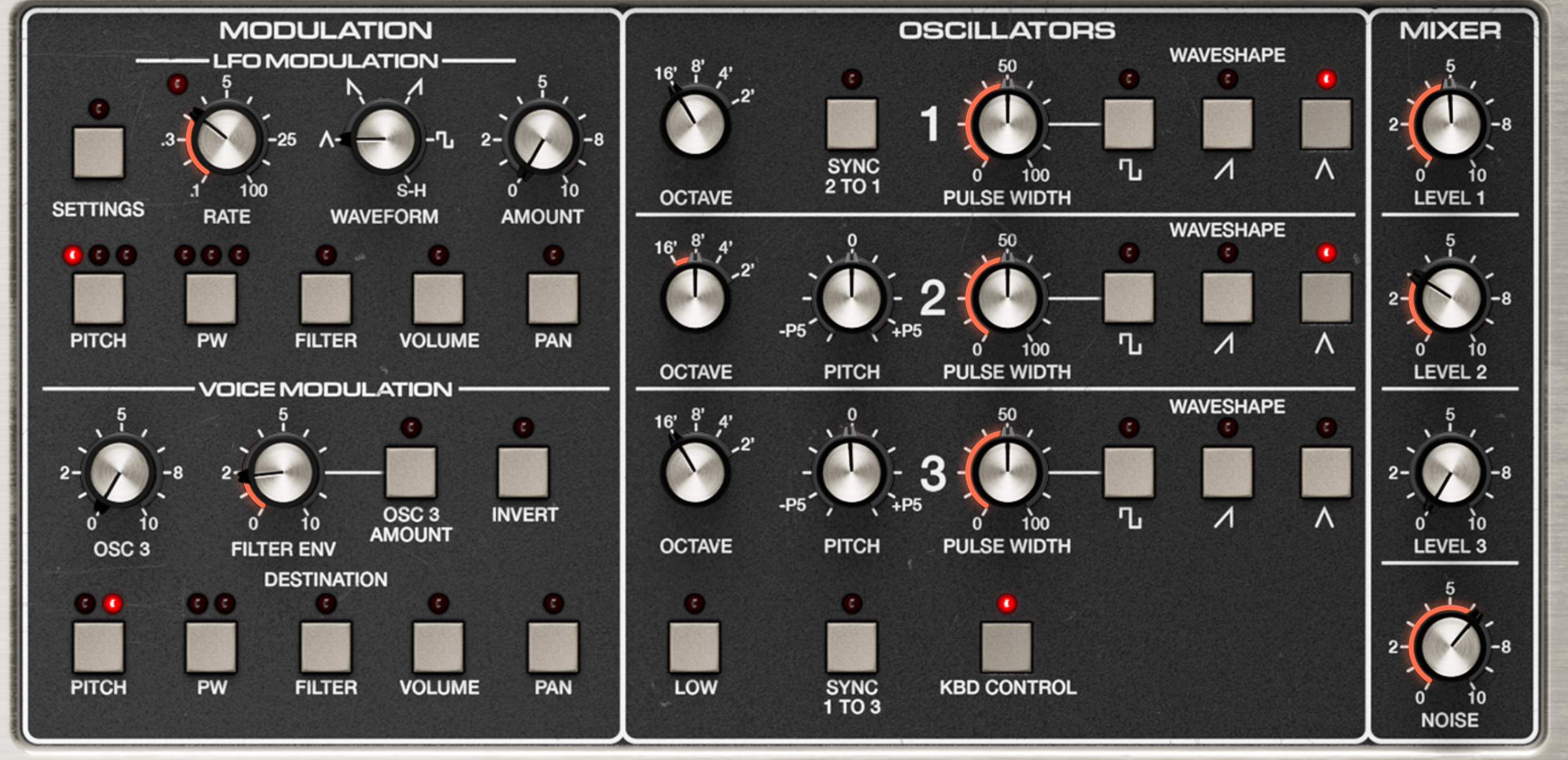
Yet Memory V comes strikingly close to its model. The chords seem to be constantly in motion, even without any effects. The oscillators interact with remarkable harmonic richness. In terms of architecture, the Memory V’s sound is generated by three oscillators per voice. Each oscillator offers triangle, sawtooth, and pulse waveforms with PWM. As with the original, the different waveforms can be combined simultaneously, allowing for richer waveforms.
Each VCO is modeled independently, and each waveform has its own nonlinearities. These are visible on an oscilloscope—they’re subtle, but definitely there. Just like on a Minimoog, Oscillator 3 can be set to a low frequency to function as an LFO. Oscillator synchronization is also included. But while the Memorymoog could only synchronize the first two VCOs, the Memory V adds the ability to synchronize VCOs 1 and 3. The Sync modes allow you to produce aggressive tones, effective for leads or for certain ‘80s-style sound effects.
A noise generator rounds out the package, and fortunately, it’s much higher quality than the one on the original. All of these sound sources can be blended in the mixer. This is one of the joys of the Memory V: just like on the hardware, a pleasant saturation kicks in when you increase the oscillator levels. This saturation can be further accentuated and refined using the Drive knob at the end of the signal chain. With it, you can achieve much more aggressive distortion.
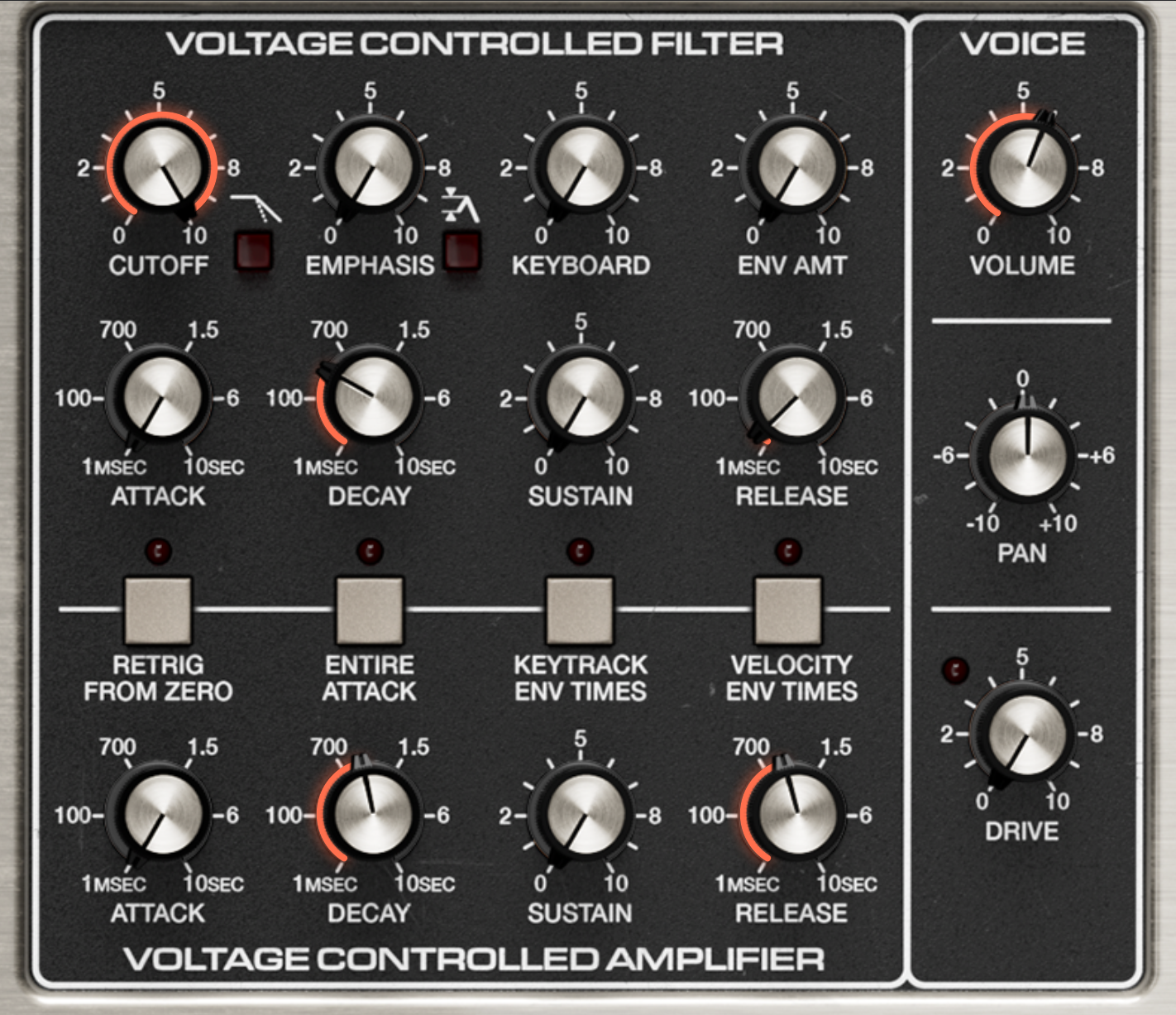
When pushed further, it can enter self-oscillation, producing a sine wave. As with any self-respecting Moog Ladder filter, the higher the resonance, the more the bass attenuates. However, Arturia had the good sense to include bass compensation. Once enabled, this feature preserves a generous low-end, even at high resonance settings. It also noticeably alters the filter’s behavior, causing it to saturate more easily when the resonance is pushed. Arturia has also added a 12 dB/octave mode, which is always a welcome feature.
Both ADSR envelopes offer excellent response and feature some interesting capabilities. A “Retrig To Zero” option forces the envelopes to restart from zero with each new note, while “Entire Attack” ensures the entire attack phase is played. Combined, these two functions enable additional creative techniques. For example, with a long attack and the Decay, Sustain, and Release segments set to zero, it becomes possible to achieve a reverse envelope effect. Used on its own, the “Retrig To Zero” option is effective for creating punchy bass sounds.
With the Keytrack Env Times option, envelope times vary across the entire keyboard range: the higher the notes, the faster the envelopes become. Velocity Env Times applies the same principle to velocity: the harder you play, the faster the envelopes become. These are simple yet clever features that make standard ADSR envelopes much more flexible.
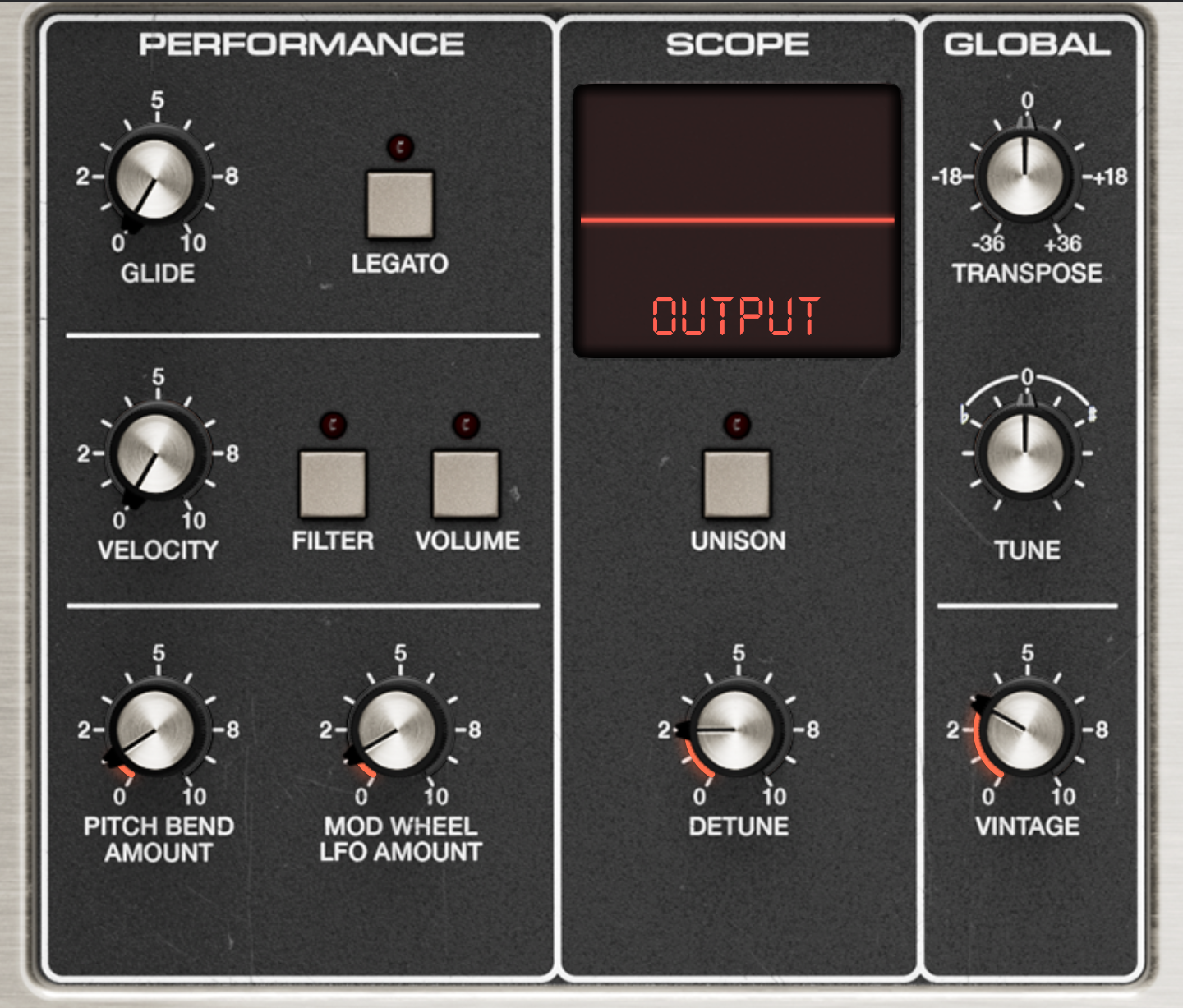
For polyphonic modulation, VCO3 can be used as a modulation source operating at the audio level, in addition to the filter envelope. It is also possible to modulate VCO3 with the same envelope, inverted in polarity. Here again, a matrix allows you to assign these two sources to the pitch and PWM of VCOs 1 and 2, as well as to the filter, volume, and pan.
By disabling keyboard tracking for VCO 3, you can produce metallic sounds or various noise-based effects, along with that gritty character that’s so hard to achieve on more conventional synthesizers. The Memory V doubles the Memorymoog’s polyphony to twelve voices. Unison mode does not benefit from this and remains limited to six voices, which is more than enough to produce rich, full textures, especially with the detune control. Unison can be played in legato or with retrigger. Finally, it’s worth noting the presence of polyphonic glide.
All in all, it’s a relatively simple architecture on paper, but one that remains extremely effective. More than just a matter of the number of parameters, it’s the interactions between the different elements that make the difference.
What’s new in Memory V compared to the original Memorymoog
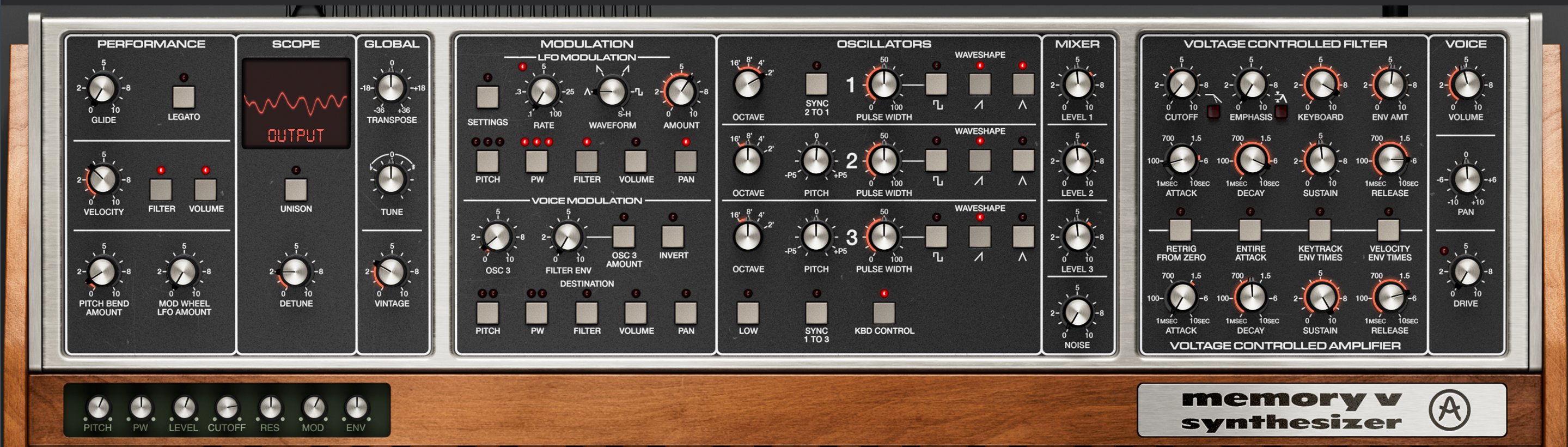
The Vintage knob acts as a shortcut to introduce more imperfections into the sound engine. The higher its value, the more the voices develop variations that affect, among other things, the VCO pitch, the filter, the pulse width, the modulations, and the level.
Hidden under a small flap concealed within the “wood” casing lies the Dispersion section. This section allows you to adjust the deviations applied to oscillators, filters, envelopes, or amplifiers individually. As a result, you can achieve extreme stability, such as for modern pop or very clean productions. Conversely, for synthwave, film scores, or ambient music, just a few adjustments are enough to inject a great deal of personality and unpredictability into the sounds.
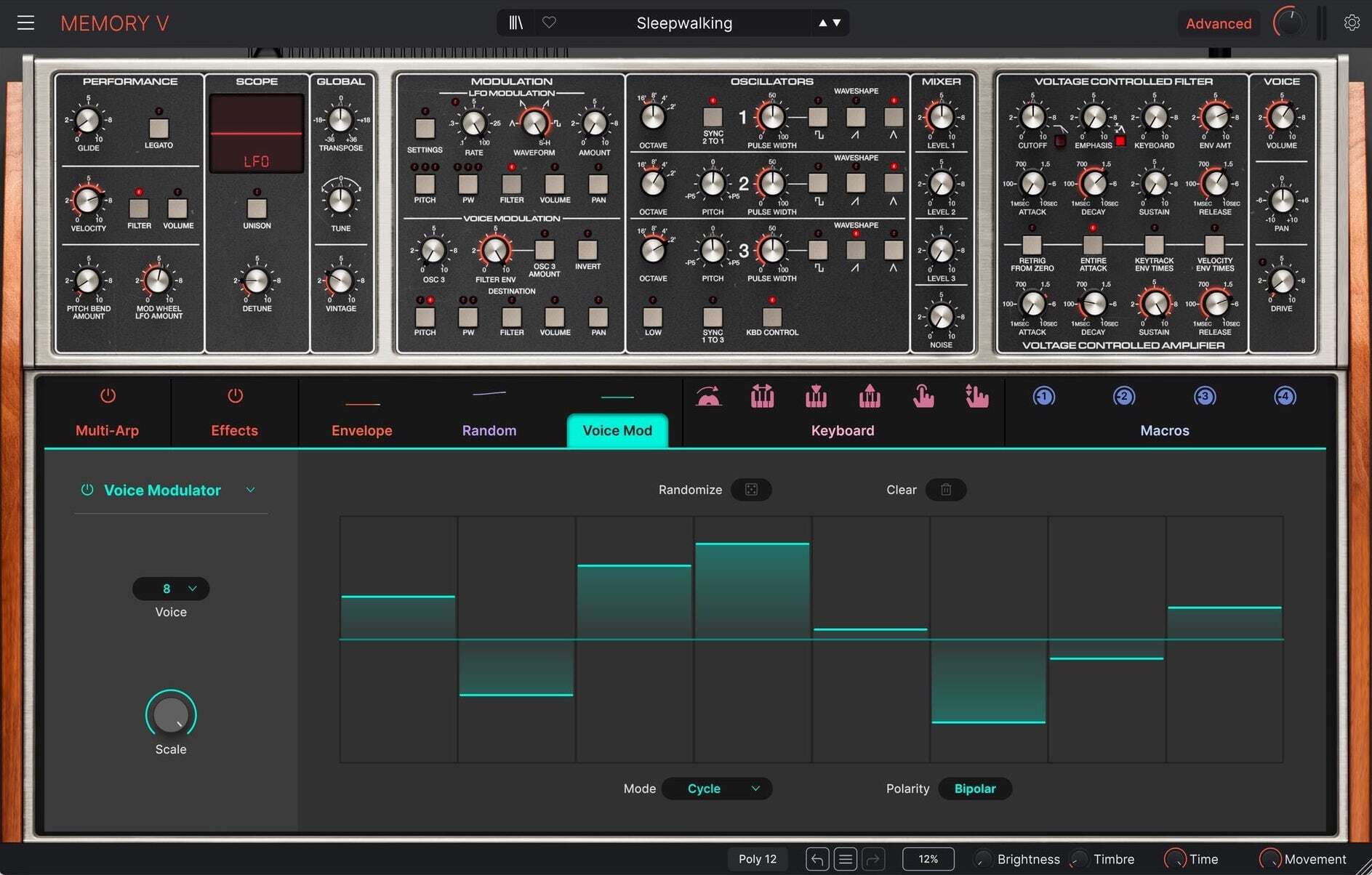
The modulation system is based on three freely configurable slots. Each can accommodate different types of modulators: an additional ADSR envelope, a function generator, a modulation sequencer, or even a random source.
Memory V adds a new feature, previously seen in Pigments: the Voice Modulator. This module acts independently on each polyphonic voice and offers several playback modes (Cycle, Random, or Reassign). It can be used to recreate the subtle behavioral differences naturally found in vintage analog synthesizers. By applying very slight variations in pitch, filter cutoff, or amplitude, it’s possible to achieve a surprisingly authentic result. This perfectly complements the Dispersion section mentioned earlier. But it’s also possible to program much more radical deviations and use it in highly creative ways to achieve original results. It can also be used to modulate the Pan parameter, thereby compensating for the lack of per-voice panning control, as found on some Oberheim synthesizers. Strangely, the Voice Modulator is limited to eight voices, whereas the Memory V can go up to twelve. Well…
Just like these three slots, the modulation wheel, keyboard tracking, velocity, release speed, aftertouch, and MPE can be assigned to any parameter. Four macros are also available. Each of them can control multiple parameters (I counted up to 22), with an individually adjustable range of action. All assignments are made simply via drag-and-drop. It’s both efficient and convenient. The only drawback is the lack of a global matrix that would provide an overview of the modulations.
The Multi-Arp: much more than just a pattern generator
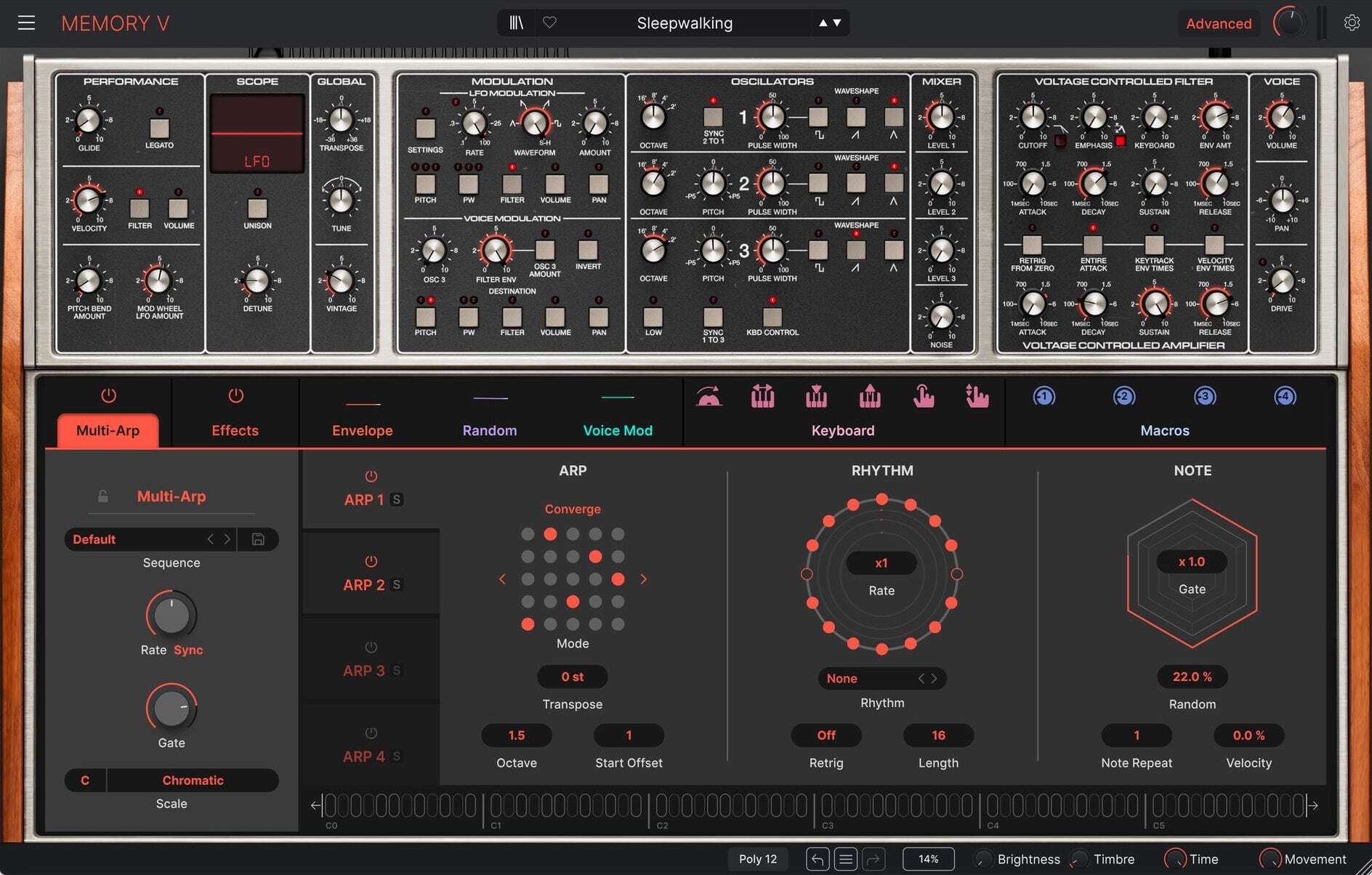
Each layer has its own playback mode, tempo, and gate parameters. This allows you to program complex patterns that are constantly evolving. The available modes go far beyond the traditional Up, Down, or Up/Down. There are more original patterns that encourage the emergence of less predictable sequences. Fans of contemporary electronic music should quickly find this to their liking. A few sustained notes on the keyboard are often enough to spark compositional ideas.
The arpeggiator also proves useful in more cinematic contexts. When combined with certain evolving pads or hybrid textures, it makes it easy to generate subtle rhythmic movements that significantly enrich arrangements. The Multi-Arp also features its own preset system. This makes it possible to reuse its patterns with other sounds. Finally, its MIDI output can be used to feed other synthesizers, whether software or hardware. This section is a real success.
Effects: effective without stealing the spotlight from the synth
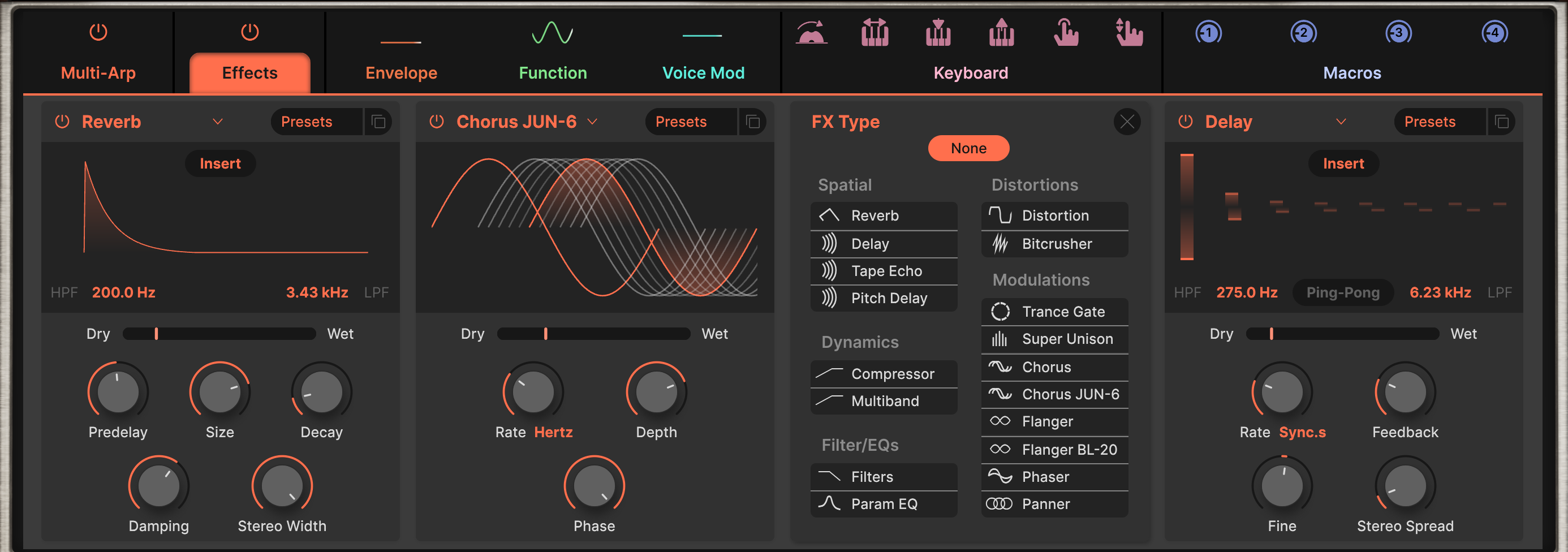
The sound quality is excellent overall, and all the effects eliminate the need for external plug-ins. Even the reverbs—often a weak point in virtual synthesizers—perform admirably. The chorus effects are just as good. Another plus: virtually all effect parameters can be integrated into the modulation system. This makes it possible to create evolving reverbs, delays with feedback that change over time, or complex, dynamic chorus effects.
That said, one of the best pieces of advice we can offer is to temporarily disable the effects while exploring the presets. Above all, the appeal of Memory V lies in the richness of its synthesis engine. Once the effects are turned off, you’ll discover a sound foundation that’s already dense and expressive. Unfortunately, this is where we encounter a flaw that’s fairly common with Arturia: once you return to the classic interface, there’s no global effects bypass. Similarly, it’s not possible to keep them disabled when switching presets. That’s a shame. It’s also a shame that there’s no preset system for the entire effects rack.
Performance, CPU usage, and behavior
When it comes to the mix, Memory V—like the original hardware—isn’t particularly unobtrusive. This is probably its greatest strength, but perhaps also its main weakness. As soon as multiple oscillators come into play, the instrument develops an impressive harmonic density. The midrange fills up quickly, and certain pads seem to naturally occupy all the available space.
When mixing, you need to stay vigilant, as the Memory V can occupy a lot of sonic territory. The midrange—particularly between 300 Hz and 1.5 kHz—can quickly become dense when multiple Memory V parts are layered together. A few EQ adjustments are often necessary to preserve the clarity of vocals or other instruments using adjacent frequency ranges. This is perfectly normal. The original Memorymoog had exactly this reputation. Its massive sounds were its strength, but they also required a certain amount of skill when mixing. This distinct personality, in fact, sets Memory V apart from many current software instruments, which are often designed to blend easily into any context. Here, it’s more a matter of the rest of the arrangement making room for the synthesizer. It’s the star.
While we’re on the subject of other software emulations, a few words about the Memory V’s direct competitors. While there are now countless emulations of the Minimoog, Prophet-5, Jupiter-8, and Juno, those of the Memorymoog remain rare. The most obvious competitor is still the Cherry Audio Memorymode, released a few years ago. But let’s face it: Cherry Audio’s version doesn’t measure up to Arturia’s. It struggles to capture the original’s personality, sounding a bit harsh and aggressive—which is completely off the mark for a Memorymoog emulation.
As for the old Memorymoon, it has never really won me over despite its more massive sound. UVI and IK Multimedia also offer virtual versions of Moog’s polyphonic synth, but these aren’t true reproductions. They’re based on sample banks and an architecture that has little in common with that of the original instrument.
During testing, I was curious to compare Memory V and the Legend HZ, an XXL polyphonic emulation of the Minimoog. I was surprised to find them very similar across many sounds. It’s actually quite astonishing. Memory V, however, allows you to achieve more aggressive sounds thanks to its Drive feature, which goes a step further.
In any case, despite the crowded field in this category, Memory V seems to carve out its own niche thanks to its distinct character. There’s no risk of confusing it with a Jupiter, a Prophet, or an Oberheim. It’s up to each person to decide whether they need a new analog-style software synthesizer, but this one at least stands out for its character, while its modern features allow it to integrate seamlessly into a contemporary setup.