Log in
EN
FR

Guitar/Bass boosters

646 products found

Filter
Sort by
Brand
Evaluation
  • Reviewed or not
  • Editor’s award
  • Reviewed by Audiofanzine
Availability
  • Available or not
  • Sold new or used
  • Sold new
  • Sold used
Must-have products
  • All products
  • Flagship products
  • Best rated products
  • Hot products
  • Popular products
Price
  • Freeware
  • Low-cost (< $100)
  • Mid-range ($100 - $200)
  • Premium (> $200)
€
Clear
Sort by
  • Popularity
  • User ratings
  • Price - low to high
  • Price - high to low
  • Used price, increasing
  • Used price, decreasing
  • Name (from A to Z)
  • Name (from Z to A)
  • Added on
Sort results
  • Popularity
  • User ratings
  • Price - low to high
  • Price - high to low
  • Used price, increasing
  • Used price, decreasing
  • Name (from A to Z)
  • Name (from Z to A)
  • Added on
Filter results 646 results found
Brands
Evaluation
Availability
Must-have products
Price
  • Freeware
  • Low-cost (< $100)
  • Mid-range ($100 - $200)
  • Premium (> $200)
Show results

The best Guitar/Bass boosters reviews

The reviews Audiofanzine members found the most helpful.
  • « Not just a boost »

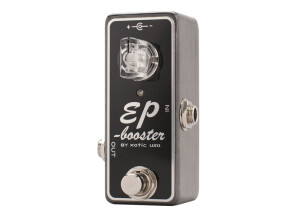
    Well this one isn't rocket science folks. It's a clean boost. There's one knob. It boosts your amp signal. Obviously this is a high quality pedal coming from Xotic. I have used a few of their pedals and never have trouble. Great stuff. UTILIZATION A lot of people seem to think this is just a regular clean boost but in reality it isn't. The circuitry, however small it may be is based on an old Echoplex preamp that Jimmy Paige used to use. To most people that won't matter. What it means in the real world is that while the EP booster does act as a regular clean gain booster, it also imparts a bit of its own sound. Xotic seems to be aware of this and they fully disclose that fact. They know it's not just another boost pedal. The expected downside to this is that if you don't like what the EP does to your sound, there's nothing you can do. Not tone knobs or any such of that nature. Hey...the footprint is small. Deal. SOUND QUALITY The EP booster in addition to being a solid clean boost, give your signal a kind a saturation and clarity too. This extra tone trickery isn't for everyone but most people tend to love it. I know a few guys who treat this as an always one pedal because they love what it does to their sound. Honestly I just use it for what it is...a boost. I like what it does to the tone in addition to that. It's a nice sound. Some people use these to match inputs with different guitars, which I guess makes sense. OVERALL OPINION If you want a genuine clean boost then look elsewhere. There's cheaper options. The EP booster to my ears is a sweeter boost pedal than most because of the extra tone improvements it brings to the table. A lot of people are disappointed with this pedal because they expect it to sound dry. This is not that pedal. It's more of a gamechanger really. Value is decent for what it does. The quality meets the price I think.

  • « A really fantastic Pedal »

    I am totally in love with my Strat, and I'm struggling because I don't always feel like bringing a Les Paul to my gigs (it's temperamental). I really think that this pedal is my saving grace. Basically, the main draw of this feature, besides functioning as a standard gain boost, is that it has settings that will allow your single coil pickups to function more as a humbucker. This is amazing. It's an analog effect, it isn't rackable and it has true bypass. There are no computer or midi functions, just a standard 1/4" input and output. UTILIZATION This is a really easy function. There is a switch with three settings. The top setting changes the sound of your pickups (which are presumably single-coil) to a tone that resembles more of a vintage-style humbucker (think the classic p-90). The bottom setting does a similar thing but makes it sound more like a newer, super-high gain humbucker. The middle setting allows the pedal to function simply as a gain boost. The knob controls the amount of gain boost added on all settings. SOUND QUALITY I use this primarily with Strats and Teles (ones that have the traditional single-coils in them). I like the sound best with Fender amps too. The pedal basically functions as a pre-amp, and does color the signal a lot, but that's the idea behind it. It does it in a good way all around. The thing is no joke, it really does allow your pickups to work like humbuckers, and the fact that it distinguishes between the vintage and newer styles is awesome. The gain boost on all settings is also phenomenal, it adds more volume and a serious raw power to the sound that absolutely kills. OVERALL OPINION I really liked the fact that this pedal can improve the functionality of my Strat and Tele. The price is also amazing for how useful the pedal is. I can only recommend this people who sometimes need more raw power from their single-coils. It's certainly easier than buying another guitar.

  • mooseherman's review

    This is a rather interesting pedal. I guess it's technicaly an overdrive pedal, even though it doesn't operate like most of those pedals do. It simply has the 1/4" input/output and is powered by a 9V adapter. This is an analog pedal, and as such, it's not rackable and cannot be edited with a computer. It is also not capable of being MIDI-controlled. UTILIZATION The editing of this effect is actually not so simple, contrary to most of my favorite pedals. This is one instance where only having two knobs ("voicing" (which is the coloring effect), and gain) is actually a hindrance rather than a liberating feature. For one thing, this pedal is unique in that it's not easy to operate while the guitar is at full volume. Once I tried rolling back a bit (and then a bit more), I found that I could actually get a good idea of what this pedal does. SOUND QUALITY This is not exactly a "vintage" sounding pedal. For once, I found something that doesn't exactly sound like a 60's throwback. Rather, it reminds me of some of the new-wave, lighter post-punk guitar tones I discovered in my later years listening to some of the New Order, Smiths, and later Elvis Costello stuff (like "Beyond Belief"). While some of that stuff is dismissed as sounding overly artificial, I beg to differ. I think that when this thing is used tastefully, it can give the guitar a jangly, chiming feeling that is reminiscent of the aforementioned bands (Smiths especially). It also, when combined with light overdrives (or heavy distortions) can get some truly otherworldly sounds. Even though it doesn't sound that much like My Bloody Valentine, I can't help but think of that band when I really push this thing. This is mainly because it overdrives certain frequencies more than others, giving certain overtones a dominance that I find intriguing. A rather unique effect that is tasteful and adds some real texture to my playing. OVERALL OPINION Even though it was a pain to figure out, I'm still really happy with this pedal. I would certainly recommend it to fans of some of the bands I discussed, or anyone bored with the "vintage" sounds who doesn't like the really wacky effects. It's not exactly cheap, so it might have to be a special treat for most of us, but I think that those who shell out for it (and know what to expect) will enjoy it. I recommend it to people who are looking for a unique effect that isn't commonly heard.

  • moosers's review

    The Diamond Pedals Boost EQ is a simple pedal designed to give your electric guitar that extra kick. The pedal is an analog one, with a pretty standard make up. Like most guitar pedals, it has 1/4" connections and needs nine volt power from a power supply. It isn't rack mountable in any way as it is a stomp box. UTILIZATION The configuration of the Diamond Pedals Boost EQ is a very simple one. The EQ section has parameters for mids and tilt, as well as an EQ bypass switch. On the right side it has a gain knob, and when the EQ is bypassed is your only parameter. As you can probably see without me having to tell you, the make up is simple and a manual isn't something that will be necessary. SOUND QUALITY The tone of the Diamond Pedals Boost EQ is absolutely top notch. While I like it primarily as a gain boost pedal, it is definitely a good sounding equalizer as well, and unique if not anything else. I've used the pedal with a Fender Stratocaster and a '76 Fender Twin Reverb to give it that extra boost kick, as well as for general tone shaping. The pedal really has a clean tone quality, and it has true bypass so you won't lose any signal quality or get any noise. The Boost EQ is definitely up there with the best sounding boost and/or equalization pedals that I've heard. OVERALL OPINION Since the Diamond Pedals Boost EQ is made up of high quality components and with extreme care, it isn't as cheap as those boost and EQ pedals that are mass produced. If you are a professional or are looking for a top notch boost and EQ pedal that has more versatility and a better sound quality than most of the competition, I'd encourage you to check it out to see if the extra dough is worth it to get a superior pedal. More times than not I think that people will opt to spend a few extra dollars on a great pedal like this one.

  • « Broadband & Treble Boost with Overdrive Qualities »

    This is no ordinary boost, and built in the USA by a sound engineer, Jim Hagerman. And as I tweaked the knobs I knew there was something unique about this boost pedal. Depending on where you place the Ungain knob (relative to working with a clean vs. dirty amp, or single coils vs. humbuckers), there is a wide range of sound characteristics that can be achieved. When turned low, just at parity, the tone livens up (clears up), which means an improved tone without any boosting. So far, so good. The clarity achieved with this pedal is due in part of the buffered bypass when not in use, but also that it adds no color when on. As you add boost slightly to the signal and beyond parity (knob rotated counterclockwise with this pedal), the tone seems to expand in scope while adding some dB in the mix. Once past 2-o’clock (for humbuckers) or 12-noon (for single coil), there is an obvious overdrive occurring with the boost. This is exemplified in the accompanying demo, as I work with clean, crunch and hi-gain amps, and with single-coil and humberbucker guitars. As Jim Hagerman explained, “all boosts end up getting dirty at some point, even those running at 18V. This one (the Hagerman Boost) falls apart very nicely. At maximum gain it can only handle 300mV input and remain clean – that would be with single coils. A humbucker would start to clip, but you also would not need as much gain for a given output. It will push 6Vpp (peak-to-peak) output cleanly. That's a lot!” He further adds, “6Vpp is signal amplitude. Single coils put out roughly 0.15 units. Humbuckers 0.6 units. The boost will amplify cleanly to a level of 3.0 units. That's 5 times higher (louder) than a humbucker. The Hagerman Boost can amplify 10x. At maximum gain it turns a single coil signal of 0.15 units into one with 1.5 units.” The Hagerman Boost produces clean, noise-free gain using expensive matched JFET pairs; consequently, the discrete circuitry “delivers pure amplification,” which helps to preserve your guitar’s tone. But what makes this boost even more appealing is that you can have a Broadband Boost or a Treble Boost. The Broadband option (Tone button pushed down) seriously fattens up the tone, making it ideal for single-coil or thin sounding pickups, for fat creamy leads or to add some serious bottom end to heavy riffing. The Treble Boost sounds incredible for crunch and riffing, and will cut through any mix. It offers a high-pass corner at 700Hz and is dialed in just right. I’ve worked with other treble boosts and there’s always as issue of dialing in to that sweet spot, whereas the Hagerman Boost delivers very well in that regard and without any thought. Jim Hagerman claims this is the highest performing silicon boost pedal you can buy, and he may be right on that front. For $129 USD this is one great sounding Boost that behaves a little differently from other boosts I’ve experienced. I also find the overall boost range very usable. Placing the Ungain knob at parity or up full provides a very suitable dB gain without sounding ridiculous (some boosts go to such extremes that you never would use the top half, unless you wanted to dominate your drummer, bassist and keyboardist). Although it pumps out upward of 19dB, the volume does not become over-bearing. I already reviewed the Hagerman Tube Overdrive and the Hagerman Phase (also silicon-based), and both definitely are studio grade and should be investigated, as well. The size of a regular pedal, the Hagerman Boost comes with a 10-year warranty and requires 9V to 12V input (negative center pin) while consuming only 7mA of power.

  • nickname009's review

    # It's active Treble, Bass ,Gain and Volume controls allow for limitless tone shaping . # The RC Booster offers a super transparent 20db+ clean boost and a +- 15db 2 band active EQ without ever compromising the integrity of the original TONE. # It provides a solution to sound degradation, caused by long instrument cables and/or long effect chains between guitar and amp, by strengthening the original signal. # True bypass for eliminating any signal interference when switched off. The RC is basically a clean boost pedal that allows you to further shape the EQ with treble and bass knobs. Depending on the original guitar signal it can add the slightest amount of clipping or 'dirt' to the signal. UTILIZATION Of course, very simple to use. 4 knobs that will help guide you into creating some very lush and thick boosted guitar tones. Plug in, tweak just a bit, and play. SOUND QUALITY The RC has a great thing about it, that it's transparent. Very transparent. So transparent in fact, that if one were to set the knobs correctly you can pretty much not even hear that it's been engaged. And once you adjust the knobs accordingly, you can either fatten the sound of a single coil, or slightly push the amp into the SLIGHTEST bit of overdrive to get a bluesy tone. It's a great pedal and very low gain. As a high gain overdrive, it's spectacular. Not only does it provide complete transparency, it pushes the amp into overdrive just enough to get that saturated overdrive tones that most hi gain players are looking for. Of course this also depends on the amount of gain one uses. Some like to add gain from the overdrive pedal itself which helps but I've always liked things to be a bit clearer, tighter and try not to overdo it with the gain. OVERALL OPINION I think this is my new favorite pedal out of the xotic line. It's so clear and yet subtle but can provide a lot of different textures depending on how you set it. It's very sublte mind you but it definitely does make a difference. It's most likely my most favorite clean boost so far. I've heard many other users and have been nothing but impressed of the tones I've heard from them whether it was blues or jazz or what have you. Yes, this pedal is mainly geared to more lower-gain styles of music, but it is not to say that the RC can't be used as a hi-gain overdrive as I've stated before, it definitely can depending on the context and the amp that you have of course. I generally like to use non-made-for-metal pedals for metal. It just seems to work better than most pedals that are actually designed for metal. I can't quite put my finger on why or how. Overall, great clean boost. Very uncompressed, transparent sound. Great!!

  • iamqman's review

    Very simple ad easy to use unit. If you think you have a weak sounding guitar and or weak sounding pickups then this might be the pedal for you. With only one knob and two outputs for different amps or a tuner out there really isn't much to think about. Just plug it in and listen how it reacts to your guitars output and boost the natural frequencies of your guitar and pickups. * Hand-painted artwork * Ultratransparent boost * High-impedance input refuses current from your pickup * Ultrahigh output * Goes from unity gain to in excess of 8V peak UTILIZATION This is the perfect preamp pedal. The "Crackle Okay" volume knob is a negative-feedback control styled after classic 60's recording console inputs. (They crackled when adjusted too.) Most vintage guitars suffer from steadily deteriorating magnets in their pickups, since permanent magnets aren't really forever. The Super Hard-On's input impedance is so high (5 Meg) that it refuses any current flow from your pickup... maintaining the most magnetic field around each string, so you can hear exactly what your pickup sounded like the day it came off the winder. The output level can exceed 8 volts peak, and when it finally distorts, the wave is shaped like triode overload, not fuzz. Like all Z. Vex designs, current flow is low in this circuit (less than 2mA), enhancing battery life. The circuit board is hand-cut and soldered with the critical component, a BS-170 mosfet transistor, placed in a socket for easy user replacement should it be necessary. Your dealer can provide you with a free replacement transistor upon request. The box is hand-drilled using no petro lubricants, and hand painted so that every box is unique. Knobs are Harry Davies, made with the same molds they've used since the fifties. Each effect is hand dated and signed by Zachary Vex. SOUND QUALITY I love the clarity it can give you when you run the control knob around 9:00. It really gives a nice sweet volume and transparency. Turn the knob up to 12:00 and you will get a nice mild overdrive signal that works very well in front of an already overdriven amp. It is subtle but sounds great in front of a Marshall JCM 800. If you turn the control knob all the way up it gets a nice tubescreamer type overdrive which is mild and classic sounding. When it is maxed out it does get a little fuzz tones in there which is very cool and unique. OVERALL OPINION Like all Zvex pedals this is built quite well and will sound excellent through just about any source. At new these unit come in at around $240 a piece. Not a bad price for a solid built and sounding booster pedal. And for what it does it does quite well. Some people might think why would someone pay for a one control knob unit that just increases the volume, but if you got the chance to plug this thing in you would immediately hear the reason why this pedal is fantastic. I would recommend this pedal to anyone who needs a bit of a boost to their signal or feel that the pickups or guitar sounds a little weak. This will give you the clarity and gleaming tone that you find on mixed and mastering recordings.

  • « Hard-to-find Original pedal that fattens and boosts »

    This is a boost pedal made by Fulltone. It's called the Fat Boost because in addition to simple volume boost, it fattens up your tone a lot. It has two 1/4" connections as well as an input for an AC adapter which will prevent you from losing tone. There are no MIDI connections, nor is there any computer options. This pedal is not rackable. UTILIZATION The editing on this pedal is pretty easy. There is a knob for volume and a knob for tone, as well as a smaller knob for input gain. It might be strange to have what appears to be two volume knobs on the pedal, but you'll soon notice that one is more of the clean boost while the other fattens, even drives, the tone a little bit. This pedal, like most pedals, eats batteries so I recommend using the adapter, it'll save you money in the long run. I don't have a manual as I got mine used but I don't think anyone would really need one. SOUND QUALITY I like this pedal a lot, but I don't know if it's my favorite boost pedal. While it is cool that it fattens up the sound, and sometimes gives it a light overdrive, I don't know if that is always what I am looking for. This is great if you play blues or R&B, or really anything with a clean tube sound, but if you play rock that is heavier, you will find that using this in combination with a fuzz or heavier distortion will make that signal muddier, which is the last thing you want, unless you're going for some type of lo-fi, mangled sound. The pedal colors the tone a little too much for my taste, as well. It's a cool pedal in its own right but I think I'd prefer a cleaner boost with my existing pedals. OVERALL OPINION While the pedal is cool, the coloring of the sound and the mild overdrive aren't exactly my cup of tea, especially since you'll get similar but better sounds from an overdrive pedal (not to mention more variety in tone). I would try the pedal if it sounds like something you'd be interested in but just make sure you know what you're doing if you're going to go ahead and buy it.

  • moosers's review

    HomeBrew Electronics' Germania is a very simple booster pedal that is designed after the Rangemaster Treble Booster, a pedal which I'm not familiar with. I've used the older version of this pedal, but the newer one comes with some added features. However, this review will be for the original Germania. The pedal has 1/4" connections for input and output and requires a nine volt power supply. It has a single button and is just about as compact of a pedal as you'll find. It isn't rack mountable in any way since it's a foot pedal. UTILIZATION The configuration of the HomeBrew Electronics Germania couldn't possibly be any simpler. The only knob that it has it for gain and the only switch that it has is for choosing between either a hi-fi or lo-fi setting. I'm not exactly sure what the new parameters are that the newer version of this pedal has in addition to these. A manual shouldn't be necessary either way since it's such a basic pedal. SOUND QUALITY While the HomeBrew Electronics Germania is a booster pedal by nature, it's definitely capable of getting some heavier distortion sounds if desired. Having said this, I wouldn't recommend getting the pedal for this only, as using this as a distortion pedal isn't really it's intended use although it's certainly possible. I recently tried the pedal out in a recording studio that had one, but we didn't end up using it on any recordings. It does have a very good sound, it just wasn't what we were looking for and is kind of limited in what it's able to do. OVERALL OPINION For a simple booster pedal, the HomeBrew Electronics Germania is an awesome little pedal. It doesn't offer up much flexibility, but for what it can do it's one of the best that I've heard. I do like that it's able to get some heavier and thicker distortion when needed, but as I stated before this is really just a bonus to having a nice booster pedal. I haven't used a Rangemaster before, so I can't say how well this matches up, but it's certainly a nice pedal on it's own.

  • Rockmonster's review

    This is a clean boost pedal.. 1/4&quot; true bypass.. I'm assuming this is an analog effect.. (durrr) Definitely NOT rackable... bulletproof construction. UTILIZATION Uh..1 button. 1 Knob. Wow. No manual necessary. Anyone can do this. It is a clean boost.. especially on cleans.. really enhances distortion if used in front of a dirty amp. SOUND QUALITY Mmm..really clean. True bypass pedal.. really quiet. Great deal for 80 bucks. Does not add artifacts, fuzz or anything else truly.. it WILL enhance distortion because it is fattening up your signal. Adds LOADS of beef to my Strat with a Dimarzio HS-3 stacked humbucker in the bridge. Using this and a Keeley TS9 in front of a Voodoo Lab Preamp absolutely SCREAMS. People cannot believe the metal tone I get with a Strat with single coils. I can get that grind from Godsmack &quot;Keep Away&quot;.. with an even heavier/fatter lead tone.. knock off the pedals, flip to the neck pickup and and I have nasty blues... hit my clean channel and I can comp Stevie Ray Vaughn. So.. using it as a pickup booster for humbucker tones can make your Strat even more versatile. To really get this as a clean volume boost on a dirty amp..You have to run it in the effects loop. My rig does not have one.. so.. I just use it for signal fattening. Either is good.. it is a very clean effect. More on the issue of volume boost versus gain boost. In the front end of a dirty amp this will NOT give you enough db gain to use as a boost for solos. In front of a clean amp, then yeah.. it will noticeably bump it up. With distortion you MUST run it in the loop.. (between your preamp and poweramp stages) to get a usable real solo boost. If you are just looking to increase your distortion or fatten your signal, run it into the front end. Use this with the Strat mostly, but also with Les Pauls, Tele's, other humbucker guitars if I want to go over the top. I use this with one particular Yamaha electric with JB's in the bridgee..and I get a really close approximation to Eric Johnson's old tone (shockingly enough. It gets that chunky Fuzz Face meets Plexi fatness). Nothing I hate about it! (except that it adds some noise.. but way less than even my Keeley TS9... OVERALL OPINION Using it about a year. Use it on and off... with the 3 channel preamp.. I use it extensively. With a Digitech GSP2101..I use it a bit. With my Boss GT8.. I don't use it at all.. (the solo boost function on that preamp is perfect.Just the right amount of boost.) Mmmm..did not try anything else for this function before this..but this has the right features. True bypass and one purpose. Pretty easy to figure that out. I think it is a great value if you need it. Does what it is supposed to.. cleanly and overall quietly for something adding gain/volume. I would buy it again. There are a lot of pedals out there with the same features at twice the price. This is not something that I bought to color my tone...the transparency IS the desired effect!

  • « Transparent High-Voltage Boost with 3-Band EQ for Customized Tone Shaping »

    Tone Tweaker is another solid hit from Carl Martin, consisting of a three-band EQ and a 12dB Boost. It’s one of those always on (or almost always on) pedals, as it allows you to shape your tone in different ways and in different instances. At the very least, with all controls flat, there is improved note definition with a hint of sparkle. https://www.youtube.com/watch?v=E6wQJcYd1gk The EQ section is obvious, allowing you to push certain frequencies, or to scoop the mids, cut the bass for tighter hi-gain, cut through the mix with more treble, etc. Bass, Treble, and Midrange remain flat with controls at 12-noon, whereas dialing up or back will boost or cut respectively. The Boost is interesting as it, too, is flat at 12-noon, which means you can cut or boost the signal, and with its internal voltage booster, it can really make your other gear rip and with added headroom. This is a transparent boost, but it will push amps and other pedals into higher overdrive and distortion, but while maintaining the integrity of the original sound (its effect is very much like a low overdrive, to my ears). However, if you have a very hi-gain tone and want to back it off a bit for crunch, the Tone Tweaker can be used as such; set the pedal’s EQ for your rhythm tone and back off on the Boost knob. Then, when the Tone Tweaker is turned off, you have a lead channel with more gain and a different EQ/frequency. Having said that the Boost section on this pedal sounds pretty sweet, with a smooth intensity that pushes, yet defines the original tone. The 3-band EQ has a very usable range, whether cutting or boosting each frequency. I play with some ‘dark’ gear, and so, I can crank the Treble all the way up and it sounds very decent (not shrill), whereas I’ve seen a few Tone Tweaker demos and pushing the treble sounded harsh. Consequently, there’s a range for everyone. Even with my ‘dark’ sounding gear, I did not find the bass flubby or too thumpy, and the midrange did not have a boxy ‘honk’ to it. Overall, I find this pedal easier to use, and even more functional than other EQ pedals I’ve tried. The Boost feature is what doubles its value, and even touching it a bit past 12-noon makes a signal sparkle with clarity. And the 3-band EQ makes it very easy to dial into a preferred or altered tone. Its buffered bypass also serves to preserve signal strength and tone quality, so when disengaged your sound remains consistent and pure. Other features include a compact size, contained within a well-built aluminum chassis, top-mounted jacks, and it requires only 60mA power (9VDC neg center). Retail price is $159 USD.

  • « Ultra-clean, warm tube boost with big headroom »

    NOTE: This review and demo video are for both the EF86 BOOSTER and the 12AX7 OVERDRIVER. Hagerman Amplification knocked the ball out of the park on these two pedals, and for several reasons. First, the EF86 BOOSTER and the 12AX7 OVERDRIVER are tube-based (as per the names), which means rich overtones, superb dynamics and response to one’s playing, amp-like tone quality, and low mA requirements (215mA for the boost and 175mA for the overdrive). Below is a demo featuring these two pedals in isolation with clean and driven amps (both solid state and tube), but also with other gear and how they respond when stacked. I have the original beta models, if you will, which indicate EF86 BOOST and OVERDRIVE on their chassis, but are one in the same, but renamed, on the Hagerman site. Boutique all the way, hand-built one at a time, the true bypass EF86 BOOSTER uses a pentode (5 electrodes), which means a warm and super clean gain for driving both amps and other pedals, which became obvious as tones blossom when matched with regular analog gear. And although the power requirements are modest, there still is high voltage (2V input and 140V tube supply) for optimal tube operation with a lot of headroom. With the Drive all the way down (and volume maxed), there is a noticeable boost, but start adding in the drive and it is LOUD, with 21dB maximum gain! The signal remains warm while still delivering ample second order (octave) harmonics. What really impresses me is how good the signal sounds when added to other gear, even if keeping the drive all the way down while pushing the volume… one of those always-on pedals. The 12AX7 OVERDRIVER is a fantastic extension of one’s amp, as its gain can be described as a classic preamp-style overdrive, so that its tone accentuates a natural sounding fat crunch with lush tones. What makes this true bypass drive even more desirable is how it behaves with other gear – it responds incredibly well when stacked with other drive pedals or amps with moderate- to high-gain output (I also paired it with a Rockerverb-style preamp, and it rocks). Some drives tend to thin out a tone, but not this one, as it remains true to that thick, breaking-up quality guitarists want and strive to maintain within a signal chain. It also has huge headroom, with 36dB maximum gain and a 30mV input, onset of clipping. The grain is warm and generous, which becomes more aggressive as you push the drive, as experienced with real tube amps. Now, it's part of a reviewer’s duty to discover elements that may be lacking, but these two pedals are so simple and deliver the goods so well, there’s not much to address. Some may want more of a Tone control range, but to my ears and with the various gear combined with these pedals, I never found that the case. In that regard, turning the Tone all the way left (more bass frequency) or right (more treble frequency) provides modest change to one’s original tone, which means dialing in your amp, then tweaking the boost and overdrive accordingly. For the most part, I never deviate between 10-o’clock and 2-o’clock, and often will keep it at 1-o’clock (flat), unless wanting a touch more bottom or top end (which really shapes those high-gain amps for thump or punch). Both the EF86 BOOSTER and the 12AX7 OVERDRIVER retail for $342 USD, which is very much on par with today’s cost of gear, and is very reasonable when considering these are studio designed with engineered quality by an amplification company. Fantastic add-ons for tube amps, they literally help transform solid state amps and pedals amazingly well. https://www.hagamps.com/