Log in
EN
FR

Reverbs for Guitar

441 products found

Filter
Sort by
Brand
Evaluation
  • Reviewed or not
  • Editor’s award
  • Reviewed by Audiofanzine
Availability
  • Available or not
  • Sold new or used
  • Sold new
  • Sold used
Must-have products
  • All products
  • Flagship products
  • Best rated products
  • Hot products
  • Popular products
Price
  • Freeware
  • Low-cost (< $150)
  • Mid-range ($150 - $300)
  • Premium (> $300)
€
Clear
Sort by
  • Popularity
  • User ratings
  • Price - low to high
  • Price - high to low
  • Used price, increasing
  • Used price, decreasing
  • Name (from A to Z)
  • Name (from Z to A)
  • Added on
Sort results
  • Popularity
  • User ratings
  • Price - low to high
  • Price - high to low
  • Used price, increasing
  • Used price, decreasing
  • Name (from A to Z)
  • Name (from Z to A)
  • Added on
Filter results 441 results found
Brands
Evaluation
Availability
Must-have products
Price
  • Freeware
  • Low-cost (< $150)
  • Mid-range ($150 - $300)
  • Premium (> $300)
Show results

The best Reverbs for Guitar reviews

The reviews Audiofanzine members found the most helpful.
  • « Reverb unit for guitars that gets DEEP... »

    This is a free-standing reverb unit, made by Fender in 1963. Almost all the ones that you will buy nowadays are reissues but they are still the same basic idea. The idea is to run this between your guitar and the amp, as it will give you a deeper, surf-rock style reverb that isn't quite possible on a guitar amp. With a regular amp, such as a Fender Twin Reverb, the reverb unit itself is pretty small, and is nailed to the wood of the guitar, which gives the sound less room to move around, and thus, less reverberation. The springs are in the center of this unit, and the tubes in it help drive the reverb even more, resulting in some huge sounds. UTILIZATION This thing is pretty easy to edit. It has 3 knobs; Dwell, Mix, and Tone. The dwell knob controls the amount of reverb that the unit produces, the mix knob controls the amount of dry signal vs wet, and the tone controls whether the reverb comes out brighter or darker. The setup is kind of weird at first, some people like to run it through the effects loop while others like to run it before the amp. It's almost entirely a personal choice. I personally have had more luck running it before the amp as you lose less volume. The manual explains the whole thing pretty clearly. SOUND QUALITY I like this unit the best with my other fender products, namely a Fender amp (almost all the greats like the Twin, Champ, Blues Jr. and Deville will do), as well as a Jazzmaster, Jaguar, or Tele. The strat doesn't usually cut through as well but it still works well. Theoretically this will work fine with any guitar but I'm sure Fender tests it with their own, which is probably the reason that it sounds so good. This is great if you are looking for surf rock tones like Dick Dale, etc. but it can also work really well with a lot of sounds. OVERALL OPINION I think that this unit is pretty cool; however, lugging it around is not always a pleasant experience. Thus I'd say leave it in the studio, unless you are a surf-rock player who plays a lot of gigs. If it's not a crucial part of the setup for you than it's really not necessary. For me personally, I don't think I use it as much as I should considering how much it costs. I'd say be absolutely sure that you need a super-high quality reverb for your guitar, otherwise avoid it unless you work in the studio a lot and need a quality reverb there.

  • « A bit overpriced and untweakable »

    The Rocktron Cyborg Reverb is one of the few pedals that Rocktron makes in their "Cyborg" line, which is a little unusual, to say the least. The pedal features 8 digital algorithmic reverbs, 8 preset spots, and it comes with Rocktron's Hush noise-reducing circuitry. It is controllable by midi, via a special connection cable (which comes with the pedal), and it functions off of standard 9 volt DC pedal power. UTILIZATION The Rocktron Cyborg Reverb has 8 programmable preset spots, which are selectable by turning the preset knob, or hitting the store switch. If you had to switch from preset 2 to preset 1, however, you would have to press the preset button 7 times, and that can be annoying and problematic. I imagine most people would often switch between a few presets, and this can be a bit of a problem. SOUND QUALITY There are 8 reverbs: Two plates, two halls, two rooms, a stadium, and an irregular room (called dual). For each reverb, there are only two controllable parameters: decay, and level. Decay usually sets the length of the decay, which is equivalent to room size on some other reverb units. Level sets the overall mix of the reverb, but it is not possible to get a completely wet signal. With the level maxed, the reverb is about 50% of the overall signal. For a reverb unit, this lack of control is surprising. Simplicity is nice, but there is no way to control the EQ of the reverb, for example. I find that some of the reverbs could use more treble, but I cannot adjust that. Compared to Eventide's Space, this pedal doesn't even come close. But it is at nearly half the price of the Eventide pedal. OVERALL OPINION Overall, it's hard to recommend the Rocktron Cyborg Reverb, unless you need 5 or more reverb presets, and want to quickly dial them in. Most guitarists don't have a need for so many preset spots, and would rather have more tonal controls. So it's hard to imagine who exactly needs this pedal. If you can get it cheap, check it out. I got mine on sale for $80.

  • moosers's review

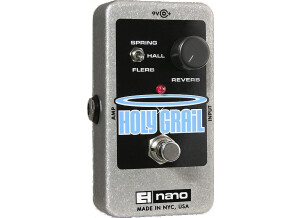
    The Electro-Harmonix Nano Holy Grail is a very simple and small reverb pedal - an offshoot from the regular EH Holy Grail pedal and also the Holy Grail Plus. It's the same great sound minus the control and versatility, but also loses the size. The pedal is an analog one and isn't rack mountable as it's a foot pedal. UTILIZATION The make up of the Electro-Harmonix Nano Holy Grail couldn't be simpler. It's got three modes to choose from - spring, hall, and flerb, the latter of which is a spacey flanger-reverb combo, also found on the other Holy Grail pedals and also on the EH Cathedral Reverb, which is my personal favorite. The only other parameter in addition to the mode switch is a large reverb knob to set the amount of the effect that you'd like. No manual is needed here of course. SOUND QUALITY Despite it's limitations when compared to it's more complete predecessors, the Electro-Harmonix Nano Holy Grail still has the same great sound. Between the three modes it's still possible to get a nice collection of tones with this, and it's definitely all at a very high quality - smooth and silky. I do prefer having the Cathedral reverb since I use it a lot and it has a lot of control, but this is a great alternative if you're looking for basic sounds only. OVERALL OPINION The Electro-Harmonix Nano Holy Grail is a great overall reverb pedal, even though it doesn't have all the bells and whistles that you'll get with the regular Holy Grail. It's of course cheaper in price which makes it appealing for users on all budgets. If you're looking for a cheaper reverb pedal without sacrificing quality, the Nano Holy Grail is a great way to go. Check out the other pedals I've mentioned here if you're looking for some more control...

  • moosers's review

    The Boss RV-2 is a digital reverb effects pedal, and I believe it was the first reverb pedal made by Boss. The pedal has a 1/4 inch input and two 1/4 inch outputs. It has the standard size and make up that most Boss pedals do, with a nine volt battery compartment and power supply jack. This isn't a rackable piece of gear as it is a stomp box. UTILIZATION The configuration of the Boss RV-2 is generally speaking quite easy to follow. In terms of parameters, it has knobs for effect level, pre EQ, time, and a six point knob for choosing the mode. The reverb modes include room, two hall modes, plate, gate, and a panning delay. All of the modes are pretty cool, though I do like some more than others. I can't say I've ever had an issue with using the pedal, so I don't believe that a manual is necessary unless you're having some sort of technical difficulty. SOUND QUALITY While the sound of the Boss RV-2 Digital Reverb doesn't match the clean sound quality of its followers (the RV-5), it does sound quite good across the board. I've used the pedal a number of times for recording with a few different guitars and a '65 Fender Deluxe Reverb amplifier. My favorite modes on the pedal would have to be the plate and the panning delay, but all of the modes have a similar sound quality and this is really just a point of personal taste. While the RV-2 doesn't offer up the same type of versatility that you'd get with the RV-3 or RV-5, you can definitely get a ton of different reverb sounds from it anyway. OVERALL OPINION The Boss RV-2 is of course no longer being made, as it first came on the market more than twenty years ago. However, you can definitely still find a good amount of them on eBay, so you can get one if you want one. There is definitely a romantic aspect of having the older model of Boss' Digital Reverb, but I have to say that I like the RV-3 and RV-5 better overall. This isn't to say that the RV-2 isn't a great pedal, I just think they perfected it after this one...

  • « Great cheap Reverb. »

    The Digitech Digiverb is a reverb pedal with a couple little special touches. The Digiverb has several different models of reverb to chose from including; Room, Plate, Hall, Church, Gated, Reverse, and Spring. Digitech uses a four knob layout that is easy to navigate. The Level knob adjusts the volume of the reverb. The EQ knob acts as a tone filter and allows you to adjust the brightness of the reverb. The Decay knob adjusts the duration of the reverb. The Mode knob allows you to switch between the different modes of reverb. UTILIZATION This pedal has a solid metal casing and sturdy knobs, so it appears to be pretty sturdy. I’ve had no issues with reliability after a few years of use. This pedal works great at the end of your pedal chain before the front end of the amp, or even better in my opinion in the loop of the amp. If the spaciousness of the pedal alone isn’t enough for you, Digitech includes stereo outs to allow you to spread your guitar signal between two different amps or for use with recording equipment. SOUND QUALITY The different modes really do make a difference in the tone pending on what you are going for. All of my amps have spring reverb onboard so I use this pedal for more washed out sounds found in the hall and plate settings, but the spring reverb is very close to the reverb found on my Classic 30 from Peavey. You can pull in a very natural amp sounding reverb all the way up to full on, wash out pads of lushness. No major changes in bypassed tone were noticed and all the models sound good in their own ways. Reverse and gated are the two models I have little experience with, but the others work perfect for my needs. OVERALL OPINION Overall this thing is well worth the price they ask for it new, and can be a steal on the used market. I haven’t had any reliability issues with it, and it seems to be well built. The tones coming out of this thing were only available in large rackmount units or bulky outboard reverb tanks years back, so it’s great to have them all packed into a manageable pedal form. The Digiverb is budget friendly, useful pedal for many applications and genres of music from Rockabilly and Surf to Metal and Modern Rock.

  • « Good reverb »

    Blackstar has made some of the best amps in the world and some of these most competitive price amps in the world as well. They have singled handily taken a huge market away from Marshall and Mesa Boogie with their solid sounds amps and their cheap prices. Now they have been putting a lot of focus on their distortion pedals and their effects pedals. May of their pedal almost resemble the look of their amps. They have very similar control knobs and switches that almost makes them like preamps. Those would be more of the distortion boxes than the effects but they have just gotten even stronger as a force with these new lines of products. UTILIZATION * 8 reverb effects * Genuine valve design * Operates at 300V HT * Unique Dwell control * Manual and Short/Long modes * Stereo * Unique switching operation * Silent switching * Power supply included * High integrity buffered bypass SOUND QUALITY This is tube driven reverb pedal that is designed to give its user some of the most authentic and natural sounding reverb on the planet. These tube buffered effects pedlas are very popular due to the demand of the best tone period out of your guitar rig. The best part about it is that you don't have to bias these tubes. The tubes that you have to bias are only power tubes and these pedals are equipped with preamp tubes. So therefore you can switch different kinds in and out to see what flavor of tone you prefer with these units. This is a very cool idea in these pedals. I like to put this pedal at the very end of a signal chain. This means out this pedal as the least pedal before your amp on the pedal board. You want everything to comes through this pedal before it hits your amp. You get a very natural sounding reverb which s makes your tone just feel more brilliant and thick. OVERALL OPINION You can pick these pedals up new for eight at around $299. That is a bit high for a reverb pedal. I am not a fan of the price of this unit. I don't think it gives you the tools to charge people the price they are asking for it. I trust Blackstar and many of their amps give me that good feeling so I wouldn't believe that they would price gouge like many other companies, but I just couldn't pay this much for a reverb pedal. I would suggest getting this pedal on the used market and not paying new prices.

  • moosers's review

    The TC Electronic NR-1 Nova Reverb is a reverb pedal that can be used with any electronic instrument. Since I've only got experience using the NR-1 with electric guitar and in the recording studio, this review will focus on these applications of the pedal. The pedal has stereo (two) 1/4" connections for inputs and outputs. It has a power supply jack as well, and I believe the power supply comes with it, although I'm not 100% sure on this. It isn't a rack mountable piece of gear as it's a foot pedal. UTILIZATION There is definitely a whole lot that you can do with the TC Electronic NR-1 Nova Reverb, so getting in depth with it is certainly going to take some time. Getting basic sounds from it definitely isn't difficult however. It's got five main modes, with parameters for decay, pre delay, color, dynamix, and mix level to control all of the sounds. It has two buttons - one of engaging the effect, and one for choosing and setting your presets. A manual is definitely a good thing to have around if you are looking to learn everything about this pedal, but isn't necessary if you're just using the basics. SOUND QUALITY The TC Electronic NR-1 Nova Reverb is definitely one of the more versatile reverb boxes that you'll find out there. The five main reverb modes that it has are for room, spring, hall, plate, and 'specials.' Each has their own sub presets as well, as for example the plate setting has options for either a tin, silver, or gold plate reverb. Overall, the sounds on the Nova Reverb are extremely clean sounding. It's a very versatile pedal, as it's possible to get just about every type of reverb sound imaginable. Even though it's a digital pedal, it doesn't come off as tinny or digitally enhanced as many digital reverb pedals do. I like the plate setting the best, but that's just my personal opinion. All of the sounds are definitely useful, I guess I just like plate reverb the best in general. You can save presets for each of the main settings, so it's nice that you can come back to sounds you've made. OVERALL OPINION The TC Electronic NR-1 Nova Reverb is definitely designed for the professional who is seeking a versatile reverb pedal for the road or the studio. While it doesn't have the warmth that you'll find with analog reverb pedals, it has a flexibility that won't be found on analog pedals. The trade off is definitely worth it for those who are looking to get a lot of different high quality reverb sounds in one place. The price is more expensive than most pedals out there, but this does more than most pedals out there. For any experienced player who is looking at reverb pedals, the NR-1 is a must try.

  • « Pretty Solid Digital Reverb »

    This is a reverb pedal made by Marshall. Marshall is primarily known for their amps but they are also increasing production of effects pedals. This one is a digital reverb with a lot of different settings. There is a 1/4" jack for input and output, and an input for a power adapter. This pedal is not capable of being edited through MIDI or with a computer. It is also not a rackable unit. UTILIZATION This pedal is a pretty easy one to use overall, it's got a pretty basic functionality to it. It has a mode knob which switches between 6 different modes of reverb (hall, plate, room, spring 1 and 2, and reverse.) There are also knobs for damping, reverb time, and level. The manual explains each function pretty clearly but you can get a feel for using it without the manual pretty easily, in fact I'd say you don't need it in the least as you'll learn more from just using the pedal in practice. SOUND QUALITY I like this pedal for a lot of different things. For a live reverb in a difficult acoustic environment, it's got enough functionality to get great tones. The damping knob really makes this pedal more interesting, you don't always see that on this pedals, and I think that makes the difference. It can give you a variety of reverbs, from a surf-rock drenching reverb to a light room sound. Most of the 6 modes are pretty accurate in terms of their descriptions, and they all work pretty well. I really don't think they compare to analog or tube or spring versions of these effects but they do a pretty solid replication for a pedal. OVERALL OPINION While this isn't my favorite reverb pedal, it's pretty good for a digital, and one of the better pedals that Marshall makes. I'd say it most likely works best with the Marshall pedals, I don't use it with my Twin Reverb because that has its own reverb obviously. I like that it isn't too much money but is still pretty useful. I definitely would recommend this for somebody who needs a versatile reverb pedal and needs a more functional pedal that still sounds good.

  • « Incredibly clear and diverse reverb »

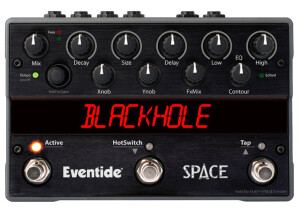
    Most important is the sound of any piece of music gear, and the Blackhole does not disappoint. Anyone familiar with Eventide’s reputation, but also the fact that the algorithm in this pedal is the same as in the Space pedal and the H9, will confirm that the reverb in the Blackhole not only is extensive (from a medium slap-back room to an infinite space, but incredibly clear and pristine – you can hear the detail in the reverb, as opposed to it being murky or washed out. That certainly is a plus, but the nature of the Blackhole’s reverb is extensive. You can have either a standard or reverse reverb (of different weights or ‘gravity’), mix in some or a lot of modulation, and also add delay up to 2000 ms. You can sculpt the sound of the reverb with hi and lo EQ controls, affect the resonance with the Q control, and add in feedback for short or long tails. Overall, and for $250 USD, the Blackhole reverb pedal is worth the investment, since it is studio grade and can be implemented on vocals, guitar, and keyboards (there’s a Guitar-Line Level switch on the back). However, this pedal does have some serious contenders for about the same price among its competitors, which I have not tried in order to make a comparison. Regardless, I can compare it to the reverbs found on Fractal (Axe-Fx) units, and the Blackhole holds its own very well. It’s also ideal if you want a smaller, more compact version of the Space pedal and if you desire the Blackhole algorithm, yet with massive amount of flexibility, a Freeze function, MIDI capability (via USB), running in either mono or stereo, and you can add an expression pedal for some cool transitions. I should mention, also, that the Blackhole does come with its own adapter, but requires only standard 9VDC 200mA if choosing to use a different power supply. For those interested, I’ll address the Blackhole’s operation, which is addressed in the video, along with its sound possibilities. The Mix affects dry versus wet, whereas Size is how big a space you want and the Gravity how pronounced the reverb’s attack (either normal or inverse decay). The Feedback affects whether the tail is nearly non-existent to a massive wave that washes over the sound. Gravity is minimal when sitting at 12-noon, whereas normal decay weight occurs with the knob turned clockwise, and inverse weight increases when turned counterclockwise. Obviously, tone of the reverb is controlled via the Hi and Lo EQ knobs, but the Q (resonance) does sculpt that tone even more (with no effect if the EQ knobs are flat, at 12-noon). You can add a sense of warmth or a big warble of gooiness with modulation, controlled via the Depth and Rate knobs, as well as adding in some reverb Delay, via its knob. Now, to keep the Blackhole pedal small, most of the knobs do have double functions. When pressing the toggle button at the top right of the pedal, the Gravity becomes Delay; Feedback becomes Q-resonance; Size becomes Depth (modulation); and Lo EQ becomes Rate (modulation). As stated, when using the software, you see all these controls simultaneously, thus making it easier for detailed editing. The use of an expression pedal adds to the diversity of the Blackhole; any of its controls (e.g., mix, delay, EQ, etc.) can be assigned to the expression and in any amounts/within any range, so that you can alter those elements in real time. In regard to the two footswitches, the left acts as an on/off (bypass can be set to buffered, relay, DSP+FX or kill dry), but also in selecting a preset. The right footswitch enters preset mode (when held down for a few seconds), but also Freezes the reverb when clicked quickly and released. Freezing allows you to play overtop with a dry signal, although it sounds best if you have some delay in your mix to make it sound less bland. The left switch’s LED can be pressed to toggle between Latching<>Momentary; and to save a preset, press and hold the right switch’s LED. Lastly, the Blackhole can be set to include/preclude the ‘Catch Up’ function, which eliminates abrupt changes in sound when tweaking knobs beyond their saved settings (e.g., the Mix knob may be at 3-o’clock for a preset, but physically turned to 9-o’clock on the pedal).

  • « Inspiring. »

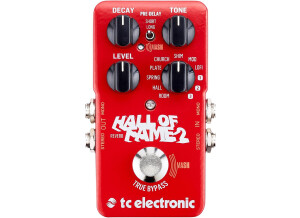
    Overview Simple. Elegant. Amazing. These words do not even begin to describe my love for this pedal. I love it even more than I thought I would love it when I first bought it. Let me be clear; I almost never buy gear for full price unless I believe it is something truly great. The Neunaber Effects Wet (Stereo) Reverb fits that bill. The pedal is housed in a lightweight (but durable) die cast metal chassis. It comes with three simple controls: mix, decay, and the custom expression control that can be programmed via the free downloadable software from the Neunaber Effects website. This custom control can be used as a reverb tone, shimmer effect, or reverb decay, and controlled with an external expression pedal. The Wet Stereo Reverb comes with endless possibilities, all built into a small, lightweight package. My Experience I bought this pedal directly from the Neunaber Effects website after I sold a few old guitar pedals and scraped together the money for it. Before I had the Wet Reverb, I was using the T.C. Electronic Hall of Fame reverb for my guitar setup, and I was happy with it. It has a multitude of options, and could be tweaked up the wazoo… but there was one thing it was missing: simplicity. There were so many options and controls, I didn't know what to do sometimes. I ended up just choosing one setting out of convenience so I wouldn't have to move the knobs around over and over again. Then I stumbled upon a video of the Wet Reverb, and it was love at first listen. The flexibility to go from a slapback room sound to an ethereal cacophony of buffered trails, all at the turn of one knob. I was so excited at the thought, I couldn't stand it. One of my favorite genres to play with guitar is ambient post-rock. With the turn of one or two knobs, this pedal turns your guitar signal into an ocean of endless ambience. Literally, if you turn the decay all the way up on this pedal, it will take a few minutes for the reverb effect to fully fade away (I know... I've tried). Pros and Cons For what it's worth, I can't say this reverb is for everyone. Don't get me wrong, it's incredibly versatile; I've used it for rock, blues, country, jazz, and experimental styles of music. But for all its wonderful simplicity, it may not get the exact sound that a certain niche musician is looking for. This pedal won't necessarily have the exact tone of an old analog spring or plate reverb, but the digital circuit will come pretty darn close. Another thing to note is that the reverb sound and decay is incredibly smooth--very suitable for ambient soundscapes, but not as suitable for gritty rock and country styles. Bottom-Line If you have the money for it, I would recommend this pedal again and again. If you don't have the money for it, but you can scrape it together to buy this pedal, I would say it's worth the effort. If you're a tone snob who won't accept anything less than old-fashioned analog gear, I dare you to give the Wet Stereo Reverb a try. You might just fall in love with it.

  • « A ridiculously powerful guitar reverb »

    The Eventide Space is a reverb effects stomp box that has more features and capabilities than you can possibly imagine! Loaded with 12 reverb algorithms, including the famed BlackHole reverb, standards like Plate and Hall, and with oddities such as Reverse and Shimmer. It is fully capable of stereo input and output, which makes it perfect for studio use. It is software upgradable via USB, and it is fully controllable via midi, and it is also controllable with external footswitches. It is capable of saving presets, but the presets cannot be saves or transferred to the computer via the USB connection. UTILIZATION This pedal is a bit confusing to use; notably, changing presets versus changing the reverb type can be confusing, especially since the first new factory presets are the exact same names as the reverb type (Hall, Plate, etc). It also doesn't help that both of those are controllable by the same knob. However, editing an actual preset it fairly easy, just turn the knobs, and the name of the parameter shows up in the display. The general names of the parameters are written on the box, but for some presets, they switch it up. There is also a hotswitch function, which lets you change the parameters within a preset instantaneously, back and fourth between two settings. A cool function, but I'm not sure when I would ever use it. SOUND QUALITY The sound quality of the Eventide reverbs is top notch: with so many controllable parameters, these are some of the best non-convolution reverbs I've ever heard. In fact, they certainly beat many convolution reverbs I've heard as well. When the mix and room size are turned up to extreme levels, the reverb doesn't hide, it shines. Eventide is famous for their delays and reverbs, and it certainly shows here. OVERALL OPINION Overall, this is a great (but pricey) reverb box unit. Is it worth buying for a guitar setup? Probably overkill, unless you are utilizing some of the more unusual reverbs, or if you need huge reverbs. Is it worth using in the studio? Possibly, but sometimes using VST or software-based effects can be easier. If you're looking for one of the top reverbs available in a physical hardware stomp-box form, then this is the pedal for you.

  • « Features galore »

    24-bit A/D/A converters True stereo inputs and outputs 8 programmable reverb styles with the ability to load and save Tap Tempo to set pre-delay section Damping/Tone control available for each reverb mode Grail Spring, Accu Spring, Hall, Room, Plate, Reverse, Grail Flerb, Echo Hold tap tempo for infinite reverb UTILIZATION At first look, this strikes me as a reverb pedal with the perfect "not too many but not too few" knobs. It's not like a boss reverb where it has 3 knobs. But it's no eventide where you will spend an hour on it. The cathedral is a fairly visual and menu free affair. You have your typical blend, time, and damp knobs. Then you have feedback and pre-delay which I think are a little excessive but hey, at least I don't have ti access a menu to get them. It has 7 total modes plus an echo. All stereo sound. You get about every style of reverb you would need. This is also a great studio pedal in case you haven't guessed that by now. Bottom line, with all the knobs you are allotted, if you can't dial in the reverb you are looking for then I pity you. I use this in an ambient instrumental band and it can basically dial in any sort of reverb tone you need. There's a point with units like this where adding more tweakable parameters is just peanuts. You don't need more than this. Serious. SOUND QUALITY The question really isn't whether it has enough bells and whistles to work. Clearly on paper it's a sick pedal. But does it sound good? Well short answer, yeah. It's not going to sound like a real vintage spring reverb or a high end Lexicon hall reverb. Don't realistically expect that. But it does sound very good for a pedal in this price range. And better yet, pretty much every mode is usable. How bout that? It doesn't color the sound as much as I thought it would. Kind of depends how you set it really. The tap switch is a great idea and I think it puts this pedal into the must have area. OVERALL OPINION The only gripe I have is how cheap it feels. Granted, it has not gone south on me, but I've only owned it for a year and I haven't used it as much as a lot of people would. So we will see. It's not noisy. I don't think this pedal is a deal by any means. But unless you wanna shell out money for a space echo or something, this is about as good as it gets under $250. Kind of a bummer that there aren't a whole lot of verb units out there right now.