Log in
EN
FR

Korg Pianos & Organs

70 products found

Categories
Series
Filter
Sort by
Korg
Evaluation
  • Reviewed or not
  • Editor’s award
  • Reviewed by Audiofanzine
Availability
  • Available or not
  • Sold new or used
  • Sold new
  • Sold used
Must-have products
  • All products
  • Flagship products
  • Best rated products
  • Hot products
  • Popular products
Price
  • Freeware
  • Low-cost (< $350)
  • Mid-range ($350 - $800)
  • Premium (> $800)
€
Clear
Sort by
  • Popularity
  • User ratings
  • Price - low to high
  • Price - high to low
  • Used price, increasing
  • Used price, decreasing
  • Name (from A to Z)
  • Name (from Z to A)
  • Added on
Choose a category
Selected category: Pianos & Organs
Sort results
  • Popularity
  • User ratings
  • Price - low to high
  • Price - high to low
  • Used price, increasing
  • Used price, decreasing
  • Name (from A to Z)
  • Name (from Z to A)
  • Added on
Filter results 70 results found
Brands
Evaluation
Availability
Must-have products
Price
  • Freeware
  • Low-cost (< $350)
  • Mid-range ($350 - $800)
  • Premium (> $800)
Show results

The best Korg Pianos & Organs reviews

The reviews Audiofanzine members found the most helpful.
  • Man who sold the world's review

    The features can be read in the first review. 7 1/2 octaves Sounds aren't editable. It has 6 sounds but you can combine two at a time and "mix" them. Headphones output, left/right outputs (1/4" jacks), MIDI in/out UTILIZATION The keyboard is OK, but after having played a grand piano, there's no point of comparison. What's more, the keyboard is VERY noisy: I play upstairs and my house has badly isolated parquet so you can imagine the amount of noise downstairs. But it's not too bad. It couldn't be easier! Which is good, it's a piano! It's not a synth, you turn it on and start playing! It is sober, no backlit display, no disco-like LEDs. Only the required red LEDs! I have never used midi on this piano, I'll have to put myself to it :D And, yes, the manual is clear! The piano sounds quite all right! A small drawback: the outputs aren't sturdy enough, the headphones output came off after two years. I ordered spare parts from Korg and had to wait 6 months to get them. OK, yes, I use it live and it has aged well. But it could be a bit sturdier! Besides, after 3 years... There's an E flat that sounds a bit too loud. I have adapted to it (it's practical when you play Cm, because it emphasize the chord!). But I repeat, I'm being a bit harsh on the piano! The metronome is practical but complicated to use (you have to use a key combination to adjust the tempo, but it's a whim! You can control the volume of the metronome independently from the piano. Overall, it is quite functional! Useful and practical! Very pro, very sober...I like it a lot! The shell is made of metal not plastic! The top panel is very solid and nice. The only defect is that it isn't completely glued to the piano, there's a small gap, so when you have too many sheets they can fall down (I might be VERY picky, but it has happened to me on stage :D) SOUNDS Very good for jazz, because the sound doesn't have too much dynamics! So it sounds smooth! It may lack some attack for a hard-driven boogie! But I'm nevertheless satisfied with it! For me it sounds very realistic. Anyway, I stand by my assertion that NO electric piano will give me the same pleasure as an acoustic one! (It may be psychological, knowing that you activate a whole mechanism and you have to wait for the hammers to do their job... MMMmmmm lol) Now, seriously, nothing can replicate the sound of an acoustic piano, that's true. But I'm being picky. OVERALL OPINION I think I've had it for 5 years (I need to check that) What I like best it its class. What it does, it does well. What I like the least is the shitty sturdiness of the outputs and the pedal! But you can always buy better ones! I have played many pianos! There are certainly better ones, but for $500, it is all right, because the pianos I find are very expensive! But I recommend you to spend a bit more and get its successor, the SP-300, which is damn good, given that the defects have been corrected!!

  • « Excellent choice for an student »

    I bought my SP250 when I first started studying piano back in 2008. As a student of orchestral conduction, I was looking for an instrument that could help me as a tool. I looked into cheaper options (such as Privia, some Yamaha, some other Korg models, etc.), but I couldn't find a piano that really satisfied me in matters of weight and feel until I found the SP250. The piano sounds are really decent, and the price wasn't sky high, so I decided for it. Now, when I reached this point I realized that, if I was going to buy an electric piano, I should go for the most transportable choice. I'm also a rock musician and I correctly guessed that, eventually, I was gonna need the instrument to play gigs. Sadly, even though the SP250 comes with a removable support, it's so heavy and large that it is practically impossible to lift by one person alone. It's also quite big, so it won't fit in most cars easily. That being said, its a simple, straightforward and resistant instrument. It has 88 keys and includes a support, sheet music stand, sus pedal (that attachs itself to the support so it doesn't get loose), mono/stereo output, and MIDI in/out, 2 phones out (which cancel the speaker). Not too many sounds (6 pianos, 6 e-pianos, harspichord, clave, funk clavinet, vibes, xylophone, nylon guitar, 3 church organs, 3 hammonds, 3 string sections/pads, 3 choirs). They can't be really edited, as the only parameters available for change are reverb and chorus. It isn't actually necessary, as the instrument has MIDI capabilities. UTILIZATION The setup of the instrument is as easy as it gets: plug and play. The manual is absolutely detailed and clear, and comes in several languages. The effects selection system is really simple, with a particular button for each 'type' of sound, and then another button for selecting a patch inside that first selection. There are controls for reverb, chorus, touch sensitivity, transposition and metronome. Two sliders, one for volume and one for metronome speed. You can also perform control combinations in order to achieve certain transpositions or particular effects, like for example muting the audio output to work in MIDI mode alone. SOUNDS The sounds are realistic and effective. Of course, nowadays its easy to find awesomely realistic piano VSTs, but the SP250 built in sounds have always been enough for me when it comes to live setups or quick recordings. The electric piano sounds are subtle and vary their timbre according to dynamics. The harpsichord and clavichord are excellent, and the funky clav features a sort of built in wah fx. The organs are not mind blowing but they work really well. The only weak spot would be the string pads: you are offered a selection of 2 string sections that only vary in attack speed. The remaining string pad and the chorus-pads are average sounding, and I would not use them as my primary pads of choice. OVERALL OPINION The only thing that's really missing in this instrument is the presence of mod and bend wheels, though I understand those are features more commonly found in other types of keyboards. It has never had any technical problem, and the value/price ratio is excellent, so I would choose it again over many competitor models.

  • « Vintage Digital Piano's »

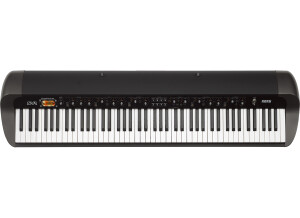
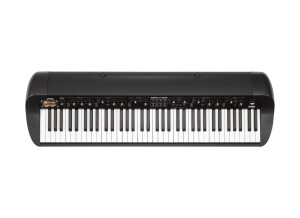
    The Korg SV-1 is a very good digital electric piano. I have been using it for years, a friend has one at his house. Even though I am not a great pianist its still good for me to get to use it from time to time just to work a little bit on my skills. So for me it is a practice piano but for him and others it’s a piano that they have really polished their skills on. It can be in either 88 or 73 key version, he has the 88 key version and it has a really nice feel too it. Similar to a real grand piano, you really cant even tell that it’s a digital piano buy the feel of the key’s. Of course you can by the sound though because nothing is like a real grand piano except for a real grand piano. Overall, I would have to say that purchasing this digital piano (Korg SV-1) is really worth the money spent. Its pretty light too just incase you have to transport it from one place to another. It also has mide connection abilities so you can sync it up with your software. Though I have never used that feature so I cant really comment on it. Also, a ¼ jack is available for the pedals that you can purchase. The pedals don’t come with it though, you need to purchase those separately. If you are willing to invest a good amount of money in a vintage style digital piano then the Korg SV-1 will work for you without a question. Not all of the sounds are piano sounds, it also has good Rhodes and organ sounds. Don’t expect to get the synth sounds that you get on workstations though. It just doesn’t have those capabilities. But the electric piano sounds are great, you will be very pleased.

  • « Korg SP-200 »

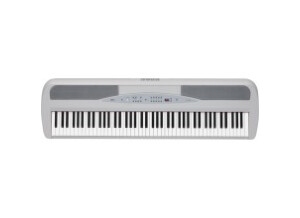
    Bought used as a rental return in Vancouver, Canada. The Korg SP-200 has all the essential features of a quality digital stage piano, and is ideal for piano students who'd like to try some other sounds. Gigging musicians will find it a pleasure to play, but might find some of the features a bit limiting for stage performance. The piano, electric piano, harpsichord, vibraphone, pipe organ, and clavinet sounds are excellent. Though not quite as grand-piano-like as those on Yamaha's P series stage pianos, the weighted keyboard is very fine indeed. The control layout -- a row of buttons with LEDs, and just two sliders for volume and metronome tempo -- takes an excellent less-is-more approach, making the SP-200 easy to use for beginners. Korg claims 60-note polyphony (simultaneous notes) for ther SP-200, but that's not always true. Some of the better sounds, like the first two stereo grand pianos, use two sets of oscillators and reduce polyphony to 30 notes, while the reverb and chorus reduce polyphony still further. If you layer two complex sounds and add effects, it's not hard to make notes cut off if you hold down the sustain pedal and play a few two-handed chords. On the other hand, if you use the lovely mono grand piano with no effects, it's nearly impossible to make that happen, so whether the polyphony limits are an issue depends on what you want to do. The jazz/rock organ and synth string/choir sounds are merely adequate to good. There is no way to store custom user settings (for reverb, key-touch sensitivity, etc.), so when you turn the keyboard off and on, everything reverts to factory settings, which is why the SP-200 might not be best for those who primarily use it onstage. The SP-200 can act as a MIDI controller or sound source, but neither is its forte -- it is designed to be plugged into some speakers, turned on, and played. Those seeking a weighted keyboard controller probably want other features, such as a pitch bend wheel, that the SP-200 lacks. The case is about as small as it can be for a weighted, full-88-key stage piano, and at 40 pounds it is even relatively light. All the connector plugs are on the back, even for headphones, which is too bad, since a front-mounted phone jack would be more useful. There is only a single headphone jack, and no line-in to play along with CDs. The power adapter is a standard "wall wart" type with a small plug, rather than a more robust three-prong plug. The included damper pedal is just a footswitch, though a separate piano-style half-damper pedal is available. For compact, high-quality, excellent sounding stage pianos in this price range, it's a tough competition between the SP-200 and comparable models such as Yamaha's P60 and P90, Kurzweil's SP88X, Roland's RD models, and a few from other manufacturers. The SP-200 acquits itself well, and can be a wise investment if you understand its few limitations in advance. This review was originally published on http://www.musicgearreview.com