Log in
EN
FR

Korg Other musical instruments

95 products found

Categories
Series
Filter
Sort by
Korg
Evaluation
  • Reviewed or not
  • Editor’s award
  • Reviewed by Audiofanzine
Availability
  • Available or not
  • Sold new or used
  • Sold new
  • Sold used
Must-have products
  • All products
  • Flagship products
  • Best rated products
  • Hot products
  • Popular products
Price
  • Freeware
  • Low-cost (< $500)
  • Mid-range ($500 - $1,500)
  • Premium (> $1,500)
€
Clear
Sort by
  • Popularity
  • User ratings
  • Price - low to high
  • Price - high to low
  • Used price, increasing
  • Used price, decreasing
  • Name (from A to Z)
  • Name (from Z to A)
  • Added on
Choose a category
Selected category: Other musical instruments
Sort results
  • Popularity
  • User ratings
  • Price - low to high
  • Price - high to low
  • Used price, increasing
  • Used price, decreasing
  • Name (from A to Z)
  • Name (from Z to A)
  • Added on
Filter results 95 results found
Brands
Evaluation
Availability
Must-have products
Price
  • Freeware
  • Low-cost (< $500)
  • Mid-range ($500 - $1,500)
  • Premium (> $1,500)
Show results

The best Korg Other musical instruments reviews

The reviews Audiofanzine members found the most helpful.
  • « Expressive, compact and resourceful. »

    It's a full sized piano, with piano keys and all the bells and whistles in terms of connections, XLR or line outputs, midi in and out, sustain pedal, etc. Korg aimed this product at the professional piano player who needs various timbres at her disposal on a portable solution, and they did so very well. While most of the sound are presets, you can alter various settings with the handsome and responsive knobs on the front, and if 'analog' is your thing, you can 'heat' up things with the built-in AX127 tube. UTILIZATION I gotta be honest, most of my experience with this product comes from recording other people playing it, since I'm not a pro piano player. That being said, I've had no trouble asking the performer to adjust the timbre or even experimenting with the vintage sounds. We can almost get where we want quick and easy and once it's setup we can focus on the performance, and that's where, I think, good pianos stand out from the rest of the controller/synth market. As an engineer, it's always a pleasure to mix sounds coming in from this keyboard. SOUNDS Grand Piano, Electric piano, organ, you name it, this one has it all. As I said in the previous paragraph, responsiveness is top notch for performers with piano technique that really use dynamics in their playing, even saturating and distorting pleasantly when really hammered. My favorites are the organ and electric pianos, and since you get all the octaves of a regular piano, you can really spread those chords and create huge sounding pads. OVERALL OPINION I love that you can just plug it in, browse the sounds and hit record in about 5 minutes. I hate that things this good and easy are not cheap. I love that piano players that know what they're doing immediately begin pouring out great sounds out of this device. I hate that I'm not a great piano player. If you're in the look for a piano solution for your studio, definitely give this one a try. Remember that Korg sounds too Korg sometimes and compare it to Nord's options out there, which are definitely strong competitors.

  • Jim Nasty's review

    Well, this is my first electric piano. It has 88 keys (7 1/2 octaves) with "piano" feel, although it's not as authentic when compared to a real piano. It has a very simple design. And it is also very heavy!!! 44.1 lb!!! But it's sturdy, a real tank. However, I know some people will not be happy having to move it around frequently to go to rehearsals or a gig, which is something I stopped doing early on! The SP 100 comes with a poor-quality pedal, true, but it's indispensable... It features a midi in and a midi out (but no thru...) independent L/R jacks outputs and a headphones output. UTILIZATION As I said before, the keyboard is very nice, but maybe not as inviting as that of a real piano, and yet the mechanism is interesting, but unfortunately too noisy acoustically (very annoying to play at night, even with headphones). It's a very simple piano in terms of design and usability, you can only configure certain basic midi parameters like multichannel, midi return, etc., by pressing a key together with the Function button. You will have to open the manual to configure midi to your needs. SOUNDS I only use the piano, which I think is the most credible and the best-adapted of the six sounds available. They are quite all right, worthy of KORG It has 32-note polyphony. 8 buttons for 8 sounds, simple as that: Piano (Stereo Sample) Electric piano Harpsichord Vibraphone Organ Strings - A very basic piano, with very nice lows but very tiresome after the 4th octave...but that's a matter of taste (I recommend you to use a light reverb to add some depth, but use an external effects module instead of the 2 internal effects: reverb and chorus). - Very nice electric piano sound, but it lacks some warmth and smoothness. - An uninteresting strings sound, like the organ, which is nevertheless a bit better. - A very nice harpsichord, but I think it won't be used much by anybody. - The vibraphone is, in my opinion, superb! You can also combine two sounds of your choice, but neither of them can be modified. Add to that an adjustable metronome and a 4000-note recorder (Rec / Play). I think they could've done without some sounds to have more memory space and improve the piano. After all, a digital piano is still a piano, isn't it? OVERALL OPINION It's been over 3 years since I have it, using it mainly as a master keyboard. I do not intend to change it, it is as good as any of the best! It is not that bulky for a 7-octave piano (in terms of depth, obviously) Its sound and keyboard seduced me in the store. It's only with time that I've changed my mind, but it is still very interesting for its price. What's sure though is that the next time I want a piano I wont' look beyond KORG.

  • scual's review

    - 7octaves. - 30 sounds in 10 banks, so you have 3 sounds available for each bank. Possibility to mix two sounds. 2 effects: Chorus and Reverb, 3 settings for each effect. Touch function for the keyboard. The piano sounds are obviously the most interesting (I like especially three of them), which is what made me decide to go for the SP-200, considering my budget and the other pianos I tested. - Mono/stereo audio outputs PLUS headphones, midi IN/OUT, sustain pedal (not the best...) Considering what I was looking for, and at this price point, it has the perfect features. UTILIZATION - The keyboard is very nice, but that's something very subjective. I learned to play piano on my own, so I'm not very technical (not at all, actually!). Up to now I'd had a "real" entry-level acoustic piano and have had the opportunity to play synths and other digital pianos (Yamaha P-80 / P-90, Roland RD-150). I have never liked the keyboards on synths, so I was looking for a weighted keyboard. After having tested the Roland FP-2 and 2 Casios at the same price point, I preferred the keyboard of the SP-200. - The overall configuration is very intuitive. I miss a digital display and the possibility to configure sounds banks (to be able to switch quickly between sounds, which ought to be possible via MIDI, but I haven't tested it yet). - I haven't tested midi, so I'll let you know my thoughts once I do. - The manual seems very clear, but I have barely looked at it because it's very easy to use. SOUNDS - I was looking for good piano sounds right from the start and that's what I found in the sp-200! I didn't think I'd be using the other sounds but have surprised myself playing electric pianos (including one with a very '60s sound) or mixing pads with piano sounds... I love it to play rock/pop-rock!!! :-) - In terms of realism, and compared to other pianos I tested, for me, this is the best one (below $1500). - Good expressiveness. There's some sort of "damping" sometimes when you press the same note quickly, which is something I hadn't seen in a real piano. But I still need to confirm that it's not a problem of me not releasing the key enough, which reduces the velocity. - I prefer the following sounds: Grand Piano 1, Bright Piano 2, Classic Piano, There's no single sound that I don't like, but it's true that I don't see myself using the Acoustic Guitar, for example. I would've liked a bass sound better. OVERALL OPINION - I've been using it for six days. - There's nothing in particular that I like or dislike about this piano, I like it as a whole. I'm happy with my investment. I bought it new and think it will be my companion for years to come! What I regret a bit is the sustain pedal, which isn't worthy of this piano, and (something I think has been mentioned by other reviewers) the low level of the headphones output (very, very limited...). I plan to buy some active speakers to really profit from the sound of the piano. - I didn't test too many products (3 Roland, 2 Casio, 2 Yamaha). My main reference was an acoustic piano, so I was looking for something that resembled it in terms of the keyboard feel and that, at the same time, had a good sound. The SP-200 was the best for me. - I think it's an excellent value for money, compared to the other models I tested. - After one week of use, I'm not ready to get rid of it! We'll see in a couple of months... NB: Since I had no experience with digital pianos, I underestimated an element that has proved to be very important: A stand! I bought one for $40 online and as soon as I get a bit excited it starts rocking with me, in every sense of the word... It's all right for the time being, but I need to get a better stand in the future. Think about it when you buy a piano!!! Update: I ended up making my own stand out of solid wood. I spent less than $50 and have a very solid stand that it took me a couple of hours to mount.

  • phraseland's review

    I was looking for a metronome that allowed me to tap in the tempo, was loud enough so I could play my dreadnought along with it and had a sound that didn't hurt my ears after a few hours of playing. I looked hard and eventually only found the KDM-2 by Korg. A lot of the other metronomes try to be as small as possible or cut corners elsewhere. This one is bigger than most of its competitors but I find it to be still small enough to be taken out. The advantages of a bigger size are of course: - bigger display - louder and better sounding click - normal batteries can be used This metronome also doesn't make the mistake that it tries to be a mini-drum-machine...it is just a very good metronome. You can adjust the beats and have even presets for clave and similar rhythms. The tap button is very present on the top of the unit and the accent is also visible via an LED that either lights up green or red. The only thing I have to complain is that they didn't think of building in an 'auto-off' function...so don't forget to turn the unit off when you're done using it. The batteries do last a long time but after a week or two of just being turned on even they will run dry.

  • « A nice practice digital piano with some fun features. »

    The SP-250 is an 88 note, weighted key digital piano with its own built in speakers and plastic music stand attachment. The keyboard is of plastic construction, with rubber buttons and a metal stand to hold it up. The keybed itself is Korg's "RH3" which has been used on many of their instruments, including the M3 and Kronos if I am not mistaken. On the front there are 2 1/4 inch jacks for headphone output, a power button, plastic faders for Master Volume and Metronome Tempo, and 17 rubber buttons for changing the sounds. There are 3 effects- Reverb, Chorus, and Touch (sensitivity). The keyboard can be transposed up or down with the Transposition button. There is a Demo mode that can be activated by another button which plays example music on the keyboard to show you the sound potential, and there is a button for turning the metronome on and off. The sound banks, which can be triggered by their buttons, are as follows: Piano 1 and 2, E Piano 1 and 2, Harpsichord, Clav, Guitar, Vibes, Organ 1 and 2, Strings, Pad, and Choir. Each bank has 3 alternative modes, which can be activated by pressing the "Bank" button. The back panel has 5-pin Midi In and Out ports, 1/4 inch Left and Right audio output, and a Sustain Pedal input. UTILIZATION Using the keyboard is as simple as can be. You turn the power on and begin playing piano. The manual is easy to understand, and I highly recommend reading through it to get an idea of the extra features hidden under the hood. There is an impressive amount of options considering that this keyboard is intended to be a basic practice instrument. I have never used the SP-250 as a midi controller though it does have the proper midi-jacks. As a controller it would be very limiting- you would be able to plug it in and play the keys to trigger more sounds. Patch selection is as easy as pressing the button for the instrument bank you want. One feature I really enjoy is that you can layer 2 sounds by pressing 2 buttons at the same time. This makes for some fun practice if you want a little more going on in the background of your piano playing by adding strings to the piece. There is no "split" function though so you are stuck with the notes playing together every time. The volume and tempo knobs are a bit weak feeling. Maybe I am just rough with my equipment but I can see myself breaking those if I ever slipped on them the wrong way. The tempo knob only lets you select the tempo by sliding from left to right. I find this a little annoying if I want an exact tempo when I'm practicing and wish there was a way to be more precise. Especially considering that this is a practice keyboard, I would think they would have included a more detailed metronome. Everything works as intended and shouldn't cause any confusion if you are familiar with the terms such as "reverb" and "tempo." SOUNDS The sounds are very nice. The pianos could be used in a mix comfortably, though I would not rely on their sound for a solo act. That is how I feel about all of the sounds actually, they are fun and get the job done, and really are great sounds, but the keyboard is a little dated now and you wouldn't want to perform a professional job using these sounds alone. The touch sensitivity is decent. I don't notice that I am using a digital keybed very often. That is to say that nothing sticks out to set it aside from a real piano as far as play-ability goes. I personally feel that the dynamic range on this keyboard isn't as wide as it could be. You can certainly play soft, medium, and loud, and everything in between those, but I have actually had moments where I use the master volume to get softer and louder within a piece. The touch sensitivity remedies this to an extent, but compared to something like the Roland FP series I find it lacking in dynamic freedom. The effects, much like the sounds, are very good and get the job done. They are nothing too special and have little room for change, but they work and you can hear them. I don't like that Reverb is on as a default. I think they did this to make it sound more realistic, but sometimes I like to keep it off and just use the natural reverb of my practice room. I don't use external speakers with this and never have so I can't comment on the converters. My brother has an SP-250 as well, and I can say that when he records it from the Stereo Outs and sends me the WAV file the piano doesn't sound very good. This could be his fault in some step of the recording process, so don't assume it is the converter's fault. If anything I would recommend that you find an SP-250 you can use and hook it up to speakers if you think you would use external systems often. OVERALL OPINION I love the ease of access. There are no loading times to use any feature. You turn it on and are ready to make music. The keybed itself is very nice and everything works as advertised. I don't like the plastic construction too much, and I'm not particularly in love with the metronome, but other than that and the little complaints I mentioned above it is a great keyboard for practice at home. The SP-250 is quick and reliable. If you are a student who needs something that you can plug headphones into and practice late into the night this is a good choice. Likewise if you are a professional who just wants a decent keyboard in another room of your home in case inspiration hits you, this would not be a bad option. I have played more digital pianos in my life than I can remember. I like Roland's FP series much better, particularly the FP 4 if you can find one. The FP series has more and better sounds, better construction, better metronome, and a better keybed. The only reason I have a Korg SP 250 as well is because I got a great deal on one and needed a cheap second keyboard for my studio to teach children's lessons on. I had previously had access to 2 of these at my parent's home and knew it would be reliable. Additionally, if you are in the market for one of these and have extra money to spend, check out the newer Korg SP-280, which offers updated, yet similar features.

  • « KORG MA-30 METRONOME - Wish it was louder »

    Ok so what can you say about a Metronome, it should keep time and have a good range of speeds, this one does that from 40 to 208BPM. Instruction manual is very good and explains the features in enough detail to understand. It looks good and appears to be built pretty well for what it is. It also has a beat tap feature to get the tempo just where you want it to be. It also has a sound calibration button to choose from 12 different pitches. Comes with earphone jack, memory backup and the big one for me, adjustable volume. 250 hour battery life as well which is fantastic. That is all fine and dandy except for one big problem...it isn't loud enough, even with headphones. I bought this for my son to use with his drums and he can't hear the darn thing loud enough to use it for drums. For the sake of being fair, I think it serves guitar players very well and is loud enough for that purpose. It seems to be a nice metronome and I have used it for my guitar playing but I wish it was louder and I could appreciate all of the great features I mentioned above for my son's drum lessons. Also to be fair, this was suggested by my son's Berkley educated drum teacher so maybe we are doing something wrong. I just have to believe there is something better out there that maybe has it's own amplifier and can put out a louder tone. I have to conclude that this is probably ok for some people but we have just found it to be inadequate for our purpose. I have not tried any others as of yet but I have to say I will need to in the near future. Can't really give this high marks based on the volume.

  • « Just a home piano. »

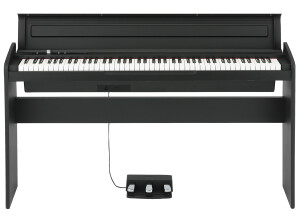
    The Korg SP 170 is a rather striking entry level digital piano, in that it has no buttons on it! It looks like an instrument instead of a machine. Visually, the SP 170 is a thing to behold, and the way the chassis itself feels screams quality when compared to its competition in the Yamaha P95 and Casio Privia PX-130. Thankfully, the SP 170 doesn't share the polyphonic plight of the Yamaha P95. I has enough to get by, a strange 120 note polyphony, just under the generally used 128 note polyphony but just as acceptable. Especially since you can't layer voices with this piano. Yup. That's something that this piano doesn't do, unlike its competition. This piano also has the weird lack of 1/4" outs. Like its friends, it can be fixed with adapters, and considering the market, it's acceptable, but it's still quite annoying to have to deal with. Thank goodness again, for the MIDI. UTILIZATION Everything that needs to be a button is painstakingly tucked away where no one can see. Even the volume is out of the way; this gives the SP 170 a very clean look. It is quite deceptively full of features though. Hold down the top three keys and depress another key to change the sounds, and to adjust reverb, chorus, etc. It is a bit clunky at first, but it's endearing once you get used to it. It also discourages drunk groupies from pushing a lot of buttons on your piano (speaking from personal experience with the Casio Privia PX-330 I personally own here). SOUNDS Once again, I urge you to listen to samples and if possible, try the feel of the piano itself; this area is entirely subjective. In my opinion, however, this is where the SP 170 gets a little erratic. I'm NOT a fan of the samples at all. The only samples I really like are the Rhodes and the FM piano, the grand piano doesn't do it for me; the decay of the notes is very bizarre. The feel of the piano is also strange. While it's obvious that these pianos are all artificially weighted, this makes it the most obvious. It's heavier and spongier than its competition, but it doesn't seem to be because of hammers. However, the speakers of the SP 170 are godly compared to its peers. While the Casio's speakers are acceptable and the Yamaha's speakers are awful, the Korg SP 170 speakers are incredibly usable. OVERALL OPINION If you're stuck in this class of digital piano, go for the PX-130. It's the most comprehensive and easy to use. Once again, you should try them out to see what works for you. They are all roughly the same, except the Korg and Yamaha have a strange set of limitations that the PX-130 seems to transcend. Again, see for yourself. The Korg SP-170 is still a perfectly great piano if it's going to sit in a living room!