Log in
EN
FR

Acoustic-electric Folk/Western guitars

3700 products found

Filter
Sort by
Brand
Evaluation
  • Reviewed or not
  • Editor’s award
  • Reviewed by Audiofanzine
Availability
  • Available or not
  • Sold new or used
  • Sold new
  • Sold used
Must-have products
  • All products
  • Flagship products
  • Best rated products
  • Hot products
  • Popular products
Price
  • Freeware
  • Low-cost (< $800)
  • Mid-range ($800 - $2,000)
  • Premium (> $2,000)
€
Clear
Sort by
  • Popularity
  • User ratings
  • Price - low to high
  • Price - high to low
  • Used price, increasing
  • Used price, decreasing
  • Name (from A to Z)
  • Name (from Z to A)
  • Added on
Sort results
  • Popularity
  • User ratings
  • Price - low to high
  • Price - high to low
  • Used price, increasing
  • Used price, decreasing
  • Name (from A to Z)
  • Name (from Z to A)
  • Added on
Filter results 3,700 results found
Brands
Evaluation
Availability
Must-have products
Price
  • Freeware
  • Low-cost (< $800)
  • Mid-range ($800 - $2,000)
  • Premium (> $2,000)
Show results

The best Acoustic-electric Folk/Western guitars reviews

The reviews Audiofanzine members found the most helpful.
  • « Exceptional »

    I was after a baritone acoustic guitar that I could strum and play like a standard acoustic, and allow me to sing in lower keys while playing songs with my normal chord patterns/progressions. I demo'd this Ibanez AE255BT against the better-known and highly-regarded Alvarez ABT60, which is the only other baritone I could find with a similar list-price and spec. I spent an hour A/B'ing the two guitars, and they were surprisingly very different beasts. The Alvarez is much louder (presumably due to its jumbo body) compared to the Ibanez, which has a grand auditorium style body. The Alvarez also had more sustain, a scooped frequency range (pronounced bass and treble) and powerful (almost unwieldy) overtones. The Ibanez had a far more controlled tone, with strong fundamentals and a pronounced mid-range. For a normally-pitched acoustic, I'd usually prefer the tonal qualities of the Alvarez, but - for a baritone - I felt it sounded a mess when strumming open chords. The Ibanez, however, retains clarity in the lower registers and can be played open, just like a standard acoustic. The fundamental tone is more suitable for this type of guitar. I found the intonation of the Ibanez to be better than that of the Alvarez. The Ibanez stays perfectly in-tune up and down the whole fretboard, whereas the Alvarez struggles to keep intonation up the frets. This is a real testament to the build quality of the Ibanez. The Ibanez is also more comfortable to hold and play, with its slimmer body shape and slimmer neck For fingerstyle, both guitars sounded great. The Alvarez has a zingy tone, and you can really hear the metallic sound of the strings. The Ibanez, although quieter, has a beautiful deep tone; the low B-string sounds similar to a bass guitar, and the overall tone is very piano-like. Overall, I felt the Ibanez was the superior baritone acoustic guitar - and I chose this over the Alvarez. The Ibanez AE255BT is a very attractive instrument. The quality of the woods is great (solid Sitka spruce top and beautiful layered ovangkol back/sides - which looks very similar to Indian Rosewood). Appointments, such as the wood binding and vine fretboard inlay, surpass the expectations implied by the list price. Overall the fit and finish is impeccable; easily on par with acoustics far above its price-point. If you're looking for a baritone that plays and feels just like a standard acoustic guitar, I highly recommend the Ibanez AE255BT. It has a low, controlled and rich tone, great playability and offers exceptional value.

  • « Small, yet huge »

    I’ve received it. Don’t believe the rumours, its finish is perfect and beautiful. A real lightweight, yet it provides a huge projection for such a small guitar! It was set too high, so I immediately endeavored to sand the guitar’s saddle (I’m used to it as I’ve done with every acoustic guitar I’ve owned). I unwind the strings, take the saddle out and I see the pickup – a thin, metal strip. Hey, what shall I do? If I modify the saddle (which can’t be reversed), the pickup’s width will have to be taken into account, and if I take it off the sanded saddle will be too low… And that’s precisely what I want: to take that pickup off as I know I won’t use it, I don’t like too much that sort of things (had the AE been available without the Baggs that’s how I would have bought it). So I slide the pickup throught the bridge into the guitar’s body (really easy to do), it’s so thin that it doesn’t move, hanging on its wire. I leave it this way, thinking that in case I’d change my mind someday… I put the saddle back in place, wind the strings and the action is perfect! And now, the guitar is totally changed, very playable with a really compressed sound, clear with nicely articulated notes, a great “thump” in palm mute, blose to a real percussive instrument. I couldn’t stop playing for 2 hours, everything goes from jazz chords to funky riffs, fingerstyle, picking, strumming, solo… Playability and sound at their best! It’s hard to describe, the guitar is hardly 4 or 5 lbs still it resounds from everywhere, even when you just grab it, a sound filled with overtones, shiny harmonics… I must add it is perfectly expressive: very soft playing, gentle touch, small appoggiatura… it whispers and brings out all nuances – a feather on the strings would make itself heard. And it follows as you play more and more powerfully until heavy, rough playing, and even then it keeps projecting your sound with a wonderful drive, it keeps straight. Then the player gives up, as it also perfectly renders the tension in playing and this is… unnerving! :-) What seems even more impressive to me is that it’s brand new!! How will it sound as the wood matures?... Now I understand why vintage LG-2s are said to absolutely rock, soundwise and comfortwise! That’s just what the American Eagle does! I’d been looking for a model for a year, so I’ve tried many small body guitars (taking very details and analytic accounts into consideration, but also the raw feeling I got from the instrument itself): Simon&Patrick, Martin, Recording King, Eastman, Blueridge, Yairi… and many others. This is the best. Gibson’s American Eagle is a recent acoustic guitar series that brings the brand back to the Golden Age that made it famous. This is the best acoustic guitar I’ve played since I started to play some 25 years ago. When I read some forum users taking it down without ever laying their hands on it, all I can say is “what a mistake”: they know not what they’re missing. $1400 is quite a sum, of course, but after a few hours spent with it it turns out to be a great value for money for such a quality instrument. Definitely!

  • « Vantage VS-35 - Fun to Upgrade, Gibson CF-100 copy »

    This guitar has a wide neck - 1.75 inches. Very nice for finger picking. :bravo: The old electronics were broken - so I replaced them with a no-name brand. Works fine. Also replaced the tuners, nut, and I have purchased a compensated bridge to put in. I believe the guitar's top to be made of solid Nato wood, which is a wood similar to mahogany. The sides, I am pretty sure is a laminate, again Nato wood. (I had to enlarge the hole for the new electronics and I am pretty sure it's a laminate.) The guitar projects great and with the new compensated bridge it really sounds and feels great. It has a deep tone. All in all, it is a fine guitar to get cheap and upgrade. It's now about the quality of a 1000 dollar guitar. This guitar model was made in Korea by the precursors of Samick.

  • « Very good guitar »

    I bought this VESTER guitar (manufactured in Korea) secondhand. It's a replica of the celebrated OVATION BALLADEER. The person who sold it to me said he had it 10 years. It is in very good shape and is equipped with a passive pickup with two controls (tone and volume). I had never seen a VESTER with the shape of an Ovation online (it might be a rare specimen). USE The neck feels very nice, it provides a good playing comfort. The guitar's form (ovation balladeer) is extremely comfortable, it's light for an acoustic-electric. I think it's more shallow than an ordinary acoustic guitar. Access to the upper frets is easy, but the height of the strings annoys me a bit, I might need to reduce the bridge nut a bit. You get a good sound both with a pick and your fingers. SOUND The sound of the guitar is interesting. The highs, mids and lows are well-balanced. The neck is perfect and it doesn't make any fret noises at all. The sound is not bad at all, it's quite impressive for a Balladeer replica. I tried it out with an acoustic-electric amp and the sound was very good. OVERALL OPINION I bought it secondhand, I think I got my money's worth. It was a very good deal, in my opinion. I recommend it, if you find one. I had a Lag Spring Saison before this one and you can really tell the difference.. Overall, it's a good guitar, very interesting.

  • Audiofanzine FR's review

    (Originally written by biecoul/translated from Audiofanzine FR) Made in China, conceived by Yamaha Japan. Mini jumbo slim body. Preamp with 3-band EQ. Glossy finish (I clearly prefer the LAG matte finish). Plastic bindings and rosette! Generally speaking, I prefer the LAG natural finish. UTILIZATION I chose this guitar because it is very comfortable to play! I usually play electric guitar but I wanted an electro-acoustic one. I bought a Jumbo (LAG Autumn 300) for its warm sound but I quickly realized that it wasn't that comfortable to play. I'm quite big and I'm used to playing a Stratocaster, so I feel much more comfortable with a slim acoustic guitar! I tested several models and I found the Yamaha APX is the best for me. The action is low, the strings are neither too soft nor too hard, the slim neck reminds me of my Strat... It's great! SOUNDS The acoustic tone matches all my expectations: it's not a big sound but a well-balanced sound to play chords at home without disturbing my neighbors! The amplified sound is simply amazing! For electric guitarists who aren't looking for the Paco De Lucia sound, this guitar is perfect. Oasis, Chapman, Floyd, etc. Perfect! With a modeling amp like a VOX DA, everything sounds well, warm and full. OVERALL OPINION If you have a weakness for that warm, big and powerful MARTIN sound, choose a Yamaha APX! The APX 500 is for small budgets, the 700 is for people who just sold a couple of guitars, and the 900 for people who want the same guitar as AYO or Tryo (Gizmo). It's a guitar you'll take with you everywhere. It's perfect to practice or to accompany a singer. Very good value for money. Just try it out!

  • « Waow... »

    Giving an objective opinion on it promises to be a tough work indeed, but I’m gonna try my best. First, I want to mention that I won it at a Yamaha contest and had never even heard of it before I got it. When the dealer gave it to me, he said “well you’re quite a lucky guy, for this instrument’s acoustic qualities could well be sold for double the price”. And that wasn’t a salesman”s argument as I was bound to get it anyway. :-D One last precision on this review: my previous folk guitar was a Storm which I must have bought for less than $100 many years ago, so no wonder I asked the Yamaha to marry me after hearing its first notes! I brought it to my favorite luthier’s so that he added a strap button at the heel (le lack of which is the instrument’s first – yet petty – fault). Seeing it, he spent 10 minutes telling me what a great piece of work it was. And for having played on an instrument that he made, I can tel this man knows his trade! I play various styles ranging from Andy MacKee to Fink to Vaï (yes, he does make great acoustic tracks too) to very simple songs with 4 open chords in all, and I never found a style for which I found this guitar to be too limited. As far as the acoustic sound is concerned, it’s very impressive compared with my Storm which was only exceptional for being my very first folk guitar. The solid wood is full of qualities and can be heard very distinctly. As for the ARE treatment which is supposed to imitate an aging wood, I can’t judge and you’d have to get the very same guitare with no such treatment to compare. Anyway, the highs and mids are very beautiful, clear-sounding and detailed. As for the lows… I fell in love with them at my first palm mute. Thes resound very well, yet not too much so precision isn’t sacrificed, even in DADGAD. The instrument’s tone balance is great and its sustain is awesome, no matter if you use Ernie Ball Earthwood Bronze 11-52 or 12-54, Elixir Phosphor Bronze 12-53 or Martin Retro 12-54 strings. Now let’s keep ou feet on the ground, of course this guitar can’t be perfect and has its share of faults. First, I already evoked the lack of a strap button – that’s a first one. Also, it’s an electro-acoustic guitar with a passive electronic. No hole in the guitar’s body to fit the usual ugly rectangle-shapes interface that allows to set the preamp, but no preamp either. In the end, you get a lower output, which is not that much of a problem except for the fact which disturbed me: you can’t use it as a DI as it sounds very small, shrilly and doesn’t sound its best. And losing these great lows would be such a pity! However, using an amp (in my case a 1978 Roland Jazz Chorus 120 which was originally not designed for that) it sounds much better. The piezo uses a mini-piezo system for each string. I don’t know if that’s the reason or not, but the sound that comes from it is very precise. With such a preamp system, you’ll certainly have to consider buying an external preamp (which is by the way what Yamaha’s website recommends, so no surprise here). One last fault (which may be proper to the one I got and not to the entire model): the action is set a little low, which can lead to the strings buzzing but I often play in DADGDAD so maybe that’s an explanation. In short, It’s really an excellent guitar and I think finding a better value-for-money will prove hard!

  • Digisound's review

    Hello to all fans of this wonder called Tanglewood TW-145 SC. Personally, I have one and I actually chose it because its sound is similar to the sound of Jimmy Page and Robert Plant on the wonderful House of the Holly album. But also for its design, since I don't want a guitar that looks like the ones used in church on Sunday, especially not in a light brown color. I love the brown of the TW-145. My selection came down to six models and this one was my pick. This is only my opinion and I think you should always compare it to other guitars before buying it because, at the end of the day, the sound you are looking for determines your final choice. What's more, I just replaced the original string set (Dadario 12/53) with an Elixir Light 12/53, which is more expensive, but it is really worth it. Now it's acoustic Led Zep full on. The neck is almost as wide as my Fender Strat, the upper frets are easily accessible and it has a remarkable lightness. Plugged into the acoustic guitar amp of a friend, it gave me the vibrations I was expecting. The preamp has all necessary controls to mark your territory (Bass - Mid - Hight - Presence - Vol) It has a rather linear resonance curve, the lows aren't exaggerated and its response to mid and higher frequencies is very crystalline and pure. I think it has personality. I compare it to a unique piece within a collection, because its value for money is unbeatable, +/- $600 to have virtually a high-end instrument. The only drawback is that it doesn't have a fixing point for a strap. Alain Valentour.... UTILIZATION It has everything to become a standard SOUNDS It offers a very wide sound palette, depending on the settings of the preamp. OVERALL OPINION Exceptional value for money. I don't regret my investment at all.

  • Audiofanzine FR's review

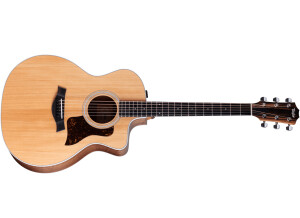
    (Originally written by jetlag/translated from Audiofanzine FR) Hello everybody. I'm surprised to be the first to write a review about this Taylor 114CE! What a responsibility! As usual, this is only my personal opinion. It's my first impression and I will update it in a few months. It's a Taylor 114 CE (venetian grand auditorium with cutaway) made in Mexico. It has 20 frets, a sitka top and laminated sapele back and sides. Mahogany neck, Indian rosewood fingerboard and bridge. Chrome machine heads. Natural and satin finish. Great Taylor ES-T preamp with three controls (vol/low/high). Provided with an elegant and well-made gig bag. I think it will get dirty really fast since it's light beige. The packaging is good and contains lots of protection for the guitar. For the price, I do regret the lack of a hard case, even a low-budget one couldn't cost more then the included soft gig bag! The guitar is very light and the top shows tiny wood imperfections which enhance the woody character without detracting from the overall aesthetics. The finish is perfect. I observed every inch of the guitar without finding the smallest imperfection. The action and overtones of the guitar were perfectly adjusted. So it's a serious product in the low-budget price range! I give it 8/10 because it has no hard case. UTILIZATION - Is the neck comfortable? Yes but I have many guitars so I can easily adapt myself to different necks. This one is rather slim and pleasant. The fret work is good and the hand slides without a problem. - Is the access to the upper frets easy? The cutaway makes it easy but it's still an electro-acoustic guitar, meaning you'll play more ballads than wild distortion solos, so it's not really that important. - Is the instrument ergonomic (body shape, weight...)? Yes the overall ergonomics are good. The guitar is very light and the neck is pleasant but I haven't played it standing. The body shaping is comfortable and it honors the Taylor legend... SOUNDS - Do they fit your music style? Pop, rock, power ballads, finger picking, folk... Yes, I bought it for that reason. I can't actually say that it's a blues guitar (perhaps later in the review update...) - Which amp(s) or effect(s) do you use it with? I plug it directly into the desk with a slight reverb effect! It sounds great! - What kind of sounds do you get and which settings do you use ("crystal-clear", "fat", ...)? Now we are getting serious: The powerful preamp provides a clear sound with well-balanced mids and a slightly weak low-end which you might need to boost with the knobs. The highs are ok. The preamp has an impressive power compared to other guitars. It really makes a difference. - Which sounds do you prefer / hate? Generally the guitar gives me the sound I expected for my music but I'm not sure if that would be the case for blues. OVERALL OPINION - How long have you been using it? One week, that is about 5-6 actual playing hours! - Which feature do you like the most / the least? +++ Preamp sound / --- no hard case - Did you try any other models before buying it? I tested over 10 guitars in this price range from Yamaha, Takamine, Ibanez, Breedlove and Seagull. - How would you rate its value for money? The difference between this guitar and slightly cheaper ones is INCREDIBLE! I can imagine the sound of the high-class 600 Series! It's without a doubt the main advantage of this guitar. - Based on your experience, would you buy this product again? At the present time, yes!

  • « An excellent value-for-money and a surprising electric-acoustic sound »

    Takamine GN10 ce series. Very well built for that price range. Of course, I’m not comparing it with a €1000+ model, but for an instrument under the €400 mark you get a great-looking, well-built, sturdy instrument – plus, for the price, it’s an electric-acoustic, which in my opinion makes all the difference. The Takamine neck is comfortable and pleasant to play. The cutaway allows for easy access to the lower part of the neck. Its acoustic sound is well-balanced with great lows and a great projection quality (it’s a dreadnought). When plugged on a good electric-acoustic amp, it becomes really surprising. The sound is natural and true to the original, plus it’s really punchy. The preamp perfectly does the job. It’s very easy to use, the right setting is easily found and the sound is pleasant – a real, good surprise. The guitar stays very well in tune, and the onboard preamp features a rather practical integrated tuner. Perfect for all users including beginners and those doing the jump from a nylon-stringed guitar to a folk model, it can also be used as a spare guitar and will go anywhere – to the beach, to parties, basically everywhere an experienced player would be reluctant to bring the jewel of a guitar he paid very, very much more for. It can easily be found used but mint for under €250, and an electric-acoustic in such a price range really offers an unbeatable value-for-money.

  • « World class entry level guitar. »

    Made in Mexico Type/Shape 6-String Dreadnought Back & Sides Sapele Laminate Top Sitka Spruce Soundhole Rosette Plastic Neck Sapele Fretboard Ebony Fretboard Inlay Pearloid Dots Headstock Overlay Indian Rosewood Binding Black Bridge Ebony Nut & Saddle Tusq Tuning Machines Enclosed, Die-Cast Chrome Plated Strings Elixir® Medium Gauge Strings with NANOWEB® Coating Scale Length 25 1/2 Inches Truss Rod Adjustable Neck Width at Nut 1 11/16 Inches Number of Frets 20 Fretboard Radius 15 Inches Bracing X-Brace Finish Varnish Color Options Natural Sunburst Options None Cutaway Venetian Electronics Taylor ES-T® Left-Handed Available; No Charge Body Width 16 Inches Body Depth 4 5/8 Inches Body Length 20 Inches Overall Length 41 Inches Case Gig Bag U.S. Suggested Retail Price $1098.0 UTILIZATION Another great guitar from Taylor. This one is geared squarely in the low-mid level market, with a street price around $599-699 or so. For the money, this acoustic is certainly hard to beat. It was expertly crafted in Mexico in a factory merely 40 miles away from Taylor's USA factory in El Cajon, California. The playability is fantastic, the construction is superb, and the sound is much more detailed than other guitars in this range. SOUNDS Tonally, this guitar has a smooth timbral texture. The highs are clear, with a nice sheen to them, and the mids are strong. Low end is crisp and distinct, and has enough weight for the rest of the register to sit on, yet it isn't overpowered. The pickup system does a good job of transmitting the sound of the guitar - the amplified signal sounds a lot like the acoustic signal, in terms of frequency response. This is a great fingerstyle, flatpicked, or strummed instrument, and would work in any genre. OVERALL OPINION What more can I say? Taylor makes fantastic guitars, and even this lower end model is a winner. Anyone that has reservations of buying a Mexican Taylor should just play one - it is a great guitar all the way around! For anyone on a budget, this might be the one, and even guitarists that have loads of money to throw around would probably dig this guitar as a "beater". Highly recommended.

  • Julien-Jee's review

    This Takamine is a mini-jumbo acoustic-electric. Regarding the preamp, you have a volume control, a 3-band equalizer and a tuner. UTILIZATION The guitar is small (mini-jumbo) and light, the neck is very nice. The strings are a bit high, which requires you to play with precision (not very practical for beginners, but a real treat for experienced players!). Good access to the upper frets, you can reach the very last ones without any problems. SOUNDS Arpeggios sound wonderful with this Takamine. Sound is very well balanced, highs are sparkling and, despite its size, low notes are also reproduced fine. It is just as good to play rhythm guitar, however, it doesn't have the bold sound of a big dreadnought or a super-jumbo. Once plugged in, sound takes its full dimension. The equalizer is very effective and, increasing the lows a bit, you have the impression of having in your hands a huge guitar, given the fullness and warmth of the sound. The signal is clean, without any overemphasized buzz or noises. OVERALL OPINION I have been playing this guitar for over five years. It's my favorite guitar, it's always by my side, just in case. The fact that the strings are slightly higher than on most other guitar makes practicing with this EG560C formidable, because I know that if I can manage with this guitar I will almost automatically be able to do it on any other guitar. I bought this guitar for about 600 euros. It's an excellent value for money given its performance. I would buy it again without hesitation.

  • moosers's review

    The Epiphone SST Classic 1.75 is a nylon string acoustic/electric guitar. The 1.75" amount refers to the width of the nut, and therefore the width of the neck itself. There's also a 2" version that's the same price - this is just a matter of personal preference, but it's worth trying both sizes if possible. The guitar has a Shadow NanoFlex pick up inside of it that is controllable with the outboard panel of settings for it. The body of the guitar is made from chambered mahogany, while the neck is rosewood. UTILIZATION The feel of the Epiphone SST Classic 1.75 is quite good as the guitar is easily playable. I don't know exactly how it compares to the 2" nut version, but I would imagine that both are within the same ballpark. When plugged in, the sound of the guitar is easily controlled with the outboard panel which includes EQ and volume control. SOUNDS The sound of the Epiphone SST Classic 1.75 is actually pretty good as it certainly sounds like a nylon string guitar and a good one at that. It's not the best nylon string guitar I've heard or played before by a long shot, but it does sound good and would be suitable for recording or otherwise. The owner of the studio I work at has one of these at his home studio but he brought it by a few months ago and left it in the studio. I've done a little bit of recording with it and have definitely been happy with the sounds I've been getting from it. OVERALL OPINION In my opinion, the Epiphone SST Classic 1.75 is a very solid nylon string guitar for the price. It's perfect for the guitar player who might want this kind of sound every now and again, but doesn't use it all the time and perhaps only for recording purposes. It can definitely be nice to throw in a nylon string guitar sound once in a while, and the SST Classic is perfect for this kind of use since it's fairly inexpensive but is still a good instrument...