Log in
EN
FR

Dave Smith Instruments

30 products found

Categories
Series
Filter
Sort by
Evaluation
  • Reviewed or not
  • Editor’s award
  • Reviewed by Audiofanzine
Availability
  • Available or not
  • Sold new or used
  • Sold new
  • Sold used
Must-have products
  • All products
  • Flagship products
  • Best rated products
  • Hot products
  • Popular products
Price
  • Freeware
€
Clear
Sort by
  • Popularity
  • User ratings
  • Price - low to high
  • Price - high to low
  • Used price, increasing
  • Used price, decreasing
  • Name (from A to Z)
  • Name (from Z to A)
  • Added on
Choose a category
Choose a series
Sort results
  • Popularity
  • User ratings
  • Price - low to high
  • Price - high to low
  • Used price, increasing
  • Used price, decreasing
  • Name (from A to Z)
  • Name (from Z to A)
  • Added on
Filter results 30 results found
Evaluation
Availability
Must-have products
Price
  • Freeware
Show results

The best Dave Smith Instruments reviews

The reviews Audiofanzine members found the most helpful.
  • « Disappointing »

    You can read the full specs at the manufacturer's official website. UTILIZATION Using it demands some time to get familiar with it, it's a complex and powerful synth, as well as a sequencer. Editing sounds is rather pleasant, you rarely have to push 4 buttons at the same time to do things. However, the sequencer is really limited. I have more often screamed in rage than in joy because I have managed to pull an impossible trick with Maschine... There are no undos on the Tempest, so there you are 20 minutes tweaking a pattern, make a bad turn and you can kiss your pattern bye-bye... SOUNDS This is its only strength. On the model I had, one of the voices always produced sound (a triangle, I think) even if all the oscillators were muted. No calibration ever helped resolve the problem. As usual, I was not dazzled by the factory preset. It has a polyphonic mode, in theory, because in practice the story looks completely different.... The internal sequencer doesn't record several notes at the same time. Envelopes reset to 0 every time you trigger a note. Try to make a nice pad with that... OVERALL OPINION I know I won't be making any new friends for this, but I think this unit is awful. And I don't say that just because it obviously doesn't fit in my workflow, I don't judge it for that. But I'll give you a warning: If you are used to the versatility of software programs (like I am to Maschine), you'll have a hard time, it's like going 20 years back in terms of usability. Maybe that's what you want, but I have found myself more often handicapped than stimulated by its limitations. When I say that this unit is awful it's because it's full of bugs. It's been three years since it came out and there is still no stable OS version. So you find yourself having to choose a version that offers the best compromise in terms of possibilities and bugs. Indeed, not all functionalities mentioned are available on the synth, maybe with the next update (the free-running LFO, for instance)... But worst of all is that when I tried to use it with my DAW, using the Tempest as a slave with MIDI clock, it wouldn't even sync to time. Sometimes I'd get variations of up to 10bpm. A drum machine that can't play in time... For $2000, that's stretching it way too far. In my view, it's a product that isn't finished and I don't know how anybody would dare bring out a thing like this... They probably thought that, since all the problems are software-related, it's not that bad and they can always make up for them with updates... The problem is that the updates never come. Although I've heard rumors that development has resumed work... The same old never-ending story. I can already hear fans of the Tempest telling me I didn't use it enough, I don't know how to use it right, it's a unit that has a steep learning curve, blablablabla.... I don't have anything against learning a new product or new concepts. But learning not to do certain things because the product might blow up in your hands... It's like using Windows 95. It's not learning, it's a waste of time.

  • « Classic and modern in the same time... »

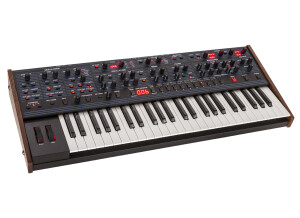
    I've received a request to post a review after I updated my gear list, which I consider all the more normal on a community website like this. First, I must say I’ve only owned the OB-6 for 4 days so far, which is of course too short to have an exhaustive and precise idea of it, even if I’ve spent a lot of time on it since I brought it home! However, I’m still going to post this review, even if I’m to edit it later, as so far the site lacks user reviews on this product. The OB-6 is a complement to my large array of various synths where it fits a hole in the “analog polyphonic” department. It is to be used in a home studio context exclusively. It is heavy, sturdy and – yes, well-finished. The knobs remind of the “old” Oberheim models, and even if they may look cheap at first sight they stand in place and are pleasant to use. A very well assembled product, no fault and the sides’ wood seems of high quality. I’m not much into the horizontal blue lines but they don’t look out of place either, and in the end I find this synth rather good-looking. The keyboard’s touch is really pleasant, and so do the pitch and modulation wheels. 49 keys is on the short side, a 61-key model would have suited me better especially to be able to use it also as a MIDI controller. It’s very easy to use, and while a beginner will probably have to look up for the basis of sound synthesis and read the manual, the controls are organized in a very logical way and allow creating very decent sounds quickly. There’s no value indication on the knobs. In that, it’s neither a lack nor a problem, as working by the ear is done easily. However, I think it would be nice if the current value was reminded on the main display, which is not used in such a situation. Maybe on a future OS? I also tend to consider the LFO setting as not progressive enough. The effect can be heard on the very beginning of the course and is difficult to set precisely, though you can still compensate using the modulation wheel. The sound is awesome in a large array of genres. Technically, the signal-to-noise ratio is almost flawless, I checked it by recording some sounds and looking carefully at the curve in SoundForge. Artistically, it seems very versatile to me so far. Bass, leads, strings, pads, you name it: everything’s eventual, with the awesome varying-response filter tending to push the sound either on the soft side when closed or toward brilliance while open. So in the end, you’ll rarely end up with an aggressive sound, which is not the OB-6’s home ground. The factory settings (500 – well enough to do) are as a rule very good, with each offering an assorted sequence. You see a great work on sound design behind them, as they can be used “as is” but of course tweaking the knobs a little bit is always interesting just to see the changes induced, it often leads to pleasant surprises ;-) . I won’t write long on the inboard effects, they’re also high-quality and really bring something but I seldom use them as my synths are routed toward an Eventide Timefactor and a Space via my sound interface, so I use them when I need some effects, waiting to complete my effect chain with a Baloran Triko when I’m financially back on track (so far I’m in dire straits). I don’t have the editor (yet) so I can’t comment on its editing and processing capacities. On that regard, I’ll have two things to say: - an editor is very practical, especially to classify and save presets, however I prefer playing with the front commands; - considering the price of the synth, the software editor could have come freely with it: just saying… While we’re talking computer, a small digression: the OS’s update requires exchanging Sysex through MIDI or USB. I had a little difficulties doing it (using MIDI-OX), and I tend to think things could have been made simpler and quicker considering the machine has a USB plug. Certainly there’s a technical reason to that. Also, unless I’ve missed it, DSI’s website doesn’t provide information on the new OS’s additional features and the online manual isn’t up to date yet. In the end, here’s a quick overview of the synth’s pros and cons, which I may not have evoked so far but don’t impact the grade I give to this OB-6 anyway, as I consider it an exceptional synth. Pros: - radical sound - very easy to use and inspiring - high-quality keyboard - polyphonically sufficient (at least for a poor keyboardist like me) - very well finished - 500 factory presets + 500 user presets. It’ll take you a while to fill’em all!!! - MIDI implementation is almost comprehensive (no arpeggio or sequenced note send), with no signal send/receive issue and easy control from your DAW. - the (English-only) manual is clear and easy to understand Cons : - 49 keys, 61 would have been perfect - no value indicators for the knobs - the LFO’s amount lacks progressivity on its early course - cumbersome (especially in depth): plan room in your home studio! Here it is, sorry for being long – and I’m still convinced I could have said much more! I may edit later after using it more intensively, with also non-factory setting sounds as this is what really matters… G.

  • « The Synth that ate my brain! »

    This synth has to be best invention Dave Smith has created under the DSI incarnation! The keyboard's action is top-notch and incredible aftertouch responsiveness, which on a machine in which you can modulate anything with everything, having aftertouch to further "evolve" sounds is really ideal. It's monophonic but sounds nowhere like a typical monophonic or any other synth, period! I actually owned the Evolver Desktop firstly and decided I wanted all the hands-on control of the MANY knobs and buttons and to use in a polychain set-up. I now have two desktop evolvers polychained to the MEK. It's worth noting that while using the polychain midi out, the midi out is still able to send note data in same number of notes allowed in polychain set-up; three notes in my case, but you can have up to 20 Evolvers polychained. EACH Evolver, while remaining monophonic, possess 2 analog DCO's and 2 digital wavetable oscillators, of which come from the infamous SCI Prophet VS. The signal path is divided in a true stereo path, with one DCO and Wavestable Osc on each side. Each side has their OWN analog Low Pass Filter and each path has a digital High Pass Filter, and of course each path has own Analog VCA. There's SO MUCH in-between and before each path's output that it would behove one to go to DSI website and look at signal path and of course lay your hands and ears on an Evolver because the simplicity on paper of these signal paths leaves logic because it really is THAT deep!For instance, there's 4 LFO's and all the envelopes, all of which bipolar/loopable, etc, etc. Personally cannot even imagine having any more than I do because of nature of this beast makes this quite a wall of intricate sounds. Now, seeing how EACH monophonic Evolver has even the brevity of signal path explained above; imagine what happens when you add Evolvers or have the four Evolvers under the hood of the Poly Evolver Keyboard? Openning a sonic wormhole is best way to even explain it!! UTILIZATION Editing it very easy and much easier than the desktop evolver. There's still a few menu-deep in programming but huge majority of all controls have dedicated knob or button. What's cool is you can actually isolate and play/program each of 4 osc per evolver, individually. Can even press the analog or digital osc's buttons to play massive real analog that in my opinion sound much more FAT than DSI Prophet 08's osc but then you also have two osc's with all the Sequential Circuit's Prophet VS wavetables,which can be played/programmed and isolated/played, and the mix of the two is what makes such intricate sounds that truely EVOLVE into whatever you want over any period of time; with real anolog low pass filters on both sides of sound path, upon which you can select 4 pole for self-oscillation madness! The manual is fine and assumes one already know more than basics about programming synths. A labor of love was put together by Anu Kirk called, "The Definitive Guide to the Evolver", which is a free download and is indispensable to wrap brain around this incredible synth. SOUNDS There's basically no limits aside from one's creativity in what this synth is capable of. I dare say that have had ALOT of "happy accidents" and also fact the Evolver DARES YOU to even attempt to get her to "play nice". (Yes, I just personified her) Her "happy spot" is that weird transition where a back scratch starts to be painful yet feels so good!! Best to watch your volume levels lest your studio cat wants to permenantly be wearing a woofer collar! The presets are actually quite good and very good starting points for making your own and in a polychain set-up, any edited sounds saved on MEK also saves to any polychained Evolvers. Delay and distortion are effects built-in and need no other because there's FOUR LFO's, etc. to modulate anything and the 16x4 step sequencer allows for both note and modulation sequencing--at same time. The external input allows for many more possibilities in one's set-up. When not using the polychain midi output, it should be noted that it acts as a second midi out. The MEK only transmits sysex data so anything other than additional evolvers polychained and connected to midi out like say a Mopho desktop or anything external, you would have to make changes on that external unit's interface rather than from the MEK evolver's knobs. It also should be noted that while making parameter changes to MEK via knobs/buttons in a polychain it of course affects all other evolvers in polychain but not say the Mopho connected via midi out from MEK nor would changes made on the Mopho affect the Evolvers BUT it *may* require placing that Mopho (in provided example) to be placed on it's own midi channel.I have recently learned that originally, all the controls sent and responded to System Exclusive messages only. Now there are over 40 MIDI Controllers that the Evolver responds to, which is ideal when you want to drive it from an external sequencer. Usefully, you can now address the cutoff frequency and resonance of both (left and right) analogue filters as discrete modulation destinations, which is ideal, whether you're processing external signals or just creating dynamic stereo patches. Lastly, if you have as I do, three evolver's polyphonic (three notes can be played simultaneously), any instrument also connected via MEK's midi out while plychained will ALSO be sent same number of voices. I have ONLY scratched the surface here and it is like trying to describe what color blue is to someone that's been blind all their life...it's THAT deep but at same time the signal flow shows the brilliant simplicity therein!! OVERALL OPINION Love everything about MEK and it was offically discontinued in June, 2012, however technical support from DSI is pretty awesome that other companies, big and small should take note of as an example of a company with true passion for what they create. The Poly evolver and desktop are still in production. I purchased the MEK now because this is destined to be a future classic and although I will never sell mine, they are holding their original MAP $ even second hand. If anything were to happen to mine beyond repair, I definitely would replace it quickly!! Know that the build-quality is top-notch and I actually PREFER the endless encoders and have had not issues with jumpy parameters but DSI still offers the PE (Potentiometer Edition) changeover as well as I have, the Prophet 08 black with silver ring knobs on mine as love the feel and it looks pretty amazing as well! This is like alien technology used to make an instrument or simply an alien musical instrument reverse engineered from Roswell, New Mexico in the 50's....so much time goes by while working with it I have had to remind myself of need of food and water. Did I mention I really love the Evolver?

  • « Everything I need from a Synth »

    I’m a singer songwriter with a home studio. This synth has such a broad range of sounds. I needed an on board Sequencer which this has. I’m into 80s post punk new wave and electronic genres. This does everything I need. I’m tempted to get the new Prophet 5 but I think this does most of the Prophet sounds I could ever want. I’m no synth expert and have used many of the factory presets and bought a sound set of presets I like as well as my own patches. I’ve added a track I recorded using this synth.

  • Audiofanzine FR's review

    (Originally written by pvi/translated from Audiofanzine FR) Mono synth: • Two oscillators + white noise generator • Low-pass Curtis filter (2 or 4 poles) • Analog VCAs • Three envelop generators (ADSR plus delay) • Two octavers (one and two octaves below) • External input with feedback • Four assignable controllers per program • Four non-assignable additional controllers for cutoff, resonance, attack, decay/release • 16 x 4 step sequencer • Comprehensive modulation matrix • Arpeggiator • MIDI in, MIDI out/thru, audio in, L/R audio out, headphone out • Free PC and Mac editor software Lots of videos on youtube: UTILIZATION Easy sound editing thanks to the Mac/PC editor, many routing possibilities, complicated sequenced sounds. You can change the assignment of the four controllers directly on the synth, but it's not very practical in emergency situations (you need 10-20 seconds to do it). The knobs are encoders so they have a unusual response, which requires a certain time to adapt to them. They don't have a linear response so it's sometimes difficult to set the parameter value you want. Certainly an OS upgrade will solve this problem. Another disadvantage is that the attack and release controls affect the overall sound, in other words you change all three envelopes simultaneously, which is not convenient for all presets. To keep it short, you'll need a sequencer or a control surface to get the best out of this synth. SOUNDS The sound is the main asset of the synth. The circuitry is 100% analog and you can hear it. The sound has an impressive presence even without using the sub-oscillators. The envelopes have a great punch. The device produces deep and percussive bass sounds as well as great lead and techno sounds (check the Introverted program). OVERALL OPINION Nice synth considering its price. It's perfect to get a big and powerful bass sound in my home studio.

  • « 4 voice polyphonic synth »

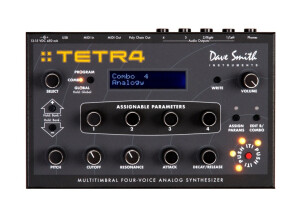
    The Dave Smiths Instruments tetra is a small portable desktop synth, it has 128 programs and comes with software for Mac and PC. It has 2 oscillators and a 100 percent analog signal path on this 4 voice analog synth. This unit is not rack able but its so small and portable that you would not want to rack it, you can pretty much take it anywhere with you. I think it only weighs about a 1 pound and is small enough to fit into any gig bag. UTILIZATION The manual is easy to navigate through and to understand, it comes with a wall power supply too. There are no digital ins or digital outs on this unit it is completely analog. There are also no effects, which it would have been nice to have some on board effects so you wouldn’t have to route it through your DAW to get to them. SOUNDS It comes with 500 plus presets , some of which are pretty good, and some that are pretty simple and basic. It does have an arpeggiator and a simple MIDI step sequencer. The 4 voice polyphonic synth on the Tetra makes it an amazing value for this unit to cost under 900 dollars. Generally an analog synth with 4 voice polyphonic synth will cost you over a grand easily. OVERALL OPINION The workflow of the Tetra is pretty cool, it’s a simple layout and easy to work with and to understand. It wont take long for you to understand this unit because all of the knobs are labeled so you can see what you are doing right on the board. The software with PC or Mac’s is pretty cool, but it does not seem to be very stable. I have had it crash on me several times and I kept thinking it was some sort of a driver issue but never really figured it out. My favorite part of the Tetras is that it has a combination mode that allows you to take up to 4 different programs and put them together to get the ultimate sound. It is worth the 850.00 dollars If you ask me.

  • « pricey »

    This Electronic Keyboard has a ton of sound on it that I think are spectacular. It is probably one of my favorite poly keyboards. The bad thing about this keyboard is that the price makes it un buy able. There is no way that the average person on a budget can afford to pay for this piece of gear. This keyboard coast as much as all of my gear at home put together. It is a mix between an analog and digital machine and the possibilities with the Dave Smith Instruments Poly Eveovlver are endless. You can just do so much with this gear. It has a vintage look, but with more of a digital sound and feel to it. Its like an old school new piece of gear. I really wish I could use this machine all the time, the amount of time I get to use it is really slim due to the fact that I don’t own it. UTILIZATION The sequencer is something that I am still having problems with. I havent quit figured it out yet, plus when I use it I don’t have a manual so that could be part of the problem. I am jus winging everything and just exploring and figuring it out on my own. Which isn’t a problem, but I have heard the manual is a headache to read through and understand. SOUNDS The sounds are great, I haven't heard many other machines that sound as good as this one does. So that could be part of the price problem. I guess you get what you pay for. OVERALL OPINION The look of this unit is very futuristic and retro at the same time. I am actually surprised that more people are buying these up. But again , that could be due to the price point with it. The sounds one this keyboard can be used in almost all types of music, its just great.