Log in
EN
FR

Keyboard Arrangers

821 products found

Filter
Sort by
Evaluation
  • Reviewed or not
  • Editor’s award
  • Reviewed by Audiofanzine
Availability
  • Available or not
  • Sold new or used
  • Sold new
  • Sold used
Must-have products
  • All products
  • Flagship products
  • Best rated products
  • Hot products
  • Popular products
Price
  • Freeware
  • Low-cost (< $250)
  • Mid-range ($250 - $1,000)
  • Premium (> $1,000)
€
Clear
Sort by
  • Popularity
  • User ratings
  • Price - low to high
  • Price - high to low
  • Used price, increasing
  • Used price, decreasing
  • Name (from A to Z)
  • Name (from Z to A)
  • Added on
Sort results
  • Popularity
  • User ratings
  • Price - low to high
  • Price - high to low
  • Used price, increasing
  • Used price, decreasing
  • Name (from A to Z)
  • Name (from Z to A)
  • Added on
Filter results 821 results found
Evaluation
Availability
Must-have products
Price
  • Freeware
  • Low-cost (< $250)
  • Mid-range ($250 - $1,000)
  • Premium (> $1,000)
Show results

The best Keyboard Arrangers reviews

The reviews Audiofanzine members found the most helpful.
  • « Genos, the magnificent »

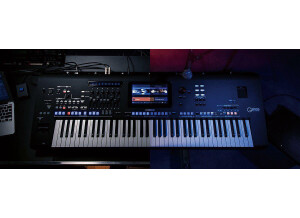
    I’ve been the happy owner of this keyboard for a little over a month now. The Genos is now the core of my studio, I write music for events (e.g. soundtracks) as well as for my own pleasure in an Electro/Chill genre. I quit my previous "100% in-the-box" workflow as I really needed a “real” instrument under my fingers that could quickly render my inspiration on the spur of the moment – plus, I already spend well enough time in front of a computer the rest of the time. The “arranger keyboard” philosophy behind it is interesting as it instantly provides a good basis to compose, improvise, reproduce and rearrange your own creations. While I wanted to leave DAWs and VSTs for composing purposes, needless to say I also required high quality sounds to make the jump, and the Genos gathered all these elements I was after. Regarding its design and building quality, the Genos is really great. Plastic parts are thick and well-made, knobs and faders are pleasant to use and really bring something in terms of creativity and live playing. The touchscreen makes navigating through the machine easy, making its use even more intuitive. The keyboard’s touch is very pleasant and perfect for all kinds of instruments. The number of audio (2 main, 4 subs) and MIDI (1 in, 2 outs) outputs suit my needs (multitrack recording + controlling my synth through the Genos if need be). The keyboard instantly brings in a very wide sound palette in all kinds of instruments. Acoustic sounds are very convincing. Of course, you can always find a VST that will be even more realistic for such or such instrument but as far as I’m concerned the Genos is the first hardware that managed to please me so much through all of its presets. Regarding synth-type sounds, I can find what I’m after with punchy bass and lead sounds and thick pads – though you’d better look elsewhere if you’re into tweaking oscillos, LFOs, filter and so on! The Genos is to be seen as a “ROMpler”: you pick a preset, put effects behind it if necessary and play! You can tweak the filter, resonance, effects and EQs but this is it. The arpeggio is a real asset to me as I like playing mindblowing, evolutive synth parts, but so far I have to do with the factory arpeggio presets (an update will certainly correct this). They are numerous enough for me but again it won’t suit just anybody. The drumset and drum machine sounds sound great – at last! Thank the RevoDrums and new electronic kits. I’ve always found arranging keyboards to lack punch in that field, but the Genos is a real gamechanger to me. Plus, if you’re still not convinced, you can create your own kits using the YEM software. Styles cover all kinds of music genres, from house to club jazz to 60s rock to cha-cha, and so on… They’re great starting points to build tracks. I consider many of them to sound kitsch when taken as is, so I always modify the accompanying sounds, the rhythm patterns and the effects, which allows me to get what I want quite quickly (using StyleCreator + the mixer part). The included effects are high-quality (reverb, chorus, delay, phaser, flanger…). The GUI is very practical when setting the effects, reminding the universe of computer music, VSTs and so on. I haven’t used the sequencer so far. The mixing part (volume, EQ, compressor…) is basic but does the job for both creating and live playing. While I’ve left computer music for composing, it still is a necessary step in finalizing a track (final mixing + mastering). As for its cons, as far as I’m concerned, I’ll go with the impossibility to apply effects other than reverb and chorus on the aux Ins and multipads, and to combine MIDI and audio multipads. Hopefully, Yamaha will correct this in a future update, especially as it seems far from impossible… In the end, the Genos is a really great machine for live and studio provided you like the philosophy behind it. No way to do pure synthesis, its sound design features are very minimal, and for in-depth editing it never will rival with a Montage-like workstation either. What you have here is a simple interface which offers instant, ready-to-use beautiful sounds with styles that provide a solid basis over which you can build your tracks – or just play a quick trip after turning the machine on. Playing and writing music with the Genos is a real pleasure, and I find its €4000 price tag legit (I wouldn’t have paid more for it, though).

  • « The Tyros 5 is pure joy »

    After having worked 8 years with a Roland G70 (which is excellent), I fell for the T5. Finally 76 keys, something we had been waiting for a long time. Pianists are grateful. In terms of sounds, it sounds silky overall and the super articulations are a significant plus, as long as you use them wisely, which demands some training. In terms of effects, there's not much to say, the DSPs are formidable and cover all your needs. Perfect connection both over Midi (it has 2) and USB (it has 3), although there's a small and bizarre thing: To access the HD directly, without a computer, you need to turn it off and turn it on again pressing Song List. It would've been better to include a dedicated function in the menu. Sounds are barely editable, there's no synthesis section, but hey, it's an arranger not a synth. It was a good idea to separate MIDI and audio, because it allows you to use both at the same time if you want to, or to go from one to the other without problems. In terms of audio, it supports all common formats, the choice is up to you. UTILIZATION Very good and fast usability. It's easy to do anything without breaking your head, On the other hand, the printed manual is disappointing and you are forced to download the Reference Manual in PDF to go any further. Not very smart of Yamaha, especially for a product with such a price tag. Fast but limited sound and effects editing. OVERALL OPINION I've had it for a month but I had already studied it thanks to the different forums and demos. Overall, it's very easy to use. After some experiences with arranger keyboards, especially Roland's G70, I was never confused, so there's not much to add. What I do regret, is everything that has to do with the sequencer (the visualization on the screen), which isn't even close to the one on the G70 that resembles a DAW, as well as the lack of clarity for editing (you have to browse a lot of pages). But most of all, something that is a real pity for a product at this price point, is the lack of a touchscreen! And the pretext used by the brand (the price), just doesn't hold up. But you'll get used to it!!! The price is justified, given the technology and performance of the T5, although I would've expected a more solid shell and not this fragile-looking plastic one ─ Flight Case mandatory. Another small drawback is that the keyboard is a bit light, for my taste, especially coming from the semi-weighted keyboard on the G70, which was wonderful. However, I don't regret my investment at all because it is exactly what I was looking for in terms of sounds and usability, as well as modern and well-written arrangements. Even if traditional sounds (accordion, folklore among others) are not up to par, guitars, brasses, wind instruments and strings are really cool. And the Ensemble section is a real treasure, because instruments really sit in their place. In short, a good tool for people who do piano bars or who record demos directly or with a DAW. And, besides, Yamaha cares about its products and often offers updates that always add something more. In terms of reliability, if it stems from the same line as previous instruments (DX Series and more recent ones), I think you don't have anything to worry about. I strongly recommend it, even if it seems expensive. After all, quality and reliability have a price.

  • « An entry level keyboard with very sound arguments »

    Main specs: Keyboard: 61 keys (with velocity) Maximum Polyphony: 64 voices Tones: 614 + 256 (GM2), Drum Sets: 61 + 9 (GM2) =&gt; can’t be either modified or edited Effects: Multi-FX: 47 types, Reverb: 8 types, Chorus: 8 types =&gt; fx quantity can be set Transpose: -12 to + 12 (in semitones) with direct octave transpose for each part (main, dual, split) 130 styles – 3-type Band Orchestrator: Drum & Bass, Combo, Full Band «One Touch» setting: 2 settings/style User Program: 100 programs 16-track Recorder Mode: 4 easy modes (ALL, Keyboard, Single, Punch In/Out) =&gt; 1 single song! Rated Power Output: 7.5 W + 7.5 W – Speaker Dimension: 10cm Connectors: Output Jacks (L/MONO, R), 2x Headphone Jack, MIDI Connectors (IN, OUT), Foot Switch Jack Dimensions: 1045 (W) x 320 (D) x 128 (H) mm / 41-3/16 (W) x 12-5/8 (D) x 5-1/16 (H) in Weight : 7.3 kg/16 lbs. 2 oz. My main criticism aims at the recorder mode: why 16 tracks? To record a rhythmic patters??? Well, a mere 2-3 tracks would have been enough to study. Or, they could have equipped it with a memory card reader or USB connector for MIDI files playing: this would have made the 16 tracks useful. Just a little something regarding the amplification (which I won’t criticize in itself as it sounds awesome): with a device that heavy, a stronger amplification would have been appreciated. I believe 2*10W wouldn’t have made the whole much heavier, while I found it lacked a little power. USE All elements are easy and quick to access : you choose the instrument mode if need be, then a controller for each part: main, dual or split. Attention: you can’t have main+dual+split, onli EITHER main/dual OR main/split. Choosing a tone is quickly done (using its number) provided you know all 600 of them by heart; otherwise, it’s ranked in categories, ala Roland! You can program your own sound setting and record them inperformance files (well, in user programs). By the way, it would have been even better if all these user programs had been accessible through their categories, while to recall one you have to dial its number; making it accessible through a single button would have been more convenient! The keys lack depth compared with other keyboards (which is surprising but you get used to it) and its touch is rather firm. The included user manual is in English only, for other languages you’ll have to go download the corresponding version from Roland’s website. The grade I gave it takes the playing mode into account: you can’t get Main, Dual AND Split… Granted, I’m not using it everyday, but in this price range other keyboards allow this. It also takes into account the lack of subtelty of the way user programs are managed. Frankly, allowing to access it through category folders with a single button instead of entering the program number (which you additionally have to enter at the exact right moment) would have been more than welcome! As for the styles, a quick access to the “Auto Bass” or “Bass to Lowest” functions (allowing to play bass chords according to the chord’s lowest note) would have been a nice addition. If you’re lazy like me and often change chords, you’ll get lost as chord recognition is pitiless: playing F9 with a C as first note generates a C6/4 on this keyboard! OVERALL In order to put my review in perspective, I must precise that I’ve used this keyboard for slightly over a week now and I also own a GEM PK7. I needed another keyboard with new sounds to play with a band: no sequencer, great rhythms and so on were needed, I only wanted a keyboard to be played! As far as that is concerned, I’m more than happy. I like its touch, which is both soft and firm. You can feel a resistance, the keys aren’t pressed “passively”. Yet, I still have trouble finding the right amount of pressure to apply for the exact right velocity I’m after. Recalling user programs can be a problem for live performance if you happen to switch instruments a lot during a same song: you need to take the time to enter the program number. You can’t get from 12 to 18 in a single click! Even if dedicated buttons allow to switch with the previous/next program, you’ll need to program everything carefully! Soundwise: First, the way sounds are organised per “category” is really fine, except for the fact I don’t understand how come harpsichords & co (clavinets, xylophones…) are considered “Organs” while they’re actually “Keyboards”. The same goes for the harp which is located in the “World” folder instead of “Strings”, and so on… Some instruments are out of place. All in all, you get: - pianos: no comment, all are excellent with a great, long-lasting sustain, a real depth, a lively sound reproduction. - electric pianos: I’m not convinced by the Rhodes (except for #15: “Wurly”), otherwise they’re pretty correct. - organs : a very versatile collection, you’ll find whatever you’re after ! (with a special mention for the “puff organ”). - accordion: nice musette ahead with the adequate instrument, with a rather realistic result. - chromatic percussions: marimba, xylophone. No objection, very nice carillons and harpsichords (by “nice” I mean “realistic compared with a real-life instrument”!). - acoustic guitars: well… it’s much less convincing. For a classical (nylon string) guitar sound, it sounds “short” and lacks resonance. Chords vanish very quickly, even with a sustain pedal… 12-string guitar is average, and the steel guitars are fine but nothing special, both regarding its realism and sustain – still short. Not convincing… - electric guitars: the clean guitar sounds are really good. Using effects, you can get convincing renditions of famous rock songs. As for electric saturations, they’re… saturated, sometimes too much (avoid long-sustained notes…). - basses: great! Acoustic, electric, all are really good! Plus, the keyboard’s internal, “mini” (10cm) amplification system renders them very well! With a bit of pitch bend, you get stunning slides! - strings: well… avoid solo strings (violins, viola…), they’re really not good-sounding… all the opposite compared with ensemble strings… - choirs: “Aah”s son’t sound too good (my GEM really does MUCH better), yet soft (MellowChr,humming) and special (VoiceDoos) choirs are really nice! - Sax/Brass: just DON’T! except for the 2-3 first on the list, they really lack realism (I have a sax playing brother, so I can all the more judge). - woodwinds are a nice surprise: very good flute (a nice, well-placed vibrato), others (clarinets…) are standard, nothing special. - acoustic brass: somewhat realistic, better avoided for solo sounds, better get through MIDI sequences or another playing system… - synth brass: good brass sounds. You get rather realistic ensemble sounds, provided they’re played correctly. You even get that “Jump” sound!! - synth lead/pad: up to everyone’s taste. I managed to find what I was after, with a certain disappointment for the GM norm standards (halopad, sweeppad…) compared with my GEM: it lacks flavour, dynamics, warmth… - world ½: ethnic sounds (with a special mention for the sitar), Asian and so on. I don’t use them, but they seem pretty well done (banjo, santur...). Rhythms: I come from a 4intro/variations/fill-in/ending arranger with drums+bass+3 instruments, and this one provides 2intro/2variations/1Fill-in/2endings including drums+bass+2 instruments (if I heard well, I can’t tell for sure if it’s 2 or 3). I lost in variations and number of backing instruments. Variations are less numerous, almost empty with empty patterns, they don’t fill in!!! The backing tracks themselves lack variety, not rich enough, no “impro-style” things. It reminds me of Casios and other low-end keyboards that boast to feature hundreds of rhythms with a single variation each… Hardly good enough for self-accompanying on a single song. I’m not criticizing the quality of the sounds or adequacy of the rhythms, only their contents. In brief: First, the feeling left after browsing all rhythms is how “electronic” they sound. Many of them have an “electronic” variation – what I mean by “electronic” is electronic sounds (see the drumkit), electronic-style that immediately remind of some R’n’B, hip hop, soul, electro, house tracks. Not much here is folk/traditional, anyway – influences are mainly US/UK. Still, Roland also included Eastern & Asian rhythms, and even if we (Western users) won’t necessarily use them, they prove really immersive! I’ll get back to it after reviewing all kinds of styles: Rock: for all 6: a great ballad and a great, punchy rock. All the rest is about electronic rock version and a (bad imo) “Power Rock”: not really well done, hard to make a good rock song on it… Dance: Err… 15 rhythms to be chosen from: difficult to really find nothing suitable!!! Hats off! Everything’s here with great electronic sounds, from 70s disco to modern house music. I’ll admit I’m satisfied, you definitely will find a rhythms for such or such style!!!! 8Beat: 12 settings. A little less diversity: you really feel that “electro/pop” style I mentioned before. Except for 2 rhythms that match what you’d expect, you get guitars when you’d expect pianos, or a way too percussive drumset for a would-be “romantic” ballad… 16Beat: 10 rhythms for a nice pop sound. You’ll get what it takes to reproduce many UK tracks! Jazz:6 possibilities and not much originality. It remains standard, classic, sounds almost empty in the end: the patterns just seem to loop, with nothing original compared to what other keybords offer. Latin: 9 choices. A bit like for Jazz, it’s all standard with no innovation. You let it take you to Latin land, but with no real exaltation. Traditional: 15 rhythms from polka to reggae to country, 6/8th and ska! The latter is slow (125) but nice, while the blues don’t sound that bluesy (one is electric, the other is gospel-style and lacks energy). I was disappointed by the 6/8. What about ternary ballads??? Ballroom : the 17 different rhythms offered include the classic mambo, beguine and cha-cha, which are of standard quality, and waltz which lacks… a bit of… practice? I’m a little disappointed by rumba and its guitar that lacks character. World: in a nutshell: 11 Eastern rhythms, 4 Indonesian, 3 Thai, 3 Russian, 4 Chinese and 2 Koreans. They conform to their origins. Unless I change style, I’m not likely to use them. This leads me to add something on these World rhythms. I can’t see the interest of including them in a “for all” synth: I wish different versions had been available, one general and the other specifically Eastern. Hence, with a normal version you’d get 32 new rhythms to expand your choices, like, say, 2 bossa, 2 Vienna waltz… (plus a gospel?). As for the Eastern version it would feature Eastern (including Asian) styles PLUS controls for quarter tones, “Arabic scale”. This would justify the whole (GEM has done that for years, Yamaha and others are starting to follow). Regarding chord recognition, everything’s alright. By the way, be careful about your chord positions! As I said in the previous section, playing a reversed F9 chord with C – F – G – A won’t give you an F9 but a C6/4! No way to get a F9/C, I changed the Bass inversion parameter but that’s how it works. I’ll have to change the way I’m used to work. Regarding the “One Touch” mode which allows to have 2 sound presets in relation with the chosen style, I haven’t tried them all but yhose I tried seem to me a bit off. Like, you expect it to provide you with the kind of sounds you’s expect, but it really doesn’t work and you’ll have to make a “user program”… The lack of variations can be compensated by the “band orchestrator” system: you can select the number of accompanying instruments. Quite useful for lighter passages in a song. Plus, when you get into “Combo” mode you get the same result: you keep the drums alone (not the other instruments) when you take your fingers off the keyboard. All in all regarding those rhythms: you get standard, classic, with heavy “pop/electro” influences. For an “entry level” product, it’s correct, just the least to be expected. Except for some rhythms that could suit me, I can’t find what I want. So it can suit you if you tried and liked it or if it’s your pick as a first keyboard ever, but it may not if you’re more demanding! I’ve compared before buying (I know what I’m “leaving”, but don’t know yet what’s ahead of me), the choice was long to be made but here’s what I have to say: Regarding sound quality, my GEM has been faithful and reliable for 10 years now and I’ll use it for as long as it works! Back then, it offered an awesome value-for-money at around 900€: use it to read a MIDI file and you get a good sound, while these days use a Yamaha/Roland/Kork and use it for same, you’ll get low-end sounds that don’t even sound good at all… Nowadays, unless you use all kind of effects and/or the keyboard’s specific instruments (so make specific use of the XG, GS), the result sounds a catastrophe. GM(2) compatibility seems to have run its course, and one now has to stick to THE norm of ONE’s manufacturer… Still, the E-09’s sounds are great for live playing, and/or with a band… But for MIDI sequences and/or use with a PC, you’ll have to edit the file(s)!!!! Still, I’d gladly go with Roland again as its sounds are warmer and more lively, fill more space and don’t sound compressed or confined in a reduced space (the entire frequency range is rendered correctly). Even if most sounds don’t sound European, the result is more than acceptable, better than with a Yamaha or Korg (very synthetic and nor exactly realistic on some points). Even after testing Yamaha’s new range (S500 =&gt; S900) and Korg’s Pas, I wasn’t convinced by those: excessive vibrato, too much effects… Most often there was a “but”, why the Roland drives me to “fine sound”, “waow, nice fx”, “good rendition”, “so, I can play it that way”, and so on. All in all, I’m completing my “old” yet high-quality music gear with a keyboard that offers a vast array of sounds that are a feast to my ears ;) ! One last thing, regarding its 500€ price tag: I’m not a specialist but I believe Roland could do better, I would have preferred it closer to the 400€ mark… So, I’ll adapt and moderate my rating considering how I really need to use it, as that the cons I found won’t interfere much with my needs (except for the user programs) and that it remains an entry-level keyboard with very sound arguments!

  • « A good arranger keyboard at an affordable price »

    • 61 dynamic-note piano • 5.7" TFT color screen • 1564 sounds and 408 styles • 25 audio styles • Super articulation • Extension packs • Audio recording via USB & mp3 playback • Advanced audio functions • Mic input & vocal harmonizer • 2 x 15 W UTILIZATION I am here to "speak up for" the PSR S950, which comes out pretty bad in the previous review. I bought it new for approximately $2200 in December 2012. I used to have a PSR 3000 and I can certify that Yamaha has introduced real improvements, both in terms of sounds and functions, on this instrument, including many of the Tyros 3, especially when it comes to sounds. I am musically inclined towards commercial music (rock, folk and a bit of jazz-blues). I have no interest in electronic music so, consequently, Yamaha's more traditional styles and sounds suit me perfectly. One of the rare defects that can I point out is that it lacks "factory" accompaniment styles in 3/4, but it's not really a deal-breaker, because I can always create my own with the Style Creator. (In this regard, I think Roland is the one that sounds more European, but the pianos of the brand currently lag slightly behind the competition). Sigh! There's also Ketron, which is excellent…end very European, but it costs more or less the same as a Tyros 4!! Let's focus now! I really like the sounds with super articulation: Their realism comes through very well, depending on the touch. By the way, I'd say the keyboard is all right, but nothing more. The organs are also pretty good. I used to hate that my PSR 3000 didn't have any settings to resemble as closely as possible a Leslie speaker. Yamaha has solved that issue with the PSR.S950 which provides several parameters to emulate quite successfully the magical sound of a Hammond with Leslie. I also like the Audio USB function, which allows you to listen to MP3 files, to play along and also to record a song (performance) in Wav format. This allows you to listen to it immediately on an MP3 player, for instance. Learning to use it was pretty straightforward for me, because it is very similar to my PSR 3000. Besides, I had already tried a friend's Tyros 3 and, as I mentioned before, the PSR S950 has almost the same accompaniment styles. What's more, I "borrowed" from it the ones that the PSR S950 lacks, because it can read them perfectly. OVERALL OPINION I'm happy with the PSR S950, given its sounds and quality, especially considering the price. I nevertheless find regrettable Yamaha's unfortunate commercial approach, not being very generous with additional styles nor sounds, which you can nevertheless buy online from the manufacturer. And one last remark: During the test, ask the shop assistant to connect it to a small PA system or two active speakers. The stereo image is superbly accomplished and the sonic performance is amazing. What I did is try it out with a set of 2x75 W speakers. It's a real delight to have at home a good, round low end, enveloping synth pads, etc. However, the keyboard has two "bass reflex" built-in speakers that deliver 2x 15 watts, which is all right to cover a medium-sized room, office or similar. I'll finish now with the vocal harmonizer, which allows you to sing with a choir, made up of...your own voice. My old PSR 3000 already had this feature. It's simply stunning! I would buy it again without hesitation and I hope I could reassure those hesitating before buying the arranger. It's a good instrument aimed at amateur (but demanding) musicians. Soundkid Images linked to this review

  • « Excellent value for money, very complete featurewise and nice sounds »

    - For which specific applications or uses have you chosen this product and in which context do you currently use it? I essentially played the keyboard in a piano/organ band, so without the arranger. For that purpose O own a Korg X3 and Korg Kross. I bought this keyboard to learn to play alone with arrangements to replace the band. - Does it look sturdy and well-finished? How easy is it to use? How about its ergonomy? What of the quality & feel of the keyboard? What do you think of the onboard sequencer and the different arrangements available? Great ergonomics, it's quite easy to use with its 7" touchscreen. The touch and quality of the keys are similar to my 2 korgs. I haven't used the sequencer axcept to listen to MIDI files, so as I haven't gone deep in its functionalities I won't develop this aspect. Arrangements are OK, you can create your own styles using the included Grand Suite software on the accompanying CD. I could creat styles from those of the Yamaha Tyros (and even wrote a tutorial but it's in French...). The keyboard is well-manufactured and seems sturdy. What do you think of its sounds as a whole ? What of the factory presets ? First, don't compare it with a Tyros or any other high-end unit. It sounds quite good for the price, and in that regard it's way better than both my Korg (except for pads and synthetic sounds that I don't use anyway, so it's not a problem for me). For its price, this keyboard is really excellent and has no competitor with comparable functionalities in its price range. You can record straight to audio (no overdubbing necessary, as is the case with the Kross). - What do you think of its editing & effect capacities ? Very good, there are even 2 assignable knobs that allow to set different parameters in real time (volume, modulation, effect...) - What are the pros and cons of this product ? Pros : Its touchscreen, very numerous features (possibility to parameter R1, R2, R3 & L sound layers, audio or sequencer recording, audio in for a mic, player or external instrument, USB drive reader -up to 32GB- and possibility to read mp3 & wav, huge user soundbank with 500 styles, 500 songs, 500 additional sounds, direct reading of styles from USB drive, part display, and many other features). Cons : a very small user community, so you have to creat your own styles and can't get many from other people. The medeli europe website hasn't evolved for months while there are lots of things to download from its Chinese counterpart (FAME G2000 = Medeli A1000). Hopefully this will answer your questions about this keyboard. Musically yours!

  • « A small bombshell! »

    I won't repeat what has been said already. It's a modern, light, powerful, well-designed keyboard with everything you can expect and more. I only regret the lack of aftertouch on the keyboard, even though the quality of the sounds make you long for it... UTILIZATION I've had plenty of synths, workstations, digital pianos...put this is my first arranger, my first PSR. I got it yesterday and I immediately understood its design. Rather smart menus (copy-paste works for everything), very clear functions, everything is easily accessible. And it has lots of practical details when you play, you can tell the years of know-how and user feedback. Well done! OVERALL OPINION I got it yesterday and I have hardly been away from it. It's a treat to play with it! The sound are a nice surprise: Much better than I expected! I had an unfavorable prejudice against this type of keyboards, which I always imagine being played by aficionados on Sundays to entertain the family or by street musicians. But I was wrong. The sounds are terrific, sometimes better than those of a Motif or Kronos!! For example, it's the first time I find truly convincing and playable brass sounds... As for classic sounds (pianos, rhodes, organs, pads...) they are fine. Guitars, sax, etc. benefit from the "super articulations" functions, which you can find almost anywhere nowadays, and which are nice for this type of sound. 128-voice polyphony and WAV audio player. I feared the lightness of the keyboard, but I had one several days to test it and I can confirm that this keyboard is light but comfortable, very nice to play (it's obviously not the same as my Proméga3, but it isn't meant to be a piano imitation). Once again you can feel Yamaha's know-how (which I don't usually like much). The styles... I think they are spectacular, amusing, inspiring, great to entertain yourself and play on your own. Everything is of very good taste and very playable. I have lots of fun triggering the different variants of an arrangement, making the song evolve in real time, etc. The amplification: The built-in loudspeakers are of good quality and the sound acquires a nice coloration (a little like Bose), with a large enough stereo spatialization. It might not be powerful enough to play along with two or three musicians in a room (I just did that with a guitarist and a sax player, who BTW were stunned by the keyboard). Connected to my monitoring system, the sound is very, very good. Precise, well-defined, very usable with a band, onstage (although I must confirm this). And well, it's 22lbs... What a delight!!! I can take it anywhere with me, to rehearsals or to the countryside. And I wouldn't need anything else. I was looking for something comprehensive, light, self-sufficient, that I could play with a band but also on my own to have fun. I must admit that this PSR meets all conditions hands down. And for a very decent price, in my opinion.

  • « Another Casio MT with a couple curiosities & surprisingly good sound »

    this is a 1983 casio-mt, with pretty good sound, 12 rhythms and 12 tones, sustain and chorus effects, a fill-in, sure, as well as dedicated chord and rhythm volume sliders It also has detachable external speakers (with regulated angle allowing to play a bit with acoustics) that make the thing look pretty unusual but pretty in my eyes - the speakers are of high quality and they're quite powerful in fact. Appearances have it look a bit more serious than you regular MT. 4 octaves, mid keys, a standard chord section with no appregiator . There's also a light-system with LEDS along with the legendary RAM card with learning 'games' , and a limited sequencer/recording mode. All nice curiosities of an era long gone adding to fact that these keyboards look a lot out of date. Despite the limited functions, the keyboard is pretty good sounding in all sections, chord and bass, nice quality analogue drums and especially nice tones (the chorus shines too!). Back in its day it used to be an expensive one, still today it's usually priced above other casio MTs. Its also heavier, even if you exclude the speakers. It definately has its own character! UTILIZATION easy and hands on control, like with all these oldies. the ram card functions are a bit more tricky, but you can find the manual online, so... OVERALL OPINION Compared to the other 3 Casio MTs I got and tested out, MT-45 and MT-52, this would be considered to have the most "quality" tones, and even realistic in some occasions ... so maybe this might be the the best choice for someone who would like to buy one of the best sounding Casio MTs. Or lets say this one is less on the cheesy side. mt-800 is also a highly bendable Casio and the already quality tones and be tampered further with filter like results, making them even smoother. For a serious modifier/circuit bender, this keyboard is really worth exploring, given the quality of the tones and the apparently analogue filtering of the tones. Additionaly, the drum sounds are also very nice sounding and appealing and can also be modified in some ways. This is the keyboard that by a strike of luck got me into circuit bending, along with researching and enjoying an old passion of mine: old keyboards cudos go to warranty-void AKA tablehooters , where lots of info on the subject exists...

  • « Perfect for a first workstation synth »

    The Korg microArranger is a 61 key professional workstation synth. It is one of the more affordable keyboards that I can actually say that I enjoyed working with from start to finish because most synths in this range are pretty dull. The keys on this synth are touch sensitive and have a great feel to them. They made me feel very comfortable while playing melodies and chords. UTILIZATION Using this synth took a little more time than I expected because I had to learn the layout of it. But the manual covers everything so it was not hard it just took a little more time than I thought that it would. It is easy to transfer back and forth from my PC to the Keyboard too via the SD card slot. OVERALL OPINION This synth has some really good sounds, and for it to be less than 500 bucks you probably will not find a better synth on the market that is built this well while still being portable. The electric pianos and basses are really good. The basses are probably my favorite sounds because they are all full and thick, this is not what I would expect to get out of a “cheaper” board. There are also 33 drum kits and 89 total effects to choose from on this keyboard. The drum kits are ok, nothing that really stood out to me and some of them even sound very similar to the kits that are on my Fantom X6. This board is great for gigging as well as creating music in a studio because it has a one track at a time sequencer that makes everything pretty simple to work with. This keyboard worked with my DAW so it was easy for me to create music on my PC with this keyboard. I do not think they keyboard is worth the purchase if you already own some “higher end” keyboards, but if you are looking for your first

  • Audiofanzine FR's review

    (Originally written by schnoupi/translated from Audiofanzine FR) Arranger, Tyros 2 successor. See Yamaha web site for more information! UTILIZATION Easier configuration than on the Tyros 2 because the layout is better thought-out and the sliders add some advantages. But I miss a Roland or Korg-like touch screen. Very easy FX editing but poor sound editing. Style editing requires a computer (a CD-ROM is provided). The user's manual is quite good but I haven't read much of it because I just got the Tyros 3 today! OVERALL OPINION I've been using it for one hour! Pros: - Sound articulation details (articulation 2 allows you to create nuances, especially for solo instruments) - Piano, saxophone, guitar and Celtic instruments' sound quality - Accompaniments quality. A real delight, I had never heard such quality (the U2-like 80's accompaniment is amazing, as if U2 were actually playing with me). It's very inspiring for my own compositions. I love it... - Quality of percussions and rhythm parts Cons: - Keyboard quality. I wish it were a half-weighted keyboard (M-Audio has a good one) - The sliders look very cheap. The value for money is quite good. Compared to the Tyros 2, this new version brings few but important enhancements. People playing in a top 40 band won't notice big differences between T2 and T3. On the other hand, solo entertainers will notice that nuances and quality have been greatly enhanced. It's stunning! As if you played the instruments for real. There's a lot of talk about the Audya, which will have a live rhythm section, but I think its solo instruments won't reach the Tyros 3 quality. Will the Audya have such a broad accompaniment palette to choose from as the Tyros 3 ? To wrap it up: you get more styles, better sound quality, enhanced expression and a more ergonomic instrument, making it more enjoyable. It's been a while since the last time a synth surprised me (Korg M1). It sounds so good, with such detail that it brings my creativity and my songs further. If I could I would buy two... but I would have to be rich!!!

  • « Roland RA-30 Tongenerator Soundmodule Desktopversion Realtime-Arranger aus 1995. Made in Japan »

    Drumset, Bass und Begleitinstrumente! Tongenerator Soundmodule Synthesizer. Beim Anblick von Soundmodulen habe ich mich schon immer gefragt, wie man so viel Technik in ein so kleines Gehäuse packen kann. Und wenn die eigentliche Elektronik lediglich den Raum eines halben Schuhkartons belegt, dann muss im Inneren der entsprechenden Keyboard-Version logischerweise gähnende Leere herrschen – und das ist tatsächlich sehr häufig der Fall. Auch das RA30 von Roland ist so kompakt, dass man ihm auf den ersten Blick nicht unbedingt zutraut, eine solche Soundqualität und Vielfalt zu bieten, wie sie der Blick in die technischen Daten offenbart: Das Modul strotzt nur so vor Sounds und Styles. Das Roland RA30 hat einen für diese Preiskategorie (bis 100€ (2020)) guten Grundsound. Die Drums klingen wirklich druckvoll und sind mit ausschlaggebend für den guten Sound der Styles. Bei ihm handelt es sich um einen sehr gut klingenden Arranger im Mini-Format, der sich blitzschnell in vorhandene MIDI-Umgebungen einbinden lässt. Guter Gesamtsound, schnelle Einbindung ins MIDI-Setup, leicht und kompakt!

  • « My first and only! »

    I bought this keyboard while I was still in high-school (1990 or so). Yt apparently did not become "available' until the early 90's, but in Canada, I am sure I was one of the first users. The keyboard split is brilliant, and I just played a gig with it TODAY (May 2016). I love it. Its sounds (I use piano, some organs, a slap base, some horns, and some strings) are super. Still does a great job, and I love to play it. Had some keys replaced (it fell down some stairs in my rock band says!) and the left speaker is smashed and silent, but I use it live to this day. I do not use its arranger or MIDI, but I do practice with drums for tempo. I bought it to write songs with, but used it for countless gigs. The only downside I can see is that I wish the sounds were just a little deeper. They are super, but seem a little tinny on occasion. Overall, my first and only.

  • « perfect for a live musician »

    The Casio XW-P1 is a synthesizer that is more designed for live use, but can be used in a studio or at home for playing and practicing with. The Casio XW-P1 has a 6 oscillator monophonic solo synth on it that creates some amazing tones effortlessly. Every single oscillator has its own independent filter, independent key tracking, two LFO’s and portamento. UTILIZATION The Casio XW-P1 has 9 individual sliders that will give you full control over the Drawbar Organ to provide some distortion or vibrato to your sound. The arpeggiator on the Casio XW-P1 is also very good for it to be this price. The arpeggiator can be programmed to how you want it to sound. You will have full control over all of the sounds in real time by tweaking some knobs and using the pitch bend or mod wheels. OVERALL OPINION The Casio XW-P1 does have a step sequencer on it that I am not too happy with though. I don’t like the step sequencer, maybe because I am use to using the step sequencers with my DAW or software music production programs. I am always cautious before getting a piece of great that has a step sequencer on it because I know that I will probably never use it. The step sequencer on the Casio XW-P1 would be great to use to build their mix in real time and change things up fast. The Casio XW-P1 overall is a well built keyboard and it is very affordable, I would only suggest someone who is more into live use to get this keyboard. It is easy to transport from place to place because it is light and can fit into a keyboard case. The acoustic piano sounds on the Casio XW-P1 will also surprise you because for the price of it you would not expect to get those well developed and engineered sounds.