Log in
EN
FR

Parametric EQs

458 products found

Filter
Sort by
Brand
Evaluation
  • Reviewed or not
  • Editor’s award
  • Reviewed by Audiofanzine
Availability
  • Available or not
  • Sold new or used
  • Sold new
  • Sold used
Must-have products
  • All products
  • Flagship products
  • Best rated products
  • Hot products
  • Popular products
Price
  • Freeware
  • Low-cost (< $1,000)
  • Mid-range ($1,000 - $2,500)
  • Premium (> $2,500)
€
Clear
Sort by
  • Popularity
  • User ratings
  • Price - low to high
  • Price - high to low
  • Used price, increasing
  • Used price, decreasing
  • Name (from A to Z)
  • Name (from Z to A)
  • Added on
Sort results
  • Popularity
  • User ratings
  • Price - low to high
  • Price - high to low
  • Used price, increasing
  • Used price, decreasing
  • Name (from A to Z)
  • Name (from Z to A)
  • Added on
Filter results 458 results found
Brands
Evaluation
Availability
Must-have products
Price
  • Freeware
  • Low-cost (< $1,000)
  • Mid-range ($1,000 - $2,500)
  • Premium (> $2,500)
Show results

The best Parametric EQs reviews

The reviews Audiofanzine members found the most helpful.
  • phenix!'s review

    4-band dual parametric EQ with tube output circuit For the rest, everything is well described in the previous review. I bought it secondhand for $100 on this site. It maybe lacks adjustable low-cut and a high-cut filters besides the 4 bands, but each of the 2 extreme bands, highs and lows, can have this role. You lose an EQ band that way, but it's not that bad. UTILIZATION I got it two weeks ago. Right now I use it at home,with my Triton Rack synth and as insert on my Mindprint TRIO USB console/audio interface for vocals and bass. I plan to use it live as an insert on the mixer, but also in the effects loop of a bass or guitar amp. Currently I have only tested it with a jack. Generally speaking, a parametric EQ is more precise and effective than a 31-band graphic EQ to correct specific sources, although for FOH or monitors it's a different story. SOUND QUALITY It's not a tube EQ, the tube only acts on the output to warm up the sound and add some brilliance. And all to a given extent only. You really have to see it as two different things: - A 4-band parametric EQ - A "sound warmer." The second function is accessory and if you don't want to use it, you simply have to set the knob to 0 ("cold" mode). The overall signal-to-noise ratio is good. There's some background noise —from the tube circuit I guess—, but nothing annoying, much less than a Presonus Tubepre. Anyway, increasing the frequencies a lot doesn't add much noise, so in that sense the signal-to-noise ratio is very good. That's a change from certain mixer EQs that when you increase from 6 to 9 dB you inevitably end up with a good dose of noise, so with 12 or 15 dB it's not worth it at all...(even if it's not common to go to such extremes, true, but this Behringer performs well all the same). The EQ is precise and effective if you fiddle with it a bit, you can get the sound you want pretty fast. Regarding the output tube, even if it's an accessory function in my head...and that I didn't expect to have an exciter and an EQ, I admit that it wasn't very excited about it. It provides some brilliance to the sound, not too exaggerated (but not uninteresting either), and not too much warmth or roundness. That was with the original tubes, which are Behringer 12ax7a, "Premium selection" supposedly (and no Sovteks 12ax7 LPS as some people say. Or at least not on my model). I replaced one of the two tubes with an Electro Harmonix 12ax7 and you can tell the change... The tube always provides brilliance, it's more "musical" than the Behringer, but it also adds roundness to the sound, especially in the low end, which really gives an impression of warmth, which, adequately used, is one of the best effects on my bass (the sound is rounder and more brilliant), vocals, tested with a Shure Beta87a (it also provides them with a nice color and brilliance) and my Triton (the sounds have more punch, they sound less "sterile" or flat), they all have more personality. It's not a "torrid" warmth, but it turns more interesting and musical with the 12ax7EH. Cranking the Warmth pot all the way up doesn't add much (or any) noise. Try the same with the Drive knob of a tube Presonus... It's that something that can give personality or color to the signal that goes through it, without altering the sound if used wisely. It actually adds roundness and definition to the sound. OVERALL OPINION I bought this unit with the hope of having a more precise and musical 4-band EQ than those I usually find on mixing consoles here and there (from Phonic, Yamaha MG to Mackie and Soundcraft), and thus process some signals more effectively. I also use it in my home studio to EQ or correct certain sources, but also to add more coloration and warmth when needed. Therefore, I'm really satisfied with my purchase. At the same time, at this price point (mid-range products), it has no competitors, besides maybe Presonus, but their 3-band EQ is mono. With the Behringer you can process two mono signals or one stereo. In short, I agree with the previous review regarding the quality of this EQ (keeping in mind it's a mid-range product), it is much better than certain mixer EQs and plug-ins It does a superb job at processing sources with precision. For those of us who can't afford to work with Midas mixers or TL audio, Avalon or SPL Qure EQs that cost $1000 minimum... You can try it, but anyway, there's no real choice!

  • moosers's review

    The Summit FEQ-50 is a single channel passive equalizer made up of analog components. It has XLR connections as well as 1/4", including options for output routing through either the tube or solid state portion of it. It isn't rack mountable, but is about half the size of a single rack space, so if you had two of them I'm sure you could rack them together. UTILIZATION The make up of the Summit FEQ-50 is fairly simple, especially if you're familiar with the simple configuration of parametric equalization. It has four bands, each of which have gain knobs and frequencies knobs, which have set frequencies to choose from (about six different ones for each). They each also have bandwidth switches that have two different settings to choose from for if you want either a wide or narrow Q. That's pretty much all that you need to know about it's configuration, so I don't think that a manual is necessary. SOUND QUALITY The tone of the Summit FEQ-50 is incredibly clean sounding overall. I've used it on instruments of all types, as it is versatile and has the tools to be used for applications of all types. It doesn't color your tone beyond the cutting or boosting that you apply, but the FEQ-50 certainly has its own type of sound that is hard to describe or to compare to any other piece of gear that I can think of. I love having the bandwidth switches, as they really come in handy when trying to zero in on a specific frequency. While I generally like having complete control over the frequencies I choose, Summit has done a great job here by determining which frequencies are most often used. OVERALL OPINION For a high end equalizer, the Summit FEQ-50 is actually priced nicely. While it is probably still too expensive for most home studio owners out there, this is a great deal for professionals looking for top tier tone regardless of price, as you'll certainly save a bit of change when you compare this to some of the other equalizers out there. The FEQ-50 is a seriously compact piece of gear as well, as it will take two of them to fit them in a rack. I'm a big fan of most of the gear that Summit Audio has to offer, and wholeheartedly recommend the FEQ-50 as a nicely priced option for a single channel equalizer.

  • moosers's review

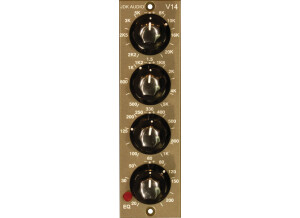
    The JDK Audio V 14 is a 500 series module parametric equalizer. It's an analog piece of gear and doesn't have any connections of it's own since it's a 500 series module and can only be powered and used within a 500 series Lunchbox casing. UTILIZATION The configuration of the JDK Audio V 14 is really pretty simple if you are familiar with the general make up of parametric equalizers. The V 14 has four bands, with parameters for gain and frequency, so there is certainly nothing out of the ordinary going on here. For this reason, a manual isn't necessary unless you're having problems hooking it up. SOUND QUALITY The sound of the JDK Audio V 14 is outstanding, especially considering the low price of this module. Setting aside this factor for a moment, I find that the V 14 is flexible and can be used for pretty much all equalization purposes. I've personally used it for mixing only and not tracking, but it's certainly suitable for both. I find that the EQ doesn't color your sound beyond how you affect it, and it's got 12 db of gain either way, so you've definitely got enough room to work with. I wouldn't hesitate to use this on any application if I were to see it fit... OVERALL OPINION If you've got a 500 series rack and you're looking to expand it via an equalizer, I'd wholeheartedly recommend the JDK V 14. It's really the perfect little four band equalizer, as it's flexible enough to get most jobs done and is easy enough to use where everyone should be able to adapt. However, the best part is the price, as it's cheaper than the API EQ's and in my opinion is on the same sort of high level sonically even though they are different sounding. Absolutely worth a look for 500 series rack owners...

  • moosers's review

    The Ashly SC-66A is a stereo parametric equalizer that I've used in the recording studio. I don't own it and have only used it in a professional recording studio setting, where we made the connections with the patch bay rather than in the back of this, so I didn't have a chance or a need to see what types of connections it has. This is a rack mountable piece of gear and will take up four spaces in a traditional casing. UTILIZATION The make up of the Ashly SC-66A is pretty straight forward and isn't too difficult to figure out on the spot, granted that you know a thing or two about parametric equalizers. Each of the two channels has four bands, and each band has parameters for gain, frequency, and bandwidth. Each also has a in/out button and an overall gain knob with a button for putting it in or out as well. As experienced users of parametric equalizers can see, this is a pretty standard configuration, so a manual is probably only necessary for beginners, if for anyone. SOUND QUALITY In terms of sound, the Ashly SC-66A does exactly as advertised, as it is easy to cut or boast specific frequencies or sweep across a band of frequencies. For the most part this unit allows you all the control you need, and having two bands is great for using this on stereo pairs or two tracks that are similar. The tone quality is very clean as doesn't color your sound in any negative way for sure, in fact it really just does the job at hand without adding it's own coloration. I used the SC-66A for mostly acoustic and electric guitar, but I'm confident that this will be useful for many applications across the board. OVERALL OPINION I haven't seen all that much of these around studios, as the one that I used was the only one I've ever seen. Upon first look at it I knew it was something that I wanted to try out, as it really has a cool look and style to it. If you ever come across an Ashly SC-66A to try or buy, it's definitely an equalizer that I'd recommend checking into.

  • moosers's review

    The Orban 642B is a dual channel parametric equalizer and notch filter. It is an analog piece of gear if I'm not mistaken, but I can't say what sorts of connections it has since my use with it has been somewhat limited and in a professional studio environment where it was already racked up and in place. It is a rack mountable piece of gear in the traditional sense, and will take up two rack spaces. UTILIZATION Since the Orban 642B offers up a lot of flexibility and control over your sound, it can take a little bit of time to get used to. There is often a trade off between ease of use and versatility, which is the case here with the 642B. I don't find it too hard to use myself, but it definitely isn't the simplest parametric EQ that I've used. Each of the two channel has four bands, each of which consists of parameters for bandwidth, frequency, boost/cut level, and vernier, which is for fine tuning. Each channel also has both a low and high pass filter as well as bypassing switches for each of the bands and for each channel as a whole. I think the 642B is easy enough to figure out without the assistance of a manual, but for beginners it is always a good idea to have it around anyway. SOUND QUALITY With so much control over your sound comes the ability to really zero in on notching and filtering with the Orban 642B. It isn't really your typical parametric equalizer, as it is designed for cutting or boosting really specific frequencies in addition to all the accommodations of your typical parameter equalizer. You can definitely used the 642B for any application where you would want to filter in anyway, as it has a clean sound quality that will extend pretty universally. OVERALL OPINION I think that you'd have a pretty hard time finding an Orban 642B, as this isn't the most readily available parametric Eq/notch filter available. Orban isn't a well known company, but I've generally liked the gear that I've used made by them. Because of this, I do think that you you came across a 642B that you'd be able to get a pretty good deal for a piece of gear like this, so I'd recommend checking it out if you need a hardware EQ and notch filter in one.

  • « Dont believe the bad press it gets on other websites ! »

    This is an incredible piece of outboard. Forget what you read on other forums, this is a total classic. It's been used by dave gilmour on all his albums since division bell and their engineer andy jackson, then there is queens roy thomas baker who had to have one the minute he played with one ! fantasically underated eq, it seems the cream of the crop know its worth while the clowns on gear slutz are comparing it to their manley passives, which is a totally different kettle of fish ! Buy one if you can find one, you wont regret it !

  • « Lovely analog sound »

    The TC Electronic 2240 is basically two TC 1140 units, glued together in a 2U (unit) rack. On the front, you have the input gain, output gain, EQ match gain, bypass switch and the four frequency control sections. Each frequency band covers a wide range and they overlap each other, so no frequency goes untouchable. Along with controls to select the center frequency, you have the bandwidth (also known as the Q value). The center frequency can be boosted or cut with as much as 20 dB - that's a lot! Since this is a parametric equalizer, your possibilities are pretty much endless. UTILIZATION The setup of the parametric equalizer is quick and easy. Once you have adjusted the input and output gain, you can go ahead and adjust the frequencies. The EQ match control has its right when it comes to adjusting the frequencies. In order for the EQ to not stand out to much, you hit the bypass switch on and off, while adjusting the EQ match up or down according to your needs. If you've made a lot of big cuts with the EQ, then you'l need to boost the signal, with the EQ match and vice versa when you've boosted the equalizer section. SOUND QUALITY If the analog sound, of old school components and not a digital chip adjusting signals with ones and zeroes, then you've certainly found the right unit. I use this on my taylor 214e guitar, on vocals on sometimes also on the kick drum, to fatten it up. It really does its job well. OVERALL OPINION There are not a lot of 2240's left on the market today, but should you be able to get a hold of one, don't let it go. Even if you don't have a use for it, don't throw it out. You'll regret it later on. The digital domain might be clearer in its signal, and you have better options, when editing and controlling the effects you use on a track (using automation). But you simply can't beat the sound of a good, old, solidt build effect unit like a parametric equalizer.

  • « Great Parametric EQ with great frequency curve »

    This is a parametric EQ for use in the recording studio or home studio. As it's a rather expensive piece of gear, it's probably better for use with analog consoles or mic-pres, as opposed to digital ones that come in the Digi 003 or something like that. With a home studio setup you are probably just as well off using plug-ins. There aren't any crazy effects or anything like that with this EQ. It's an analog technology. There are no computer or MIDI connections. UTILIZATION The Utilization of the EQ is pretty easy for the most part. It has four bandwidths, Low, Low Mid, High Mid, and High. There is a frequency knob for each bandwidth that actually overlaps the next bandwidth on either side, giving you a complete control of the sound assuming you want to boost on the lower end of one bandwidth but cut the higher end of the same one. There is also a shape knob which will determine the amount of frequencies boosted or cut. SOUND QUALITY I was pretty impressed overall with the sound of this EQ. I'd say that we have got a pretty phenomenal deal with this as it works just as well as a lot of the other EQs in our console but is much cheaper. It's super flexible for one of these EQs but gives much better response than most other EQs in the studio. The boosts don't seem as artificial as some of the plug-in EQs do, and the cuts are much more forgiving of tone. I'd have to say I am disappointed we don't have more of them as I'd use them on everything I could if I had the opportunity! OVERALL OPINION I like this EQ quite a bit, it's certainly one of the better stand-alone EQs we have at the studio, and definitely a better one than most. I'd certainly say that the price is pretty reasonable overall considering how phenomenal it is. It's definitely a great piece of gear and can hang with the old console EQs any day of the week. I've used lots of EQs and this is one of the better ones I've used. Highly recommended.

  • moosers's review

    The Great River EQ-1NV is a single channel, four band equalizer with an addition high pass filter. The EQ is made up of all analog parts, and has 1/4" TRS connections. It isn't a rack mountable piece of gear as it has its own shape and size that will sit on any sort of desk or table top. UTILIZATION If you are familiar with the way parametric EQs are set up and how they are used, the Great River EQ-1NV won't present any problems for you. Each of the four bands of EQ have the standard parameters of gain and frequency, and each also has a button to choose between a few different bandwidth settings. In addition, there is a knob to choose the high pass frequency, as well as a bypass button for it. There is also an overall bypass button and an input level knob. I've never seen the manual for this, so I can't say too much about its make up. SOUND QUALITY Like pretty much all of the gear that I've used from Great River, the EQ-1NV is a top tier sounding equalizer. It has a very full inherent tone, and does exactly what it is told in terms of sculpting your sound. I've used it for EQing vocals, snare drum, and acoustic guitar, but it's capabilities definitely range far beyond this as I do believe that it would be suitable in any situation where you might want some EQ. I find that the four bands are more than enough to work with... OVERALL OPINION I first used the Great River EQ-1NV about six or eight months ago, and I'm eagerly awaiting another chance to use this as it sounds absolutely awesome. Though pretty expensive, those who are seriously interested in something like this probably already understand that this is around the price that you're going to pay for top end quality. If you're a studio owner of any type looking to add some serious tone for equalization, look no further than the EQ-1NV.

  • moosers's review

    The Retro Instruments 2A3 Dual Channel Tube EQ is a high quality equalizer designed for use in the recording studio. It is made up of all analog components, including four 12AX7 tubes. It has XLR inputs and outputs in the back, and will take up two spaces in a traditional rack mount. UTILIZATION Each of the channels on the Retro Instruments 2A3 Dual Channel Tube EQ has the exact same make up. Each has two bands for low and high, each with knobs for boost and attenuation. Each band has knobs with fixed frequencies to choose from, and a bypass switch as well. A unique filter that it also has is for both of the channels is known as the subsonic filter, which has filtering options at 40 and 90 Hz. This is pretty much an identical configuration to the classic Pultec EQs, but even if you don't have experience with them you should be able to figure out how to use this without the assistance of the manual. SOUND QUALITY Without a doubt, the Retro Instruments 2A3 Dual Channel Tube EQ is one of the best sounding outboard equalizers that I have used. The tubes really make a huge difference in the sound as it makes it a thick and warm sounding EQ that does its job perfectly. While you might not have as many bands here as you would with some other parametric EQs out there, this isn't too big of a concern for me because I find that I'm able to do with it what I would like regardless. There are definitely no limitations on what the 2A3 can be used on, as it can adapt to any application that you'd like to throw its way for sure... OVERALL OPINION I first used the Retro Instruments 2A3 Dual Channel Tube EQ less than a year ago, and have only had the chance to use it a few times here and there since then. I would definitely use the 2A3 on every single session if it was possible, as it just sounds that good. Of course with a top notch piece of gear like this comes a big price tag, but since it is designed for professionals, this is probably an after though for those who are seriously considering a piece of gear like this, but it certainly does cost a lot. If you can afford this or get a chance to use it, definitely take full advantage of the 2A3 as it is a special piece of outboard gear without a doubt.

  • moosers's review

    The Avalon AD2055 is a dual channel parametric EQ. It can be used either in stereo mode, or as two mono channels. The AD2055 has XLR inputs and outputs and is indeed a rack mountable unit that will take up two rack spaces. UTILIZATION The make up of the Avalon AD2055 parametric EQ is pretty easy to follow. Each of the two channels each has four bands of equalization. The low and high bands have parameters for frequency and gain, while the two middle channels have the same as well as a width parameter. If you've got any experience with parametric EQs, or know how they work, I believe that you'll be able to catch on quickly as everything should seem pretty self explanatory to you. For this reason, I've never needed to look at the manual and don't believe that one is necessary. SOUND QUALITY As far as parametric EQs go, the Avalon AD2055 has a top notch sound quality. It can be used for any and all applications as this is a versatile piece of equipment that is able to adapt to most situations. Since the inherent tone quality is clean and the EQ does its job extremely well, this should apply to everything from vocals to guitars to drums, all of which I have tried the AD2055 with. The unit is simply a great sounding EQ, which like all good EQs, can be used for any application that you would like to use it with. OVERALL OPINION While expensive, the Avalon AD2055 is aimed for those who are looking for a top tier stereo parametric EQ, regardless of price. For this reason I can't say that I would recommend this to home studio owners, but for professionals this would be a great choice for a stereo EQ. It is built extremely well and is a unit that should last a very long time as long as you treat it properly. I have no complaints about the Avalon AD2055, as they are a company that I trust and this is a unit that is made with the utmost of quality...

  • moosers's review

    The UREI 565 Filter Set is a unique equalizer that has four bands and a variety of parameters not seen on most EQs. It is an analog unit and I'm not sure what type of connections it has as the one that I have used was already racked up in a studio. I do know that it has 1/4 inch connections in the front if you want to plug your instrument directly into this. It is indeed rack mountable and will take up three rack spaces in a traditional rack. UTILIZATION Using the UREI 565 Filter Set isn't all that hard, but it did take me a little while to get used to everything going on because I've never really seen an equalizer like this one. The bands are easy enough to use as you simply set the frequency, and then there are a variety of knobs including parameters for range, fine frequency, and balance, appearing more than once for the different sections of the frequency spectrum. If you are a beginner with EQ, this probably isn't for you, but if you know about equalization I think that you'll be able to figure this out without a manual. SOUND QUALITY The sound of the UREI 565 Filter Set is overall quite impressive. I knew from the start that I would be using a quality EQ as I've never used a piece of gear made by UREI/Universal Audio that I didn't like. This is a suitable EQ for just about any application, but I've only used it on guitars for the most part and it definitely does the job for this. Beyond using this as a traditional EQ, it is great for getting creative with. In fact, I would recommend this more as a creative EQ than a traditional one... OVERALL OPINION I first used the UREI 565 Filter Set about a year ago or so and have found it to be a very cool sounding EQ. While it can be used for traditional EQ means, I love getting creative with this as it opens up new doors in terms of filtering. This isn't an easy unit to come by and unless you find one in a recording studio like I did, you're going to have a hard time finding one of these. However, if you do stumble upon one of these definitely look into it as I don't think it will cost too much for what you're getting. All in all, the 565 is definitely one of my favorite creative filters out there.

Categories that may interest you