Log in
EN
FR

SeriesPRS Signature

79 products found

Filter
Sort by
Evaluation
  • Reviewed or not
  • Editor’s award
  • Reviewed by Audiofanzine
Availability
  • Available or not
  • Sold new or used
  • Sold new
  • Sold used
Must-have products
  • All products
  • Flagship products
  • Best rated products
  • Hot products
  • Popular products
Price
  • Freeware
€
Clear
Sort by
  • Popularity
  • User ratings
  • Price - low to high
  • Price - high to low
  • Used price, increasing
  • Used price, decreasing
  • Name (from A to Z)
  • Name (from Z to A)
  • Added on
Sort results
  • Popularity
  • User ratings
  • Price - low to high
  • Price - high to low
  • Used price, increasing
  • Used price, decreasing
  • Name (from A to Z)
  • Name (from Z to A)
  • Added on
Filter results 79 results found
Evaluation
Availability
Must-have products
Price
  • Freeware
Show results

The best PRS Signature reviews

The reviews Audiofanzine members found the most helpful.
  • « Orianthi PRS »

    Orianthi is a popular Australian guitar player. She was inspired to play PRS guitars after seeing Carlos Santana. This is her signature guitar from PRS. Like many PRS signature guitars this is an SE model. They like to make their signature guitars SE models so more people and fans of the artist can afford them more easily. This guitar is basically a PRS SE Custom 24 with special inlays and a sparkly finish. This guitar has a Korina body with a maple top. The top on this guitar is flat unlike the USA made PRS models that come with an arch top. The guitar has 24 frets over the traditional PRS 25 inch scale. The neck itself is made out of maple and has the Wide Thin or Pattern Thin neck profile. The 12th fret has a special Orianthi logo inlay. UTILIZATION These guitars play very well for their price range. The 25 inch scale is very comfortable and gives you a good feeling that is right in the middle of a Fender and a Gibson. The wide thin neck is very comfortable as well. It isnt like an Ibanez neck but it has a nice modern feel to it. The radius is pretty flat and it is wide so it gives you lots of room to move around. A common trait on these PRS models that I do not like is the pickup selector placement. I with they would put it closer in with the rest of the controls. SOUNDS The PRS SE pickups are cool all around pickups. They can do a decent crunch and they clean up well. People like the guys in Opeth use the stock PRS SE pickups in their guitars because they work well for all the different types of music they play. They are very smooth which you do not see much in pickups anymore. They have the smoothness but it doesnt come at the cost of clarity. Some pickups are super smooth but are also super muddy. These pickups are smooth and clear which is quite an accomplishment. OVERALL OPINION You can tell this is a girls guitar. You do not see many sparkly finished guitars these days. I think if you had a daughter or something who wanted to get into guitars and you wanted to get them a decent guitar after a couple years I bet they would like this guitar. Looks aside this is another solid PRS SE guitar. For the money these are some of the best all around guitars you can buy. Being made overseas does not automatically make a guitar bad. In this case you get a quality guitar from a maker who wouldnt sully their reputation by putting out garbage.

  • « Grea quality and sound »

    The PRS SE Santana is another axe that’s made in Korea, Korea has been known to create great guitars and they are well built. The overall, quality of this guitar will amaze you. It is very clean, not a big fan of the standard burnt orange color though. I like simple basic color schemes. But if you can look past the color you will love it. UTILIZATION You can reach the frets very easy. You will get a nice sound with out any problems as well. SOUNDS The pickups are PRS and it shows. You really feel the sound with any PRS roundness and warmth. I love! The guitar has 2 knobs, 1 volume and bass / treble. Button bass / treble enormously influence the sound and provides access to a very wide range of sounds. The guitar has a 3 position selector: Micro-position low: wonderful for clean, jazzy enough anyway, but it's not a Start (for those looking for a specific stratum). For saturates, it's a very hot with lots of bass. Intermediate-position: It's the heat of the micro bass with more acute. Perfect for saturates to be clearer while retaining heat. Position micro-acute: I use it to saturate only. OVERALL OPINION Overall, The sound from this guitar is pretty dag on smooth. The clean tones from this guitar are super mellow because of the short scale. With less tension on the strings you get less snap on each note. The pickups help make the notes super fat when you are playing with some drive. The neck pickup has a really vowelly PAF sound to it. Almost like you have a subtle wah on at all time. This gives you really smooth but clear leads in the neck position. The bridge position has a crunchy classic rock voicing. Soloing in the bridge position gives you great bite and attack on the notes. The pickups are like hot rodded PAF's. They give you a great combination of clarity and definition with your overdriven tones.

  • « Tremonti PRS »

    Mark Tremonti is the former Creed and current Alter Bridge guitarist. He has been rocking the PRS guitars for quite a while now and he has had a signature model for a while. I finally get to play some of the real PRS guitars now that my shop is a PRS dealer. This guitar has a mahogany body with a mahogany set neck. The fretboard is rosewood with 22 medium frets. The neck has PRS's wide fat profile. The neck is also PRS's unique 25 inch scale. It has PRS in house pickups front and rear. The controls are unusual for a PRS since it has dual volume and tone controls. The neck is the Pattern Thin profile or what use to be called the wide thin. Up top you get the fancy Phase 3 locking tuners. The bridge is the PRS Fender style tremolo. The controls on this guitar are very Les Paul like. You get a volume and tone for each pickup and a 3 way toggle on the upper bout. UTILIZATION These guitars play great. If they didnt play great Tremonti wouldnt be playing them. The tremolos on these models are different than the normal PRS tremolo models. There is a cutout so you can go up on the tremolo so the tremolo is fully floating. With the 25 inch scale you get the unique PRS feel. It is between a strat and a Gibson. It is really nice and intonates pretty well. The locking tuners are pretty cool and lock in tune and lock onto the strings so there is no slip. SOUNDS I thought Tremonti used a Seymour Duncan at least in the bridge. I guess not. These pickups are super hot for PRS pickups. The bridge pickup has a ton of bite and crunch. It doesnt have a cover so thats even more bite for your sound. These are pretty much metal pickups but they clean up well. The bridge is nice and thick and this pickup into a Rectifier is the Tremonti sound. The neck pickup seems to be a lead and clean only pickup. The neck pickup has a super clean sound and for fast leads it is very smooth. OVERALL OPINION There use to be a Tremonti model with a huge silly logo on the body. Im glad they are now making it just in black. You dont have to look like a billboard to play a good guitar. If you are a metal player this is probably the best PRS for you. Tremonti is a good player and know what a good guitar makes. If you are looking for a good singlecut PRS and are into heavier music this is the PRS for you.

  • mooseherman's review

    This Paul Reed Smith guitar is an American made guitar, a Carlos Santana signature guitar that is supposedly built to his exact specifications. The guitar has a tremolo bridge and a mahogany neck with a rosewood fretboard. The guitar has two Santana humbucker pickups, a volume and tone knob, and a three way selector switch which is located far behind the bridge. The guitar has 24 frets. UTILIZATION This guitar plays really well, as do most guitars by PRS. It's a heavier guitar, not quite as heavy as a Les Paul but more weight than a Strat. The guitar feels and plays really well and isn't too difficult to move around. The guitar that I played was in great shape, stable, good action, and overall a comfortable instrument. Honestly though, I don't know if it's quite as comfortable as some nicer PRS's, which in my opinion, feel better than almost any electric guitar out there. SOUNDS This guitar, for some reason, doesn't seem real to me. By that I mean, I don't think that this is the actual guitar that Santana plays. I think that he endorsed this product purely for monetary reasons. PRS sells these for far cheaper than some of their other models, guitars which, in my opinion, are far superior. The tone just isn't there on this one, the other PRS's give you far better sustain overall, and they ring with a great middle range that really cuts through. They also set you free to really wail, this one just falls a little short with it's generally bland tone. I know I'm not going to sound exactly like Santana no matter what I buy, but I feel like this guitar does a pretty weak job in even approximating his sound. It just feels like a subpar guitar from an otherwise outstanding manufacturer. Since the PRS tones aren't exactly my favorite (but are quite nice in their own right), I can't endorse this one as much as the others. OVERALL OPINION This guitar, unlike most PRS's, isn't too expensive. I can't say I wouldn't recommend it to other people, especially since most of my peers wouldn't be able to buy a nicer PRS without some serious saving. However, I realized a long time ago that it would be worth it to eventually just buy a nicer one, it will pay off more in the long run. If it wasn't a PRS, and it didn't have Santana's name on it, I doubt I'd be so disappointed with it, which is why I'm giving it an overall high score. But it feels to me like PRS is putting out lesser instruments to increase their sales, and using Santana's name as a marketing ploy more than a sign of the instrument's quality.

  • « Best guitar I ever had »

    The PRS Mikael Akerfeldt guitar proved to be one of my best choices among my musical equipment. I've owned mine for five years now and I've used it to play all sorts of music with amazing results. It is an SE model, featuring a sort-of-Les Paul shaped body of maple wood with a particular shell print on it. The neck is maple, ebony fretboard (with a sort of satin in it that is actually helpful to avoid unwanted sliding), wide neck, 24 jumbo frets, and the typical PRS birds inlay (though I think this was one of the very first SE models to feature them). It has a tone knob, volume knob, a three way selector (positioned below the strings, as in a Stratocaster). All hardware and pickups are PRS designed: treble is the PRS SE HFS Treble, and bass is the PRS Vintage Bass, and the name describes perfectly the sound of this particular pickup. The bridge is a PRS Designed Tremolo, the tuner are the standard PRS Tuners, and the hardware is gold (which makes for a very classy look and requires a lot of care). UTILIZATION The guitar was excellent out of the box. With a beautiful action, a comfortable shape and a medium weight, it has been my companion on every gig for the last five years. As this is the custom model of Opeth's frontman, Mikael Akerfeld, the guitar is designed to cover his needs on the band. Luckily for everyone, these include fingerpicking, lead work, rhythmic work and frantic riffs, so the instrument is quite versatile per se. As stated before, the satin finish of the neck makes for a quite comfortable play. The very sharp bridge makes this guitar a sort of string snapping machine if you abuse the tremolo, so that's a minus. SOUNDS As it was made to cover Akerfeldt's needs on the band, the guitar works best for clean, dark tones, bluesy leads, and extra heavy riffs. The pickups can deal with 70's singer songwriter fingerstyle sounds as well as the most intense death metal distorsion. I've run this guitar through some VOX, Marshall, and Mesa models, and the sound has always maintained its characteristic bass darkness and richness. The tone may be a little lacking for things like classic rock and such, but the variety of music you can face with this guitar totally makes up for it. OVERALL OPINION I find this an extremely stylish, comfortable, and versatile instrument. Back in 2010, I tried at least twelve PRS guitars before getting this one, and I haven't regretted my decision for a second. I even tried other SE models and I found none as this good for fingerpicking. It is totally worth its price. The hardware has worn out a bit with time, and the knobs have to be cleaned with some regularity, but that's rather normal in Korean made guitars. The tuners are excellent too, they have rarely failed me. I would definitely make the same choice again.

  • « PRS Tremonti SE »

    I,ve been making noise for over 20 yrs.I love it but I'm not so sure that my neighbors feel the same.Hey,if the only reason I played was to impress people I would have quit a long time ago.It's all about having fun!Bands?been there done that.Seems like there's always someone that takes things to serious(the Legend in thier own mind)and someone else that doesn't take it serious enough(the Flake)never fails,and just takes away all the fun.It's more fun to get a few people together and let the noise flow in whatever direction it may,Its all good. When I was younger I liked Heavy Metal and Hard Rock.Mellow was for sissies.Well now I'm turning into a sissie.I Love Stevie Ray Vaughn,Eric Clapton and even B.B.King and even worse I actually own a James Taylor CD,and I like it! I bought this Guitar at Guitar Center.It was the last of the last(someone put it on layaway then flaked)I think it was around $500 maybe a dollar or so less. The #1 thing about this guitar is(drum roll please)The Weight!!As far as I'm concerned All solid body electric guitars should be this light.Amazingly it still has great musical tone.I am impressed with the pickups.At first I thought they were a bit on the hot side,but after rolling the volume control back a tad and adjusting the tone control I'm able to get alot of different sounds.Almost reminds me of Bill Lawrance pickups.(If you haven't tryed them you should at least check them out).For a inexpensive guitar this has a nice fit and finish,better than most. The neck is thicker and wider than I like.But I must admit this guitar still plays good.I've played it from night til dawn before and my hands were not sore like some guitars I've played(Epiphone L.P.comes to mind) Very good for the price.It's made in Korea after all.NOT in USA(Memphis) or shipped from Mexico and asembled in USA(Corona)if you know what I mean,Vern? Great Guitar for the money!If you like thick wide necks(cool it down girl's,not funny)It looks cool,plays well and sounds great.This is a guitar worth having! P.S.I own 4 Gibsons & an American Strat(I sold my first born) in comparison I can't justify a five star rating. This review was originally published on http://www.musicgearreview.com

  • « Paul Reed Smith Santana II »

    Bought on Ebay for $3900.00, 2002 Santana yellow. I bought this after buying a Santana III and finding out this series of guitars are the "Holy Grail". The guitar plays equally well as my Santana III. (The best playing guitar I or any of my friends have ever held in our hands) I like the artist grade top better than the 10 top on the III. The rippled abalone inlays are beautiful and the body is a bit lighter than the III so it is better balanced. The wide fat neck feels like my 57 LP Goldtop. The Brazilian rosewood headstock veneer and OM symbol on the Brazilian rosewood truss rod cover is very cool. The Brazilian rosewood fretboard plus the super solid set neck and bridge/tremolo hardware give this the longest sustain I have ever heard. I'm scared to dent, ding or scratch it! The stock Santana II pickups are a bit edgy for me. They are harsh sounding when compared to the my Santana III so I swapped them for new Santana III pickups direct from PRS. It was the right choice! I received it "dead mint". There isn't a single scratch, dent or mark on the entire guitar. It came absolutely flawless as inspected with a lighted magnifying loop. The setup was perfect. The fretwork is the best I've ever seen. The wood used is beyond beautiful. The edge of the guitar has the natural wood binding where the flame maple top was not dyed on the edge that meets the mahogony body back. Very nice and classy. I absolutely love my Santana III, especially the pickups. The II with the III version pickups is the best combination there is yet. My Santana III is now lent to a friend and he is in love with it. The number of different sounds that are available with this guitar/pickup combination is excellent for rock, blues, jazz. Add a metal zone and you can be a shredmaster-metalhead. This review was originally published on http://www.musicgearreview.com

  • « Paul Reed Smith Santana 3 »

    I bought this at a Guitar Center blowout sale for only $1700! The list price is $3700, but they usually sell for around $2700. I was there to buy a Les Paul, but I tried this one out, fell in love with it, and bought it for the price of a Les Paul. This guitar plays wonderfully. The action's great, the pickups are very high quality, and it looks amazing. My guitar is in the Santana Orange finish. This finish looks much better in real life than in pictures. The only thing I dont like about it is the long neck heel, but PRS probably designed it this way for strength. Everything else about this guitar is absolutley perfect! The construction of the guitar is flawless. No blemishes, everythings sanded, and all the parts and hardware are very high quality. This is an amazing and very nice looking guitar, and if you have the money, you should ddefintley try it out. Even though I got it for only $1700, It's defintley worth $2700 This review was originally published on http://www.musicgearreview.com

  • « What a sweet guitar! »

    These Paul Reed Smith and guitars have a great sound and the extremely versatile tone and mixes well and pretty much any style of music. One of the selling points of these guitars is your ability to go from a very chimy clean tone all the way up into a modern new metal type tone. I have seen country players all the way up to new or modern metal type guitars use these guitars very easily and efficiently. Not to mention their versatility but they also look very good as well. Most these guitars are built well and have a beautiful maple top or a flame maple top mixed with the mahogany wood for the body in the neck. They generally have a double some bucker pick up arrangement with volume control knob and tone control knob. They generally don't feature anything more than you would see on a Gibson guitar or any type of Fender guitar but they just had a great brilliance and tone that works and most musical situations. This one is built for the guy from Three Doors Down, and it beats me why anyone marks him as an influence enough to buy his sig guitar. UTILIZATION PRS Chris Henderson Signature Model Electric Guitar Features: BODY: Carved figured maple top with thick mahogany back NECK: 25" scale mahogany 22-fret neck with rosewood fretboard Mother-of-pearl bird inlays Neck carve - wide fat HARDWARE: PRS adjustable stoptail PRS 14:1 Phase II low mass locking tuners Chris Henderson truss rod cover ELECTRONICS: 250 treble, PRS 7 middle and bass pickups without covers 2 volume and tone controls Push-pull pot on the tone knob activates the middle pickup 3-way toggle pickup selector on upper bout SOUNDS Whether you're playing a clean tone with the Fender amplifier or a modern high gain tone with a Mesa boogie amplifier you get a great soun dout of these guitars. With the mahogany wood in the body in the neck coupled with the maple top you get a great mix of frequencies with those total woods that gives you extreme versatility within your fingertips. The shape of these guitars are great stand out as well. You are able to reach the higher frets a lot easier than you would a Fender or Gibson guitar because the cutaway of the neck is more comfortable for those trying to reach those higher frets. Many of the Paul Reed Smith guitars looks similar to Gibson guitars such as the Gibson Les Paul or the Gibson SG but they really have their own body shape going. They give a very pertussis and sick tone when using a high gain amplifier that really sounds great as a rhythm or a lead type sound. OVERALL OPINION These guitars you can find pretty easily as well as many other great sounding Paul Reed Smith guitars. Many of them have pretty much a very similar sound to them. I've played a number of Paul Reed Smith guitars and most of them really sound pretty much the same to one another. They do have different feel to them and the neck can be a little bit different in shape but overall the sound is pretty much the same. Of course the cutaways that look like a Les Paul will sound different then the 24 or the 22 model PRS guitars. Overall he had a great sound and extremely versatile and a lot of fun to play.

  • « A white PRS Custom 24 »

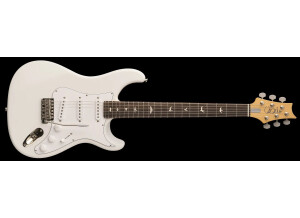
    Dave Navarro is the guitar player for Janes Addiction. A few years ago he was getting kind of famous but you hardly see him any more. This is his signature PRS guitar. It is not much different than most other PRS guitars other than the finish. You get a very white finish, whiter than most finishes. This matched with gold hardware gives the guitar a classy look. Not many guitars come white with gold anymore. The rest of the guitar is pretty normal for a PRS. The body is mahogany with a maple top. The set neck is mahogany with a rosewood fretboard. The neck profile is the wide thin profile or what they call Pattern thin nowadays. Up top you get the fancy PRS locking tuners which look futuristic. The bridge is the PRS Fender style tremolo that works really well. The pickups are 2 PRS pickups and the controls depend on what model you have. They all have master volumes and master tones. Some older models have rotary pickup selectors the later ones have a toggle like pictured here. No one likes the rotary pickup selectors that PRS use to use. UTILIZATION PRS guitars are great playing guitars. This example is no different. The Wide Thin neck has a nice feel to it. It reminds me of a 60s Gibson but with a wider and flatter radius on the fretboard. This example had the toggle switch which I prefer to the rotary switch. With the rotary switch it is kind of hard to adjust on the fly switching from pickup to pickup. I do not like how the pickup selector is way out by itself. I would prefer it to be closer with the rest of the controls. The tremolo is a very stable unit and holds tuning very well with the locking tuners. The PRS locking tuners are some of the most advanced tuners on the market. They prevent all forms of slip by locking on to the strings as well as locking the tuner in place. SOUNDS This particular example I was testing had a set of Seymour Duncans installed. It had a Custom Custom in the bridge and a Jazz in the neck. This gave it a more specialized hard rock and metal sound. The PRS pickups are quite versatile and work well in many areas but if you are going to do one area specifically you might as well get pickups designed for that area. The Custom in the bridge has a tight sound but it is not super metal tight. It is tighter than the JB which is what I think the owner was going for. It works great for metal and harder rock. The extra tightness lets you run a bit more gain without the sound becoming too boomy. The Jazz in the neck is a classic neck pickup. It is similar to the 59 but has a bit more bite for clarity. Both of the pickups clean up well if you ride the volume a bit. OVERALL OPINION If you want a white PRS this is it. If you just want a PRS 24 Custom then there are plenty more to choose from. I think they should sell this guitar cheaper than the other models since it has a plain top. But since its a sig they wont. I think PRS has some of the best looking tops on the market so personally I wouldnt bother with a plain top PRS, but im sure Dave Navarro has some fans or else he wouldnt be famous. There is a new Dave Navarro PRS SE model out now and I am hoping I can review that to see what the import version is like. That will be priced so that more people can afford it.

  • « Who??? »

    Paul Reed Smith guitars are very exotic guitars and handle really well balanced tone throughout the instrument. These are guitars that really work well and pretty much any musical setting me put them in. I've seen these guitars play in country music all the way up into drop tuning heavy-metal sounds. There's very versatile and almost take on whatever aggression or dynamics you give them. They're almost like a chameleon type guitar because they take on whatever setting rig that you give them. The thing that confuses me is that the dude from 311 gets his own custom shop guitar. Who wants to sound like 311? UTILIZATION Features Body Wood: Mahogany Number of Frets: 24 Scale Length: 25" Neck Wood: Maple Fretboard Wood: Rosewood Neck Shape: Wide Thin Fretboard Inlays: Birds Bridge: PRS Designed Stoptail Tuners: PRS Designed Tuners Truss Rod Cover: "PRS" Hardware Type: Nickel Treble Pickup: PRS Designed SE HFS Treble Bass Pickup: PRS Designed SE Vintage Bass Pickup Switching: Volume and Tone Control with 3-Way Toggle Pickup Selector SOUNDS PRS guitars have a nice warm woody tone primarily because they're mahogany based woods. The use mahogany in the body and in the neck of most of their guitars . They generally use a rosewood fretboard and then a maple laminate top on the body. This doesn't have the top but is still well balanced. You get a nice thick woody tone but you also get nice solid clean tone as well. These are very versatile instruments and they have a nice full body tones very similar to a Gibson Les Paul guitar. So if you have ever played a Les Paul guitar than you'd probably be in a comfortable group with using one of these guitars. OVERALL OPINION Many of these Paul Reed Smith guitars can very price and they're almost not clear on the pricing structure within their model lines. I have seen the same kind of guitar or the least the same looking guitar priced at $600 and then priced at $8000. I know that the different woods and builds will have a different value but it's confusing to understand the actual pricing points when you simply look at one these guitars . So I suggest doing your research on the Paul Reed Smith guitars because you can come off a little bit confusing when you see one that looks like a inexpensive guitar but price route $600 and then you see one that looks exactly like that priced at $5000. So I suggest simply doing your research before purchasing a call reach me at guitar.

  • « Real metal PRS SE »

    The PRS SE line of guitars is a line of guitars that PRS makes overseas and they are much more affordable than their USA made line of guitars. A lot of the PRS signature guitars are SE models so fans of the artist can afford them more easily. This is the current signature model for the Cradle of Filth guitarist Paul Allender. This is the current version as the older one had passive pickups I think this one is much better for heavy music. This is basically a modded Custom 24 SE. It has a mahogany body with a maple neck. The fretboard is ebony with 24 frets. It has bat inlays instead of the traditional birds. The pickups are a set of EMG's. It has an 81TW in the bridge and an 89 in the neck. The Allender obviously wanted the versatility of coil splitting. The bridge is a traditional PRS tremolo and the controls are traditional as well with a volume and tone with a 3 way switch. UTILIZATION These SE models do not come with locking tuners but everything else is pretty much PRS spec. This model has the wide thin neck which is really nice. It is like a 60s Gibson but with a flatter radius. The ebony fretboard is great and something you do not see often on even USA made PRS guitars. The bat inlays are pretty crazy and do not help much once you are at the higher frets because they are so big. I am not a big tremolo fan so I didnt use the tremolo much but PRS tremolos are pretty good even with their simple looking design. SOUNDS The EMG 81tw and the 89 are both splittable EMG pickups. But since you cannot really split an active pickups these pickups are actually 2 pickups in 1 case. These EMG's pretty much have a single coil packed in with them. Ill start with the 81tw in the bridge. With this pickup you get an EMG 81 with an EMG SA in the same pickup case. This essentially gives you humbucker and single coil tones in an active pickup without splitting anything, and these are true single coil tones. With this design you get the classic 81 sound unmolested with true single coil tone. The 81 tone needs no introduction. It has a crushing high end sound that can cut through the thickest gain or the muddiest mix. The EMG SA is one of their best single coil models. It has a very fat sound. It is almost like a single coil EMG 85. You still get the single coil twang but with this pickup the twang has some body to it. It is a very cool design. Not many people use active single coils so with this you get a very strong single coil sound. The 89 is basically the same thing but with an EMG 85 base. So it has better clean tones and the tone is thicker and has more bottom throughout the range. OVERALL OPINION This is a nice signature guitar. It doesnt have any huge logos on it or names so you do not look like an advertisement for someone else. It is a solid PRS with pickups that work great for metal. There are not many PRS guitars that come with EMG's stock. I can think of this and the Nick Catanse model and that model is not a good signature model. It is covered in logos and red binding and all sorts of crazy stuff. If you are looking for a PRS with EMG pickups get this one. Its great because it does not cost any more than a normal PRS SE guitar. They are all well priced.