Log in
EN
FR

Ring modulator pedals

24 products found

Filter
Sort by
Evaluation
  • Reviewed or not
  • Editor’s award
  • Reviewed by Audiofanzine
Availability
  • Available or not
  • Sold new or used
  • Sold new
  • Sold used
Must-have products
  • All products
  • Flagship products
  • Best rated products
  • Hot products
  • Popular products
Price
  • Freeware
€
Clear
Sort by
  • Popularity
  • User ratings
  • Price - low to high
  • Price - high to low
  • Used price, increasing
  • Used price, decreasing
  • Name (from A to Z)
  • Name (from Z to A)
  • Added on
Sort results
  • Popularity
  • User ratings
  • Price - low to high
  • Price - high to low
  • Used price, increasing
  • Used price, decreasing
  • Name (from A to Z)
  • Name (from Z to A)
  • Added on
Filter results 24 results found
Evaluation
Availability
Must-have products
Price
  • Freeware
Show results

The best Ring modulator pedals reviews

The reviews Audiofanzine members found the most helpful.
  • « Definitely need the manual »

    The Ring Stinger serves as an octaver and ring modulator. There's switchable waveform modulation via LFO that goes with the octave/ring modulation. The front panel features an in jack, 9VDC jack, VCO out, carrier in, VCO expression, LFO depth expression and an out jack, in addition to the controls of blend, timbre, drive, VCO freq, depth/manual, rate and the waveform selections for the two sides of the pedal. There's a master bypass switch along with a footswitch that switches from octave to ring mod mode. The footswitch on the left is for adding in the LFO modulation. The pedal is all analog and is a very unique/versatile circuit you won't find in any other ring mod/octave pedal. Build quality is killer and the previous owner was using it with an AC adapter rather than a DC adapter. A testament to the design, all I needed to do was recalibrate the VCO and it worked perfectly when run off DC. UTILIZATION Setting up usable sounds is near impossible without the manual. As is calibrating the VCO to sound it's best. Just in case you don't have one, I've placed a video up on YouTube called "Calibrating the Lovetone VCO". The process is quite easy, though you wouldn't know to do without an explanation. Without the manual, I was only able to get a nice octave sound. The ring mod is fairly tricky to dial in to work well but the manual explains it fairly clearly and gives you a general idea of what everything does, if it does overcomplicate some things. The LFO mod is easy to use though. Depth/rate and the wave shape are very self explanatory. Unfortunately it only does stuff with the ring mod mode switched in. To further complicate things, some of the knobs have different functions in different modes that are different than what they're labeled. Again, if you read the manual it's a bit easier but otherwise you're left to fiddle with it until you find something usable. It was quite frustrating when I'd dial in a good ring mod sound with the LFO off and then turn it on and turn the knobs only to turn it off and find my perfect ring mod sound was gone. The set up is the same as any other pedal though. If you can't make it past that part, there's no hope for understanding the rest of the pedal. SOUND QUALITY I tried the Ring Stinger with both my Strats into my Flexi 50 and a Yamaha keyboard/workstation into a Roland amp. Once I figured out how everything worked, it sounded killer no matter what situation I put it in. The octave mode is very Hendrix-y. Nails those Purple Haze octave tones, though it can do so much more it's almost a shame to only use it for that. The ring mod mode allowed me to get some classic Jeff Beck type tones as well as mindless robot noise, regardless of the instrument I was running it with. If you've never experienced mindless robot noise, it's a complete blast and you can lose yourself for hours in it. As far as practicality, it doesn't offer much but a robot breakdown is a cool addition to any song. The LFO mode adds some more over the top modulation on top of the ring mod, giving you very cool rhythmic effects that can be either smooth or choppy. It also offers a pitch mode that can make your instrument sound like a spaceship and in conjunction with a volume pedal and delay or two will give you some incredible ambient sounds. You can even get some rhythmic synth type sounds with the VCO frequency turned down in ring mod mode. This is very cool for simulating an electronica breakdown in the middle of a jazz tune. Needless to say, this pedal probably isn't for everybody. OVERALL OPINION I absolutely love the wide range of sounds I can get from the pedal. Every mode sounds killer once you manage to dial it in and it can easily replace at least two pedals on your board (and it better because it's quite a large pedal). I hate how complicated it can be at first. The learning curve is definitely steep. Once you figure out how everything works, it's actually fairly simple to dial in the sounds your looking for. For the price I got mine for, it was a no brainer to pick it up. I wasn't even really looking for a ring mod/octaver/noise maker but I grabbed it anyways hoping to learn a bit about it while fixing it. However, for the price they go for used and the price I sold mine for ($1000+), I'd be a bit hesitant about buying it unless I know it's exactly what I want and that I'll utilize it frequently. Consistency of sound is a bit tricky. If you're using a regulated power supply, you're all good. If you choose to use a battery, you have to recalibrate the VCO as it drains or suffer sub standard quality effects. Not a big deal since the process is so quick but it is an incentive to pick up a decent power supply. If I could get another for the same price, I'd pick it up in an instant just to have around. For $1000, I'll pass.

  • « Its the real deal »

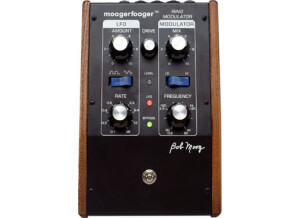
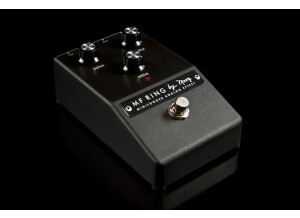
    Frequency rotary control, which varies the carrier frequency over a six-octave range. Rate rotary control, which varies the LFO's frequency from 0.1 Hz to 25 Hz. LFO Amount rotary control, which adjusts the amount that the LFO output sweeps the carrier oscillator. Mix rotary control, which crossfades continuously from unmodulated to modulated audio. Drive rotary control, which adjusts the gain of the audio input. Square-Sine rocker switch, which chooses the LFO waveform. Lo-Hi rocker switch, which chooses between the low frequency carrier range (2 Hz to 130 Hz) and the high frequency carrier range (60 Hz to 4,000 Hz). Level, a three-color LED that is used to set the DRIVE control. LFO, a LED that indicates the LFO rate. Bypoass, a two-color LED that tells whether the ring modulator is on or bypassed. On/Bypass, a rugged, smooth-acting stomp switch UTILIZATION This is a totally analog device that is basically a clone of the original...by the original maker. I use mine for freakout ambient spacey music with a guitar. I honestly am not an expert on these and I've learned mine in the last few months just by messing with the knobs till something happens. I didn't even read the manual and I honestly don't see it being a lot help beyond having a bunch of techy mumbo jumbo. One thing i found out soon is that it isn't true bypass which is unfortunate for a pedal of this quality. A lot of boutiquey companies have their own ring mods and I have tried them but at the end of the day I really think this moog is the real deal. I don't use mine terribly often but when I do it hasn't failed me and has been reliable. It seems built well. SOUND QUALITY If you have used a ring mod before there won't be (too) many surprises here. It takes time to experiment to get the sounds you want or didn't know you wanted. This will make your guitar sound...not like a guitar. The easiest way to describe it is an oscillating wah pedal on steroids. It also has a tendency to take you out of tune which is a constant issue with ring mods. What can you do? Just be careful and learn how to control it, you'll be okay. The wierd spacey sounds you will get are well worth it. OVERALL OPINION My big complaint I guess is the size. For such a wacky effect, it takes up a ton of board space. For this reason I see it as more of a studio pedal and I only take it to gigs where I know I'm gonna need it. I'm not omar from The mars volta with some massive pedal board. If you want a classic ring mod and not someone's version of it, I would say get this. It's not terribly overpriced and it seems solid.

  • « 100 percent analog »

    This a ring modulator with an LFO. It is pure 100% analog. It has 5 knobs to turn for all you editing needs, no computer necessary. It has 1/4" audio connections and expression connections (all knobs it can be controlled via expression pedals) and it is rackable if you buy the rackmount accessory (holds three mf pedals all together). UTILIZATION There are only five knobs to configure, but they have wide parameters, like all mf pedals, so there is a lot of room for change. If you memorize the "presets" in the manual, you should get a good idea where to start from to make your own sounds. SOUND QUALITY This thing sounds super weird, aka super sweet. I would have to say the sounds are very ;unreal; in a very good way. I use this in my synth/drum sampler/alt vocals mixer's effects chain (with the mf lowpass filter) and it makes even the crappiest sounding devices take on a whole new and very interesting life. Any sound that goes through this things comes out on the other end sounding crazy, so you really can't go wrong. OVERALL OPINION I have had this for 1 year. The best thing about this effect is, again, everything, and i mean everything that is sent through this sounds crazy cool. I don't think there is anything I don't like about this pedal. I did try the ring mod effect in the Boss ME-50 pedal, and thought it was ok, but this thing kicked its digital butt with glistening analog muscle. This pedal is around $275, and and Exp pedal costs around $40 ( I recommend getting at least one) which is a big chunk of change, but it is worth every penny. I would absolutely buy this again. It has impacted my sound to the bone. It is well worth the investment for anyone that needs something like this on a tight budget.

  • « cool »

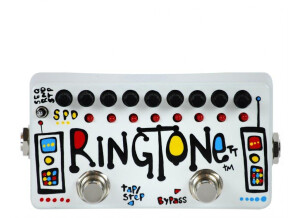
    The Zvex Ringtone is an extremely cool and unique effect for your guitar and any other electronic instrument. It's, not so basically, a spacey, chorusy, delay effect. You can definitely tell that it's a product of the late 60's! It's very rare and was made for a brief period of time in the late 1960's. There is also a smaller version of the Zvex Ringtone , but this review is for the larger version. It has 1/4" jacks on the front panel to make all of your connections and it isn't rackmountable as it sits like a mini guitar amp head. UTILIZATION There isn't much involved with the Zvex Ringtone , although I can't remember all of the controls off the top of my head. I don't think though that there's much more control beyond setting the volume and setting the amount of the effect that you'd like as it pretty much does it's thing. Good luck finding a manual, but you don't need it. SOUND QUALITY The sound of the Zvex Ringtone is definitely unlike any other effects that I've used before. Sure, it sounds a bit like chorus, a bit like reverb and delay, and a bit of something else kind of weird, but usually you'll hear those effects coming together from separate places and not an all in one like the Zvex Ringtone is. It sounds great on electric guitar of course, but probably would be cool on some vintage keys or anything else that you want to sound super spacey. OVERALL OPINION Although you guys out there probably won't be able to find a Fender Zvex Ringtone since they are seldom seen, it's still a cool effect to know about just in case! It'll add space and depth to your sound and is perfect for getting that super spacey guitar tone. Of course there are and easier ways to do it these days with digital effects, but the Zvex Ringtone has a special quality you won't fine elsewhere.

  • moosers's review

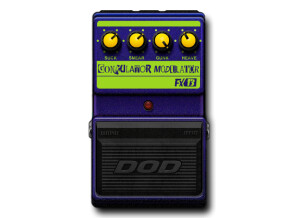
    The DOD FX13 Gonkulator Ring Modulator is a very unique pedal, even in the world of ring modulation. The pedal is analog based with pretty standard characteristics, including a 1/4 inch input and output and a nine volt battery compartment. I believe the pedal can also be powered with a nine volt power supply, but I've only powered it up with a battery. This isn't rack mountable as it is a foot pedal. UTILIZATION Using the DOD FX13 Gonkulator Ring Modulator isn't hard, but getting used to what each parameter does isn't as easy as you'd like. The pedal is really designed for users who are unfamiliar with ring modulation and the parameters that come along with it, as it substitutes each with a different name. While this did throw me off a bit, I would imagine that some less experienced users might find this a little less confusing, though at the same time the names that it gives the parameters aren't any less unrecognizable. From left to right, the pedal has knobs for 'suck', 'smear', 'gunk', and 'heave', all parameter names that I've never seen on anything else and don't expect to. However, once I was able to play with the pedal a bit I was able to see what each parameter does, although I couldn't pin point each one and match it up with its traditional ring modulator name. I've never seen the manual, but I'd definitely recommend checking it out if you're at all confused. SOUND QUALITY The DOD FX13 Gonkulator Ring Modulator is definitely a bonafide ring modulator with all the bells and whistles that you would want from one. I'm assuming that if you're looking at this review, you know a bit about ring modulation, and know that it is certainly the most far out effects processor you can get. The sound of this pedal is warm in nature and definitely has a lot of versatility between the four obscurely named parameters. I've used the pedal with a Fender Strat and a '76 Fender Twin Reverb, so I got a pretty good idea of what the pedal truly sounds like, although I do believe that the pedal would work well within just about any set up. OVERALL OPINION I haven't seen too many DOD FX13s out there for sale, but they do show up on eBay. The price of these pedals varies a good deal, as some people hold these high in regard while some don't. As far as getting a good ring modulator goes, this is still probably one of the cheapest ways to do so. Of course it doesn't hold a candle to the Moog Ring Modulator, but if you're looking for a simpler pedal with a good tone quality that will get you the basic ring mod sounds and then some, the FX13 will do the job for sure.