Log in
EN
FR

Phasers for Guitar

318 products found

Filter
Sort by
Brand
Evaluation
  • Reviewed or not
  • Editor’s award
  • Reviewed by Audiofanzine
Availability
  • Available or not
  • Sold new or used
  • Sold new
  • Sold used
Must-have products
  • All products
  • Flagship products
  • Best rated products
  • Hot products
  • Popular products
Price
  • Freeware
  • Low-cost (< $85)
  • Mid-range ($85 - $200)
  • Premium (> $200)
€
Clear
Sort by
  • Popularity
  • User ratings
  • Price - low to high
  • Price - high to low
  • Used price, increasing
  • Used price, decreasing
  • Name (from A to Z)
  • Name (from Z to A)
  • Added on
Sort results
  • Popularity
  • User ratings
  • Price - low to high
  • Price - high to low
  • Used price, increasing
  • Used price, decreasing
  • Name (from A to Z)
  • Name (from Z to A)
  • Added on
Filter results 318 results found
Brands
Evaluation
Availability
Must-have products
Price
  • Freeware
  • Low-cost (< $85)
  • Mid-range ($85 - $200)
  • Premium (> $200)
Show results

The best Phasers for Guitar reviews

The reviews Audiofanzine members found the most helpful.
  • « Unfazed until now... »

    I bought this in the mid 80s when BOSS ruled the show and everybody copied their design and aesthetic. Price on sticker on box reads £33 and I remember the limited choice of budget pedals in the store on the excited Saturday morning I had some spare cash to treat myself (I was unemployed at the time and the bills came first!) but were disappointingly limited to this PH-1, an ARIA CH-1 Chorus and an ARIA FZ-1 Fuzz or ARIA Bass Boost... so the PH-1 it was. I had always liked the Phasing on recordings and in my nativity,thought this pedal would offer that - Think 'The Groundhogs' Snowstorm stylie https://www.youtube.com/watch?v=R7x-Txo8AxI Anyway, of course it didn't do that(!) and all I could ever hear from it was Dub style Reggae tones... So, never employed it. A couple of years later the BOSS ME-5 appeared and I got one (my fortunes changed!) and as that had so many FX options, the Aria got forgotten. Come 2015, I need a Phaser to get near the Thin Lizzy Rocker song tone to demonstrate to a guitar student of mine and so pulled it out not expecting much and suddenly realise that I can use this to good effect with a couple of other pedals in the chain after all... Is not an MXR beater, but I found it can also run stacked with a Vibe or UniVibe-style unit and add more density... Glad I kept it then! Oh and is now considered a vintage in it's own right as of course it has that all important 'Made in Japan' backplate sticker! Most usable setting seems to be consistently 2-oclock, 4-oclock, 2.30 on the dials L-R See my blog and dedicated page to upgrading a BOSS ME-5 to render those essential 70s/80s SIX Vintage unit tones... https://boss-pedals.jimdo.com

  • « About the same as the Phase 90 »

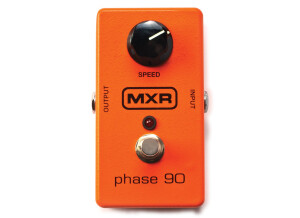
    MXR has released yet another Zakk Wylde signature pedal. This time, it's an effect he barely used throughout most of his career. As if we needed another Phase 90, they decided to release one with his fancy graphics on it. The pedal itself just has one knob, like the original Phase 90 that everybody knows and loves. Turn it until you like it, and then leave it. This also has an LED, which is helpful, but aside from that, it's not much different from the classic Phase 90. UTILIZATION The peda itself is housed in a strong and sturdy housing that can withstand tons of abuse. It's solid enough to where it can take touring without any issues at all. The thing is SUPER simple to use. You turn the knob until you get the rate you're looking for and then leave it. The graphics on this are pretty gaudy, and I don't know how you could like how this looks, but that's a matter of personal taste, I guess. It's not really a fault with the pedal itself. The manual is useless on this thing because it's such a simple pedal to use. I've never read it, and I doubt you'll need to. SOUND QUALITY The sound is pretty much like all of the other Phase 90s that MXR has on the market. There are some subtle differences between the models, but for the most part, they generally sound the same. This one is close to the script version, I guess? It's hard to remember. I personally use a custom shop MXR Phase 90 on my board as I felt those are the best sounding Phase 90s that MXR has to offer, aside from the real deal, old school 70s ones. I like to set the level a bit low and use this on leads to give a neat effect. It's subtle enough to where it doesn't overwhelm the guitar, but it adds this slight flavor that makes it sound interesting. OVERALL OPINION The pedal is decent, but you can find a normal Phase 90 for cheaper on the used market. I don't really recommend getting this unless you're a huge Zakk fan who needs to have all of his pedals. I'm not really a fan of signature gear in general, so I might be a bit biased. The pedal itself is decent, but there are better, cheaper alternatives out there.

  • moosers's review

    The Ibanez PT9 Phaser is a rare phaser pedal that is intended for use with electric guitar, but suitable for use with any electronic instrument. This is an analog pedal, with 1/4" connections for input and output. It has a battery compartment for a nine volt battery, and can also be powered by a nine volt power supply if you have one. This isn't a rack mountable piece of gear in any way. UTILIZATION Using the Ibanez PT9 Phaser is really simple, as it's only got three parameters to work with. The parameters are for speed, width, and feedback, the latter two of which are pretty common for phaser pedals. If you have ever used a phaser effect before, you'll definitely know how to use this without having to do much research or playing around with it. A manual shouldn't be necessary with the PT9. SOUND QUALITY As far as the actual sound of the Ibanez PT9 Phaser goes, it's pretty impressive. I won't say that it's my favorite, as I've used a lot of different phaser pedals out there, but it's definitely up there with the best of them that I've used. It's got a really really thick sound, and it's actual possible to get a good amount of differing sounds between only the three parameters. I've only used the PT9 in the recording studio, but certainly it's suitable for any type of use. While I don't think that the sound lives up to the price, but it is a very good sounding phaser. OVERALL OPINION I don't know why there are so few of these out there, but for whatever reason it's pretty hard to get your hands on an Ibanez PT9 Phaser. For the same reason, the price of a used one of these is surely a lot. I don't think that it's worth the price based on the sound of the pedal alone, but if you're a collector and/or like rare pedals, this is a must have. For those of you who are looking to get a great phaser pedal without spending too much, there are plenty of options out there like the Boss PH-3 that can be had for a lot less than this one...

  • moosers's review

    The Maestro Stage Phaser is a vintage pedal that can be used with any electronic instrument. I've only got experience using it with an electric guitar, but I can definitely see it sounding good for a Fender Rhodes and other keyboards, and perhaps even bass guitar. I'm not sure exactly when this pedal was made, but it's definitely an older one, both in look and sound. Although under the Maestro name, this pedal was actually designed by Moog. The make up of the pedal is pretty standard as it has a 1/4" input and output. The parameters that it has are for speed and 'balls', the latter of which is actually controlling the parameter commonly labeled as depth. It also has a switch in the middle for three different variations. Between these setting controls, you've definitely got a good amount to work with. As far as the tone is concerned, it's really quite special, as this pedal definitely has it's own sound to it. It is a very milky sounding phaser that actually has a good amount of grit to it for a phaser. You're definitely going to get a bit more noise than you would with a newer pedal, but for me it's worth it to get the sound. Although these haven't been made for a pretty long time, you can definitely find one used if you're after one, but they're going to cost you a couple of hundred bucks (USD). If you're into vintage pedals like I am, you're definitely going to want to try this pedal out if the opportunity should ever arise. I was lucky enough to have someone bring this in on a session, otherwise I probably wouldn't have gotten the chance to have heard this pedal in person. Someday when I'm able to I'd love to add this pedal to my collection.

  • « A true vintage phaser »

    The MXR Phase 45 reissue is a faithful recreation of one of MXR's most sought after boutique pedals from the 70s, the original "script logo" Phase 45. According to MXR, every aspect of the original circuit has been recreated to period-correct specifications, as has the exact build and finish of the device. UTILIZATION The setup is as simple as it gets, single input and output jacks, single on/off footswitch and a singular black knob used to dial varying phase tones. The different phase settings range from very slow to very fast as you turn the dial clockwise. Being a faithful recreation, it runs entirely on 9V battery power. Also like the original, there is neither the modern addition of an LED light indicating when the pedal is on or off or is there an AC power input. This can be problematic, because it's very easy to leave the pedal on and drain the battery. Therefore, I've made a habit of always disconnecting the input cable when not in use, since that automatically cuts power to the battery. Also, due to the subtlety of the effect when in use with other pedals, it can be easy to forget it's turned on! Other than the vintage limitations of battery-only power, the small footprint and rakish vintage appeal make the Phase 45 a great visual addition to any pedal board. It seems plenty rugged and should have no problems surviving most on-stage abuse. SOUND QUALITY I purchased the Phase 45 specifically for use as a subtle, vintage phasing effect. The Phase 45 accomplishes this goal perfectly. The much lauded Phase 90 may be the standard in the realm of modern phasers, but as with most phaser pedals, the depth of their sound comes from the amount of mid-range frequencies they dig into. Rather than inducing a deep modulation, the Phase 45 is much more subtle and leaves much of the mid-range tone in tact. The vintage circuitry however imparts a very obvious warmth that darkens the guitar tone quite a bit. At it's slowest setting, used in the sound clip below, the Phase 45 produces a slow, warm phase that in no way interferes with the main musical elements of the riff. In this second sound clip, the Phase 45 is set to it's fastest setting, where it sounds a lot like a vintage univibe pedal. Slow, Psychedelic riff: https://en.audiofanzine.com/guitar-phaser/mxr/phase-45-script-logo/medias/audio/a.play,m.473666.html Fast, Univibe solo guitar: https://en.audiofanzine.com/guitar-phaser/mxr/phase-45-script-logo/medias/audio/a.play,m.473667.html OVERALL OPINION If you are looking for a subtle phaser that won't cut too heavily into the mid-range of your tone, than there are few available that function with such finesse as the Phase 45. It should be noted though, that it will darken your tone and saturate anything that passes through it. For a more modern guitar tone this could be a turn-off, but if used after a brighter distortion or overdrive, the effect may be complimentary. The battery-only power may also be a drawback, but there are several tutorials I've seen on the internet where people have installed AC inputs and LED power indicators. Pros +Vintage warmth and saturation +Beautifully subtle phase tone +Rock solid construction +Simplicity of use Cons -No LED light indicating whether the effect is on or off -No AC power input, battery-power only -Vintage circuitry darkens tone considerably

  • « Small box, big sounding phaser »

    The PT999 is an oldschool type phaser, basically like the old orange box from the seventies. I really dig the look of this pedal, nice color :-) It is a simple pedal although there are some tricks under the bonnet. Basically, you have just the rate control for the phaser but on the inside there are 2 little controls you can turn with a small screwdriver. You can set the Q and depth of the phaser. I checked them out but left them in the original position after trying to tweak it a bit. The little controls are set at the factory, not sure how they do it but the pedal sounds at its best with their suggested setting. UTILIZATION 1 control, how hard can it be? Set the range and play away. It will get you a darker phase sound that is close to the orange phaser from the seventies. It's a fun pedal to play with. Although there are 2 small dials on the inside, I don't think the manual mentions them, I wonder why... SOUND QUALITY The phaser sounds great, I a/b-ed it with a bunch of others and really liked the sound. I was using it in my rack system, work just fine except for 1 thing. Switching the pedal on, or the loop in my case, I was losing a bit of volume. I tried rectifying it with the internal controls but that didn't work out. I could make the pedal sound brighter and then it would cut through a bit better but the sound wasn't as nice. I think there's a mod available for this volume issue but in the end I swapped mine for another phaser. OVERALL OPINION Small box, good rice, great sound. What's not to like? Well, the volume drop is annoying. If you can deal with that, this is highly recommended

  • Audiofanzine FR's review

    (Originally written by barvador/translated from Audiofanzine FR) Copy of the original MXR55 phaser. I own two of these effect pedals (old versions without LED). Only one of them has a PSU connector and I power the other one with an external PSU via the battery connection. It's an analog Japanese product so it sounds warm and has a good manufacturing quality. UTILIZATION Two controls: speed and intensity. Every setting was usable with the first pedal whereas the second one has a defect and the oscillation speed is not audible anymore with settings beyond 12 o'clock. Perhaps the problem is the PSU. Extremely easy to use. SOUND QUALITY The first pedal sounds great: it's responsive, warm, doesn't produce too much noise, in short it's an awesome product. The effect sounds vintage and analog. There is virtually no level loss compared with the Small Tone and the Phase MXR. The sound is not fully transparent and quiet but it's not a TC Electronics or a studio device. Apart from it getting broken, the only con I noticed is that the oscillation is somewhat curious, it's too fast and a bit synthetic. The rest sounds great. The sound of the second pedal has nothing special. The effect has a lower resolution. I bought the second one on ebay because the first one (also bought on ebay) got broken after three months! The brand new battery started to overheat during a rehearsal and the pedal never worked again. I took it to several technicians and they all said that the components got old and broke. In short the pedal is dead. Alkaline batteries didn't exist when it was manufactured. The power to the other one is supplied differently and I never tried to power it with a battery, I always used my customized PSU. The sound is much worst than the first one so I will try to customize it... Who knows! The sound is great and has more character than the very renowned MXR. OVERALL OPINION It's expensive. If I could choose again, I don't know... I love Japanese effect pedals and I think I would buy it again if the first one still worked. It's nice to have a good phaser. IMPORTANT ADD-ON: On the first pedal, when you remove the housing to install a battery and change the broken condensers, you'll see a hole in the circuit board to access a small dimmer. You can adjust it with a small screwdriver. The control gives you direct access to the oscillator, which opens new possibilities. You can choose between a smooth or strong oscillation centered around the low or high frequency range. This explains the lousy sound. I've found again the sound I like. It's magic! To keep it short: it has no cons, pedal 1 = pedal 2. I already said that Japanese make very good products... I give it a 9!

  • Audiofanzine FR's review

    (Originally written by solo84/translated from Audiofanzine FR) Analog phaser One mono input, one stereo output Lots of settings (waveform, envelope, feedback, LFO, start and stop points, speed, etc.) It works only with a 24-volt PSU (included, no battery operation) It's a pity that the unit doesn't have a stereo input! It would make it a must-have!!! I give it a 9 because of this last point. UTILIZATION The unit requires some learning time and I'm only getting to know it. The user's manual is ridiculous and the settings aren't intuitive. But it's only a phaser so you'll surely find out how it works! I will update this review later... SOUND QUALITY With a simple setting for arpeggios (Pink Floyd 70's sound) the result is very interesting, not as extreme as a Phase 90, quite organic and much more subtle. It reminds me of the Small Stone... The device doesn't alter the original signal and the stereo imaging is wonderful. Everything is possible, even extreme effects! It's a convenient phasing effect unit! The phase start and stop controls and the feedback setting provide huge sound possibilities! You can also use an envelope instead of the LFO, etc. I haven't tested it within a mix yet even though it's the most important thing! So I will update this review later... OVERALL OPINION Pros: - Very nice sound - Unaltered source signal - Huge editing possibilities - Look and construction Cons: - Not easy to use - Ridiculous user's manual.

  • « Phase all the way »

    Excellent, versatile little pedal for a range of classic, usable phasing effects. Not just for Van Halen fans, this pedal with it's "script" button gives you both effect types found in the standard MXR Phaser, and reissue "script logo" models. (It's just a subtle difference, mainly the standard MXR has a little more harsher mid-tone spike to it which is great for a pronounced phase rhythm effect, and the more tamed "script logo" sound which is better when soloing with distortion.) It's construction looks very solid, it's blue "on" light is practically blinding (like a deer in the headlights?). The only little annoyance I had when hooking this pedal onto my pedalboard was where the AC connecting input slot was found - on the side, close to the 1/4 inch guitar cable coupler. It just meant I had to place the phaser a little further apart than normal, to clear the daisy-chain connector. Apart from that, it's an excellect phaser and highly recommended for all styles, whether you're playing clean or overdriven, rock or jazz, or anything in-between. UTILIZATION This is simple as it gets with one knob and a one toggle button to work with. Simple and easy. SOUND QUALITY The quality is awesome. It nails all kinds awesome phaser sounds. VH all day long. I use it a lot for small little bits for leads. Just adds some great layering to it. OVERALL OPINION The Phase 90 pedal offers everything that went wrong with digitally produced sounds. I've used several Line 6 products over the years, such as the Pod, Spider and Flextone, but nothing can come close to the authentic sound of that tiny phase box. This is a simple device but can tweak your sound toward more retro music such as Sonic Youth. If you want Phase, this is the way to go.

  • « What more could you want? Seriously. »

    The Blackout Effectors Whetstone Analog Phaser is one of the most incredible phaser pedals I have ever had the joys of owning. It has the standard 1/4" ins and outs, 9VDC jack and a true bypass switch. The knob on the far right, called "range" generally changes how this thing acts all together. From big luscious phasing to subtle behind the scenes to crazy ring mod and beyond. Then it has a Feedback, Rate, Level and Depth knobs. It has a switch for two or four stage phasing. A switch for vibrato or full on phasing. A symmetry knob which is really cool. A low pass to all pass switch and a sweep knob (wide to shallow) which along with the depth knob dictates this things sweep. Essentially making this one of the most versatile analog phasers in existence. UTILIZATION This thing sounds awesome at pretty much any setting. There is so much you can do with it that you will never be bored. The manual further explains how each knob and switch will effect the sound and makes this thing less intimidating. Right out of the box it can be somewhat overwhelming, but it definitely gets easier. You quickly find out what works for you and the sounds you hear in your head can quickly be applied to the pedal. SOUND QUALITY I've only used this with my guitar, but it's so incredible. It can get some really cool warbley settings on the ring mod mode, very usable. The phaser can get soooooo incredibly slow. I like it for really calm clean guitar passages. Really fattens things up and makes it fun. I haven't really used the fixed setting at all, so no opinion there. The pad setting is nice for aforementioned clean passages. The thing sounds great, there just aren't enough words to explain that. The pedal isn't very noisy when engaged either. Which is nice, some phasers I have played have been kind of noisy. OVERALL OPINION I really, really love this pedal. I have not a single complaint with it. Just the versatility makes it worth at the very least checking out. I can't believe what I got. I think even at full price they are well worth the money. I picked mine up for only $200USD and it's limited edition Prism Black. I've played a ton of phasers, this one is (in my honest opinion) the best one.

  • « Great phaser, when it worked »

    The Retro-sonic phaser is based on the old MXR script phaser but takes things a step further. It's an all analog pedal that has more control thanks to the Level and Depth controls. It has a deep phasing effect that can go from slow to faster than a typical MXR. UTILIZATION The extra level of control allows for better tweaking and more tones from this great sounding pedal. The reason I choose this one, was the level control. I tried a number of other phaser pedals and most of them seem to loose some volume. This was solved on the Retro-sonic with it's level control. You can easily dial in both old-school phaser sounds as well as more prominent modern tones. I bought the pedal 2nd hand and the previous owner hardly used it. Much to my surprise, the pedal started acting up after a couple of months. I had it in my rack setup and was powering it with a Pedal Power and the pedal would stop working, sometimes it worked well for a while but then all of a sudden it crapped out. I got in contact with the company and they told me to ship it. In the end, I took it to a repair guy I know and he had a look at it. He was able to fix the pedal and discovered a design flaw. I'm not a technical guy but basically, there's something wrong with the electrical part of the circuit resulting in some pedals having issues. Eventhough he fixed my pedal and I sold it because I could not have a possible unstable pedal in my setup SOUND QUALITY I was using the phaser in a rack setup and really liked the tone from it. It had a nice deep pulse and I could get the volume dialed in just right. I gigged with it plenty until it started having issues. When it was fixed, I sold it and replaced it with a HBE Psilocybe. OVERALL OPINION Tone-wise, it is a great phaser, I choose it over a bunch of others but it was a huge let down when it broke down. I have read from other pedal who had the same issue with this and other Retro-Sonic pedals so buyer beware!! For tone I would rate it a 9, for build I would say a 2, hence the 5.

  • moosers's review

    The Fender Phaser is a vintage pedal designed for use with electric guitar but suitable for any electronic instrument. The pedal has 1/4 inch connections and has a battery compartment to power it. It is an analog pedal and isn't rack mountable as it is a stomp box. UTILIZATION Using the Fender Phaser couldn't be any easier than it already is. It simply has a button to engage the effect and the wheel that effects the rate of the phaser. On the side of the pedal there is also a volume knob to set your output level. This is pretty much everything there is to this pedal and even those with no experience with pedals shouldn't have a hard time with this. I've never seen the manual for this pedal as it is an old one, but one isn't necessary anyway. SOUND QUALITY The sound quality of the Fender Phaser is pretty awesome. It has a really warm sound that definitely sounds vintage since it is. I usually use the pedal with a Fender Stratocaster and a '76 Fender Twin Reverb amp as I feel that Fender on Fender is just about as good as it gets. The tone of the pedal is really rich and full and is definitely one of the better sounding pedals that I have heard for what it can do. The only downfall is that the pedal isn't all that versatile and can only get a limited number of phaser tones. OVERALL OPINION I've been using the Fender Phaser for a few years and since the first day that I used it I really liked what it can do. It is easy to use but it doesn't get too many varying sounds, which is the only problem with this pedal that I can think of. They are pretty rare, although you can get a newer version of this pedal, but it doesn't have the same allure and sounds duller to me. If you get a chance to try or pick up the Fender Phaser you definitely need to try it out.