Log in
EN
FR

Multi-effects and other modulation effects

137 products found

Sort results
  • Popularity
  • User ratings
  • Price - low to high
  • Price - high to low
  • Used price, increasing
  • Used price, decreasing
  • Name (from A to Z)
  • Name (from Z to A)
  • Added on

The best Multi-effects and other modulation effects reviews

The reviews Audiofanzine members found the most helpful.
  • « Superb Clarity, Low Noise and Flawless Quality in These 16 Effects »

    SOUND: Thanks to the 24-bit technology and custom buffer circuit, the Coral Mod II has great clarity. It also has very low noise, making the inclusion of its tremolos, wahs, flangers, etc., a pleasure to use with both clean and high-gain tones. With clean or slightly crunchy tones there isn’t even a whisper of associated noise (swoosh, pulse, etc.), and with high-gain tones the ‘noise’ is inconsequential and excusable. What stands out as much with the Coral Mod II is that the tones are both organic and natural sounding, but they also penetrate the mix exceptionally well. In sum, the clarity and quality of sounds make for ideal home studio recording, but also when playing gigs when you want to cut through the mix with an effect. I also think the quality of the tones relative to this pedal’s price makes for unbelievable value when compared to other combination pedals, and definitely hard to beat when compared to single use, one-trick pony (e.g., tremolo or flanger) pedals. OVERALL IMPRESSION: Valeton’s Coral Mod II pedal offers exceptional value. Some multi-effects pedals have some tones that are winners, some that may be all right, while others are duds. I find all the tones in this pedal usable and superb sounding. There are sixteen modulation effects from which to chose, in categories of Chorus, Tremolo, Flanger, Phaser and Other. This is a brief rundown, but do refer to the included demo for sound samples. The J-Chorus mimics the vintage ‘Jazz’ amplifier, the T-Chorus is lush (modulated by a triangle wave) and the Detune mixes the dry with a slight detuning for a quasi-chorus sound. The B-Trem simulates the bias tremolo from vintage tube amps, the O-Trem is a classic optical tremolo and the Echo-Trem adds a delay to the tremolo for a step-like effect. The Flanger setting is a classic flanger tone, the NFB Flanger includes negative feedback, and the Jet flanger produces that 1980s massive flanger with huge feedback. The Phaser setting produces a bright and sharp phasing tone, whereas the Phase+ simulates the MXR Phase 90 pedal. The U-Vibe simulates the legendary Univibe (4-stage phasing/rotary) circuit. The T-Wah produces a wah effect that varies relative to your picking dynamics (soft wah vs. hard honking wah). The A-Wah automatically varies the wah effect as you play. The LoFi produces a sample reducing effect (from wild and crazy to gritty and thick distortion). The Vibrato produces a warm and natural sounding vibrato. A very good buy at only $69.99 USD. GENERAL USE: There are three control knobs: Volume (self explanatory), Depth (mix) and Rate (speed). You can alter the rate manually with the Tap Tempo function (hold the footswitch down until the LED blinks and then tap your tempo). In some instances the control knobs may have different functions. For example, with the T-Wah effect the Volume control becomes the Mix, the Depth controls the cutoff (filter cutoff frequency) and the Rate controls the Tone (effect brightness). The included reference cards (manual) provide clarity and instruction in this regard. The large white control knob selects the modulation effect, from chorus, to flanger, to phaser, etc., and as detailed in the section Overall Impression of this review. The selections are printed white on aqua in very small lettering (since this is a micro-pedal), and so reading glasses for older musicians will be necessary. The footswitch turns the Coral Mod II on/off, or can be used as a Tap Tempo, as mentioned previously. OTHER DETAILS: Measuring 93.5mm(D) × 42mm (W) × 52mm (H) or 3.74 (L) x 1.65 (W) x 2.0 (H) inches, the Coral Mod II weighs 160 g or 5.6 ounces. Its aluminum alloy die-cast casing is light, yet strong to withstand regular and daily wear. The soft (no ‘click’) footswitch feels solid with no audible noise in the signal when in use, for both tap tempo and turning the pedal on/off. The mini plastic knobs and their associated pots feel smooth and solid when turned. The footswitch also is set higher than any of the controls, thereby avoiding damage when stomping. The Coral Amp requires a 9VDC standard power supply (negative tip) while drawing 100mA of current. #Valeton

  • « Two for one »

    The Strymon Flint was inspired by the traditional pairing of onboard reverb and tremolo effects in early tube amps. The Flint features two sides for each effect, each with three modes to toggle between. For tremolo, you have the '61 harmonic setting, the '63 tube setting, and the '65 photocell setting. For the reverb side you have sounds from the following modes: 60's (spring), 70's (plate), and 80's (hall). Each effect has separate controls and can be activated individually of one another. Holding both bypass switches, toggles secondary functionality of the controls which include boost/cut controls for each side of the effects, tap subdivision, and effects order. UTILIZATION The Input/Output section of the Strymon is rather versatile. An EXP input can accomodate an expression pedal, tap tempo, or one of strymon's favorite pedals--which recalls a previous arrangement. A selectable TRS stereo input allows use with stereo applications. The power is standard 9v. The unit's build quality is exceptional and rugged. SOUND QUALITY The Flint's sound is second to none. The tremolo sounds are very useable with the speed knob going to a lower threshold than other tremolo effects. Very mellow and pleasant. The harmonic trem was my favorite of the three for its unique flavor. I found the reverb to be no slouch, performing just as splendidly as Strymon's dedicated blue sky reverberator. The ability to configure an expression pedal with any specific control can lead to very interesting results.Having used the pedal through a variety of amps, I was pleased with the flints sound both in front of amps for a more mangled sound and in a given amp's loop as well. OVERALL OPINION The Strymon flint is another excellent, studio-quality offering from the brand. I have never been a fan of Tremolo effects, but the flint's capacity for subtlety charmed me, as well as it's over the top sound quality. The effect is competitively priced against other boutique tremolos alone, let alone for a two-in-one arrangement such as this. Awesome product.

  • moosers's review

    The Electro-Harmonix EchoFlanger is a unique effects pedal that can be used for getting a variety of different tones. It is an analog piece of gear that has a 1/4 inch input, a 1/4 inch effect output, and a 1/4 inch effect input. It isn't rack mountable as it is a stomp box. UTILIZATION The make up of the Electro-Harmonix EchoFlanger isn't too hard to understand overall. It simply has a variety of knobs including parameters that control feedback, rate, width, tune, and mode. Even if you aren't aware of what these terms mean, although an experienced user will, even just playing around with this for a few minutes should give you a good understanding of what everything does. Since everything is user friendly and pretty self explanatory, I don't think a manual is necessary but haven't seen one so I can't say anything about it. SOUND QUALITY The overall sound quality of the Electro-Harmonix EchoFlanger is very impressive. It has a warm overall tone and is very versatile. You can get a good amount of varying tones both in terms of delay like sounds and modulation tones. It is perfect for those who may not necessarily use these effects all the time, but since want access to them if you want them. It is also just great for creative experimentation as you are able to get all sorts of cool sounds with this pedal. I have used the EchoFlanger for recording with a Fender Strat and a '76 Fender Twin Reverb, and within this configuration I'm able to get clean effects with this pedal that are pretty awesome sounding overall. OVERALL OPINION While the Electro-Harmonix EchoFlanger isn't Electro's most readily available pedal as they are no longer made, this is still a very cool pedal to look into. It is interesting and unique while still maintaining the high quality that you would expect with an Electro-Harmonix pedal. If you are looking for a unique echo and/or flanger/modulation pedal, definitely look into the EchoFlanger as even if you can't buy one in the store, you never know when you will stumble upon one!

  • mooseherman's review

    This is a vibrato/tremolo pedal that is entirely tube-driven. It can be powered through a 9V power supply or with a 9V battery. It has a 1/4" input and output. The pedal cannot be edited with a computer and is not connectable to a MIDI controller. It is not a rackable pedal. UTILIZATION The editing of effects with this pedal. There are five knobs to select and/or edit with, as well as the footswitch which activates the pedal's effects and the true bypass (one of the best things about this pedal is its completely true bypass, no excess noise comes from having it plugged in!) There are knobs for volume (overall volume with effect), intensity (rate of clean signal to effect signal), a switch to go from vibrato to tremolo effects, a knob which controls the rate of vibrato/tremolo, and a final switch that switches between four distinct vibrato settings. The names of those settings are looz, hamm (short for Hammond, it emulates a leslie speaker), Acey (a re-imagining of the AC30's vibrato channel), and Whirl (a tone reminiscent of a Wurlitzer electric piano). The tremolo effect, as well as each vibrato, is capable of a variety of sounds, due to the manipulations of the rate, intensity and volume knobs. SOUND QUALITY The sounds that come out of this pedal are fantastic. They are especially great for people who have a passion for classic, vintage vibrato and tremolo sounds. I really like the settings on the vibrato, they allow the user to really hone in on the most useful sounds. The sounds all remind me quite vividly of the instruments and speakers they are meant to emulate. I truly like the sound that I get with my Strat and Fender Twin. It almost feels like I'm using the AC30 when I try the acey channel. The same applies for the other settings as well. The tubes do color the sound slightly, which is a drag if you are looking for a pure effect. However, I tend to enjoy the coloring of the sound greatly, so I don't think it's a problem. OVERALL OPINION I like this pedal a lot because it has a lot of really cool, useful features and all of them sound great. This pedal is great for practical, classic tones. Those looking to get really wacky and far-out with this pedal should probably look elsewhere, this pedal serves more realistic functions than sheer noise-making and knob-twiddling. I don't think this pedal is too expensive, probably can get it new for less than $300. I would recommend that anybody check this out.

  • mooseherman's review

    This is a really sweet pedal. It's technically a tremolo pedal, but it is more realistically a simulation of the Leslie speaker effect, in pedal form for the electric guitar. This is a great invention, considering that recording engineers for the Beatles and others had to rewire Leslie Speakers to attach them to guitar amps. This is a basic 1/4" connection (in/out), and this pedal is not MIDI-capable or rackable. UTILIZATION The effects editing on this guy is actually rather easy. There are only three knobs, one each for speed, volume, and intensity. I think the simplicity of this pedal is pretty liberating, in the sense that you can easily manipulate the effects on the fly. Some people might not be impressed with the lack of knobs, but I am convinced that the sound alone makes up for this. SOUND QUALITY The sound of this effect is good enough to justify the lack of controls on the pedal. With a rich tone that really does come pretty close to emulating an actual Leslie speaker, it's hard to go wrong with this pedal. I think the perfect example of this type of sound would be Jimi Hendrix's "Machine Gun" (even though I'm not sure it's this pedal that he's using). I don't really know how else to describe this pedal, except that its more natural-sounding then most of the products calling themselves "tremolo" effects these days. This thing gives your guitar a rich, shimmering sound that isn't quite tremolo, as it's a bit too fast for that and it isn't deep enough to really be obvious. Overall, I think this is a great sounding Leslie emulator. I haven't heard one that I can say is better than this. OVERALL OPINION When it comes to this pedal, the sound quality is definitely the best thing about it. It doesn't have a ton of control, but neither does a Leslie in real life, so when it comes down to actually emulating the real thing, it does it pretty much perfectly. I do sort of wish that there was more options available on it, but I guess I can buy other pedals for that. This thing is about $200 new, but it's probably going to be available used, so I'd have to recommend going that route with it. You won't be disappointed if you love classic tones and Leslie Speakers.

  • « Clear quality and great price »

    Sonicake’s 5th Dimension is a Swiss Army Knife of pedals. These multi-effects pedals have been around for a while, but the affordability of the 5th Dimension certainly makes it ideal for those looking to access various modulations in their most basic form. Contained under the aluminum alloy chassis is a phaser, two types of flanger (classic and jet), two types of chorus (Jazz amp and stereo), two types of tremolo (liquid and optical), rotary, vibrato, auto-wah and a lofi (bit crusher). These modulations are controlled by three knobs. The Mix controls the effect level. Depth determines the extent of the effect (from subtle to more boisterous). The Rate determines the effect’s speed (although the footswitch can be used as a tap tempo). Obviously, each effect has a broad range, whereas I demoed only one setting on each. https://www.youtube.com/watch?v=OLBrDa4_5j4 The quality of each effect is very decent; very clear and low noise. Now, the Lofi on the 5th Dimension is not as good or as versatile as Sonicake’s Wave Crush, and for understandable reasons, since the Wave Crush is dedicated to Lofi sounds, but if you want a ‘taste’ of Lofi in your music, then it does the job. The same is true of the Phase, Flange, etc., in that a person looking to have a basic taste of an effect, without needing all the bells of whistles of more flexible stand-alone pedals, the 5th Dimension is a viable option and can go head-to-head with other such pedals in its category and price point. And that, really, is the only downfall of the 5th Dimension. If you are an avid phaser user, then you likely will invest in a phaser that can do more or have more voicings, etc. However, most players dabble in various effects, used here and there for the occasional song or composition, and the 5th Dimension saves a lot of pedal board space while providing eleven modulation effects at your fingertips and when you do need them. Ideal for studio use, when you need a particular sound that is digitally clear, it works with bass and keyboards, as well.

  • « Jim Dunlop Rotovibe »

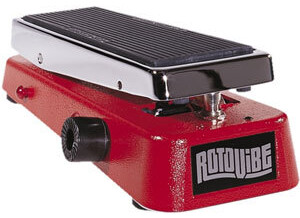
    I bought this unit over the internet at guitartek for £139.95. I bought it because I wanted to add a little spice to my basic valve tone. I generally really like the rotovibe pedal. It has a enveloping warmth and a quality lacking in many similar chorus/vibrato pedals. I knew that I would love the tone because I remember my friend had one and also from listening to perhaps the best known user of the pedal, dear Jimi...unfortuntately I still don't sound like either of these wonderful players but I'm chipping away at that big block of marble! It has these two effects, changable by a little switch on the side which you can press with your foot if you're careful and a larger rotary knob for the intensity of the chosen effect. The pedal part (where you put your wah foot) controls the speed, going from a lovely slow swirl to an intense vibey effect. I love this pedal and it really complements the sound I have which is a seventies Telecaster through oldish valve amps. Like guitars and amps, I think many things were done better in the old days, not just cos I'm getting an old fart, but this sort of gear has a certain quality to it, missing from the new techno age...I think it would suit many styles of music, not just retro sounds like blues, funk and jazz but anything like rock or dance music, you know I bet drums or just about any instrument would sound good through it...quality is quality at the end of the day... The only thing I could say in a negative sense and it's probably more a matter of opinion than a fault, is that the chorus sound has a slightly thinning effect when on heavy, but it's probably more the nature of the beast than anything and my tele which tend to be thinner in tone than fat humbucking gitars! The construction was very good, solid and dependable and the quality was, as with most Jim Dunlop products, very good. It is built to last with steel construction and the only maintenance I could foresee would be a squirt of WD40 once a decade! This is a great pedal, creating some fabulous tones and would be useful to most guitarists, keyboardists or even studio engineers who like to experiment a bit...It's not cheap cheap, but it's definetely worth it, as it'll provide years of groovy sounds for you to drift away into the wonderful world of music, the healer, with! This review was originally published on http://www.musicgearreview.com

  • « Marshall Vibratrem »

    Bought at Dawson's in St. Helens, Merseyside for a little over 40 pounds about 3 or 4 years back. Got the VT mainly for the trem. effect but really like the pedal because it 'sweetens up' my amp sound. Was last night playing a Fender Telecoustic through a Roland keyboard amp & the vibe mode on a low setting very much rounded out and gave a bit of much needed flavour or character. Hard to define but it just improves the character of what you play. Can use the vibe setting for those bluesy licks a la Clapton or B.B King. I read grouses about the tone switches being fiddly. In reply, I would say just find a setting you like and keep to it. Don't mess with things on stage - you got enough things to think about as it is. Thing is with switches, it is so tempting to play with them. Stop it now. Put stickers on the pedal so you know where your best sound effect is. Small grouse: tremolo is a great effect but you wouldn't use it in a lot of songs (unless you're Chris Isaak). Very well made unit with v.usable sounds for not a lot of money. This pedal keeps up Marshall's good name, I think. I do own other Marshall pedals, however and I do use them a bit more because the Trem sound is a bit specialist. This review was originally published on http://www.musicgearreview.com

  • « Electro-Harmonix The Worm »

    I got The Worm at Guitar Gallery of New England and paid 94 dollars for it. I was originally looking for a Wah-Wah pedal but I was having trouble finding one with an extreme enough wah sound. My friend suggested I try The Worm, so I did and it was incredile. I love the modulated wah especially te fac that if you crank it you can get some crazy sounds, it was just what I was looking for. I have since then discovered that the phaser effect is also very cool, it's one of the best phasers I've ever used. And the tremolo and Vibrato also help make it a slightly better pedal. I think it is just a little bit to noisy sometimes it can sound like a helicoptor is inside your amp. Also the tremolo and vibrto aren't that hot, they work but if you want those effects buy a different pedal. Also I whish there were numbers or even dots around the dials, so I could remember my settings, but if you take the time to adjust the unit you can get someawesome sounds. The thing is made out of metal not cheap plastic, it is a tank. I don't think it will ever break. I love this pedal and highly recomend it, it has brought my playing to the next level. This review was originally published on http://www.musicgearreview.com

  • moosers's review

    The Prescription Electronics Vibe Unit is a modern day reissue of the classic Univox Uni-Vibe pedal that I believe was made in the late 1960's. A few companies have reissued this pedal, including Dunlop, but this is certainly the real deal. The pedal has a standard make up with 1/4" connections for input and output and requires standard nine volt power. It's not rackable since it's a foot pedal. UTILIZATION Using the Prescription Electronics Vibe Unit isn't difficult. As far as make up is concerned, it gives you knobs for controlling the volume and intensity, as well as a larger knob for speed. It also has a switch to use the pedal as either a chorus or vibrato pedal. There's nothing else to the pedal, so I don't think users will be needing a manual. SOUND QUALITY I really like the way the Prescription Electronics Vibe Unit sounds. I've never had a chance to try the pedal side by side with either the original Univox version or the Dunlop version, but I'd imagine that they're all within the same ballpark. Both modes on here are definitely viable as they each bring something to the table. I wouldn't say that I like either of them better as they're each different, so it's definitely nice to have the two of them here. OVERALL OPINION The Prescription Electronics Vibe Unit is pretty much as good of a chorus/vibrato pedal as you're going to find in this price range. I'd definitely be hard pressed to find something better, as it seemed to be a bona fide Uni-Vibe. I'd like to shoot the two of them out if possible, but it's tough to get your hands on the original. It's at least worth trying it out next to the Dunlop version if possible, but this is an awesome chorus/vibrato pedal to use in any situation.

  • Audiofanzine FR's review

    (Originally written by masstoman/translated from Audiofanzine FR) Square wave tremolo (chopper) + classic tremolo effects (sinus or triangle, I don't know exactly). Both effects work independently or simultaneously when you use the unit in stereo mode. The speed of each tremolo can be controlled either with an expression pedal or with a classic rotary control (and the pedal only has an on/off function). The chopper square wave impulse width can be adjusted with a ratio control for effects ranging from wide tremolo to machine gun shots. A depth control adjusts depth/intensity of the classic tremolo for effects ranging from light tremolo to a tremolo with silent phases The circuitry is fully analog with digital control. The unit offers a Midi input for tempo sync with a Midi clock signal. It has also one audio input and two stereo outputs (also usable in mono mode). UTILIZATION The configuration is simple and quick, effects immediately sound good and you can adjust the effect's speed with the expression pedal. It's fun to find the right speed with the foot. The action is smooth and responsive. It can produce strange and inspiring results. You can adjust the stiffness of the expression pedal. The unit works good in Midi sync mode and it has an immediate response to tempo changes. If you tune the tempo changes in your sequencer and choose a high ratio setting to get very short impulses, you will even get chopping sequences. Coooool! The effect develops its full dimension in stereo mode. The chopper springs from left to right, very exciting! In stereo mode, the classic tremolo effect is like a panner which progressively sends the signal from left to right as if you were playing with the pan knob of a mixer. This way, you can use both effects at the same time. Listen to the sound demos on the manufacturer's website, they are very eloquent. SOUND QUALITY The chopper produces an organic sound especially when you take the time to carefully set the impulse width to get the desired square tremolo effect. Although it produces a sharp sound, the effect has not such a hard attack as the one provided by other square tremolo effects. I don't know if it's the result of the analog circuitry but I love it. When the effect is on but without a signal you'll hear a high-output noise (pop) on time (it's probably the impulse of the chopper square wave). But it isn't annoying. And if there is no signal, you can simply switch off the effect! And then the unit becomes exceptional. It's a strange statement but you'll discover one of the advantages of the unit when the effect is turned off. It's simply as if the pedal wouldn't be present anymore but your mono guitar signal becomes stereo. I play a Gibson Flying V equipped with high-output level ceramic pickups and I haven't noticed signal loss. It's simply transparent. I didn't know that I had also bought a stereo splitter! Excellent for dual amping applications! OVERALL OPINION IMO this is the best and most comprehensive product of its kind. Awesome audio quality. Maybe I'm really enthusiastic because I've only used it one week... but honestly... wow! I looked for sequence tremolo/filter effects with tempo sync for a long time and I first bought the Roger Linn Adrenalinn III. Although it is well conceived it wasn't that convenient. With high output levels in an overdrive channel, I could hear the digital stage making a sort of overloaded-HDD noise. And I noticed signal loss when the effect was turned off. I plan to buy the Mega-Wah and couple it with the Pro-Chop to get huge modulation effect possibilities! I bought it via an excellent US shop: www.pedalspluseffectswarehouse.com ( https://www.pedalspluseffectswarehouse.com ) I only want to add that the staff at Gig-Fx are very responsive and nice. I sent them technical questions before buying it and the boss immediately answered me. They also responded to my (very positive) feedback.