Log in
EN
FR

Choruses for Guitar

400 products found

Filter
Sort by
Brand
Evaluation
  • Reviewed or not
  • Editor’s award
  • Reviewed by Audiofanzine
Availability
  • Available or not
  • Sold new or used
  • Sold new
  • Sold used
Must-have products
  • All products
  • Flagship products
  • Best rated products
  • Hot products
  • Popular products
Price
  • Freeware
  • Low-cost (< $85)
  • Mid-range ($85 - $150)
  • Premium (> $150)
€
Clear
Sort by
  • Popularity
  • User ratings
  • Price - low to high
  • Price - high to low
  • Used price, increasing
  • Used price, decreasing
  • Name (from A to Z)
  • Name (from Z to A)
  • Added on
Sort results
  • Popularity
  • User ratings
  • Price - low to high
  • Price - high to low
  • Used price, increasing
  • Used price, decreasing
  • Name (from A to Z)
  • Name (from Z to A)
  • Added on
Filter results 400 results found
Brands
Evaluation
Availability
Must-have products
Price
  • Freeware
  • Low-cost (< $85)
  • Mid-range ($85 - $150)
  • Premium (> $150)
Show results

The best Choruses for Guitar reviews

The reviews Audiofanzine members found the most helpful.
  • « Chorus and Vibrato with Three Different Modes Equals Diversity »

    SOUND: The Piem II produces some lush and ethereal sounds, from classic vibe and chorus to modern prog shimmers, as demonstrated in the YouTube video below: Unique to the Piem II are the various settings and that you get to choose a Vibrato (tremolo) or a Chorus. And with each you can choose a Classic, Normal or Leslie sound. I'm not sure why it's called Normal, but if I were to compare it to the Classic I would say the Normal mode is more subdued and passive, whereas the Classic is more aggressive (which means controlling the amount of Depth or mix to avoid an effect that sounds too detuned). I like either, as each mode sounds very different. However, what I really like is the Leslie mode, so that your vibe or chorus can have a swirling Leslie speaker type result, which is very 'dreamy' to the ears. There is some minor noise coming from the Piem II, but only on the Classic setting (common among vibrato/tremolo pedals)... and you only hear it if not playing (and mostly if using a high level of Speed). Otherwise it's minor and not very obvious, and absolutely quiet on the Normal and Leslie settings. The reason for the subtle noise on that one particular setting (not sure why the other settings are whisper quiet) is that the way a vibrato/tremolo works, viz., by engaging and disengaging the signal repeatedly, whether slowly or quickly, to give that phasing in and out quality. Bear in mind that is just a minor hiccup in such a great pedal... and, again, it’s barely noticeable, but I thought I would bring it to your attention… you might even hear it the odd time in the demo. I've heard other tremolo-type pedals that are very obvious in the 'sshhhh' department, but only when you stop playing. The only other minor glitch is that you can hear the switching when you move from Classic, Leslie and Normal. OVERALL IMPRESSION: Developed by Doc Music Station (France), the Piem II is a smaller and newer version of the Piem. Now, just what does Piem mean? One would think it has significance to the nature of the pedal, but Denis, the designer of the pedal, was nicknamed Piem during his teen years, and so he must have felt a personal connection to this vibe/chorus merger. Regardless of the name, it's wonderful to have a vibe/tremolo and a chorus under one chassis. Typically you would not use both at the same time (although there may be some compositions out there doing just that), and so being able to choose between the two, and then being able to choose the style or nature of the vibe/chorus is pretty cool. You can get that Classic or vintage quality, a more modern or 'Normal' sound (less intense) or a swirling wave-like Leslie. Priced at 179 Euro, it's not an inexpensive pedal, but you do get two pedals in one... and in a standard size to save on pedal board real estate. A decent deal overall and it sounds fantastically clear and defined. EASE OF USE: This pedal is not difficult to use, but it does requires some tweaking to achieve a proper speed and mix. The Chorus has an obvious multi-instrument sound ( very separated to the ear, as though there are two instruments), which is different from a tremolo type effect with the Vibrato. If choosing the Vibrato, the Speed needs to be set so that it matches the tempo of what you're playing (although nothing wrong with a faster speed when playing slower, although too slow a speed will not pick up effectively when playing quickly). Obviously a more subtle result (to shape your tone) necessitates less Depth or 'mix' than an effect more in-your-face. The Chorus works by doubling up on the signal via detuning. Too much Depth and Speed can produce some wacky results, whereas just enough of either gives you anything from a lush tone to something that resembles a mandolin or 12-string guitar with distinct separation of the notes. And you can produce significant differences among the 'mode' choices, with Classic being more intense or aggressive in its signaling than the Normal mode. The Leslie is very different from the other two in that it produces a swirling wave effect, which is great for those dream-like ethereal compositions. RELIABILITY & DURABILITY: The true bypass Piem measures 2.5 x 4.25 inches (113 x 67 mm) and has an aluminum chassis with a gloss painted ocean blue finish (waves and all, likely to reflect the waves of a vibe or chorus effect). The chassis is a Hammon 1590B model that provides shielding of the electronic card. The LED ‘on-off’ light is far situated from the foot switch and between the two knobs (Speed and Depth). The footswitch has a solid click to it and is somewhat close to the switches to choose between Vibe/Chorus and the respected modes, and so exercise a little care when stomping. Likewise, the guitar cable input and output, as well as the power input (standard 9V DC), are located on the sides, all of which necessitate some obvious care and caution to prevent strain on the cables and inserts. The plastic knobs for Speed and Depth are of heavy construction and the pots are of good quality when turned. The audio components comprise of carbon resistors, Wima silver mica capacitors, and the Piem II is protected against over-voltage and reverse polarity.

  • « Simply awesome »

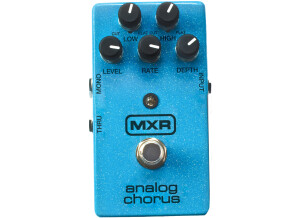
    Analog chorus Two EQ controls: low and cut One volume control One rate and one depth control Two output: mono and stereo USE I haven't opened the manual. It's very easy to find your sound. The EQ and parameters allow for a really wide variety of sounds. SOUND QUALITY It's simply awesome. It colors sound in a wonderful way. You need to find the right balance between rate and depth so that it's not to muddled (unless that's what you're looking for, obviously). Personally, I don't like it when it becomes a tremolo. I use it between my amp and preamp (because I don't have an effects loop). I think it could also be used as a booster. In short, the sound is both versatile and excellent. OVERALL OPINION I've had it for several months and I don't regret it. It's a quality unit, plus it looks nice. I love '80s thrash and was looking for Megadeth's sound in "So far so good so what" and I immediately found my own tone (both with clean and distorted sounds) with this pedal. I didn't give it 10/10 because nothing is perfect and, especially, because I have nothing to compare it to (except too digital multi-effects), but I dreamed about it.

  • « Discreet and effective »

    Boss chorus pedal, mine is made in Taiwan (or Formosa, for erudites and old dogs) and it's Green Label. It has two controls, depth and rate, and a third one to output sound to two amps: so, two outputs. You can either output the chorus on both or the processed signal on output 1 and the "dry" signal on output 2. And it's analog (you can hear it, you can't cheat on that) Make sure you have a daisy-chain power cord because it uses the old system (12V) and if you connect it to a PSA, the LED won't light up completely and the sound won't be "whole." USE It can't get any easier, that's the Boss trademark. I don't have the manual, but there are no mysteries behind the controls. SOUND QUALITY I already have an analog chorus (on the VS h2o; I love the chorus) and, compared to the CE5 (which I also have, since I couldn't sell it), it's warmer. The "hazy" chorus swirling is very characteristic, but also better and bizarre (I'd say a mix of sine and square waves), and even with the depth set to max, you won't feel dizzy. I use it with the Fender Mustang and Tele (aerodyne, to be more precise), together with the DS2 SD 1, BF2 (the other analog one) and the boss DD 20, as well as a holier grail reverb, plus an Engl screamer Combo (I don't like to talk about it like that because it sounds very pretentious...). Do note that even if using only one output and setting it to type II, the sound will be different. It's fantastic to play in stereo. Some people say it has a low level, but I haven't noticed it. It's a bit noisy, but, honestly speaking, whose gonna notice during a gig at high volumes??? OVERALL OPINION I've been using it for... 48h, so these are my first impressions. Yes, I've tested several models, which I own and have in stock (VS h2o, Small Clone, CE5) and I'm a chorus fan. Its simplicity and VERY distinctive sound are the trademark of this nice pedal. I don't regret having bought it. At a time when effects can be really expensive (but also very good), it's a god alternative and a convincing buy. It's easy to slam BOSS, but it's still excellent shit (except for some disgraceful examples, like the MT2, but that's only my personal opinion!).

  • « For the more discerning player »

    The Carl Martin Chorus X2 is a stereo chorus pedal that offers two independent choruses that you can switch between without moving dials midway through a song. So in effect it’s two identical chorus pedals in one box (except for the fact that you can only use one pedal at a time). UTILIZATION So you get a depth dial, a speed dial, another depth dial and another speed dial. You also get an on/off switch and a select switch, which allows you to switch between the two choruses you have dialed up. There are also three LEDs on the pedal, one which lights when the pedal is switched on. Of the other 2 LEDs, one will light depending which chorus has been selected, and it will flash in time with the speed setting, which is quite useful when on stage. When you switch the select switch, the other LED will light on instead. SOUND QUALITY The sound is very warm and rich. Obviously you need 2 amps or stereo speakers to make the most of the pedal. The pedal itself is best suited to bluesy or slightly rocky/alternative music. Nothing to noisy or messy. You can’t really go over the top with the speed or the depth on this pedal. Even at the maximum setting there’s nothing too over the top - it will still only give you a subtle effect. So if you’re after a very heavily chorused sound (think ‘Come As You Are’ by Nirvana), you’ll want to look elsewhere. Other negatives would be that the pedal is connected to it’s power lead - it can’t be connected as part of a daisy chain, and it wont take batteries. Also it is quite a big, bulky pedal. Lastly, with no tap tempo and only 2 different tones you can get without moving the dials it is compared to some digital delays on the market a bit basic in a sense. But you’re not buying this pedal for digital features. You are buying for a clean sound, for true bypass and for subtle warmth. You should not be putting this pedal in between a cheap guitar and a cheap amp, via a daisy chain of the usual suspects of effects. OVERALL OPINION This is a refined pedal for the refined player and needs to be treated as such. One for the more discerning player. Pros Doesn't thin your tone Stereo Nice tone Cons Big and bulky Limited range of effects for the more experimental player In hindsight, would I buy this pedal again? No, I would not. Why? Although it is great having a stereo chorus pedal (I used it at gigs plugged into 2 amps and it made the guitar sound great), I think the effect is too subtle to warrant having the 2 'different' choruses to switch between. For the money I would want something with more obvious, perhaps 'crazy' effects. I've also changed the style of music I make and so the tones this pedal creates doesn't add anything to my sound. If you have a definite style and sound and know this pedal will fit into that then go for it. It's good at what it does. But if you like to chop and change your playing style or experiment with new sounds, this is not the pedal for you.

  • « Killer budget chorus »

    - Controls for speed, time, and depth - Stereo outs - Side mounted jacks - Powered by 9v batter or DOD style 1/8th inch adapter - Top mounted battery compartment - LED indicator UTILIZATION The Good: The addition of a time knob gives you a little more control over the fx65 than you would find on a standard chorus. It’s a simple plug and play pedal that sounds fantastic, and they have survived for a while so pretty reliable. The Bad: I still worry about the construction of the actual stomp section. The plastic seems fragile, and is only connected at the top end. The battery compartment has the potential to fall off completely and get lost. The most frustrating aspect is the design of the adapter jack. You can get adapters that will allow you to use a standard boss style plug, but it is an extra step that you have to take. SOUND QUALITY Fantastic. Do yourself a favor and try it in stereo. Definitely one of the best sounding chorus pedals in this price range, and none of the volume drop issues that comparable pedals seem to go through. The fx65 can do anything from a slight warble to underwater madness. Probably not the most intense throbbing type of chorus if that’s what you’re after. Perfect for 80s stuff, but really adds a great shimmer to any clean channel. OVERALL OPINION This is till my favorite budget chorus. No, it doesn’t sound quite as good as a Jam Pedals Waterfall. But $300 seems a little steep for you, the fact that these can be picked up under $40 is a blessing. They definitely blow away the EHX and MXR offerings in my opinion, at a fraction of the price. I do know of people that prefer the earlier DOD460, but I did encounter volume drop issues with that model. If you are looking for a cheap, solid sounding chorus, this is a great choice.

  • « No real differene that the Taiwan »

    This was the third edition to the chorus line from Boss back in the 80's. The reason primarily for this pedal to become produced was the need for two outputs. The CE-2 only has one output and there was a need to run the pedal in stereo, so this pedal was created. The pedal looks unique in that it has the three knobs level in a row. This is the only 3-knob pedal that has three knobs in a row. This caused the LED light to be hidden and it was a design that was soon changed in favor of the V shaped 3 knob control layout. Boss finally stopped making these pedals in 1992. The Japan one had two labels. The first being a black label and then the green label which was introduced in 1984. The tone wasn't changed but people will often times sell these claiming the Japan label as there is an allure to get the Japan made ones over the Taiwan. Some pedals suffer d in the transition but not this one. UTILIZATION Specifications Controls: Rate, Depth, 2-way Mode Switch Connectors: Input, Output A, Output B, AC Adaptor Current Draw: 13 mA (DC 9V) Weight: 400g/0.88 lbs. Input Impedance: 1Mohm Residual Noise Level: -90 dBm (IHF-A) Recommended Load Impedance: 10kOhm or greater Recommended AC Adaptor: ACA Series SOUND QUALITY The sound quality is pretty much the same as the Boss CE-2. The sound quality s pretty much he same as the Taiwan made pedals. The only real change is the output section and the added stereo output. The tone is the same and the EQing of the pedal is the same with simply the rate knob and the depth control knob.You get a nice shimmering watery chorus tone. The liquidity of this pedal is remarkable. It sounds very lush in nature and springs up some nice modulation tone. This is the kind of pedal you use with a nice clean guitar or a distortion amp that you need to add a little bit of beef to. OVERALL OPINION These pedals have long been gone from production so the used market is the only way to to go at this point. The Japanese version goes for a little more because of the allure to have the first editions. The black label being tom most famous and later moving to the green label.I haven't seen them on the classifieds in quite some time and have no idea what the going rate for them are in this market. I would recommend this pedal if you can find one at a decent price in the classifieds. They are lush sounding and will add a great amount of depth to your tone.

  • « Cheap box, expensive sound »

    The Arion chorus is a mono in, stereo out chorus with a wide range so it can also get you that faux-leslie type of tone. It can be run in mono with a little switch. The pedal became famous because some LA-studio players started using it, it's cheap (although they are fetching bigger prices on Ebay now) and has a great sound if you want THAT sound. There are different versions available and the internet-rumour says that the grey box sounds best. I owned them all and had 4 of them at a certain point, kept the best one which is a black box... UTILIZATION The setup is straight forward, the 3 control work well together. The rate and depth work well to fine tune the chorus tone. Running the rate high will get you that faux-leslie sound, works great!! The tone control is powerfull enough. Although I owned one with manual, I don't remember it, don't think I ever looked at it. I have used the pedal on my board and in a rack setup. 1 annoying thing, the pedal is always off when you power it, so when you have it in a rack, you always have to remember switching it on! SOUND QUALITY I usually run the rate at about 10:30 for chorus sounds and have the tone a little above 12:00. When using it for leslie tones, I have the rate and depth up but keep the tone lower, around 11:00 for a smoother tone. In bypass, it does suck some tone so there are modded-version available. Put it in a looper and it's no longer an issue. I currently have it in my rack but am considering picking up a modded version to put on my board. OVERALL OPINION It's a really cool pedal if you are looking for that tone. THAT tone would be the Michael Landau chorused clean sound he used to get from his big rack system. It's not 100% nailing the tone but close enough for rock 'n' roll!

  • moosers's review

    The Diamond Pedals Halo Chorus is a unique chorus pedal suitable for use with any electronic instrument. I've used the pedal only with electric guitar, so this review will be based on use of this pedal with this instrument only, which I would think is what most people are using this pedal with anyway. The pedal has stereo 1/4" inputs and outputs, as well as a 1/4" output for an expression pedal, which is something that I've never hooked up to this pedal. This isn't rackable as it is a stomp box controlled by your foot. UTILIZATION Users of the Diamond Pedals Halo Chorus shouldn't have any problems using it, as everything is pretty straight forward here. For parameters, you've got chorus depth, speed, phase modulation mix, and chorus mix. If used, an expression pedal can also control delay time and LFO. After playing with the pedal for a short while I was able to understand the pedal fairly well, so I can't imagine too many people having difficulties understanding it. I've never had a need to look at the manual for the Hal Chorus pedal. SOUND QUALITY The sounds that are possible with the Diamond Pedals Halo Chorus go way beyond just your standard chorus sounds. It also has delay and phase like tones, the combination of which makes for an awesome sounding modulation pedal. While it is certainly possible to get traditional sounding chorus tones, I think that this pedal makes its living on its unique tones, as this sounds unlike most pedals that I've used out there. I've used the Halo Chorus with a Fender Telecaster and a '65 Fender Deluxe Reverb, so I definitely got an accurate read on what the pedal truly sounds like, and let me tell you that you can really get some interesting sounds with this one. This isn't to discredit the more traditional chorus tones that are possible, as they are extremely clean sounding as well... OVERALL OPINION While more expensive than most chorus pedals out there, Diamond Pedals Halo Chorus isn't your typically chorus pedal at all. It has unique parameters and unique sounds to match, as well as more traditional ones. The pedal is built extremely well and is one that should last a long time if treated properly. If you're looking only to get some standard chorus tones, this can do that for sure but I would probably recommend looking elsewhere as there are plenty of cheaper options out there that don't have all the bells, whistles, and versatility that the Halo Chorus does.

  • « Warm and Lush while Blending Chorus with Echo »

    SOUND: A cross between classic and ethereal, Dark Waves allows you to add echo… or chorus… or both. Considering the Echo first, it is not an expansive delay with long tails; rather, it produces a warm delay that stands out in the mix without sounding muddy. The best way to describe it is an extensive and modified slap back response (you can hear 3-4 repeats), although it is not snappy in its delivery. It very much coordinates well with its Chorus counterpart and how they respond together. The Chorus aspect is very good and not shrill. Some chorus pedals, particularly as you increase the mix, depth and rate can sound somewhat edgy and even grating to the ears – settings you likely would never use. With the Dark Waves chorus feature up full (with Depth, Rate, Volume/Mix up full and the Filter completely counter-clockwise) you get a strange ray-gun-like sound, as though some vibrato had a bout of nervous laughter. Lastly, the Volume knob controls the extent of the chorus, which is very much a mix knob since the loudness of the pedal does not seem to increase (or if it does, it is subtle). OVERALL IMPRESSION: Sounding great with guitar, Dark Waves also has been engineered for use with Bass and Keyboards. At a very reasonable price of $129 it is an excellent buy considering you get two effects in one that work very well together. The Echo is straight forward, but it performs as intended (you will not get a spacey result, but it is solid sounding and its pulse synchronizes with the Chorus). The Chorus is rather good and in a number of ways. First, as with any quality Chorus, you can make the effect rather subtle and barely audible, which is ideal for lead playing when you want to add some dimension or thickness to a tone. Second, there are some very nice parameters and usable ranges with the Rate and Filter knobs, to control how rapid the chorus sounds, but also how smooth or edgy you would like it. Third, even with all the knobs turned up full you still get interesting chorus results that don’t sound unpleasant. Idiotbox produced the Dark Waves Echo/Chorus pedal with a focus on ‘Instant Death Rock’ (and there’s a good in-house demo video on its site) although it likewise sounds awesome with acoustic strumming and traditional or classic rock playing. The warm yet punchy echo certainly compliments the chorus and Dark Waves definitely is worth considering if you’re in the market for a highly-functional Chorus with the added bonus of an Echo. GENERAL USE: You get a nice hint of the Chorus effect with volume set at 12-noon, while remaining behind the main signal and without overpowering it. With Volume up full there seems to be an equal mix of the original signal and Chorus. The Depth knob controls how deep the chorus effect is or its ‘reach,’ whereas the Rate controls the speed or shimmering of the Chorus (up full and it still sounds good rather than a chorus out of control, if you know what I mean). The Filter shapes how subtle or extreme the chorus effect is: fully clockwise produces a very smooth sounding chorus, whereas fully counter-clockwise creates more aggression in the effect. There’s also a Swell knob that produces a quick rise and a slow fall in the effect (fully counter-clockwise), a slow rise and quick fall (fully clockwise) or anything between. The Echo knob is what it is, and about 12-noon produces a nice subtle effect that floats softly in the background, whereas cranked full makes the echo very noticeable, but not overpowering. A setting of about 12-noon to 1-o’clock works well when playing some heavy riffs, whereas slower more ambient passages sound good with the effect up full or nearly so. OTHER DETAILS: Dark Waves Echo/Chorus is a standard pedal size, measuring approx. 122 x 62 mm (4.7 x 2.6 inches). Encased in a 125B sized solid steel chassis, the purple sparkle paint on black gloss appears to be of good quality and its looks certainly portray the atmosphere of this pedal. Likewise the six control knobs and their pots are both smooth and of high quality when turned. The foot switch produces a solid click under foot, but remains noiseless in the signal when switching on-and-off. The footswitch also is far removed enough from the control knobs that damage should not occur from a stomping foot; regardless, the knobs feel very solid and should take some abuse. Both input and output are located in the back, whereas the power input is located along the right side and next to the footswitch (exercise some modest care, and so no heavy drinking and stomping). Dark Waves accepts a 9V battery or it can be powered by a standard 9V DC ‘center negative’ 2.1mm BOSS style input while drawing 100mA.

  • « Warm and Lush while Blending Chorus with Vibe »

    SOUND: The Atlantic Chorus is another in the line of great sounding vintage pedals by Carl Martin. And although considered a chorus pedal, it morphs from Chorus into Vibrato. At 12-noon the Rate knob produces a combination of Chorus/Vibrato. As you turn the knob counter-clockwise you hear a more traditional Chorus and as you turn the knob clockwise it sounds more Vibrato. Regardless of choosing a Chorus or Vibrato (or a mix of the two) the pedal automatically adds warmth to the tone, although more so within the Vibrato zone. This may mean adjusting your EQ slightly and depending on the ‘color’ of your pickups and the desired tone. In a very small dose (with Depth low) both Chorus and Vibrato can add a very pleasant and tasteful dimension to an overdriven lead tone – you know the sound is fuller, but the effect is not overly obvious. But even when pushing an overdriven sound with a lot of Chorus, the effect remains true in the mix and without weakening. As with clean tones, the warm swirling effect of the Atlantic Chorus encourages a guitarist to increase the mix and completely enjoy an exceptionally full sound. What is very notable about the Atlantic Chorus is that it has a very organic aura to it… warm and almost dream-like, and more subtle than modern-based chorus or vibrato pedals. This makes it easy to achieve a more vintage sound, but also a chorus/vibrato that maintains a highly natural presence. Another bonus is the Level knob, which adds quite a bit of boost to the signal, unlike other chorus/vibrato pedals I have tried, and so you need to be careful with that function. OVERALL IMPRESSION: Carl Martin has once again demonstrated that the company and its tech engineers can produce solid and well-intentioned gear. Certainly there are digital chorus and vibrato pedals that offer more options, but this all-analog pedal stands proud in what it offers. If you’re looking for a basic design with chorus/vibrato that ranges from almost inaudible to very noticeable, and yet have characteristics that sound so natural that it becomes part of the tone (rather than producing an effect), then the Atlantic Chorus is a solid buy at approximately $150 Canadian. The Atlantic Chorus will warm your tone, and so there may need to be some EQ adjustment, although I suspect it would sound fabulous on a Fender or Vox clean channel. Not only is there a very healthy boost with the Level control and, of course, you can alter the Speed and Depth of the effect, but the Rate knob allows you to select all Chorus, all Vibrato, or you can bleed one into the other for various levels/combinations. GENERAL USE: The Level control produces quite a boost in the signal; consequently, make certain that it is turned completely down or perhaps at 9-o’clock – then adjust as required. The Depth controls how much of the effect is mixed into the signal – keeping it around 9-o’clock produces a subtle effect, which adds nicely to lead solos or if you want some shimmer in your clean tones. The Speed knob controls how rapid a pulse you get, with either the Chorus or Vibrato, from an eerie Pink Floyd effect to a fast Surf Rock. The Rate controls how much Chorus and or Vibrato you get, which makes the Atlantic Chorus rather unique. At 12-noon you get a mix of both effects, but as you turn the knob counter-clockwise to about 10-o’clock, there is an obvious dominance of Chorus with some vibrato, whereas turning it even more to about 9-o’clock produces primarily a Chorus quality. Conversely, once you get to 2-o’clock and beyond when turned clockwise, the sound is more obvious vibrato and even warmer to the ears. OTHER DETAILS: The Atlantic Chorus consists of a two-tone die-cast chassis and measures 115 x 60 mm (about 4.50 x 2.4 inches). The off-white vintage-looking plastic knobs are of heavy construction and the pots are very solid and firm when turned (not stiff, but they will stay in place even if tapped slightly and accidentally). The bypass switching produces a solid click when turned on/off and there doesn’t appear to be any ‘noise’ when doing so… you do not hear a ‘click.’ The footswitch is a good distance from the knobs and the on/off LED is toward the back and between the upper two knobs. All inputs, including power, connect to the back of the unit, which is an ideal space saver on pedal boards. The Atlantic Chorus does not run on batteries and requires a standard 9VDC power supply (drawing 40mA minimum).

  • « Wasn't overly impressed »

    The TC Electronic Corona Chorus is another one of the new Tone Print pedals that the company has released. It was initially of interest to me when I wanted to pair one with my Flashback delay for some shimmer on my clean sounds. It has a slightly less complex feature-set than some of the other pedals in this series. It has a basic chorus setting, and a switch to take it into the Tone Print (load presets on with USB) or Tri Chorus modes. The controls are nice and basic, just speed, depth, tone and a master FX level. It is on par with many of the popular chorus pedals on the market (BOSS, MXR, EHX, etc) for features. It does have the nice small size and easy to access battery compartment which are nice things to have in a pedal for sure. UTILIZATION Setting up this pedal is pretty easy. I wasn't really able to get any chorus tones that I personally cared for, but the controls were easy to use and did what I thought. It can go from a nice light shimmer to a very warbly shaky sounding chorus. A nice feature too is the "tone" knob, which allows the user to dial the EQ in (IE: if they prefer a darker chorus or maybe something brighter) they can do that with this pedal. Like all TC pedals in this series it's shooting for a nice set of boutique level tones in an easy to use package. SOUND QUALITY I was initially very interested in this unit to add some nice shimmer to my clean sounds and perhaps use it with some overdrive for an eighties type "detune" effect as well. Unfortunately I just could not get into the tones of this unit. It didn't quite have the rich and lush choruses that I was hoping for, but it tended to sound a bit thin and bright to my ears. I tried dialing it in as best I could but I found it just not to work for my ears. The regular chorus mode and tri chorus mode didn't sound too different to me, just a bit darker and more bassy in the tri chorus mode. It was surprising because I know TC is known for effects like this, but I guess you can't win 'em all. OVERALL OPINION All in all I think the TC Corona Chorus is a decent idea for a good quality chorus at a fair price. However I just wasn't impressed by the tones or way it sounded. It just seemed thin and anemic compared to what I heard in my head and ultimately I decided not to buy one afterwards. For $130 this pedal is a decent deal, but its tones might not be for everyone. I guess the user should really try one to decide!

  • « One amazing pedal »

    One of the great units from Boss back in the 80's. The CE-2 was the first compact pedal chorus from Boss. The CE-1 was released 1976 and contained the exact same circuit as the Roland Jazz Chorus JC-120 Amp. So to have the same specs as the Roland Jazz Chorus you are in good company. The Roland JC has been considered the best clean and chorus tone that has ever been produced. So this chorus is something to be revered. This was the pedal to have when playing a good clean tone or even needing a little thickening of the distortion guitar which was popular throughout the 80's. Metal guys would use this pedal to help beef up their overdrive tone and sweet the spectrum of frequencies up a little bit. This pedal was produced in Japan up until 1988. They then took production over to Taiwan. Some say the tone changed but I think unless you A/B them and even still wouldn't hear any difference. The label on the back change from black to green while still in Japan. Then later changed to to Taiwan but kept the same green on the label. UTILIZATION Specifications * Controls: Rate, Depth * Connectors: Input, Output, AC Adaptor * Current Draw: 9 mA (DC 9V) * Weight: 400 g. (14 oz) * Input Impedance: 470kOhm * Signal/Noise Ratio: 90dB or more * Recommended Load Impedance: 10kOhm or greater * Recommended AC Adaptor: ACA Series SOUND QUALITY I think this pedal shines in almost any situation it finds itself in. It sound superior with a clean guitar. You will get a nice watery shimmy tone that is almost magical to listen to. If you use it with an overdriven amp like a Marshall you get lighten up the control knobs a bit to add just a slight sweetening of the distortion. This will get you a big bigger tone much like adding an analog echo to the distortion tone. It is a nice tone filler. This is a legacy pedal from Boss. This was the second introduction to the chorus world and the first compact chorus pedal ever produced from the Boss company. So this pedal can be put on a pedestal. This pedal was one of the best sounding chorus pedal in history. If you can score one then you will understand the tone to which many other manufacturers attempted to emulate. OVERALL OPINION These pedals were stopped being manufactured in 1988. They continued in Taiwan until 1990. So you would have to find one on the used market somewhere. They are great sounding pedal and some considered them the best chorus pedal that has ever been produced. If you score one somewhere you won't be disappointing.