Log in
EN
FR

Tremolo pedals

270 products found

Filter
Sort by
Brand
Evaluation
  • Reviewed or not
  • Editor’s award
  • Reviewed by Audiofanzine
Availability
  • Available or not
  • Sold new or used
  • Sold new
  • Sold used
Must-have products
  • All products
  • Flagship products
  • Best rated products
  • Hot products
  • Popular products
Price
  • Freeware
  • Low-cost (< $100)
  • Mid-range ($100 - $200)
  • Premium (> $200)
€
Clear
Sort by
  • Popularity
  • User ratings
  • Price - low to high
  • Price - high to low
  • Used price, increasing
  • Used price, decreasing
  • Name (from A to Z)
  • Name (from Z to A)
  • Added on
Sort results
  • Popularity
  • User ratings
  • Price - low to high
  • Price - high to low
  • Used price, increasing
  • Used price, decreasing
  • Name (from A to Z)
  • Name (from Z to A)
  • Added on
Filter results 270 results found
Brands
Evaluation
Availability
Must-have products
Price
  • Freeware
  • Low-cost (< $100)
  • Mid-range ($100 - $200)
  • Premium (> $200)
Show results

The best Tremolo pedals reviews

The reviews Audiofanzine members found the most helpful.
  • « From Eerie Pink Floyd to Surf Rock,the Surf Trem is excellent value »

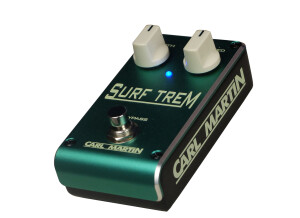
    SOUND: Below is a YouTube demonstration video on the Carl Martin Surf Vibe 2018, which is the latest ‘scaled down’ or streamlined pedal board version of this classic. The Surf Trem is as simple as it gets… only two knobs, DEPTH and SPEED, which vintage sound allows you to mimic the tremolo circuit found in vintage Fender and Ampeg amplifiers. The sounds possible with this pedal are quite expansive and enjoyable to implement in one’s playing and is not so straight forward as simply a Surf music device. For example, by using a lot of Depth and moderate Speed you can get that eerie Pink Floyd quality. Or decreasing the Depth and increasing the Speed works well for faster rhythm and lead work, reminiscent of that Surf sound. However, maximizing both Depth and Speed produces an incredibly fast pulse that can add an extra dimension and thickness to power chords and Metal lead playing. OVERALL IMPRESSION: What I like about Carl Martin is that the company produces highly useable pedals that range from classic to modern. There are few bells and whistles with Carl Martin gear, but what you get is what the pedal suggests in the highest quality. If you want a quality delay or overdrive, then Carl Martin can deliver, with the Surf Trem being no different. Pure analog, the Surf Trem produces incredibly clear and beautiful sounding tremolo that truly is like the vintage amps of yester-year (which is why this pedal is found under the ‘Vintage Series’ section on the Carl Martin website). Because the Surf Trem produces such wide sweeping effect it is indispensable for spacey Prog compositions and long drawn out chords. Add a bit of reverb or echo to it and it sounds simply fantastic. However, one cannot avoid throwing in a bit of Surf music for the sheer fun of it. But what I like most is that you can have just a little or a lot of Speed while dialing back the Depth, so that you get a hint of effect with your dry tone, which produces even more variations of effect. EASE OF USE: You can’t go wrong with only two knobs, although you still will have plenty of tweaking to do because of the wide array of tonal possibilities. Anything below 12 o’clock on the Speed knob has a wave-like effect to something that sounds slightly swirling. Once you get around the 2 o’clock range on the Speed knob you begin getting that familiar pulsating sound. Around 3 o’clock and almost all the way (95%) produces a Surf type effect at different rates (moderately fast to very fast tremolo). All the way must be around 220 bpm and sounds like a super fast stuttering. The Depth knob is simply the ‘mix’ of the tremolo effect. This is the control that makes the Surf Trem so expressive. You can have a high level of Speed and still barely notice it in the mix when the Depth is turned down, which means adding in some dimension and quality into a guitar’s tone without it being overwhelming. And so, because a higher Depth means a more pronounced effect, it’s interesting to note that when you use a very slow Speed, for that spacey sound, you can play at a moderate speed if the Depth is down; but if you increase the Depth then a very slow Speed necessitate a slower speed of playing (otherwise, you miss out on some notes since a tremolo effect means altering loud with SOFT). If this isn’t clear, refer to the Demo video above – you can hear how I had to slow down my playing to use a slow Speed setting to its best effect and as the Depth increased. RELIABILITY & DURABILITY: This is the 2018 version of the Surf Trem, designed in the same manner as the newly and recently released DC Drive 2018. It comes in two-tone anodized die cast housing – black along the sides (with the Carl Martin name) and a groovy surf green metallic top. The switches and knobs are typical, comprised of both metal and plastic. The Surf Trem has a metal foot switch (for on and off) and plastic turning knobs for Depth and Speed – all of which are solid in construction. The foot switch is not close to the plastic knobs, and so it is unlikely there would be any stomping mishaps that would crack the Depth and Speed knobs. The standard 9v 50mA power input is located at the back, which means less chance of a power cord mishap (twisting or bending of the input). Likewise the cable input and output are located in the back, which I tend to prefer (out of harm’s way, but it also allows you to pack in more pedals on a pedal board) and which Carl Martin has been doing with their latest pedal releases (smart move!). As a final note, you cannot use batteries with the Surf Trem – a typical 9v power source/adapter must be used.

  • mooseherman's review

    This is a pretty solid tremolo pedal. It's got a decent amount of controls and the great warmth of an analog pedal. This is tried-and-true analog pedal, so there are no computer or MIDI capabilities with it. The pedal isn't rackable either, as it's a floor pedal. The connections are the basic 1/4" input and output, and there is an adaptor for this pedal as well. UTILIZATION The editing of the tremolo effect on this pedal is pretty basic, and therefore, it's easy to do in a short time. This works out great for on-the-fly edits and changes. There are only four knobs. The first is for the speed of the tremolo effect. The second knob controls the rate of the effect. The third knob determines the volume of the tremolo, its basically the mix between the effect and the dry signal. The fourth knob switches between different settings, which are basically different variations of the tremolo effect. The switch between the middle two knobs also changes the effect drastically, adjusting the character of the effect in a way that is difficult to explain. The manual will explain things clearly to anyone who has trouble getting it to work, although I don't think it's hard to use at all. SOUND QUALITY I really liked the sound that I got out of this pedal, which I was hoping for. Not many tremolo effects really do it for me, I like the way they sound on record more, and that's mostly because of studio effects and not so much pedals. This pedal sort of betrays that stereotype. I think that what I like most is the tap feature on the second switch, that allows you to adjust while playing in a way that is totally liberating. In general, the best thing about this pedal is that it doesn't overwhelm the tone, and in fact only enhances it. It also doesn't make everything super muddy, either, which I like. OVERALL OPINION Overall, I'd have to say that this is one of the more enjoyable tremolo pedals I've had the pleasure of playing. For the most part, I don't use this effect that much, which makes me wonder whether or not I'm going to hang onto it, really. I think that I will for now mainly because it's the best tremolo pedal I own. I'd have to recommend it to anybody who needs a tremolo that doesn't frustrate and annoy them, and needs it mostly for live purposes. If you haven't gotten into the effect in a big way yet, this might be the pedal that changes your mind.

  • « Usable weirdness »

    Sine and Sawtooth Wave Options Mono or Stereo with Panning Output Switchable Envelope Control for LFO Variable Envelope Sensitivity and Acceleration Speed and Depth increase or decrease independently Trigger input for clean signal direct to Envelope and Beat Sync Expression Pedal inputs for Speed and Vol / Pan Pigtronix 18VDC power supply included High Fidelity Analog Optical circuit Circuit Design by Howard Davis Sound Design by David Koltai Chassis Size = 5.7” x 4.7” x 1.5” UTILIZATION I have historically been a traditionalist when it comes to pedals. So this one is a bit of an odd purchase for me. I have owned and played weirder though. The idea with the tremvelop as that it's a tremolo that responds to the dynamics of your playing. Or in other words, a trem with an envelope filter attached. I believe this is something that in the past you could only do with some sophisticated rack unit programming. Maybe with an Eventide Eclipse or Axe fx. But not it's in pedal form. Feature wise it is pretty robust. Has expression pedal inputs for both the speed control and to pan the volume. To be honest it's hard to get your head around everything this thing can do at first. For the first week I used it, the thing was little more than a noise maker. This is one of the few pedals that I would strongly suggest reading the manual. It helps a good bit. Other than that, it's a well made pedal with a great spec set so I have no gripes on that end. SOUND QUALITY The first thing I realized about the tremvelope is that it sounds very good in a studio setting where the stereo outputs are used. The whole panning thing opens another world to this pedal. Unfortunately this gets a bit lost in a live setting. But that's not a big issue. Most of the effects are sort of your run of the mill trem things. The cool thing is a how you can manipulate them with dynamics of your playing. This opens up a lot of possibilities. There are a lot of very odd effects in it too though. You can get some crazy ambient stuff and some other sounds that are just plain weird. The ambient stuff is very very good though. OVERALL OPINION I know Pete Thorn is big on this pedal. I think it is best used in a controlled studio environment but it's fine used live if you know what you are doing. It does do the classic trem duties very well, but you really only get your money out of it if you play with it for a while. There are some unique and usable sounds in there, just give it some attention. You can get great atmospheres from the tremvelope and in my opinion the weird sounds are even more exciting than the typical stuff.

  • « The Best! »

    The Supa-Trem is a tremolo pedal available from Mike Fuller at Fulltone, and it lives up to the Fulltone name. Fulltone uses a three switch and two knob format for this pedal, which is different, but very easy to navigate. One knob “Rate” adjusts the rate of the pulsing (there is a LED that blinks to show you the rate the pedal is set at), and the other knob “Mix” adjusts the amount of dry signal it gets mixed with. A bypass switch turns the pedal on and off, a speed doubles or halfs the tempo of the tremolo depending on how you set it, and the hard/soft switch lets you go between shimmer to stutter. True bypass switching , a large LED, and sturdy metal construction round out the features. UTILIZATION Many pedals have the same features as this pedal, but not very many of them have them available via footswitch. Most pedals use toggle switches to change between settings but using footswitches is great for live settings. Being able to double or half the rate of the tremolo is great for adding special effects to parts of songs. It is very easy to get a good sound out of this pedal, and with about any amp I’ve paired it with. I believe it’s harder to get a bad sound out of it honestly. The pedal is laid out very well and the knobs are sturdy and turn very smoothly. Fulltone manufactures their own custom potentiometers according to their website “because what has been offered as "Industry Standard" has a 20% failure rate within 2 years”. I’m not sure about that fact, but the ones they put out are very nice. The bypass switches are also heavy duty and designed by Mike Fuller. SOUND QUALITY This pedal sounds super. It uses a real vintage style photocell, so it gets those true “tubeamp-like” tones but there is no external clicking like certain other tremolos that use this technology. I love that all the tones can be adjusted on the fly using your feet, either on the switches or the oversized knobs that can be turned with your shoes. This thing really does get that classic CCR style amp tremolo that really warms up a rhythm tone, and at a flip of a switch it can get go crazy and get super stuttering effects for dramatic intros and the like. There is absolutely no loss in tone or added noise with this pedal, or any other Fulltone pedal I’ve played. OVERALL OPINION Overall this is the last tremolo pedal I will ever buy. Fulltone pedals are pricey, but worth it in my opinion. You’re getting a well made pedal that is going to last that has been designed and hand built by a musician. Putting a 5 year warranty on these pedals says a lot too. If I were just looking for a basic tremolo to use sparingly I would probably just stick with a Danelectro Cool Cat Tremolo because really, it is a good pedal and is true bypass. If you’re looking for a few more options and an upscale tremolo pedal, you would be hard pressed to find a better one than this.

  • moosers's review

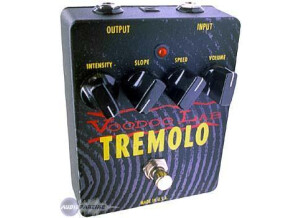
    The Voodoo Lab Tremolo pedal is a guitar pedal that can be used with any electronic instrument in addition to an electric guitar. The pedal is an analog one and has standard 1/4 inch connections. I'm not sure the exact voltage on the pedal, but I used a power supply that was suited specifically for it. This isn't a rack mountable piece of gear as it is a foot pedal. UTILIZATION Using the Voodoo Lab Tremolo pedal isn't complicated at all as it has some standard parameters. It has knobs for intensity, slope, speed, and volume and all are easily accessed and manipulated. These parameters definitely provide enough control over your sound to make it possible to get a wide selection of different tremolo and vibrato tones. This is pretty much a fool proof pedal to use and even if you aren't familiar with what the parameters will do before hand, playing around with them for a few minutes will give you some ideas. I've never seen the manual for this pedal so I can't say how well put together it is or not. SOUND QUALITY I'm definitely a big fan of the way the Voodoo Lab Tremolo pedal sounds as it not only has a great deal of versatility, but has a clean tone across the board no matter how you set the parameters. I use the pedal whenever I don't have access to a Fender amp with vibrato, and generally play a Fender Stratocaster with it. I love the sounds that I'm able to get with this pedal and it is one of the better tremolo pedals that I have used out there... OVERALL OPINION If you are looking for a tremolo pedal that is versatile and has a great tone quality, the Voodoo Lab Tremolo pedal needs to be in the discussion. While there are certainly other tremolo pedals out there that have comparable sound quality and even better, this pedal is absolutely worthy of a try. The price isn't too expensive and it is built like a brick so as long as you treat it reasonably well it should last a while. All in all, if you are looking for a great sounding tremolo pedal and don't already have vibrato or tremolo on your amp, this pedal is a popular item for a good reason.

  • « Organic, warm and lush »

    SOUND: One of the best sounding tremolos I’ve come across, and straight-forward in use. The OptoTrem allows for a change in Rate and Depth, while adjusting the Wave, while the quality is so warm, organic and lush. If you’re looking for a tremolo with a bit more ‘cut’ or bite, then the OptoTrem may not be the best solution since it is a warm tremolo. Where this tremolo shines is with music that is not too complex (e.g., a lot many instruments or in a distorted setting), but definitely with ambient and ethereal music, whether instrumental or perhaps something with a Pink Floyd vibe. The tremolo effect is heard slightly at about 9-o’clock, whereas 12-noon the effect seems to be in parity with the original tone. At 3-o’clock and greater you hear almost nothing but tremolo, which sounds absolutely dreamy, as though the notes are floating on clouds. The Rate ranges from a slow pulse to a fast stutter, and likely faster than anyone requires (a machine-gun rate when turned full). The quality of the wave varies, from Square (all the way counter-clockwise) to Triangle (all the way clockwise). The wave tone or quality around the middle (between 10-o’clock and 2-o’clock) has more of a sine/rounded square character with a bit of asymmetry like an amp trem. Any background pulsing noise (typical with tremolo and vibrato pedals) is relatively low and only slightly noticeable when playing ceases and the listener listens for it. OVERALL IMPRESSION: The OptoTrem is priced reasonably at 110 Euro, particularly for the quality of construction and sound. Designed and hand-built in Spain by a lone individual, Pedro Garcia (who also does custom mods), the OptoTrem is his latest offering – and his company as a whole should be looked into as he has some really great sounding gear. As for the OptoTrem, which is an optical tremolo (hence the name), whether using a square wave with a bit more edge, or a triangle wave for a smoother transition (or something between), and combined with any measure of Depth and Rate and you will achieve sounds incredibly smooth and organic, as though the tremolo is part of the guitar’s tone as opposed to an effect added on the side. As an important feature, the on-off switch is popless true bypass, which means you’re not going to hear any clicking or noise as you turn the OptoTrem on and off. GENERAL USE: From subtle wave to a fast pulsating ‘surfer maniac-paced’ tremolo, the OptoTrem has all the bases covered. Consequently, all bases are covered. Depth at 9-o’clock makes the effect (rate and wave) audible, although very passive within the mix. The tremolo becomes more obvious at 10-o’clock and definitely present around 12-noon. Once you get around the 3-o’clock range or greater you hear very little of the dry mix, which makes for some utterly beautiful ambient results. The Rate goes nuts at 3-o’clock and beyond, and I suspect most people would use the OptoTrem between 9-o’clock and 12-noon (unless you like Surfer music, which means pushing past 12-noon). A low Rate gives you that warbling Pink Floyd quality, whereas 12-noon works perfectly for playing the theme to Twin Peaks. The Wave knob will give you a harder hitting square wave when turned all the way counter-clockwise, and smoothes out considerably with a Triangle wave fully clockwise. Anything between will give a mix of results best described as a sine/square (similar to what you would hear in most amp tremolos). OTHER DETAILS: OptoTrem is a regular-sized pedal, OptoTrem, measuring 112 mm (L) x 60mm (W) x 50mm (H) with knobs (4.4 x 2.4 x 1.97 inches). The heavy duty chassis is powder coated in dark blue with black lettering – the pulsating LED light (to indicate Rate) is centered nicely within a wave graphic for a pleasing look. The three plastic knobs are a heavy quality and should withstand normal use and abuse. All knobs have good quality pots (smooth and solid when turned). The Alpha footswitch (on/off) produces a solid click when engaged or disengaged – there is no popping when switching. The cable input/output and the power input all are located in the back, which saves on pedalboard space, but also keeps them in a more secure location. OptoTrem has shielded inputs/outputs to avoid radio-frequency interferences, as well as Alpha potentiometers with dust shield. Other quality features include Panasonic and WIMA caps and 1% metal film resistors for lower floor noise. Finally, the OptoTrem has a filtered and ‘wrong polarity’ protective 9VDC power input (requires standard 2.1 mm center negative jack) while drawing 24mA of current.

  • « Fantastic and innovative tremolo pedal. »

    Dual Channel Tremolo with individual rate and depth controls Rate: Controls speed of tremolo Depth: Controls level of tremolo effect Volume/Boost: Controls signal output 9vdc, battery or adapter powered 1/4" in and out I rate it a 9 as it would be nice to have a stereo option, which it does not have. UTILIZATION This pedal is extremely easy to use. There are two channels, and each can be set up for different settings. I love this, as I like a slower, throbbier tremolo on clean passages, and a quicker, yet narrower trem on lead work. The volume feature is genius, as this pedal can boost the output of the guitar signal. Typically tremolos suffer from a perceivable volume loss when engaged, but this pedal does not have that problem. SOUND QUALITY The sounds are extremely rich and luscious, like an old 50 or 60s Fender tube amp optical tremolo. Not too choppy - this is a vintage-sounding unit. The trem will get very deep, and very fast or slow - there is a lot of room to find just the right settings here. The pedal is pretty transparent - your guitar will still sound like itself. One neat trick to try is to run this before a distorted amp, and have the tremolo engaged to have a medium-fast speed but shallow depth - the solos tend to jump out, and the tremolo sound gets very subtle at that point. Joe Bonamassa does something similar with his rig, to great effect. OVERALL OPINION This is a great pedal all the way around! Josh Smith is a fantastically tasty guitarist, and to have his name on this pedal is a testament to how lush the tones are. Having two settings in one pedal is a boon, and the volume boost is fantastic. I'd absolutely buy another one of these pedals. This is the best tremolo I've ever used.

  • moosers's review

    The Diaz Tremodillo Tremolo is a pedal useful for any electric instrument, although specifically designed for electric guitar. This is what I've used the pedal for, although I definitely wouldn't doubt it's ability to be a great pedal for keyboards or otherwise. The pedal has basic characteristics, with 1/4" jacks for input and output and a nine volt power supply jack. It's not going to be rack mountable in any way as it's a stomp box to be controlled by your foot. UTILIZATION It's not hard to operate the Diaz Tremodillo Tremolo, although there are some unique features here to be aware of. It's got knobs for controlling rate and dwell parameters, the latter of which is the equivalent to depth, while it then has foot switches for both engaging/shutting off the effect, and the other is a unique button for doubling the speed, which is something I haven't seen anywhere else. It's very easy to use, so you shouldn't require the assistance of the manual. SOUND QUALITY The Diaz Tremodillo Tremolo is definitely up there with some of the best sounding tremolo pedals I've used. It's definitely a traditional tremolo, reminding me a bit of vintage Fender amp vibrato. I was an engineer on a recent session where this pedal was being used, and was almost immediately impressed with the depth of the effect, despite only a minimal amount of controls. There are some pedals out there with more control and a comparable high quality sound, but you're going to be hard pressed to find one you could say sounds better than the Tremodillo. OVERALL OPINION While expensive for a compact pedal of this kind, the Diaz Tremodillo Tremolo pedal is made for professionals looking to add a top tier trem pedal to the mix. There are cheaper models out there that I'd recommend checking out, but if you're looking for tone regardless of price, Tremodillo needs to be near the top of your list of pedals to try out. I don't know too much about Diaz, but judging on my use with Tremodillo and a few of their other pedals, they have a very good idea of what they're doing!

  • moosers's review

    The Malekko Heavy Industry Trem is a super small tremolo pedal suitable for use with all electronic instruments but designed for electric guitar. The pedal is an analog one, consisting of 1/4" jacks for input and output and runs of a standard nine volt power supply. The pedal is definitely smaller than any pedal I've seen out there other than other pedals made by Malekko Heavy Industry. UTILIZATION There's not much at all to using the Malekko Heavy Industry Trem pedal. It only has two parameters for speed and depth, which is a pretty standard make up for tremolo pedals and are the same parameters you'll find on Fender amps for the same effect. The pedal probably isn't big enough to hold any more parameters anyway! SOUND QUALITY The Malekko Heavy Industry Trem definitely gives you that classic tremolo sound much like that found on vintage Fender amplifiers. You don't need to do much at all in order to get a good sound from the pedal, which is one of my favorite aspects of the pedal. You control it to get the sound you want from it rather than controlling it to get a good sound from it, if you know what I mean. I've used the pedal with a Fender Telecaster and I don't remember the amp, although it was obviously not a Fender since we were using a tremolo pedal. OVERALL OPINION While not the most versatile tremolo pedal out there, it really doesn't matter too much as the Malekko Heavy Industry Trem has a great overall sound. I also love how small this pedal is as it makes it easy to bring around if necessary. It's also the cheapest pedal in this line of pedals from Malekko Heavy Industry, at $100 US dollars. There are definitely cheaper and more versatile tremolo pedals out there, but this one has a great sound that is hard to beat, even if it's not a open to manipulation as others out there. I'd recommend checking out this pedal and the others in this super small line of pedals for sure!

  • Audiofanzine FR's review

    (Originally written by solo84/translated from Audiofanzine FR) - Analog tremolo effect (digital tremolo effects are rare!). - Sturdy and small metal housing (convenient if your pedalboard is already full). -Two controls, input, output, Boss-type 9-volt DC PSU connector (negative center) - Battery compartment (remove the rubber border to release the aluminum bottom... It seems bothersome but it isn't and it actually takes the same time as if you would change the battery of a Boss pedal... - Effective logic bypass that doesn't alter the sound. UTILIZATION It's ultra easy. Very effective controls. The effect ranges from a very slow tremolo to a machine gun! SOUND QUALITY I read a review in Guitar Part where they praised the device and said they were surprised by its quality... Me too!! Much better than a TR2! As its name implies, it really sounds like a Vox... I recommend you to try it out before buying it because the effect does color the sound a bit, like a slight tube overdrive would and it boosts the signal 2 or 3 dB. So it's a matter of taste! I personally sold it again because I was fed up with its light distortion! Now I have a Tremulator that's perfect for me! But I repeat it, it's all a matter of taste! I heard that if you open it you'll find a trim control that allows you to do some additional settings but I didn't try it out. OVERALL OPINION It's a good effect pedal you have to try out before buying it. Excellent value for money!

  • « Worth it, but not at full price »

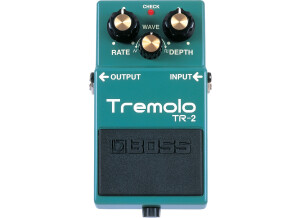
    I’d like to start out by saying that this pedal is worth it if you buy it at a discount or second hand because it’s a Boss pedal and they will work just fine even if they’re from the 80s. This is generally a good pedal, but unless you need tremolo effect constantly in your setup, there’s no need to invest quite this much money in my opinion. Because I own another tremolo effect pedal, Behringer’s UT100 which costs 5 or more times less than the TR-2 I will try to compare both of them to give you a better idea on the value you get for what you invest. I don’t use tremolo effects frequently in my setups but I started out with the cheap UT100 and when the opportunity arrived I upgraded to the Boss pedal; I will explain later why. Features Following Boss’s simple design, this pedal has only three knobs to play with. The knob called “Rate” controls the speed of the effect, “depth” is the volume control and “wave” controls the type of effect which can go from a smooth tremolo to a more rough and choppy type of effect. It’s a straightforward pedal, very easy to get all kinds of settings and the much cheaper UT 100 follows the exact same design. Both can run on 9V batteries, though the Boss pedal seems to drain the battery faster, or you can use a standard power supply. Sound I usually run this pedal through my Bugera V5 tube amp when practicing and I must say, the effects you can set up are quite accurate and beautiful in sound. There are few songs I need this pedal for, but it’s great to use for Green Day’s ‘Boulevard of broken dreams’ or any Tom Morello type of riff. The TR-2 is clear in sound, it emits no humming or any extra noise and you can take the effect from playing rapidly to being slow and choppy. It depends on your play style but you can get any kind of tremolo effect from this pedal, it will do its job. Now to mention the one massive problem I found with this pedal. While the TR-2 is reliable and gets the job done when it comes to effect quality, it has one major flaw…at least in my experience with it. If I play song without this effect and then I engage it for one specific part, it will suck out the volume coming from my amp. It will literally lower the volume at which I am playing and that is quite a disappointment. If you plan to play a whole song with this effect on, there is no issue, but for some reason, if you engage it mid-song it will suck out your signal. The UT-100 by comparison is very similar. Even though the difference in price is quite big, the quality of sound and versatility is similar to that which Boss offers. There is no extra noise or humming and this pedal does not bleed out your amp’s volume once you switch it on during a song. Reliability The boss is invincible in this area. This pedal will withstand anything you throw at it and that is the only reason I upgraded from UT100 to the TR-2. A Boss pedal will work even after being stomped on for 30 years. You will never have to worry about crushing it under your boot if you step on it hard while you practice or play with your band and this is the reason I chose it, especially when I found it at a great second hand price. The UT100 is quite bad in this case and this is why it’s so cheap, I assume. Boss is pure metal (pun unintended) while the Behringer pedal is plastic. Even at home I managed to step on the UT100 a bit too hard and I managed to get spring inside the pedal stuck and almost broke the thing. Boss is highly resilient and you can use it without the fear of breaking it or jamming it. Overall Impressions Both pedals are decent in their own area. The UT100 should be bought because it offers a great sound for the cost of 3 sets of basic guitar strings, but only if you plan to use it at home in a safe environment. It is too sensitive to physical abuse to be used for band practice or live gigs. On the other hand the Boss TR-2 is perfect for live play, but only if you use it for the full duration of a song. Suddenly decreasing the volume mid-song can be problematic, unless maybe you use some kind of signal booster together with it. They both offer a quality tremolo effect and if the TR-2 wouldn’t bleed out the amp signal, it would be perfect. Bottom line is, do not buy the Boss TR-2 at full price because of its issue, unless you use it a lot in your setup.

  • « Versatile Tremolo unit with tap tempo »

    Nicholas Catalinbread is a boutique pedal maker out of Oregon in the United States. All their pedals are hand made and they make a wide variety of pedals. This pedal is the New Semaphore pedal. It has much more features than the old Semaphore. Across the top the controls are. A rate function that controls the rate of the tremolo effect. The Tap Divide function that takes the tap function and can divide it up into musical beats. THe Shape knob controls the waveform of the tremolo function. It can flatten it out or make it more abrupt. The Waveform knob is very cool. You can select different types of tremolo sounds with this knob. On the Waveform knob going clockwise you can get a ramp up sound, ramp down, square, triangle, sine, hyper triangle, lumps and finally random. After all that you get your depth knob which controls the intensity of the effect and then finally your volume. UTILIZATION Even with all these controls the pedal is pretty easy to use. The Bypass switch on the bottom right controls if the pedal is on or off and it has a blue LED light which tells you that. The Tap Tempo switch is like it says. It is a tap tempo switch. When you are using a tap tempo the red LED next to the switch will blink on and off to the tempo you have inputted. When you are not using the tap tempo the red LED stays off. There are jacks on the back for expression pedals and another pedal for inputting the tap tempo. Some not so good things about the pedal. The knobs are pretty small and close together. If you are use to adjusting the knobs on the fly with your feet you probably wont be able to do that with this pedal. SOUND QUALITY With this pedal you can go from really thick lush tremolo sounds to really subtle sounds. With all the different Waveshapes the tremolo pedal is very versatile and if you have a lot of tremolo pedals on your board this could replace all of them. The Waveshapes are very distinct from one another. They actually modulate your tone. not just volume up and down it actually shifts your tone in a very pleasant and Brownface Fender type of way. With subtle settings on the depth you can really get a soothing behind the scenes tone. With the Depth knob you can go from no tremolo at all to breaking your speakers level of tremolo. The Tap Divide knob makes it easy to tap out slower tempos. You can tap out a normal speed tempo and tell the tap divide knob to subdivide the sound giving you a longer tempo since it is kinda hard to tap out really slow tempos. OVERALL OPINION A tremolo pedal like this really puts just about every other tremolo pedal on the market to shame. If I was big into the tremolo sound this would be the only pedal I would need. If you are in to the Tremolo sound this is the only pedal you need. It is kinda pricey for a tremolo pedal but you can replace a ton of tremolo pedals with this one. You get all these features and boutique hand made in the USA build quality with this pedal. It is kind of pricey but you can replace a few tremolo pedals with this one.