Log in
EN
FR

Tube Pre-amps

254 products found

Filter
Sort by
Evaluation
  • Reviewed or not
  • Editor’s award
  • Reviewed by Audiofanzine
Availability
  • Available or not
  • Sold new or used
  • Sold new
  • Sold used
Must-have products
  • All products
  • Flagship products
  • Best rated products
  • Hot products
  • Popular products
Price
  • Freeware
  • Low-cost (< $600)
  • Mid-range ($600 - $2,000)
  • Premium (> $2,000)
€
Clear
Sort by
  • Popularity
  • User ratings
  • Price - low to high
  • Price - high to low
  • Used price, increasing
  • Used price, decreasing
  • Name (from A to Z)
  • Name (from Z to A)
  • Added on
Sort results
  • Popularity
  • User ratings
  • Price - low to high
  • Price - high to low
  • Used price, increasing
  • Used price, decreasing
  • Name (from A to Z)
  • Name (from Z to A)
  • Added on
Filter results 254 results found
Evaluation
Availability
Must-have products
Price
  • Freeware
  • Low-cost (< $600)
  • Mid-range ($600 - $2,000)
  • Premium (> $2,000)
Show results

The best Tube Pre-amps reviews

The reviews Audiofanzine members found the most helpful.
  • « Fantastic! »

    This is a recording channel (mic pre, EQ, and compressor) which features all in one. It has a tube based mic pre which gives it a nice warm sound compared to solid state. It also has a ton of controls, not only for the mic pre, but the EQ and compressor as well. This is a really good purchase for a studio engineer who likes to use the EQ and compression during tracking (basically, a really good engineer). This isn't ideal for home studios as it's really expensive. UTILIZATION There's a whole lot going on with this channel strip. Each facet of the strip has a lot of controls. The pre-amp features two input gain knobs (coarse and fine). There is also a phantom power switch, a -20db pad, a phase reverse, and a low cut filter, and a DI input. The EQ has three bands (lo, mid, hi) and has high and low shelving EQ. The mid section has a bell-curve. The compressor has threshold, ratio, attack, and release, as well as output gain controls. There are switches to turn the EQ and compression on or off as well as routing controls. SOUND QUALITY The sound quality of this entire setup is fantastic. The pre-amp is a great tube device, with a really nice fat warm sound. I can't really complain about this at all. I wouldn't make it the only mic pre in your setup, as a solid-state pre-amp is probably better for certain sounds, but if you need anything to maintain a warmth, this pre is great. Acoustic instruments like guitars and violin are particularly excellent, but overheads, pianos, even some electric guitar sounds are really fantastic with it. Also, the EQ and compression on this are both top-notch. While I was a little disappointed that the EQ had only three bands, I quickly got over it as they can really help shape the sound really well. The compressor is likewise a fantastic compressor, using the tube power to maintain the warmth and thickness of the tone without sacrificing quality or amplifying too much noise. OVERALL OPINION This is just a really solid channel strip overall. It's expensive but the money is totally justified in this case, as every feature on the unit is awesome. I'd highly recommend this channel strip to a studio owner.

  • « Tube Pre-amp/DI box that colors, but enhances tone »

    This is a tube driven DI box/mic pre-amp. This alone makes it an interesting package as most mic pre-amps will not double as a DI box. I've noticed, however, that given how difficult it is to use as a mic pre-amp, most will probably end up using it as a DI. There are 2 1/4" inputs, which is part of the reason that using a mic is difficult (you need an XLR to 1/4" adapter just to use it, and you basically need to put it after the mic-pre in your line to get it to work.) There aren't any effects on this DI, and while it is rackable, it'd be difficult to use unless you brought your instruments into the control room (which isn't always easy, or even possible). Thus I probably would not rack it. UTILIZATION It's really easy to get good sounds with this when it's used as a DI. It's basically as simple as plugging into the input and choosing either the balanced or unbalanced outputs, both of which are post-gain There is also an unbalanced output that is pre-gain knob, which I've only used when using it as a mic pre, which actually still requires another transparent mic pre to even work, which I found odd. The manual will explain how to do all of these tasks, and for once, it's totally necessary because it's really confusing. SOUND QUALITY For all of the difficulty that can come with using this box (at least when it's not just as a DI), there sure are a lot of aesthetic benefits. It sounds fantastic when used properly. If you like to rely on digital-sounding things, and prefer a transparent DI box, this is not at all what you should be looking for. The coloration of this tube-driven box is the selling point. It really makes instruments that can sound weak and anemic (like bass and keys, especially when using a transparent DI) ring out with tone and color. I personally love using it on bass because it absolutely sings when in use. It also gives digital keys a warmth and edge that they would otherwise lack (this is crucial to me, as I have often been frustrated with digital keys in general). This isn't to say it won't also work great on a Rhodes or Wurlitzer, on the contrary I enjoy using it very much. Last but not least, it can make a condenser mic sound like a tube mic, which is pretty awesome. It requires the aforementioned difficult of going through the unbalanced output but it ultimately does sound pretty awesome. OVERALL OPINION I like the DI functions of this box the most, the tubes really make everything sound more saturated and colorful, in a good way. The downside to this is that there isn't much room to make a change after the fact, however, I'd rather know for sure that I have a particularly good sound before tracking than have one afterwards that I can't get to sound right. This is a really expensive DI, so I'd really think twice if you don't need it for many different instruments. I'd say it's more crucial to have it for keys than anything, because bass can also be amplified for tonal control. As a mic pre it's really awesome, however there are others that do similar things, and either way it still isn't quite like using a tube mic itself. So while it can be amazing, I don't know if it's a must-have by any means.

  • songboy's review

    This is an analog, tube based preamp. There are a pair of 1/4" input/outputs and a pair of XLR input/outputs. The are no traditional effects. I guess you can say that the Phase correction is an effect. This comes in handy when setting up your mic correctly. Yes, it is rackable. Thats what its designed for. UTILIZATION This is all analog with all the parameters that you can edit on the face, so yeah, its very easy tweaking the sound. The setup/configuration is fairly simple. I had not had much experience with tube preamps before, but the manual is actually quite helpful in guiding you. After I read it, I felt pretty confident on this guy and was able to get some really good sounds out of it. SOUND QUALITY Yes, it is transparent if thats what you are setting up to be. It also colors the sound and warms it up a bunch if you set up to do so also. The quality of the "Tube" sound (if thats what you are going for) is highly dependent on the quality of the tubes you put in it. It comes with a pair of cheap chinese tubes (i forget what brand) originally. I got online and bought a nice pair of Gold plated Tung sols and it made a world of difference. Very warm sound now and much more transparent than the original tubes. OVERALL OPINION What I like most about this unit is the very good quality sound you can get out of it with the Right tubes. Even with the right tubes, this thing didn't cost me more than $400. Thats not bad for a quality preamp. What I didn't like...? Nothing really. When I got mine in the mail, one of the VU meter's Lights wasn't working. I called ART and they express mailed two new ones to me, free of charge and explained how to change it myself (they did say I could return it or have it serviced, but doing it myself was the quickest and easiest way). All good stuff to me. I was shopping around for a Tube preamp for awhile on a budget, and this was by far the best I could find for the price. The precision and quality of the sound is quite good for how much I spent on it. I used a really nice Avalon preamp in a studio a few years back. It was amazing, the sound was fantastic. I would have definitely bought an Avalon if I could afford it, but they are $2000 minimum. Other than that, I only read reviews to figure out which preamp to buy. I am happy to say that the ART Mpa is a pretty solid machine and I wasn't disappointed at all. Yes, I would make the same choice being as it is that I can't afford an Avalon yet.

  • Audiofanzine FR's review

    (Originally written by barbilux/translated from Audiofanzine FR) Most people use it with guitar but I personally use it with a condenser mic for vocals and my DAW. T-Bone MB78 Beta. Housing and components seem to be rugged (connections, switch and controls are good). The 48v phantom power can be switched off. UTILIZATION Easy and convenient to adjust the gain level. Wide and good sensitivity. Some people might miss a scale around the controls to write down their settings more precisely, but the clip indicator and the computer meters ought to be enough! SOUND QUALITY I always use settings so that it stays linear, and I like its sound clarity. I get neutral and faithful voices. OVERALL OPINION I've been using it for one year and I'm satisfied. It was recommended to me via Audiofanzine and it has a good value for money. I read that tubes give a smoother and warmer sound than solid-state but I haven't done any test in that regard... I use the original tube. This preamp works good. It's a top product among versatile low priced products.

  • sat4n's review

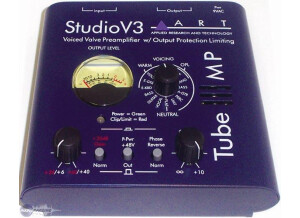
    This is what you might call the hot-rodded version of ART's famed, low-priced tube preamps. The hot-rodding here has to do with variable voicings, which means that you can change the way the tube affects the signal. I'm not sure exactly how they do this, whether they do it by modifying the signal itself with capacitors or by modifying the plate voltage in the tube or some other way, but it basically gives you a bunch of slightly-different midrange peaks to choose from. These are all labeled things like &quot;bass&quot; and &quot;guitar,&quot; but I usually just turn the knob around until I find one that sounds good for the signal I'm recording, and ignore the labels. It's also got all the usual stuff for a preamp: phantom power on and off, boost, input level, output level, phase reverse. It has a cool analog output meter, though the input meter is just an led that turns green for signal and red for clip. It's powered by a wall wart. There is no on off switch, so when you want it off you just unplug it. UTILIZATION This is one of those somewhat-controversial &quot;starved plate&quot; designs. This means it's not what is traditionally meant by a tube preamp, even though it does have a tube in it and it delivers what many would call authentic tube sound. Basically it's a solid state preamp which also runs signal through a tube. The way I understand it (I'm no expert) the voltage on the tube is lowered to make the tube work harder in passing the little bit of signal it's given. This imparts a little bit of tube warmth and distortion, like a traditional tube preamp being driven really hard. In a traditional tube preamp you have lots of tubes and input and output transformers. This sounds a lot better, but can cost literally a hundred times what the V3 costs ($4000 rather than $40). SOUND QUALITY Many people don't like the whole &quot;starved plate&quot; thing because it imparts a kind of exaggerated tube sound. This can be good for some kinds of music and some kinds of signals, but not for all. It sounds terrible, to me, on the sound of a miced tube amp, because that sound is already plenty tube-y. It sounds pretty good on bass guitar when you're going direct, but less so on a miced bass amp. It sounds *awesome* on vocals. The starved plate design can generate a lot of noise, so you don't want to use this on every track of an 8 or 16 track project, the cumulative effect would be really buzzy/hummy. I've had great luck using solid state pres on most things on a song and using this just on the vocals, though. It gives the vocals a nice faux-60s sound which, because you're using it only on the voice and not on the instruments, never becomes a sad parody of itself. OVERALL OPINION The bottom line is: This is a great tool to have. Only use it on one (or at most two) tracks on a given song. It sounds best on vocals, especially with a large-diaphragm condenser. Don't use it on anything you want to be really clean, or anything that is already being tube amplified (i.e. electric guitar). It tends to make acoustic guitar sound really unnatural, but not unpleasant. People who complain about this thing are usual mad because either 1) they think it should sound like a $2000 &quot;real&quot; tube pre, or 2) they are using it on everything and don't like the amount of noise this generates. Use it once in a while on something you want to have a distinctly and unnaturally warm tone and you'll be happy with it.

  • Old World Kaos's review

    Manufactured for digitech by IVL technologies, is a High voltage mic tube pre amp, line level input, 4 band Eq, spdif and AES/EBU digital out at 18 bit 44k or 48k user selected, low cut, 20db pad, phase, and 48v phantom power, analog rms meter. Does a real good job warming things up. Nice OD is achieved using input and output gain knobs. Insert points are handy too. 2 rack space is needed for the massive power transformers. EQ is switchable to A/B adjustments. Clip meter is helpful to reproduce OD on things like snare and certain vocal sounds to imitate that vintage edge. Line level inpust are not good for instrument applications such as non-active bass and guitar. UTILIZATION Simple to use and better results than the sub $75.00 low voltage stand alones. SOUND QUALITY Good sound quality. Does not color the sound unless you add gain. Slightly overdriving a top snare mic or vocal really brings details out and adds a harmonic quality like a good old fender guitar amp does for guitars. OVERALL OPINION Great value for price. I've had this for over 10 years and paid retail. Find one used for a lot cheaper. I've used it in live FOH mixing, tracking, mastering, between pods/sans amps and DAWs. Very rugged and reliable. Would buy another to add more tube front end to my DAW. I like scooping the 2 bands of sweepable mids on vocals and kick drums. Replaced the stock tubes with EI 12ax7.

  • « Great, warm tube pre »

    This is a microphone preamplifier designed for use in the recording studio. It has two channels. It is a tube mic preamp, so expect a lot of warm tones and less harsh ones. It's smooth all the way which is good. I would say that it's one of the warmest, smoothest mic pre's that I've used. It's got the normal mic pre connections. I used it in a studio so I just used the patch bay so I can only assume it's got the typical XLR connections. There are no effects in this mic pre but it does have features like phantom power and a -20db. UTILIZATION Using this mic pre is pretty basic overall. It's got a pad and phantom and those about as tough as it gets to use. I've found that it works really well with a lot of stuff, though there are definitely instances where you'd be better off using a solid-state preamp like an API or SSL, as they are more in-your-face and sometimes harder in a good way. I haven't used a manual for this mic pre as I really haven't ever used a manual for any mic pre. It's easy enough for any engineer to understand assuming they've used a mic pre before. SOUND QUALITY This is a great, warm preamp. It has some great warmth without sacrificing clarity. I like this amp with condenser mics the best as it gives the clear and detailed signal of a condenser mic blended with the warmth of a tube pre amp. It's good with dynamic mics too, but I don't like it with tube mics as they are too noisy. No matter though, theres a whole lot of other uses for it. I like to use it with small diaphragm condenser mics for drum overheads, with large diaphragm condensers for acoustic guitars and vocals, as well as many other uses. It's just a great sounding pre overall. OVERALL OPINION I like the sound of this preamp a whole lot as well as it's variety of uses. It's not good with other tube mics but it sounds great with all types of regular condenser mics. I think that it's pretty expensive overall, enough that I would only use it if you own a studio or are opening one. It's too nice for most people to use, it actually needs converters that are good enough to handle it. I'd highly recommend it though to anyone who could use it as it's a phenomenal piece of gear.

  • « Expensive but fabulous new tube preamp »

    This is a tube preamp, but using modern technology, it does sound a little different from the classic tube preamps. This has two preamps on it, both of which have the same controls. It needs to be put into a racked unit to work, and you need to either plug directly into it or have it set up in your patch bay to work. UTILIZATION The editing on this pre-amp isn't much different than most pre-amps. For each channel, It has an attenuation (input gain) knob. phantom power (+48v), a -20db pad, and phase reverse. Each channel also has an input (Lo-Z) that is designed to perform well with transformerless mics. The manual will explain everything about this pre-amp in detail, and the customer service that comes with D.W. Fearn products is very good. SOUND QUALITY This preamp has a great sound to it. It doesn't color the sound too drastically, although it isn't completely transparent. However, most of the time you don't want something completely transparent anyway, mainly because it'd be a dull sound. The Fearn sounds particularly good with low end instruments like bass and kick drums, but it can be used for all instruments well. It does a particularly good job of bringing out a full, round sound and emphasizing the favorable frequencies. OVERALL OPINION I like the sound of this preamp the best. I haven't had the chance to use the Lo-Z input yet, but I look forward to it. The phase reverse and phantom power work fine, and the pad is useful. There isn't much more to say, other than this is a great tube pre-amp with a few modern touches thrown in for good measure.

  • mooseherman's review

    This is a tube pre-amp, one of the best products of its era. The only way this could be hooked up to a modern DAW would be through the patch bay, as those are the only connections. There aren't any effects on this pre-amp, just a simply great tube sound. It is a rackable pre-amp but it works best as part of a console or in a similar position. UTILIZATION The impedance levels for this pre-amp are pretty high, so make sure you know how to solve this problem before you blow something up! Other than that, it's not a difficult pre-amp to use, it has your basic functions. It has an input gain knob, an output knob, and a 3 band EQ. It isn't really the most complex piece of equipment around. You will never find a manual for one of these machines, considering that the machines themselves are almost impossible to find nowadays. SOUND QUALITY This being an old pre-amp, it is really not transparent at all. I happen to think that this is a positive, rather than negative, trait. The color that this pre adds to vocals is pretty much unparalleled. It grew out of an era where there really wasn't any such thing as a transparent pre-amp. This is part of the reason that rock and roll records used to sound much better. That's really where the best use of these pre-amps comes from. You certainly wouldn't use these on a classical recording, or for foley recording. While the pre is limited in it's applications, there really aren't many better pre's for getting that warm, vintage vocal sound (Think Beatles, Buddy Holly, Elvis). Considering that I love this sound passionately, I am thrilled that the studio I work at owns one of these. OVERALL OPINION These are probably only worth getting if you are fanatical about vintage tones, like I am. I think that in general, most people wouldn't want something so expensive that is so limited in its application. I'm usually the same way, however, with a good vocal mic, you can't really top the sound that you can get with the combo. It's so warm and dynamic, and even when the instrument clips it still sounds OK. I think that most old-school engineers would find much to love here. Just be careful again with the impedance.

  • moosers's review

    ocumentProperties Normal.dotm 0 0 1 62 258 None 4 1 440 12.0 ocumentProperties 0 false 18 pt 18 pt 0 0 false false false tyle <p class="MsoNormal">The LaChapell Audio 538S is a microphone preamp and direct input box that runs on a 12AX7 vacuum tube. The unit has a 1/4 inch input in the front and XLR in the back. This isn't in a traditional rack mount form, and I'm not sure exactly what type of rack this is designed for as the one that I've used was just out in the open on a desk. UTILIZATION ocumentProperties Normal.dotm 0 0 1 123 507 None 8 1 865 12.0 ocumentProperties 0 false 18 pt 18 pt 0 0 false false false tyle <p class="MsoNormal">The configuration of the LaChapell Audio 538S isn't anything too out of the ordinary. You've simply got knobs for input and output and a variety of switches for phantom power, polarity, mic/line selection, and a -20 db pad. These features are generally seen on most microphone preamps, so anyone will some experience with pres should be able to catch on instantly. Even those who don't have much experience with recording and mic preamps I think will be able to understand everything, granted that you have a basic knowledge of mic pres. For this reason, I don't think a manual is necessary but can't speak to how well it is put together because I've never seen it. SOUND QUALITY The overall sound quality of the 538S is very impressive. It has a crystal clear sound while still offering a great deal of warmth and character. LaChapell Audio definitely isn't the biggest mic pre manufacturer, but sometimes it is these smaller boutique companies that make some of the most well made pieces of gear. I've used the pre for recording vocals and drums, but hopefully I get a chance in the future to use this again because I'd love to try it out on some more instruments because I really think that this is versatile pre that is capable of being used all over the place. I don't think too many engineers will have any complaints about the way the 538S sounds. OVERALL OPINION For a piece of gear of this stature, the price of LaChapell Audio's 538S is very reasonable. While it may be out of the price range of most home studio owners, if you can get your hands on one of these you should definitely take advantage of using it while you can as I know you'll be happy that you did. For those that can afford the 538S, I would say that it is definitely a good investment as it gives you a top of the line mic pre and DI box that is extremely well made and should last a lifetime if treated right...

  • moosers's review

    The Dbx 386 is a tube based analog and digital pre amplifier. It has two channels, each with its own XLR and 1/4 connections as well as separate metering and parameters for each. Each channel has a knob for drive, analog output level, and digital output level, as well as buttons for a pad, phantom power, phase, and low cut. This is a rackable unit and will take up a single rack space unit. UTILIZATION The configuration of the Dbx 386 is pretty easy to follow and it won't take long to figure out what everything does on this unit. It is easy to set your level and the vast amount of parameters allow for this to be a versatile unit that can be used for a variety of applications. I don't have the manual for the Dbx 386, but it is easy enough to use you shouldn't need it if you don't have one. SOUND QUALITY The sound quality of the Dbx 386 pre amp is warm and rich and great for a number of different instruments and applications. I have used this pre amp to record vocals, electric guitar, acoustic guitar, drums, and bass guitar and I always find that I get good sounds when using this pre amp. The sound is warm because of the real tubes which gives it a unique sound that is tough to replicate without real tubes. OVERALL OPINION I've been using the Dbx 386 for about a year and I have found it to be a great sounding tube pre amp. It isn't too expensive and is a great deal for the home studio owner. Dbx makes some great pre amps and the 386 is a nice example of what they can do. Overall, the Dbx 386 is a great option for a cheap tube pre amp.

  • Audiofanzine FR's review

    (Originally written by efabric/translated from Audiofanzine FR) Tube/modeling hybrid technology. No effects. You can boost the signal until it starts to distort, and change the EQ. Compact and transportable unit (not for rack). I use it with a Bass V-amp, a powerblock and a Vox 2 x 12" speaker cabinet. UTILIZATION Very easy setup. Easy editing and short user's manual. I would have liked more precise descriptions of the limiter section, the low-pass frequencies, the modeling, and the amplifier stages. In which stage the tube actually works, etc. SOUND QUALITY The sound of the instrument is faithfully reproduced but the modeling is not versatile enough. Sometimes the selector generates some noise when manipulated. Sound coloration is very evident! It's not comparable with a solid-state amplification system! In the beginning it's quite subtle, but as soon as you play a solid-state preamp you feel the difference. You can boost the effect until you get distortion. The sound is good with moderate settings otherwise I don't like the effect. I'll make some new tests when the unit is hot and do some comparisons with modelings. The unit doesn't clip except when you boost the instrument's signal or when you pick up the sound of a speaker with a mic for example. I haven't tried out every combination but it's true that the limiter reduces the dynamic range greatly. Review update: With a bit more experience now I find the saturation sounds good, and when you increase both gain and volume settings you can enhance the signal of a guitar. The limiter effect is strange: I connect my bass and get a strong sustain. When I attack a string hard the limiter rapidly decreases the volume. Normal! On the contrary, when I let the string ring, the volume increases again after 1 or 2 sec. before the note fully fades out! It's a strange effect like an ADSR filter... However you can use the limiter (with low settings) for phrases with short notes. OVERALL OPINION I've been using it for 2 days. It's has no power on/off switch. So use a multiple socket outlet with a switch. Pro: the tube warmth! Con: the modelings, especially with the limiter. It's my first tube gear. Very good value for money. It colors and enhances every sound source very subtly. I recommend it even though my experience with it is rather short. Review update: With more experience I find this unit is essential. It's great with a multi-FX processor! It's ideal for guitar or bass recordings if you don't have a DI box but only a mixer!

Categories that may interest you