Log in
EN
FR

Shure Dynamic Microphones

147 products found

Filter
Sort by
Shure
Evaluation
  • Reviewed or not
  • Editor’s award
  • Reviewed by Audiofanzine
Availability
  • Available or not
  • Sold new or used
  • Sold new
  • Sold used
Must-have products
  • All products
  • Flagship products
  • Best rated products
  • Hot products
  • Popular products
Price
  • Freeware
  • Low-cost (< $150)
  • Mid-range ($150 - $350)
  • Premium (> $350)
€
Clear
Sort by
  • Popularity
  • User ratings
  • Price - low to high
  • Price - high to low
  • Used price, increasing
  • Used price, decreasing
  • Name (from A to Z)
  • Name (from Z to A)
  • Added on
Sort results
  • Popularity
  • User ratings
  • Price - low to high
  • Price - high to low
  • Used price, increasing
  • Used price, decreasing
  • Name (from A to Z)
  • Name (from Z to A)
  • Added on
Filter results 147 results found
Brands
Evaluation
Availability
Must-have products
Price
  • Freeware
  • Low-cost (< $150)
  • Mid-range ($150 - $350)
  • Premium (> $350)
Show results

The best Shure Dynamic Microphones reviews

The reviews Audiofanzine members found the most helpful.
  • Audiofanzine FR's review

    (Originally written by antoinedroogies/translated from Audiofanzine FR) - What kind of mic? (for vocals, instruments, both...) Vocals and acoustic instruments OVERALL OPINION - How long have you been using it? One year. - Which feature do you like the most / the least? It produces a clean sound appropriate for a recording studio. And it is obviously good enough for rehearsals and concerts (it's even nearly too good for punk music...). It's very rugged. Here you can hear it in action: http://www.myspace.com/lesdroogies (I recorded everything with it except the drums and some vocals). - Did you try any other models before buying it? Before buying it I recorded with a couple of professional mics from a friend (I can't recall the mic names). - How would you rate its value for money? Nearly unimaginable. - Based on your experience, would you buy this product again? Now that my budget has increased I would choose an SM58...

  • victormelamade's review

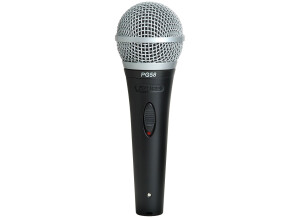
    The PG57 is pretty much supposed to be a low cost other option instead of getting a real Shure SM57. The mic is a little bit different on the outside, but I actually thought they sounded very similar. There are a few key differences, first of all this mic has an on/off switch right on the handle. Seeing as this is an instrument mic and not meant for vocals really, the on/off switch is kind of useless. If you are setting this up to record something, you won't have any need to go over and switch the mic on and off. Second is the grill. This mic has a large wire mesh grill over the top, whereas the original SM57 just has a tiny wire mesh grill on the very tip of it and plastic lines on the side. I don't think it really affects the sound, but this mic would actually stand up better if you dropped it on the head of the mic. It is a dynamic cardioid mic just like the SM57, and seems to have a very similar frequency response. There is a low roll-off, and there is definitely a hyped upper mid area that is around 3khz. My brother bought this mic and I was curious to how it stacked up against the SM57 so I tried it on a guitar amp and a snare drum. Honestly, I thought it performed almost exactly as the SM57 did. I might even encourage people to just get this mic instead, and save $50. OVERALL OPINION I only used this for a day when I was borrowing it, but it was long enough to recognize that this mic is basically just a discounted SM57. It sounds extremely similar and is about half the price. Those on a budget should definitely consider picking this up instead of the more expensive 57. You will find it difficult to tell the difference. It's a very good value.

  • afterglow479's review

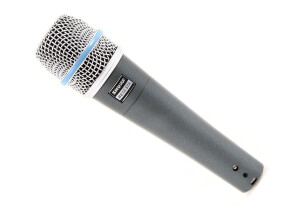
    This mic is a moving coil dynamic from Shure. It looks and feels like an updated version of Shure's SM58. It's a dynamic, so you don't need any phantom power. The pickup pattern on this is cardioid. The primary use you'll find for this mic is on stage for vocalists. The frequency response is tailored to this usage. There is a peak around 3k for added clarity and sharpness on the voice, and there is a generous roll-off on the bottom to compensate for boominess from the proximity effect, or from someone handling the mic as singers often do. There is a built-in mesh pop filter to aid in cutting back on plosive sounds. This mic offers very good side and back rejection, which is great in a live situation where you want to minimize your bleed - especially on the lead vocal. There isn't an on/off switch like there are on a lot of hand-held vocal mics, which is unfortunate because those can definitely come in handy when the mic suddenly starts a feedback loop. OVERALL OPINION I have owned one of these for a couple of years. It really is very similar to the Shure SM58. I honestly don't really find a huge difference in the sound quality. The Beta does look a little nicer and flashier, but that doesn't warrant the large price difference. The Beta does sound just a little bit crisper, but I feel that the difference that does exist would easily get lost in a live setting because it is so small. For that reason I really think most people should just stick with the cheaper, dependable SM58 for live vocals. They will do pretty much the same exact job. I probably wouldn't get one again, since the SM58's I have are almost just as good.

  • peepsaudio's review

    This mic is a dynamic cardioid mic that finds it home in a studio as well as live. I like to think of this mic as an upgraded version of the classic SM57. It is a standard XLR connection and doesn't need phantom power. It's about the same size and weight of the original SM57, but it has a better grille on it. Sound is rejected from the sides and back because of the cardioid pattern. When you mic something up close, you will get enhanced bass because of the proximity effect on these kinds of mics. OVERALL OPINION I have had this one for a few years. I got it on recommendation that is kind of like a brighter, clearer SM57. I borrowed one to try it out, and used it on a snare drum and a guitar cabinet. It definitely beat out the SM57 in both categories, and sounded almost more like a Sennheiser 421. The transients are more crisp which is great for the snare drum, and the guitar distortion seemed to have more bite on it and sounded more alive. I pretty much never use the SM57 anymore after buying my own beta 57 - this one sounds better almost every single time. It's also just as rugged as the SM57, you could probably throw this mic against the wall and it would work fine. You can also twist off the grille cap if you need to clean it out. If you use this for vocals of any kind, you're bound to get a lot of dried up gunk stuck in the foam part under the metal grille which can worsen the sound, so it's worth giving it a good cleaning once in a while. It's really not that much more expensive than the SM57, so it's definitely worth the upgrade if you can afford it, it's a great value. I would definitely get it again.

  • « Do not buy »

    The SM48LC has a cardioid pickup pattern that is suppose to only pick up what you are recording and not pick up external noises and sounds. It does not do that very well, so when recording with it you will need to make sure that you are in a completely quiet room or you will hear everything that is going on around you in your recordings. This microphone is geared more toward someone with a very small budget and wants to record vocals at home. But honestly you are better off getting a cheap USB microphone, it will be about the same price and it will be more portable than this is. OVERALL OPINION After you purchase the SM48LC you will also get a carrying bag and a stand adapter. There is no pop filter needed because it has one built into it. That is about the only positive thing I can say about this microphone is that it does a good job with the popping sounds. The overall quality of your recording will not be bad as long as your environment around you is quiet. With this microphone being the price that it is, you mine as well spend 10 more bucks and get a better microphone from Shure. This microphone let me down way too many times and I am not very happy with it. I was using it a long while ago probably back in 2005 but it was a horrible microphone then and it still is. If you are going to record where you live there really is no way you can stop the sounds around you like other people in the house and street noises. You will have to have a completely quiet room to work with this microphone. I do not recommend it unless you live in a quiet box! Spend a little more money and at least get something that you will be happy with and work no matter what your recording conditions are.

  • « Good first drum microphone »

    The Shure PG56 is an affordable kick and tom microphone, and when I say affordable I mean affordable! It is a Cardoid Dynamic microphone that only cost 69 dollars. I have not seen a kick drum or tom microphone that cheap in a long time. I have had this microphone since 2007, in fact it was one of the first kick drum microphones that I purchased for my own home studio because I couldn’t afford a more expensive one at the time. It comes with a solid mounting system that is well built and wont fall off your drums, the PG56 itself is a smaller microphone and you could probably even hook it up without the drummer even knowing that it is on the kick or toms. It does come with a 15 foot cable which isn’t a very good one and should be replaced if you purchase this microphone. The PG 56 is made for close proximity to your drum or source. OVERALL OPINION I love how small this microphone is, and if you are not use to drumming while having a microphone attached it can always be a bit different especially with your toms and snare, but the Shure PG 56 is already so small it will not matter if you know its there or not, you wont knock it off. I am still happy that I own this microphone even though I don’t really use it much anymore. It is still good to have just to travel with because of its size and the price of it keeps me worry free from it getting broken or stolen while we are out recording somewhere else. For the price you really can beat what you get with the Shure PG 56. It is well worth the 69 dollars to buy it, especially if you are just getting started with recording drums. It will be a great first drum microphone for you to record with from home.

  • « Good for drums »

    Great mic for drums ala toms. I don't like them for snare. Use an SM57 over this mic. Great hard hitting low end bump at 200 hz. I do have to ad top end or a boost at about 5k. They are not clean sounding mics but they work for tom toms. Specs say 50 to 16k but I doubt this mic has anything going on about 12k. For just over 100.00 I think it is good for drums. I happen to use this mic on a horn track recently and I must say I liked the track and the mic a lot. I thought it did well for the most part. I do think that for the money it is not a bad buy and for live it is great. I used it recently for a tom toms and I liked the sound over all. I felt that the only real issues I had was the high end clarity from about 8K to 12K it seemed very dull. I had to add a great deal of EQ in order to get the sound that I desired from the toms and it took a while to get the low mid bump out well. I do think that if you are in the market for a cheap tom mic that could second as a kick secondary mic or even as underneath mics. It also was good for live. I have used this mic live and it does a really good job live. I also like the fact that they are tough mics and can take a real beating for live sound. I have had a set of them for a while now at the studio that we sometimes take out for live recording and they sound good and can take a great deal of input. I have had some of my students use these in their home studios and have brought the files to the studio. If the placement was right they sounded good for the most part. On our set up in the B studio we place them a bit away from the toms. I like micing the toms a bit back and not so up front or on top of the toms. I think that it sounds better for toms to get a bit of distance from the tom. I also have used it on a kick but as a mic that is not too close to the front of the head. OVERALL OPINION I would buy these mics for LIVE SOUND application and for a home studio application. I would not buy these for professional recording nor would I use them unless it was my only option. I would invest in some 421's if I am serious about tom mics. I think that for the money I would consider this mic for a home studio but not for a pro studio if you are real serious about your tom sounds.

  • « Great for Live Performances. »

    Shure Beta 58A Supercardioid Dynamic Microphone is a live and recording mic. It uses a condenser dynamic technology. OVERALL OPINION Shure Beta 58A Supercardioid Dynamic Microphone is great for a small studio and for live performances, it provides a deep quality of the incoming signal and it sounds decent on the entire range. Shure Beta 58A Supercardioid Dynamic Microphone is a cheap microphone that still provides a more natural sound, it has a wider frequency response, and it's quite heavier because of it's material. What I like most about it is the great price and quality that Shure managed to give for us, I also enjoy the neodymium magnet that produces a stronger electric current for hotter output voltage for higher frequency sensitivity. It has a frequency response of 50 Hz to 16 kHz so it basically captures all the pitch changes and phrases. Another great thing about this mic is the Supercardioid capsule that makes the recording process to take place much much faster because after the recording you basically have the vocals quite in place and you don't need some crazy mastering and eq. As I mentioned, my opinion about the value of price is great, it costs around 200 $ and it comes with a soft storage pouch and a mic clip that is adjustable to 180 degrees. Precision and quality of the sounds is good, you can ever record yourself at a very close distance and still get a pretty sounds without any kind of distortion or any kind of interferences. I've tried several dynamic mic and I gotta admit for only 200$ I don't think you can get any better deal than this, the mic doesn't feel cheap, it's made of some heavy material, it provides a deep frequency response, so it's basically a very good product at a low price.

  • « nice »

    The 54SSd by shure is a dual impedance dynamic microphone that I have used on a few occasions. Mainly from a buddy of mine having one of this and he has been using it for a long time now. I wish I could have one of them but my budget wouldn’t allow it at the time. Still may purchase one though, but it really reminds me of the SM 57 by Shure. I already own the SM 57 so I really didn’t feel the need to have the 54 SS D as well as the SM 57, especially when they are so similar in sound. OVERALL OPINION One of the things that I notice with the mic was when he purchased this instrument mic, that it didn’t come with a cable chord. I am not sure why or im not sure if they all come like that because im pretty sure that he purchased his directly from a major chain store so there was no reason that it didn’t come with the cord unless it was just a mistake, but he ended up getting one anyways from a local music store. So he had to pay extra for the cord, which I think is a bit goofy because of the fact if you are purchasing a brand new microphone then it should be ready to record right out of the box. But generally speaking the mic sounded great on several instruments, it has a silent reed on and off switch that can lock as well. The 54 SS D doesn’t just have to be used as an instrument mic either. It can also be used as a speech mic. I wouldn’t use it for music vocals though, because im not sure how it can handle the quick and diverse changing pitches of music voices. But I still recommend this mic.

  • « Universal legend »

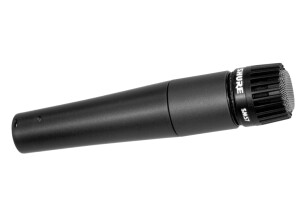
    The Shure SM57 is a modern classic microphone, and it is used more prominently in the studio that any other singular microphone. It is a legendary, but simple dynamic microphone, with a frequency response from 40 Hz to 15,000 Hz, cardioid pattern, 150 ohms rated impedance, and the basic 3-pin XLR connector on the base. It is unidirectional in nature, with a very small sound entrance and windscreen. It doesn’t have a particularly flat frequency response, but it sounds very musical, and it can be used in a variety of applications, including guitar amps, vocals, drums, wind instruments, stringed instruments, acoustic guitars, room ambience, and more. What’s great about the Shure SM57 is that it is used almost universally, and it is one of the cheapest microphones you can buy. It is still a quality product from a quality microphone manufacturer (in Shure), and that makes it perfect for so many budgets and applications. However, there are many fake Shure SM57’s floating around, particularly on eBay, and if you are not careful, you will end up with a Chinese-made fake that looks just like the real mic, but sounds thin and tinny. In fact, I owned a fake SM57 for a few months, and I didn’t realize it was fake until I started testing it against another SM57: I knew the mic was sounding bad, but I assumed it was my other equipment, bad mic placement, or phase issues, because I just assumed the mic was real and it fine working condition. Do make sure you do not fall into the same trap, and buy from reputable sellers. OVERALL OPINION Overall, the Shure SM57 is a great mic that belongs in every studio, simply because it is so universally used. Even if you have better microphones that work better for specific situations, it’s still a good idea to keep these around, because they are always useful and every musician is familiar with them.

  • « Shure SM-58 »

    Mostly black with gray windscreen, although this thing is so scraped up from abuse that it might as well be called silver and loaded with scratches. Been playing for a while now, various bands, a little recording. A little this and a little that. I actually won this SM-58 in a poker game from a buddy believe it or not. It was a terribly beat up mic and he threw it into the pot because he had already replaced it. Based on the ante, he probably only valued this at $5, but I think I ended up with the deal. First of all it still works and it still sounds good. I think these things develop character over time, especially with use and abuse. It says a lot for Shure products when you have a microphone that can be this abused and still deliver crisp clean rock vocals day in and day out. There's nothing to not like. I guess I wish they were less expensive new, but if you have an opportunity to pick up a used one, don't delay. Like an old Toyota, these things will deliver and you could get 300,000 miles from yours. First rate, built like a tank, or an iron pipe as it were. Overall, I love it. It sounds great, works night after night, and is beat to hell. This is what gear is supposed to be built like. If you end up buying one new (I think they are around $100 new), you will get years out of it. As a matter of fact, it might outlive you. Perhaps the preacher will be using it as they lower you down. This review was originally published on http://www.musicgearreview.com

  • « Shure Beta 57A »

    I bought this mic from Guitar Center for $99.00 after very extensive research. I found this price on the internet and Guitar Center matched it. In fact, they were only able to match it down to $99.99 and had to take the extra $.99 off of the table stand I bought with it! That's how good a price I got it for. It was a good deal... Welp, quite honestly, I like everything about this product. I am very satisfied with it. This thing is built like a tank with classic Shure heft, so durability is absolutely no problem here. It sounds so clear and so natural too. I use it primarily to mic my 30 watt amp, but it has so many other applications as well. I know that my drummer plans on getting one for his snare and it is used to mic anything from vocals to harmonicas aside from these applications! Pretty cool... Also, I should mention that this mic has completely eliminated feedback as well. I was afraid this would be a problem, but it really isn't. I guess that this is due to this mic's supercardioid design and superior gain before feedback... Another thing is that I am able to get so many different sounds depending on how I place this mic in relation to my amp. At first, I had it -center and was met with a sharp aggressive sound. By moving it a mere 2.5" down to the left, however, I found that it was a much smoother, natural sound. It's fun... I love this mic! There's nothing that I dislike about this microphone. I have been unable to find any faults as of yet. I am very satisfied. Again, this is a Shure and built like a tank. I expect this mic to outlive me! I am very satisfied with this and would recommend it to anyone. In my opinion, this is the ultimate instrument mic and every musician should own one. Go for it! This review was originally published on http://www.musicgearreview.com