Log in
EN
FR

Electro-Harmonix

385 products found

Categories
Series
Filter
Sort by
Evaluation
  • Reviewed or not
  • Editor’s award
  • Reviewed by Audiofanzine
Availability
  • Available or not
  • Sold new or used
  • Sold new
  • Sold used
Must-have products
  • All products
  • Flagship products
  • Best rated products
  • Hot products
  • Popular products
Price
  • Freeware
€
Clear
Sort by
  • Popularity
  • User ratings
  • Price - low to high
  • Price - high to low
  • Used price, increasing
  • Used price, decreasing
  • Name (from A to Z)
  • Name (from Z to A)
  • Added on
Sort results
  • Popularity
  • User ratings
  • Price - low to high
  • Price - high to low
  • Used price, increasing
  • Used price, decreasing
  • Name (from A to Z)
  • Name (from Z to A)
  • Added on
Filter results 385 results found
Evaluation
Availability
Must-have products
Price
  • Freeware
Show results

The best Electro-Harmonix reviews

The reviews Audiofanzine members found the most helpful.
  • « Some awesome sound presets, but two of them ain’t good at all »

    Hi If you LOVE mellotron sounds, If you’re a big fan of Genesis – hence of Tony Banks, or King Crimson and so on, If you love progressive and ambiance music… Here are the sounds you’ll get: 1. ORCHESTRA – This sound represents a full orchestra – including an octave below the normal guitar – and produces a gigantic, full sound. Really awesome! 2. CELLO – This sound of a solo cello includes the cello’s natural vibrato. Really awesome! 3. STRINGS – Presenting the sound of a small four-piece string section, including natural vibrato. Really awesome, this preset sounds very close to a real mellotron. 4. FLUTES – This preset presents the classic solo flute sound heard on many recordings. Sounds OK to me. 5. CLARINET – This osund of a solo clarinet sounds great both as a solo (played monophonically) instrument and when playing chords. Sounds OK to me. 6. SAXOPHONE – This funky vintage British solo saxophone sound is perfect for playing Beatles-like rock lines. It blends great with an overdriven guitar. This is where things get – say, complicated. While the Roland GR 20 perfectly simulates a sax’s sound (except for a little latency, or tracking if you prefer), this one ain’t good at all and makes it impossible to get a good, realistic and reactive sound with this rather bad preset. 7. BRASS – This preset is a trumpet-like sound, and when playing chords it produces a great brass section sound. The ATTACK and SUSTAIN knobs work differently for this preset than for other presets. The ATTACK knob controls a filter sweep for brass synthesizer sounds and the SUSTAIN knobadds the “lip buzz” characteristic of trumpet/brass sounds Same as precedent : far from seamless, and getting a good, realistic and reactive sound out of this – rather bad – preset proves just plain impossible. 8. LOW CHORALE – This sound is a full low-voiced choir made up of many voices. Really awesome! 9. HIGH CHOIR - This sound is a higher-voiced choir made up of many voices. Really awesome! So whether you like TONY Banks and 70s Genesis or not, you’ll get the ultimate pedal! Yet, sometimes its sound is a bit shrilly while Roland’s GR20 (for instance) won’t, it will be softer sounding – but also less warm – than EHX’s. That’s a choice to be made, as here you won’t need a GK3 pickup. This is a really good product, though a bit pricey and two of its presets (sax and brass) are really messy and dispensable. Please note that Roland’s GR20 features the same sounds and that its orchestral sounds ans string ensembles sound different, they’re more powerful and will sound more punchy and somehow less shrilly. Roland’s sax and brass simulations are also much better, making these presets more convincing. Now, it’s a question of choice – use, need, place, budget and so on... Don’t forget to read the manual, each note won’t deliver the same power and so on. It can be used with an overdriven amp and a clean sound amp, as well as in stereo. There are attack (like a swell/slow attack) and sustain settings, but also the lip noise simulation on the flute and so on. This pedal will only deliver these sounds, no organ sound like the brand’s B9 and C9.

  • « It does the job - for a lesser price! »

    I’ve used it with a US Standard Strat (neck pickup replaced with a Seymour-Duncan SHR-1B) and an Epiphone Les Paul Custom Pro; my amps are a Fender Machete and a Marshall 8240 Stereo Chorus. I play all kinds of music ranging from Dire Straits to AC/DC to the Beatles, Genesis and Depeche Mode. I use several stompboxes, the noisiest of them being the ProCo Rat, Boss CS-3, Boss PH-2, Boss OD-2, and the Silencer really does the job when using the appropriate routing for the FX loop. The pedal comes with a 9V battery, though having renounced to using batteries for ages now I use it with a Thomann supply. Controls are very efficient: - the Thresh knob sets the signal level necessary to open the noise gate and allow the signal through - the Reduction knob controls the amount of signal reduction, ranging from -70 to +4 dB - the Release knob controls how fast the envelope signal closes down after the incoming signal falls under the threshold. In a nutshell, this setting will allow you to tell the box when it is able to cut the signal again when you’ve finished playing the last note of your musical phrase. That speed can be set anywhere from 8 milliseconds to 4 full seconds. Unlike Boss (and many others), the manual doesn’t feature a routing diagram :8O: which may disturb beginners, so if need be I advise you to have a look at the Boss’s manual (available here, see on page 2: http://lib.roland.co.jp/manual/en/dl_06-10493/NS-2_e.pdf ) as the logic behind it is exactly the same as with the Electro Harmonix Silencer: you plug the guitar to the Input, the amp to the Output, get the signal out from the Send to the first pedal in the effect chain to be processed and get it back in plugging the output of the last pedal in that chain to the Return plug. Not so difficult, yet a connection schema would have been useful to those who don’t know how to use such a setup. I haven’t tried the ISP Decimator G-String, but it costs 275€ (vs. 59 for the Silencer) so clearly the Silencer is unbeatable as to its value-for-money.

  • « It does the job, no worries! »

    It cuts the signal momentarily, between the effects loop and direct connection. Connections: In / out Send / return Boss 9v power supply input type (not supplied) Place 9v power possible (the pedal comes with a battery) Pedal consumes 12.5 mA 3 switch on the pedal: The 1-switch "ENGAGE" with two positions: FX and THROUGH The 2-switch "SEND" with two positions: ON and FSW 3-The footswitch to trigger the loop or not. UTILIZATION Use could not be more simple. The manual clearly explains the different possibilities. Available here: https://www.ehx.com/products/killswitch/instructions It's simple, it can cut through the effect or the effect that is plugged in between send and return. The 1-switch "ENGAGE" Depending on whether the switch "ENGAGE" is "FX" or "THROUGH" is cut or move under the loop. FX: items support the effect when the footswitch is pressed. THROUGH: Turns the effect back on when one presses on the footswitch. The 2-switch "SEND": The switch "SEND" is a send effect in constant loop so that the effect works instantly when the switch is engaged, for example: If you have connected a delay in the loop, with the switch to "ON" signal it is sent into the delay times, the delay works, so even if you do not hear it, thereby engaged when they switch immediately to hear the sound with delay, no need to wait until the first rehearsal. The footswitch works great, even in short bursts, it's clean and the cut is clean. If you do not branch in the loop, the pedal acts as a Killswitch, cut the sound when the footswitch is engaged. This pedal has nothing to do with an LS-2, since it does not allow mixing dry / wet, it passes through the pedal plugged into the loop as if it was connected in series, not parallel as possible. SOUND QUALITY I felt no change with the sound, the pedal is transparent. I use it as a Killswitch end of the chain at the foot of my keyboard, AC avoids me having to turn down the sound of the guitar, leaving both of my hands free when I attack the guitar. OVERALL OPINION I use it for 3 weeks already and it works very well. At 38 bucks on the net, a very good quality / price ratio.

  • « A "traditional" distortion pedal. »

    A "traditional" distortion pedal. It differs from other Big Muffs as it doesn’t have the usual solid state circuit but two op amps : a JRC4558 – the same the Tubescreamer has – and a µA741, making it the first AOp ever built. While some claim these components are rare so as to sell their pedal, they lie: they’re still being manufactured now and they’re easy to get for 30 to 40 cents – or even less if you buy them by 1000, 10000 or 100000. Connectors include a 6.35 jack input and output, as well as a 3.5 jack for external supply. Of course, no computer editor, digital i/o, midi or anything of the kind. This version was sold for approximately 2 years in the late 70s, approximately 1977-78 or 78-79. USE Couldn’t be simpler: A volume, a tone (that can be switched off using a switch behind the pedal) and a sustain knob which actually commands the distortion rate which is generally left full on: you don’t take a Big Muff for a slight crunch or OD, do you? ;) SOUND QUALITY # Are the effects effective, adapted and realistic? You don’t ask a Muff to sound realistic: you choose it to get a filthily, heavily distorted sound that keeps playing when you’ve already stopped. The Muff AOp or V4 has a slightly more defined sound compared with its old, solid state sister models – still it remains a real Muff sound, hence terribly dirty : after all, it was designed by a guy who was all about psychedelism, and I’m not only speaking music here. ;) I’m still wondering how they managed to keep the same signature sound while changing technology (inversely i don’t find the recent BigMuff Tone-Wicker to have the same sort of sound at allanymore, and the BM Ge4 has nothing in common with it either, even though it’s another really great 60s-style vintage-y fuzz). As for this version, the Smashing Pumpkins’ own Billy Corgan uses one, I believe one of Iggy Pop’s guitarist does too but don’t ask me on which record. OVERALL # How long have you used it ? I’ve had this one for a year and a half, but I already owned one in the late 80s until the second half of the 90s. # Have you tried many other models before this one ? Which guitar player hasn’t tried an infinite number of distortion boxes??? # Quelle est la particularité que vous aimez le moins ? L'encombrement! Surtout que le boitier est surtout plein de vide et le circuit imprimé inutilement gros pour le peu qu'il y a dessus!!! En fait, ça pourrait sans problème tenir dans un boitier de petite pédale MXR : y'a + de composants dans un Phase90 que dans une Muff AOp, c'est dire! En même temps, ces bons gros boitiers ont quand même un certain charme, mais là, c'est peut être aussi un peu de nostalgie d'une époque où on se marrait quand même bien plus que de nos jours! # What are the pros and cons of this effect pedal? It’s a real, dirty-sounding Big Muff, but in the same time you get a little more control and playing dynamics than with solid state-equipped models. # How would you judge its value-for-money ? I got it for 354 bucks one and a half year ago ! I had just made a printed circuit board to make myself one when this offer popped up only 2 miles away from my home. Still, I also saw some offered for indecent prices eg 150+, which is just crazy, especially as most involve replacement parts less effective sonically, such as RC4558 instead of JRC, Indonesian-made UA741 instead of a real µA741, MKT orange condo (plain sh*t!) instead of greenies. Hard to expect a pedal that age to have never been restored, but doing it properly is just the least thing to do, especially as EHX doesn’t use high-end components. By the way, I’d definitely NOT recommend to use high-end components in a Muff, at risk of making it sound Mr. Clean-style which is definitely NOT what it’s expected to do! I can even easily reproduce this model’s circuit , and there’s even a website which sells printed circuit boards designed in a way, way more compact format! The only reason I bought it is so as to not waste time assembling it – plus, yeah, granted, this old, vintage box definitely DOES look good. # Would you do the same choice again ? I’ve already done it again: I’d owned an original for 6 to 7 years, then a homemade clone, but as I needed money I had to sell both. I then went with digital stuff as I only played my guitar very rarely (so no need to keep all that stuff), then when I took back music I wanted another good old Muff AOp. Now, such a device isn’t for just anyone: if you like psychedelic, space-rock, grunge or punk, then the Muff is bound to suit you. If you expect a clean, defined distortion, well… wrong direction here: feedback comes quickly, gain has to be at 200, the sound destroys everything around and it all sounds like getting stoned – legally or not. It’s not a hobo, pop-rock distortion, but for anyone fancying Pink Floyd, King Crimson or looking after a really filthy sound: yeah! Actually I suspect the AOp version will even better suit fans of Gilmour or Fripp compared with their solid state counterparts : you really get a better touch control and it sounds more airy and acid while remaining just as dirty. Otherwise, it’s also very good as a bass distortion, but you’d better have an all-tube bass amp as I only find it so-so on a solid state bass amp.

  • « Russian spin on the classic Big Muff »

    The Russian Big Muff Pi is a variation of the classic American Big Muff. There have been many revisions of the Russian Muff. Mine is version 8 in the black, small-box. Though for a small box, it still takes up quite a bit of real estate on my board! The Muff has the usual simple control layout, consisting of Volume, Sustain and Tone. The knobs seem to feel almost loose. They are securely attached, but they are extremely easy to turn. (This may be due to the fact that I got a second-hand unit.) A small nudge will turn the knobs so I lightly marked my settings! Other than than that, this pedal feels very solid and sturdy! Good build quality. UTILIZATION The pedal has three controls; Volume which controls the output level, Sustain which is the amount of gain, and Tone, which sweeps through a wide range of high end and mid control. Finding a good tone is as easy as twisting the knobs and playing. It doesn't get any easier! SOUND QUALITY The Muff produces a singing, fuzzy distortion that only a Big Muff can. It's similar to the American Muff, but has a smoother gain character with a bit less sustain. While the American Muff gets very raspy, gnarly and bright, the Russian retains a more "polite" distortion tone, even with the tone knob cranked up all the way. But worry not fuzz seekers, this guy can still get plenty aggressive and cut through with a searing tone. Turning the sustain to about 2:00 and the Tone all the way up executes some bright and cutting, yet thick classic Muff tones. Knock the tone all the way back and you've got an almost boosted lower mid section. It's almost counter-intuitive, in that the tone knob still seems to boost certain frequencies when backed all the way counter-clockwise. Cool! I found that the Big Muff excelled at that classic Muff tone, only with a twist. Big and fat, layered gain that sustains for days. Great for Gilmour-ish leads or a wall of Pumpkins style fuzz! Using the pedal as a boost for an overdriven amp was not beneficial at all, but that's not what the Muff was designed for. It's meant to be fuzzed out and played loud! I was able to pull one other cool sound from the Muff by dialing back the Sustain a bit and running it into a BB preamp with the gain set low to moderate. This resulted in crazy, compressed oscillation that seemed to feedback and sustain without even playing the guitar! Fun stuff! Bassists also like the Russian Muff because it adds a cool fuzzy edge to their sound while keeping the punchy low end intact. OVERALL OPINION Though the Russian Muff has been discontinued, i highly suggest trying to grab a used one. They are a blast to play. Unique, singing overdrive that is a classic for a reason! I might have to buy an American Muff now because they are so addicting:)

  • « East River Drive - a great journey! »

    I did not own a TS808 clone as such - I had a couple typical ODs and transparent ODs and was quite happy with them. There weren't too may online demos of the East River Drive (ERD) and not any dissenting voices, so I took advantage of my Thomann review voucher and grabbed the ERD for just £10 of actual money! I was quite excited about getting this for some reason - maybe because it had great graphics! All my other pedals are rather plain by comparison. As usual it arrived within 3/4 days and in good shape. I set about trying out some settings and combinations of equipment and it stood up well to anything it was played with and put through - even some stacking - particularly with a Joyo Deluxe Crunch - massive room/stage filling presence. The most exciting find for me was that with a Gibson Les Paul and a Cornford EL34 equipped Roadhouse amp, it is classic early 1970s Marshall tone. Think Spiders from Mars' Mick Ronson, Hawkwind, Humble Pie etc. Massive square-toned Marshall drive - lovely! As per usual, I am of the habit of taking pics of the settings that sound best for me against the specific gear and then print these out and place them in a folder for an 'at a glance' guide. What often becomes apparent is that the same dial shapes appear over and over again. Is true here too but no matter where this pedal is dialed you get great usable tone. I use it primarily powered via a Soundlab Pedal Power supply, where it is noiseless switching and operation boss-pedals.jimdo.com

  • moosers's review

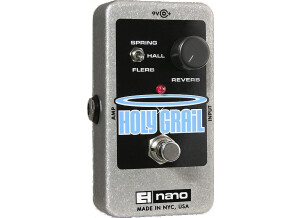
    The Electro-Harmonix Nano Holy Grail is a very simple and small reverb pedal - an offshoot from the regular EH Holy Grail pedal and also the Holy Grail Plus. It's the same great sound minus the control and versatility, but also loses the size. The pedal is an analog one and isn't rack mountable as it's a foot pedal. UTILIZATION The make up of the Electro-Harmonix Nano Holy Grail couldn't be simpler. It's got three modes to choose from - spring, hall, and flerb, the latter of which is a spacey flanger-reverb combo, also found on the other Holy Grail pedals and also on the EH Cathedral Reverb, which is my personal favorite. The only other parameter in addition to the mode switch is a large reverb knob to set the amount of the effect that you'd like. No manual is needed here of course. SOUND QUALITY Despite it's limitations when compared to it's more complete predecessors, the Electro-Harmonix Nano Holy Grail still has the same great sound. Between the three modes it's still possible to get a nice collection of tones with this, and it's definitely all at a very high quality - smooth and silky. I do prefer having the Cathedral reverb since I use it a lot and it has a lot of control, but this is a great alternative if you're looking for basic sounds only. OVERALL OPINION The Electro-Harmonix Nano Holy Grail is a great overall reverb pedal, even though it doesn't have all the bells and whistles that you'll get with the regular Holy Grail. It's of course cheaper in price which makes it appealing for users on all budgets. If you're looking for a cheaper reverb pedal without sacrificing quality, the Nano Holy Grail is a great way to go. Check out the other pedals I've mentioned here if you're looking for some more control...

  • « Blew my speakers »

    So let me explain what this pedal professes to be. It has a high filter and a bass filter. A blend knob. A sub stitch. Has a dry and wet output which is a nice feature. Basically it's a sub octaver. EHX generally makes pretty well built pedals for the price this one feels solid. UTILIZATION I am a collecter of odd and out there pedals which means EHX stuff it a pretty frequent staple of me. They have a lot of octavy pedals and some of them are very nice. I bought this having no real idea exactly what it should be used for. There are really two applications for this pedal. You can use it as a bass emulator or as a special effect for vocals and such. SOUND QUALITY I first used this as a vocal effect for electronic music projects and for that it's pretty darn good. I tried it with my guitar briefly and decided it was pretty "toylike" for anything other than bass emulation. More on that in a bit. The vocal effect is a lot like something you would hear on a daft punk or Kayne track. Some people might find it over the top but I guess it depends on the genre. Now here's where the problem lies. My friend was at my practice space messing with some of my pedals and he was trying to make his strat do a bass emulation. He switched on the sub switch and had the bass knob rolled up and there was so much bass coming out of the speaker that it blew my 2x12. Speaks for itself. Dangerous costly pedal. OVERALL OPINION Now let me be clear, I really liked this pedal for the crazy vocal effects. But as a bass sim it blew my speakers and didn't even sound all that great to be honest. I haven't heard of other people blowing speakers with this. Maybe I just got unlucky. I have since let go of mine because I don't need it anymore and don't want anymore blown speakers.

  • mooseherman's review

    This is a pretty cool pedal from Electro-Harmonix that combines the features of a harmonizer and a vocoder into a pedal that can be hooked up to a vocal mic. The interesting feature that separates this box from other similar products is that it automatically adjusts the harmonies that it produces to an accompanying instrument. This is achieved by plugging in said instrument to the instrument input. There are inputs for both the microphone and the instrument, as well as outputs for each. The instrument output is dry (meaning there is no effect on it) while the microphone output is affected. UTILIZATION This pedal isn't the easiest one I've ever used, but once you get used to it it gets better. Mainly, having to hook up the second instrument was strange to me. However, once I got used to the idea, it became better and better. There are knobs for adjusting the sound as well. The first knob blends the dry signal with the wet one. The next two knobs are reverb; the first adds reverb to the dry vocal, the second adds it to the effect vocal. The "gender bender" knob adjusts the timbre of the vocal to make it sound more "feminine" or "masculine", but those terms are rather limiting. The effect comes out rather androgynous no matter what setting you use. The voice mix adjusts the frequencies highlighted from low to high. The mode knob simply changes the mode that you have selected. There are several modes; one for low harmony, one for high harmony, one that switches, three multi-harmony settings, an octaves setting, a unison/whistle setting, and the vocoder setting. SOUND QUALITY The sounds that come out of this box are certainly interesting to say the least. While they could be considered to be pretty artificial sounding, I don't think anyone really expects the pedal to sound like multiple singers. That being said, it's a pretty interesting thing to use when performing solo. If you want to get an idea of how to write harmonies for a certain chord progression, this can be a great tool. It's also really fun. It can make playing solo far more lively and entertaining. The vocoder sounds are arguably the most useful, considering the quality of the sound. That sounds almost like a traditional vocoder with the full keyboard. Some of the harmonies aren't as useful, and there are tuning issues when using it with a guitar, but I think most people would be happy with this pedal. OVERALL OPINION I think that this pedal is a great tool for exploring harmonies to an extent, and the vocoder setting is really cool. However, I didn't really get much use out of this other than the obligatory messing around. I wouldn't really use this much in a live setting or even recording, except maybe for the vocoder. I'd say that if you have a profound interesting in artificial harmonizers, than this is probably the cream of the crop. Otherwise, it's probably best to avoid it.

  • moosers's review

    The Electro-Harmonix Attack Equalizer is a unique guitar pedal, suitable for use with electronic instruments of all kinds. This is a vintage pedal that is no longer being manufactured. They do have a reissue of the pedal called Knockout, which sounds pretty close to this one. The Attack Equalizer has 1/4" TRS connections for input and output, and has an on/off switch. This isn't a rack mountable piece of gear as it is a stomp box. UTILIZATION Using the Electro-Harmonix Attack Equalizer is very simple, as there are only three separate parameters to work with. The pedal has knobs for fundamental, which is the volume of your original tone, one for blend, and one for attack. Even if you're unsure off the bat what these parameters will do, after playing with it for a minute or two you should be able to catch on. A manual for the Electro-Harmonix Attack Equalizer would probably be pretty hard to find. SOUND QUALITY Let me start off by saying that the Electro-Harmonix Attack Equalizer isn't the type of pedal that is necessary a player of any type. It is a cool pedal to have if you're looking to have some subtle toning available at your feet. I've used the pedal with a '76 Fender Twin Reverb and a Fender Jazzmaster, so I'm getting a pretty good idea of what this pedal sounds like. I also use both a Big Muff and an Ibanez Tube Screamer, and this helps me to control the attack of my sound in great detail. I don't use it all of the time, but only in situations where I feel a tone I am already working on could use it. As always with EH, you've got a clean sounding pedal here without too much noise. OVERALL OPINION If one of the studios I've worked at didn't have the Electro-Harmonix Attack Equalizer, I'm sure that it isn't a pedal that I would have sought out myself, as these are pretty rare. Like I said earlier, they do have a reissue known as the Knockout, which works quite well and is a lot more readily available. If you're looking for ultimate control over your attack levels this is the perfect thing to help you level it all out, but isn't a necessity.

  • Audiofanzine FR's review

    (Originally written by solo84/translated from Audiofanzine FR) Analog phaser One mono input, one stereo output Lots of settings (waveform, envelope, feedback, LFO, start and stop points, speed, etc.) It works only with a 24-volt PSU (included, no battery operation) It's a pity that the unit doesn't have a stereo input! It would make it a must-have!!! I give it a 9 because of this last point. UTILIZATION The unit requires some learning time and I'm only getting to know it. The user's manual is ridiculous and the settings aren't intuitive. But it's only a phaser so you'll surely find out how it works! I will update this review later... SOUND QUALITY With a simple setting for arpeggios (Pink Floyd 70's sound) the result is very interesting, not as extreme as a Phase 90, quite organic and much more subtle. It reminds me of the Small Stone... The device doesn't alter the original signal and the stereo imaging is wonderful. Everything is possible, even extreme effects! It's a convenient phasing effect unit! The phase start and stop controls and the feedback setting provide huge sound possibilities! You can also use an envelope instead of the LFO, etc. I haven't tested it within a mix yet even though it's the most important thing! So I will update this review later... OVERALL OPINION Pros: - Very nice sound - Unaltered source signal - Huge editing possibilities - Look and construction Cons: - Not easy to use - Ridiculous user's manual.

  • « Cool unique effect »

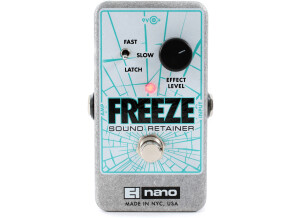
    This is a stompbox from electro harmonix which can be used to infinitely sustain a note or chord of your guitar playing. Even better than just being able to sustain a note or chord is that you can play over the top of it to create some interesting sonic textures. This unit isn't rackable or able to be edited using a computer. Some of it's features are: -24 bit buffered bypass which doesn't seem to change the signal when the effect isn't engaged in my rig -1/4" input and output jacks -Powered by a 9V input jack or 9V battery -Three simple controls: Volume of the frozen signal, 3-way mode toggle switch (Fast, Slow and Latch) and finally the footswitch which sustains the sound when depressed. UTILIZATION Very simple to operate, only three controls: Volume knob, Mode toggle switch and the Footswitch. The volume knob simply controls the volume of the frozen signal so you just set it to get the frozen signal/dry signal ratio that you want. The mode switch has three options Fast, Slow and Latch. In the Fast and Slow modes the frozen signal is only heard when the footswitch is depressed. The difference between the two modes is the fade in and fade out times, the Fast mode fades in quickly and decays quickly and in Slow mode the fade in and out is a bit slower. The fade in and out times in Slow mode can be adjusted fairly simply. Finally the Latch mode sustains after the switch is pressed once until you press it again so it allows you to move around while sustaining a sound. SOUND QUALITY It's an interesting sound which can sound a bit glitchy some times but this pedal definitely has it's own character. Using the Slow mode some interesting bowed style sounds can be created. I really like this pedal and will be keeping it on my board for a while. OVERALL OPINION I really love this pedal, it has lots of different uses and it's nice an small. The only thing I dislike about this pedal is that I've found that it can sound a bit poor if there are fuzz pedals in front of it which makes it difficult to have a fuzzy frozen signal and play over the top of it with a clean tone. I have found some mods for the freeze to add a effects loop so that the effects in the loop only effect the frozen signal so hopefully I can work out to do this myself as that will make this pedal amazing. If this pedal come with an effects loop built in then I would give it a 10 so hopefully in the future EHX will add this feature in.